Guardrail Compliance Rate is an Agentic Service Level Indicator (SLI) that quantifies the percentage of an autonomous agent's actions or outputs that adhere to predefined safety, ethical, and operational policy constraints. These guardrails are hard-coded rules or model-driven classifiers designed to prevent harmful, biased, or non-compliant behavior, such as generating unsafe content or executing unauthorized tool calls. A high rate indicates a deterministic, trustworthy system, while a low rate signals a critical failure in the agent's safety mechanisms.

Glossary
Guardrail Compliance Rate
Guardrail Compliance Rate is an Agentic Service Level Indicator (SLI) that quantifies the percentage of an autonomous agent's actions or outputs that adhere to predefined safety, ethical, and operational policy constraints.
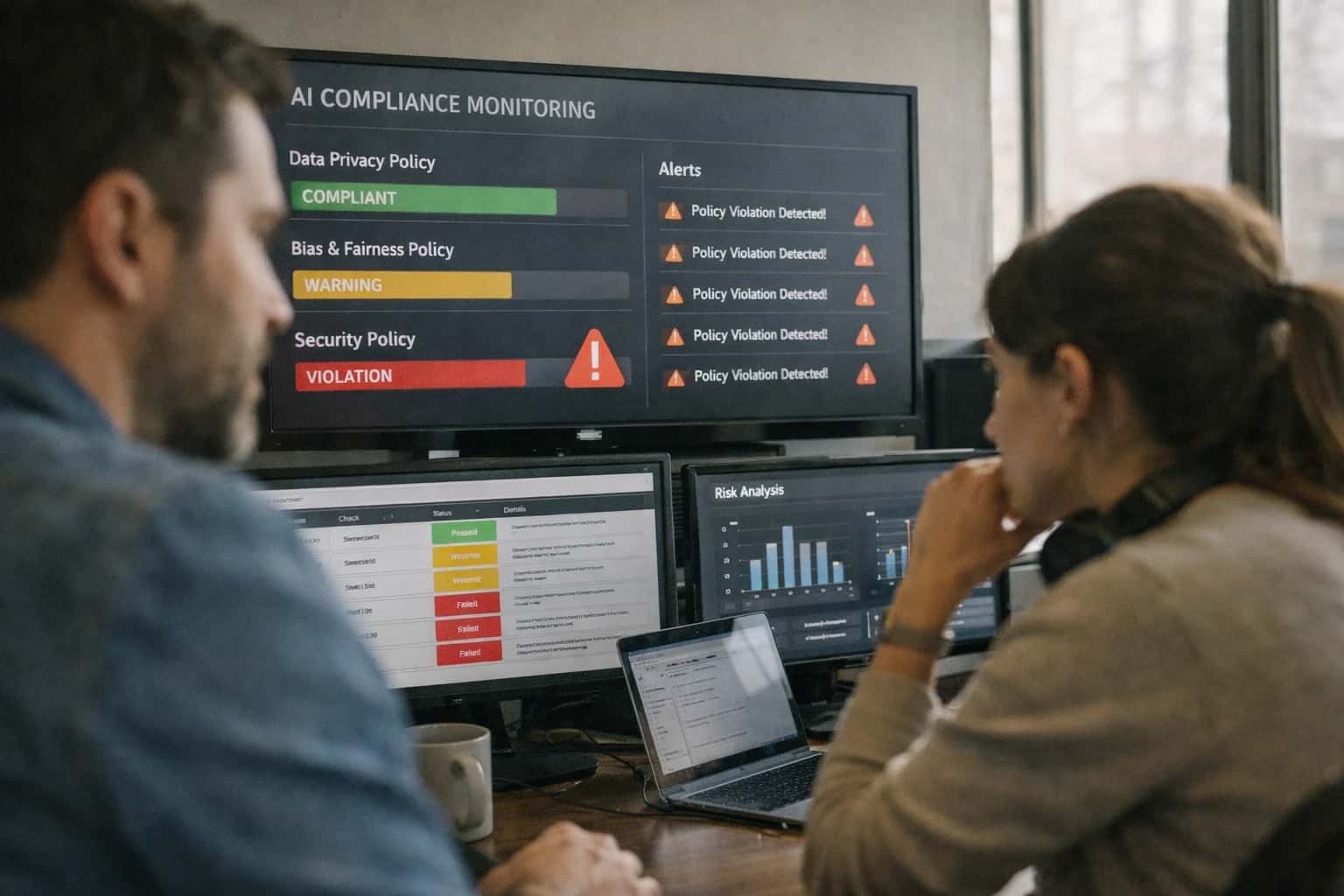
AGENTIC SLI/SLO DEFINITION
What is Guardrail Compliance Rate?
Guardrail Compliance Rate is a critical Service Level Indicator (SLI) for measuring the safety and policy adherence of autonomous AI agents.
This SLI is foundational for Agentic Observability, providing a quantifiable measure for enterprise governance and risk management. It is calculated by dividing compliant actions by total actions over a time window. Monitoring this rate alongside SLIs like Hallucination Rate and Action Success Ratio creates a comprehensive view of agent reliability. A sustained breach of its associated Service Level Objective (SLO) triggers alerts and consumes the system's Error Budget, necessitating immediate investigation to prevent policy violations.
AGENTIC SLI/SLO DEFINITION
Key Characteristics of Guardrail Compliance Rate
Guardrail Compliance Rate is a critical Service Level Indicator for autonomous agents, measuring adherence to safety, ethical, and operational constraints. Understanding its characteristics is essential for defining reliable SLOs and ensuring deterministic execution.
01
Definition and Core Purpose
Guardrail Compliance Rate is an Agentic SLI that quantifies the percentage of an agent's actions or outputs that adhere to predefined safety, ethical, and operational policy constraints. Its core purpose is to provide a quantitative, auditable measure of an autonomous system's alignment with critical business rules and risk mitigation policies. This SLI directly answers the question: "Is the agent operating within its allowed boundaries?" It is foundational for enterprise governance, providing CTOs and compliance officers with a clear metric to verify that agent behavior is deterministic and safe for production use.
02
Measurement and Calculation
Measuring Guardrail Compliance Rate requires instrumenting the agent's decision points and comparing outputs against a rule engine or policy library. The standard calculation is:
(Number of Compliant Actions / Total Number of Actions) * 100
- Compliant Actions: Tool calls, generated text, or planned steps that pass all active guardrail checks (e.g., data privacy filters, content safety classifiers, operational cost limits).
- Total Actions: All actions attempted within the measurement window.
This measurement often relies on post-hoc evaluation systems that log agent outputs and run them through validation suites. For real-time enforcement, the rate can be measured based on interventions by a safety layer that blocks non-compliant actions before execution.
03
Primary Guardrail Categories
Guardrails monitored by this SLI typically fall into several key categories:
- Safety & Ethics: Preventing generation of harmful, biased, or toxic content. Ensures outputs align with organizational values.
- Operational Policy: Enforcing business logic, such as cost ceilings per task, allowed API endpoints, or data access permissions.
- Data Privacy & Security: Redacting or blocking outputs containing PII, sensitive intellectual property, or credentials.
- Factual & Hallucination Control: Ensuring outputs are grounded in verified sources, closely related to the Hallucination Rate SLI.
- Deterministic Formatting: Guaranteeing outputs conform to required schemas (JSON, XML) for downstream system integration.
A low compliance rate in any category signals a critical failure in the agent's constraint integration or prompt architecture.
04
Relationship to SLOs and Error Budgets
The Guardrail Compliance Rate is used to define a Service Level Objective (SLO), such as "99.9% of agent actions must comply with all active guardrails over a 30-day period." The difference between 100% and the SLO target constitutes the Error Budget for policy violations. A rapidly depleting error budget indicates systemic guardrail failures, requiring immediate investigation. This SLI is often a leading indicator for other SLIs; a drop in compliance frequently precedes failures in Task Completion Rate or spikes in Hallucination Rate. It is a non-negotiable SLO for systems operating in regulated industries.
05
Implementation and Observability Challenges
Implementing reliable measurement of this SLI presents several engineering challenges:
- Guardrail Definition: Policies must be translated into machine-executable rules, which can be complex for nuanced ethical guidelines.
- Evaluation Latency: Running comprehensive checks (e.g., fact verification) can add significant latency, impacting End-to-End Task Latency.
- Partial Compliance: Handling actions that violate multiple guardrails requires careful attribution to avoid double-counting in metrics.
- Evolving Policies: The guardrail rule set is not static; the SLI measurement system must adapt to new policies without breaking historical comparisons.
- Tool Call Instrumentation: Monitoring compliance for Tool Calling and API Execution requires deep integration with the agent's execution framework to capture context and parameters.
06
Integration with Broader Observability
Guardrail Compliance Rate does not exist in isolation. It must be analyzed in the context of a full Agent Telemetry Pipeline.
- Correlation with Traces: A compliance failure should trigger a detailed Distributed Trace to isolate the faulty component in the agent's reasoning chain.
- Agent Behavior Auditing: Every violation must be logged with full context (input, agent state, reasoning trace) for forensic Root Cause Analysis (RCA).
- Multi-Agent Systems: In Multi-Agent Observability, a single non-compliant action by one agent can propagate, requiring analysis of Agent Interaction Graphs.
- Performance Trade-offs: Increasing guardrail strictness to improve compliance may negatively impact Throughput or Cost Per Successful Task, necessitating balanced SLO design. This SLI is a cornerstone of Enterprise AI Governance, providing the data needed for compliance reports and demonstrating operational control.
AGENTIC SLI/SLO DEFINITION
How Guardrail Compliance Rate is Measured
A technical breakdown of the calculation and instrumentation required to quantify an autonomous agent's adherence to operational, safety, and ethical constraints.
Guardrail Compliance Rate is measured by instrumenting an agent's execution pipeline to intercept and evaluate each action or generated output against a codified set of policy rules. The core calculation is a simple ratio: (Number of Compliant Actions / Total Actions) * 100%, typically aggregated over a defined time window or session. This requires a policy engine to perform real-time validation and a telemetry system to log violations for audit. The metric is a direct Agentic SLI for safety and deterministic behavior.
Measurement fidelity depends on the granularity of instrumentation, which can occur at the planning, tool-calling, or final output stages. A high compliance rate indicates effective constraint enforcement but must be analyzed alongside complementary SLIs like Hallucination Rate and Result Accuracy to avoid false positives where an agent is compliant but ineffective. This SLI is foundational for defining a Service Level Objective (SLO) that guarantees a minimum acceptable adherence level, forming a core component of the system's error budget for safety-critical failures.
AGENTIC SLI/SLO DEFINITION
Examples of Guardrail Compliance
Guardrail Compliance Rate measures adherence to predefined constraints. These examples illustrate how this SLI is tracked across different operational domains.
01
Content Safety & Moderation
This measures an agent's adherence to content safety policies. A guardrail might block outputs containing hate speech, explicit material, or personally identifiable information (PII).
- Example: A customer service chatbot must never generate profanity or disclose internal ticket numbers.
- Measurement: Compliance is tracked by scanning outputs with a secondary classifier model or regex patterns. A violation occurs if banned content is present.
02
Operational Boundary Enforcement
This tracks whether an agent's actions stay within its authorized operational scope. Guardrails prevent unauthorized tool use, API calls, or data access.
- Example: A financial analysis agent is prohibited from executing 'BUY' or 'SELL' API calls; it can only run 'ANALYZE' tools.
- Measurement: Compliance is measured by auditing the agent's tool call logs. Any call to a blocked endpoint or with unauthorized parameters is a violation.
03
Factual Grounding & Citation Integrity
This evaluates if agent outputs are properly grounded in verified sources and include necessary citations, reducing hallucination.
- Example: A research agent must cite a document ID for any statistical claim it makes.
- Measurement: Compliance is checked by validating that claims in the output have corresponding, retrievable source citations. Uncited assertions are violations.
04
Cost & Resource Budget Adherence
This monitors compliance with predefined resource constraints, such as token limits, number of API calls, or total execution time.
- Example: An agent must complete its task using fewer than 10,000 output tokens and 5 external API calls.
- Measurement: Compliance is calculated by comparing telemetry on token usage and API calls against the budget. Exceeding the budget constitutes a violation.
05
Data Privacy & Retention Rules
This ensures an agent handles data according to regulatory and policy requirements, such as GDPR or internal data governance.
- Example: An agent processing European user data must not persist full names in its conversational memory beyond the session.
- Measurement: Compliance is verified by auditing the agent's memory stores and logs for prohibited data patterns or excessive retention periods.
06
Process & Reasoning Compliance
This assesses whether an agent follows mandated reasoning steps or approval workflows before taking final action.
- Example: An autonomous procurement agent must generate a comparison report and get a synthetic approval from a validator agent before placing any order over $1,000.
- Measurement: Compliance is determined by tracing the agent's reasoning steps. Skipping a required validation step is a guardrail violation.
AGENTIC SLI COMPARISON
Guardrail Compliance Rate vs. Related SLIs
This table compares the Guardrail Compliance Rate SLI to other key Agentic Service Level Indicators, highlighting their distinct measurement focus, data sources, and role in observability.
| Service Level Indicator (SLI) | Primary Measurement Focus | Typical Data Source | Directly Informs Guardrail Compliance? | Common Alerting Threshold |
|---|---|---|---|---|
Guardrail Compliance Rate | Adherence to safety, ethical, and operational policy constraints | Policy engine logs, output validation checks | < 99.5% | |
Hallucination Rate | Generation of factually incorrect or unsupported information | Output vs. ground truth comparison, retrieval verification |
| |
Action Success Ratio | Successful completion of individual tool/API calls | Tool execution logs, API response codes | < 99.0% | |
Self-Correction Success Rate | Effectiveness of recursive loops in fixing own errors | Error logs, correction attempt histories | < 95.0% | |
Planning Success Rate | Valid decomposition of goals into executable sequences | Planner module outputs, execution validation | < 98.0% | |
Result Accuracy | Correctness of final output against ground truth | Human evaluation, automated scoring | < 97.0% | |
Redundant Action Ratio | Proportion of unnecessary or duplicative execution steps | Execution trace analysis, plan comparison |
| |
Fallback Success Rate | Successful invocation of contingency plans | Fallback pathway execution logs | < 90.0% |
AGENTIC SLI/SLO DEFINITION
Frequently Asked Questions
Essential questions about Guardrail Compliance Rate, a critical Service Level Indicator for measuring how well autonomous agents adhere to safety, ethical, and operational policies.
Guardrail Compliance Rate is an Agentic Service Level Indicator (SLI) that measures the percentage of an autonomous agent's actions or generated outputs that adhere to predefined safety, ethical, and operational policy constraints. It is a quantitative metric for agentic observability, providing a direct measure of how reliably an agent operates within its mandated boundaries. This SLI is foundational for enterprise AI governance, as it translates abstract policy requirements into a trackable, operational metric. A high compliance rate indicates a deterministic and safe agent, while a low rate signals potential policy violations that require immediate investigation and remediation.
Enabling Efficiency, Speed & Accuracy
Intelligent Analysis, Decision & Execution
We build AI systems for teams that need search across company data, workflow automation across tools, or AI features inside products and internal software.
Talk to Us
Search across company data
Give teams answers from docs, tickets, runbooks, and product data with sources and permissions.
Useful when people spend too long searching or get different answers from different systems.
Enterprise searchRAGPermissions
Read more
Automate internal workflows
Use AI to route work, draft outputs, trigger actions, and keep approvals and logs in place.
Useful when repetitive work moves across multiple tools and teams.
AI agentsWorkflow automationGovernance
Read more
Add AI to products and internal tools
Build assistants, guided actions, or decision support into the software your team or customers already use.
Useful when AI needs to be part of the product, not a separate tool.
AI integrationDecision supportModel routing
Read more
About the author
Prasad Kumkar
CEO & MD, Inference Systems
Prasad Kumkar is the CEO & MD of Inference Systems and writes about AI systems architecture, LLM infrastructure, model serving, evaluation, and production deployment. Over 5+ years, he has worked across computer vision models, L5 autonomous vehicle systems, and LLM research, with a focus on taking complex AI ideas into real-world engineering systems.
His work and writing cover AI systems, large language models, AI agents, multimodal systems, autonomous systems, inference optimization, RAG, evaluation, and production AI engineering.
LinkedIn
Limited slotsGet a Free AI Consultation
Partnered with leading AI, data, and software stack.





How We Work
Custom AI workflows for your Business
One-fit-all AI don't work for modern businesses. At Inferensys, we aim to understand your business & custom requirements; which we use to define most efficient agentic workflows, the data, and the tools for your business.
01
Review the use case
We understand the task, the users, and where AI can actually help.
Read more02
Pick the right approach
We define what needs search, automation, or product integration.
Read more03
Build the first useful version
We implement the part that proves the value first.
Read more04
Improve from there
We add the checks and visibility needed to keep it useful.
Read moreThe first call is a practical review of your use case and the right next step.
Talk to Us