An agentic workflow anomaly is a deviation from the expected sequence, branching logic, or successful completion of steps within a predefined multi-step process executed by one or more autonomous AI agents. It represents a failure in the deterministic orchestration of a multi-agent system, where the actual execution path diverges from the intended plan, potentially causing incorrect outputs, incomplete tasks, or system instability. Detection focuses on the integrity of the end-to-end process, not just individual agent actions.

Glossary
Agentic Workflow Anomaly
An agentic workflow anomaly is a deviation from the expected sequence, branching logic, or successful completion of steps within a predefined multi-step process executed by one or more autonomous agents.
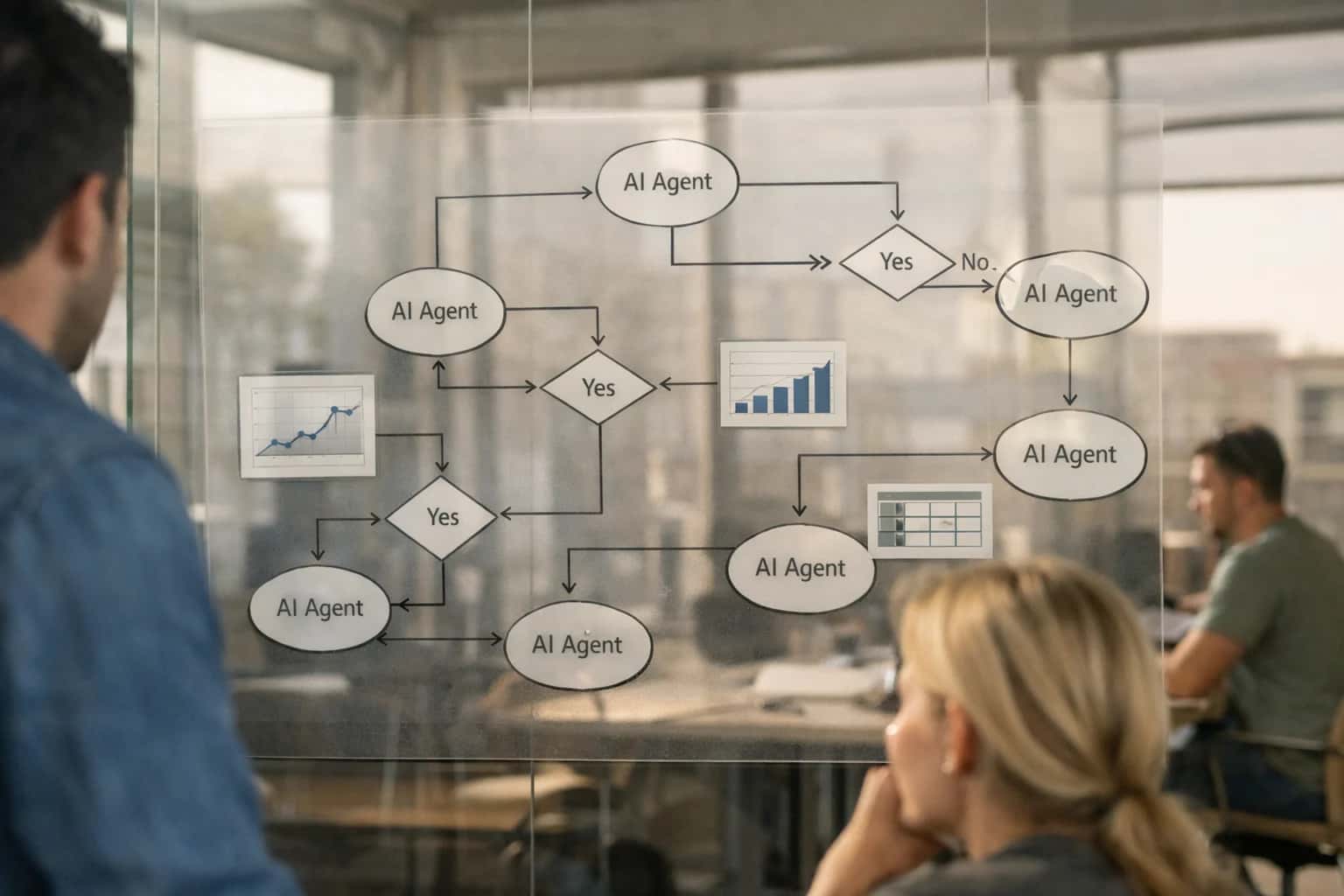
AGENTIC ANOMALY DETECTION
What is Agentic Workflow Anomaly?
A definition of deviations in the execution of multi-step, autonomous processes.
These anomalies are identified by monitoring agent telemetry pipelines for violations of expected state transitions, timing constraints, or success criteria. Common indicators include unhandled execution errors, agentic loop detection of repetitive actions, deadlocks in coordination, or violations of business logic guardrails. Effective detection requires establishing a behavioral baseline for normal workflow patterns and instrumenting for distributed trace collection across all agents and external tool calls.
AGENTIC OBSERVABILITY
Key Characteristics of Workflow Anomalies
An agentic workflow anomaly is a deviation from the expected sequence, branching logic, or successful completion of steps within a predefined multi-step process executed by one or more autonomous agents. These characteristics define how such anomalies manifest and are detected.
01
Sequential Deviation
This occurs when an agent's actions violate the expected order of a predefined plan or process flow. It is a core characteristic of workflow anomalies.
- Examples: Skipping a mandatory verification step, executing steps in reverse order, or prematurely terminating a workflow before completion.
- Detection: Monitored by comparing the agent's executed action trace against a declarative workflow definition or a learned probabilistic state machine.
02
State Transgression
The agent enters an invalid or unreachable system state given the workflow's logic and constraints. This often precedes or causes sequential deviations.
- Examples: Attempting to 'ship an item' when the system state is 'payment failed', or a multi-agent system where Agent B acts on data before Agent A has published it, creating a race condition.
- Root Cause: Often stems from faulty state management, timing issues in distributed systems, or incorrect assumptions in the agent's world model.
03
Temporal Anomaly
The workflow completes significantly faster or slower than established baselines, indicating potential problems.
- Latency Spike: Sudden increase in step duration, often due to external API failures, resource contention, or inefficient reasoning loops.
- Premature Completion: Workflow finishes too quickly, potentially indicating steps were skipped or errors were not properly handled.
- Live-lock/Deadlock: Workflow stalls indefinitely, with agents stuck in unproductive cycles (agentic loop detection) or waiting for conditions that will never be met.
04
Outcome Divergence
The final result or intermediate outputs of the workflow are invalid, incorrect, or of unexpected quality, even if the sequence appeared normal.
- Hallucinated Outputs: The workflow completes but produces a factually incorrect or unsupported result (linked to agentic hallucination detection).
- Policy Violation: The outcome breaches a business rule, safety constraint, or ethical guardrail.
- Degraded Quality: Outputs meet syntactic requirements but fail qualitative benchmarks (e.g., a generated report is coherent but lacks required depth).
05
Resource Consumption Spike
A marked, unexpected increase in the computational or financial cost of executing the workflow.
- Key Metrics: Token usage for LLM calls, number of external API invocations, total compute time, or memory consumption.
- Indicative Patterns: Can signal inefficient planning (excessive reflection loops), cascading retries due to errors, or the agent being 'stuck' in a costly reasoning pattern.
- Telemetry: A core signal in agentic cost telemetry and performance monitoring.
06
Multi-Agent Coordination Failure
In systems with multiple agents, the anomaly manifests as a breakdown in the handoffs, communication, or consensus required for the workflow.
- Message Flow Break: An expected communication (task delegation, result passing) between agents does not occur or is corrupted.
- Consensus Failure: Agents cannot agree on a shared fact or decision necessary to proceed (linked to agentic consensus failure).
- Cascading Effect: A failure or anomalous output from one agent propagates, causing subsequent agents to fail (linked to agentic cascading failure).
DETECTION METHODOLOGY
How is an Agentic Workflow Anomaly Detected?
Agentic workflow anomaly detection identifies deviations in the expected execution sequence of a multi-step process performed by autonomous agents. Detection relies on a multi-layered observability pipeline comparing real-time telemetry against established behavioral baselines.
Detection begins by instrumenting the agentic workflow to emit granular telemetry for each step, including execution status, duration, and state transitions. This data is streamed into an observability platform where statistical models and rule-based systems continuously compare the live stream against a behavioral baseline. Anomalies are flagged when metrics like step order, branching logic, or completion success violate expected patterns, triggering alerts for root cause analysis.
Advanced detection employs machine learning models trained on historical execution traces to identify subtle, multi-dimensional deviations. Techniques like sequence analysis monitor for deadlocks or loops, while semantic checks validate the logical coherence of outputs between steps. Integrating this with distributed tracing allows the anomaly to be pinpointed to a specific agent, tool call, or external API failure, enabling precise anomaly attribution and rapid remediation.
OPERATIONAL PATTERNS
Common Examples of Agentic Workflow Anomalies
These are specific, observable deviations from the expected sequence, logic, or successful completion of steps within a predefined multi-step process executed by autonomous agents.
01
Agentic Loop Detection
The identification of unproductive cycles where an agent's reasoning or action sequence fails to make progress. This is a critical workflow anomaly indicating a breakdown in the agent's planning or reflection logic.
- Common Causes: A reflection loop that fails to converge on an improved plan, or a multi-agent coordination protocol entering a livelock state.
- Detection Signals: Monitoring for repeated, identical actions or state changes without advancement toward a goal, or a stagnation in key progress metrics over a defined time window.
- Impact: Wasted computational resources, infinite task execution, and failure to complete the assigned objective.
02
Agentic Cascading Failure
A systemic breakdown where an initial anomaly in one agent or component triggers a chain reaction of failures across a multi-agent system or workflow. This anomaly highlights the interconnected risk in agentic architectures.
- Propagation Mechanism: Failure of Agent A (e.g., providing corrupted data) causes Agent B to fail, which then invalidates the input for Agent C, and so on.
- Detection Signals: A rapid, correlated spike in error rates or performance deviations across multiple agents in a dependency chain, often visible in a service topology map.
- Mitigation: Requires circuit breakers, graceful degradation policies, and robust agentic root cause analysis (RCA) to isolate the primary fault.
03
Agentic Consensus Failure
The inability of a group of coordinating agents to reach agreement on a shared state, plan, or decision. This is a fundamental anomaly in collaborative multi-agent workflows.
- Common in: Voting protocols, distributed ledger updates, or collaborative planning systems where a quorum or unanimous decision is required.
- Detection Signals: Monitoring for protocol stalemates, timeout expirations without a resolution, or persistent divergence in the reported states of agents that are supposed to be synchronized.
- Consequence: Workflow deadlock, data inconsistency, and the inability to proceed with a coordinated action.
04
Agentic Race Condition Detection
The identification of timing-dependent, non-deterministic bugs in concurrent or distributed agent systems where the final outcome depends on an uncontrollable sequence or timing of events.
- Typical Scenario: Two agents simultaneously query and then update a shared resource (e.g., a database record or an external API), leading to lost updates or corrupt state.
- Detection Challenge: These anomalies are intermittent and heavily dependent on system load. Detection often relies on distributed trace collection to reconstruct event sequences and identify conflicting concurrent accesses.
- Impact: Data corruption, inconsistent execution results, and violations of system invariants.
05
Agentic Policy Violation
An occurrence where an agent's action or decision breaches a predefined rule, safety constraint, or ethical guardrail established to govern its behavior. This is a compliance-critical workflow anomaly.
- Examples: An agent in a financial workflow attempting to execute a trade above a pre-set limit, or a customer service agent generating a response that contains prohibited content.
- Detection: Implemented through real-time rule engines that evaluate agent actions and decisions against a policy library. This is closely related to agentic decision anomaly detection but is defined by explicit rules rather than statistical deviation.
- Response: Typically triggers an immediate block or override of the action and a high-severity alert for human review.
06
Sequence Deviation & Dead-End Paths
A deviation from the expected, successful sequence of steps in a workflow, resulting in an execution path that cannot reach a valid terminal state. This is a core definition of a workflow anomaly.
- Manifestations: An agent skipping a mandatory verification step, following an incorrect branching logic condition, or entering a state from which no defined subsequent action exists.
- Detection: Achieved by comparing the actual execution trace, captured via agent reasoning traceability, against a formal workflow definition or a learned probabilistic model of successful past executions.
- Outcome: The workflow terminates in an error state, produces an incomplete result, or requires manual intervention to resolve.
AGENTIC WORKFLOW ANOMALY
Frequently Asked Questions
An agentic workflow anomaly is a deviation from the expected sequence, branching logic, or successful completion of steps within a predefined multi-step process executed by one or more autonomous agents. These FAQs address its detection, impact, and resolution.
An agentic workflow anomaly is a measurable deviation from the expected control flow, state transitions, or successful completion criteria within a multi-step process executed by autonomous AI agents. It represents a break in the deterministic execution of a predefined plan, such as a step being skipped, an infinite loop, an unauthorized branching decision, or a failure cascade that prevents the workflow from reaching its terminal goal state. Unlike simple performance errors, these anomalies are defined against a formal workflow specification or a learned behavioral baseline, making them critical for auditing complex, goal-oriented AI systems in production.
ANOMALY CLASSIFICATION
Comparing Agentic Anomaly Types
This table compares the primary categories of anomalies that can occur within autonomous agent systems, detailing their core characteristics, detection methods, and typical root causes to aid in observability and incident response.
| Anomaly Type | Core Definition | Primary Detection Signal | Typical Root Cause | Remediation Complexity |
|---|---|---|---|---|
Workflow Anomaly | Deviation from expected sequence or completion of a multi-step process. | Step failure, loop detection, SLA violation on process completion. | Tool failure, malformed input, state corruption, deadlock. | High (often requires state reset and manual intervention). |
Performance Deviation | Measurable departure from expected service level metrics (latency, success rate). | Statistical threshold breach on SLIs (e.g., P99 latency > 2s, success rate < 99%). | Resource contention, model degradation, downstream API slowdown. | Medium (may involve scaling, load shedding, or model rollback). |
Decision Anomaly | Unexpected or irrational choice deviating from trained policy or logical constraints. | Policy violation, reward/prediction confidence outlier, contradiction with knowledge base. | Concept drift, adversarial input, reward hacking, hallucination. | High (requires policy review, retraining, or constraint tightening). |
State Anomaly | Irregular or invalid configuration of agent's internal memory or context. | Invalid state transition, memory corruption flag, context window saturation. | Software bug, race condition, serialization error. | Medium (often resolved by agent restart or state rehydration). |
Cascading Failure | Systemic breakdown where an initial fault triggers chain reactions across agents. | Spike in error correlation, multi-agent interaction graph shows failure propagation. | Single point of failure, tight coupling, lack of circuit breakers. | Critical (requires systemic architectural review and fail-safe implementation). |
Model Drift (Concept/Covariate) | Degradation in agent performance due to changes in input data or input-output relationships. | Statistical distance (e.g., PSI, KL divergence) between training and production feature distributions. | Evolving user behavior, non-stationary environment, seasonal effects. | High (requires data pipeline monitoring, model retraining, or active learning). |
Policy Violation | Agent action breaches a predefined safety, ethical, or operational guardrail. | Rule-based trigger on action output (e.g., unauthorized tool call, restricted content). | Prompt injection, reward misalignment, insufficient constraint modeling. | Medium (requires immediate intervention and guardrail reinforcement). |
Enabling Efficiency, Speed & Accuracy
Intelligent Analysis, Decision & Execution
We build AI systems for teams that need search across company data, workflow automation across tools, or AI features inside products and internal software.
Talk to Us
Search across company data
Give teams answers from docs, tickets, runbooks, and product data with sources and permissions.
Useful when people spend too long searching or get different answers from different systems.
Enterprise searchRAGPermissions
Read more
Automate internal workflows
Use AI to route work, draft outputs, trigger actions, and keep approvals and logs in place.
Useful when repetitive work moves across multiple tools and teams.
AI agentsWorkflow automationGovernance
Read more
Add AI to products and internal tools
Build assistants, guided actions, or decision support into the software your team or customers already use.
Useful when AI needs to be part of the product, not a separate tool.
AI integrationDecision supportModel routing
Read more
About the author
Prasad Kumkar
CEO & MD, Inference Systems
Prasad Kumkar is the CEO & MD of Inference Systems and writes about AI systems architecture, LLM infrastructure, model serving, evaluation, and production deployment. Over 5+ years, he has worked across computer vision models, L5 autonomous vehicle systems, and LLM research, with a focus on taking complex AI ideas into real-world engineering systems.
His work and writing cover AI systems, large language models, AI agents, multimodal systems, autonomous systems, inference optimization, RAG, evaluation, and production AI engineering.
LinkedIn
Limited slotsGet a Free AI Consultation
Partnered with leading AI, data, and software stack.





How We Work
Custom AI workflows for your Business
One-fit-all AI don't work for modern businesses. At Inferensys, we aim to understand your business & custom requirements; which we use to define most efficient agentic workflows, the data, and the tools for your business.
01
Review the use case
We understand the task, the users, and where AI can actually help.
Read more02
Pick the right approach
We define what needs search, automation, or product integration.
Read more03
Build the first useful version
We implement the part that proves the value first.
Read more04
Improve from there
We add the checks and visibility needed to keep it useful.
Read moreThe first call is a practical review of your use case and the right next step.
Talk to Us