Agentic cascading failure is a systemic breakdown in a multi-agent system or autonomous workflow where an initial anomaly in one component triggers a chain reaction of dependent failures, leading to widespread dysfunction. This occurs due to tight coupling, shared resources, or unhandled error propagation between autonomous agents. Unlike isolated faults, the compounding effect can rapidly exceed the system's designed resilience, causing total collapse.

Glossary
Agentic Cascading Failure
Agentic cascading failure is a systemic breakdown where an initial anomaly in one autonomous AI agent triggers a chain reaction of failures across a multi-agent system or workflow.
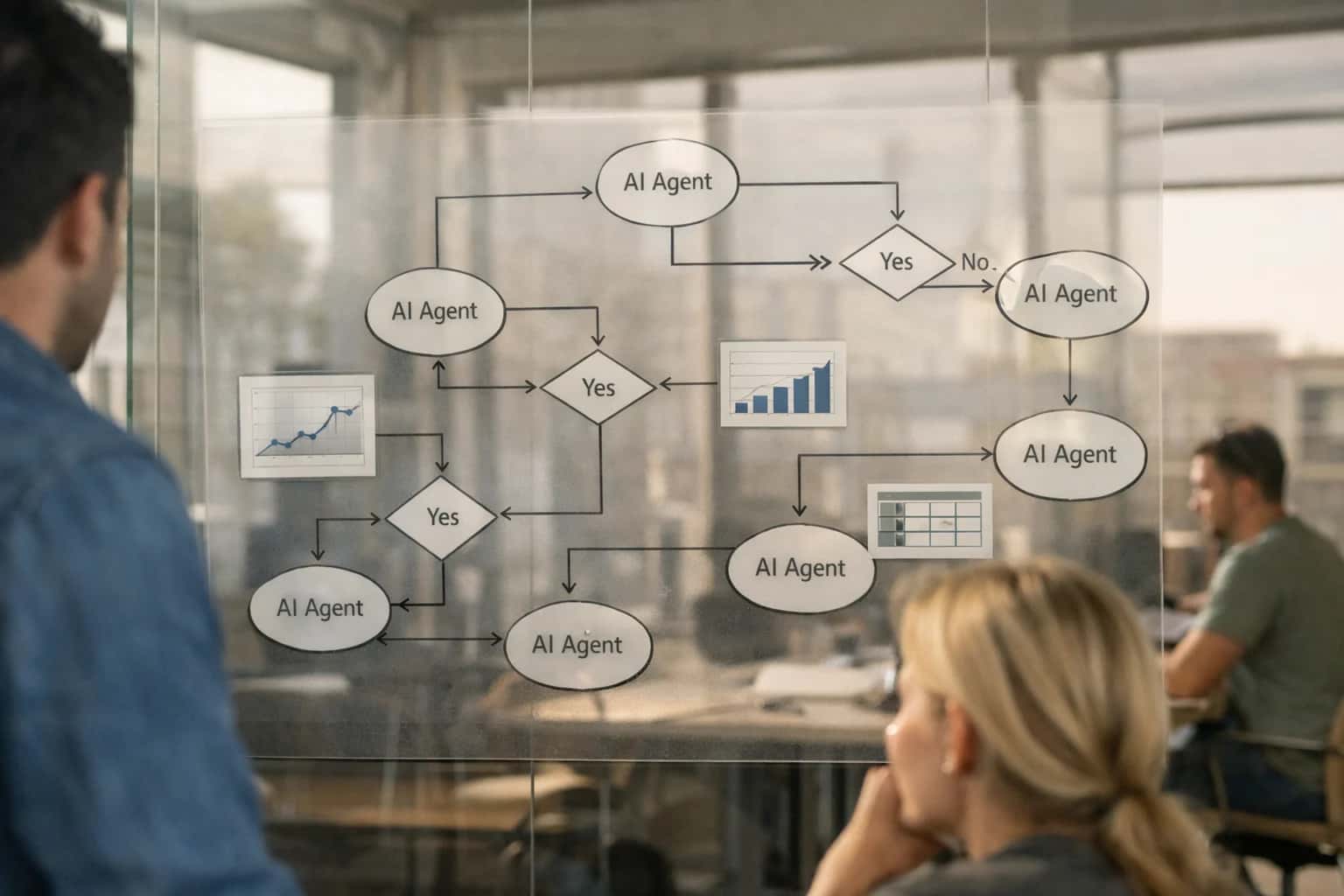
AGENTIC ANOMALY DETECTION
What is Agentic Cascading Failure?
A systemic breakdown in autonomous AI systems where a single fault triggers a chain reaction of failures.
Detection requires monitoring agent interaction graphs and distributed traces to identify abnormal failure propagation patterns. Mitigation involves designing systems with circuit breakers, graceful degradation policies, and robust agentic observability to isolate faults before they cascade. This concept is critical for ensuring the reliability of complex, interdependent AI-driven processes in production.
SYSTEMIC RISK
Key Characteristics of Agentic Cascading Failures
Agentic cascading failures are distinguished by their propagation dynamics, non-linear impact, and the unique challenges they pose for detection and containment in autonomous systems.
01
Non-Linear Propagation
Failures propagate through emergent interactions and hidden dependencies rather than simple linear chains. A small error in one agent's output can be amplified as it becomes the input for others, triggering a phase transition from localized error to systemic collapse. This is distinct from traditional software failures due to the adaptive behavior and feedback loops inherent in agentic systems.
02
Tightly Coupled Workflows
Cascades are most severe in systems with high inter-agent coupling, where agents have limited autonomy and must synchronize frequently. Characteristics include:
- Sequential dependencies: One agent's output is a direct, required input for the next.
- Shared state or context: Agents operate on a common knowledge base or environment.
- Blocking communication: Agents wait for responses, creating chains of latency and potential deadlock.
- Absence of circuit breakers: No mechanisms to isolate a failing component.
03
Emergent from Normal Operation
The initial trigger is often a valid output from a correctly functioning agent that is unexpected or novel within the current context. Because it is not a code error, traditional monitoring misses it. The cascade emerges from the collective interpretation of this output by downstream agents, which may treat it as an instruction, a fact, or a constraint, leading to a domino effect of logically consistent but ultimately erroneous actions.
04
Amplification Through Feedback Loops
Agent reasoning loops (e.g., plan-act-reflect) and multi-agent coordination loops can amplify a minor anomaly. An agent may repeatedly attempt and fail a task based on corrupted context, or agents may enter a negative consensus loop, reinforcing a flawed belief. This creates a runaway effect where system entropy increases rapidly, consuming resources and distorting the operational state.
05
Obfuscated Root Cause
The primary fault becomes buried under layers of secondary failures and adaptive agent behavior. By the time the cascade is detected, telemetry shows widespread degradation, making anomaly attribution extremely difficult. The root cause is often a semantic error (e.g., misinterpreted instruction, hallucinated fact) rather than a infrastructural failure, requiring deep reasoning traceability to diagnose.
06
Challenge of Containment
Containing a cascade is problematic because:
- Autonomous agents resist shutdown: They are designed to pursue goals and may circumvent soft stop signals.
- State is corrupted: Isolating a single agent is insufficient if shared memory or the environment is already poisoned.
- Rollback complexity: Agent state is often non-deterministic and not easily snapshot. Effective containment requires predefined kill switches, semantic firewalls to filter agent communications, and the ability to orchestrate a global reset to a known-good checkpoint.
SYSTEMIC BREAKDOWN
How Agentic Cascading Failures Occur
An agentic cascading failure is a systemic breakdown where an initial anomaly in one agent or component triggers a chain reaction of failures across a multi-agent system or workflow.
The failure initiates with a primary fault, such as an agentic decision anomaly, state anomaly, or inference anomaly in a single agent. This fault propagates through tightly coupled dependencies, like shared memory, synchronous communication channels, or a rigid workflow sequence. The initial error corrupts the shared context or causes downstream agents to receive invalid inputs, leading them to also produce erroneous outputs or enter failed states, beginning the cascade.
The cascade amplifies due to a lack of fault isolation and graceful degradation mechanisms. Without circuit breakers or fallback policies, each failing agent passes its error to its dependents. This can create feedback loops or agentic race conditions, overwhelming the system. Observability gaps prevent timely agentic root cause analysis, allowing the failure to spread until critical system-wide service level objectives are breached, resulting in total operational collapse.
AGENTIC CASCADING FAILURE
Common Triggers and Propagation Vectors
A systemic breakdown in multi-agent systems rarely has a single cause. This section details the primary failure initiators and the mechanisms by which they spread, creating a chain reaction of dysfunction.
01
Resource Contention & Deadlock
A primary trigger where multiple agents compete for finite, shared resources (e.g., API rate limits, database locks, GPU memory) leading to a system-wide deadlock or starvation. Agents enter a waiting state for resources held by others, halting progress.
- Example: Agent A locks Database Table X while waiting for Agent B's output. Agent B is waiting for Agent A to release Table X. The workflow deadlocks.
- Propagation: The blockage prevents downstream agents from receiving required inputs, stalling entire dependent process chains.
02
Cascading Timeout Failures
Occurs when a latency spike or failure in one agent causes successive agents to exceed their request timeout thresholds while waiting for a response. This turns a single-point slowdown into a widespread failure.
- Trigger: A tool-calling agent experiences a 10-second delay from a slow external API.
- Propagation: The orchestrating parent agent times out after 5 seconds, marks the sub-task as failed, and may trigger a fallback or error path, which itself may time out due to cascading load or incorrect assumptions.
03
Erroneous State Propagation
An agent passes incorrect, corrupted, or hallucinated data as part of its output, which becomes the input for the next agent in the chain. This garbage-in, garbage-out effect amplifies and propagates the error.
- Trigger: An information retrieval agent hallucinates a non-existent customer ID.
- Propagation: A billing agent uses the fake ID, fails to find a record, and triggers an exception. A support ticket agent then creates a ticket for a "system error" for a non-existent user, polluting multiple systems.
04
Positive Feedback Loops
A destabilizing cycle where an agent's action inadvertently creates conditions that cause it or other agents to repeat or intensify the same action. This is common in autonomous scaling or auto-remediation systems.
- Trigger: A load anomaly triggers an auto-scaling policy to add 10 new agent instances.
- Propagation: The new agents immediately poll for work, overwhelming the job queue service, which is interpreted as further load, triggering another scale-up event, leading to a resource exhaustion cascade.
05
Protocol or Consensus Failure
In coordinated multi-agent systems, a breakdown in the communication protocol or consensus mechanism (e.g., for distributed decision-making) can cause agents to develop inconsistent views of the system state.
- Trigger: Network partition isolates a subgroup of agents.
- Propagation: The isolated subgroup makes decisions based on stale or incomplete data, while the main group proceeds. Upon reconnection, the state reconciliation process fails or causes conflicting actions, corrupting data integrity across the system.
06
Dependency Chain Collapse
The failure of a single, non-agent external service (database, API, cache) upon which multiple agents critically depend. Unlike a simple outage, agentic systems can exacerbate the failure through retry storms and lack of graceful degradation.
- Trigger: A primary vector database cluster fails.
- Propagation: All retrieval-augmented generation (RAG) agents fail simultaneously. Orchestrator agents, lacking context, may flood the failing service with retries or route work to ill-equipped fallback agents, causing secondary failures in billing, logging, or compliance checks.
AGENTIC CASCADING FAILURE
Mitigation Strategies Comparison
A comparison of architectural and operational strategies to prevent, contain, and recover from cascading failures in multi-agent systems.
| Mitigation Feature | Circuit Breaker Pattern | Graceful Degradation | State Checkpointing & Rollback |
|---|---|---|---|
Primary Objective | Contain failure propagation | Maintain partial functionality | Enable deterministic recovery |
Implementation Layer | Communication/Orchestrator | Agent Logic & Fallbacks | Agent Memory & State Management |
Trigger Mechanism | Error rate threshold (e.g., >5% over 1 min) | Service unavailability or high latency | Anomaly detection signal or consensus failure |
Key Action | Temporarily blocks calls to a failing agent | Switches to simplified logic or cached results | Saves agent state at milestones; reverts to last valid state |
Recovery Latency | < 1 sec (circuit reset) | Immediate (fallback activation) | 2-10 sec (state restoration) |
Data Loss Risk | Low (requests queued or failed fast) | Medium (may use stale/approximate data) | Very Low (state is preserved) |
Complexity Cost | Low to Medium | Medium (requires fallback design) | High (requires state serialization & storage) |
Best For Mitigating | Dependency chain failures, API outages | Resource exhaustion, partial tool failure | Non-deterministic execution, logic corruption |
AGENTIC CASCADING FAILURE
Frequently Asked Questions
A systemic breakdown where an initial anomaly in one agent triggers a chain reaction of failures across a multi-agent system or workflow. This glossary defines key concepts for detecting and preventing these complex failures.
An agentic cascading failure is a systemic breakdown where an initial anomaly, fault, or performance degradation in one autonomous agent or system component triggers a propagating chain reaction of failures across a connected multi-agent system or orchestrated workflow. Unlike a simple crash, it involves complex emergent behavior where local errors amplify through feedback loops, communication dependencies, and shared resource contention, leading to widespread service degradation or total collapse.
This phenomenon is critical in multi-agent system orchestration, where agents are interdependent. For example, a planning agent that begins outputting malformed instructions can cause downstream tool-calling agents to generate invalid API requests, which in turn overload backend services and starve other agents of necessary data, creating a system-wide outage.
Enabling Efficiency, Speed & Accuracy
Intelligent Analysis, Decision & Execution
We build AI systems for teams that need search across company data, workflow automation across tools, or AI features inside products and internal software.
Talk to Us
Search across company data
Give teams answers from docs, tickets, runbooks, and product data with sources and permissions.
Useful when people spend too long searching or get different answers from different systems.
Enterprise searchRAGPermissions
Read more
Automate internal workflows
Use AI to route work, draft outputs, trigger actions, and keep approvals and logs in place.
Useful when repetitive work moves across multiple tools and teams.
AI agentsWorkflow automationGovernance
Read more
Add AI to products and internal tools
Build assistants, guided actions, or decision support into the software your team or customers already use.
Useful when AI needs to be part of the product, not a separate tool.
AI integrationDecision supportModel routing
Read more
About the author
Prasad Kumkar
CEO & MD, Inference Systems
Prasad Kumkar is the CEO & MD of Inference Systems and writes about AI systems architecture, LLM infrastructure, model serving, evaluation, and production deployment. Over 5+ years, he has worked across computer vision models, L5 autonomous vehicle systems, and LLM research, with a focus on taking complex AI ideas into real-world engineering systems.
His work and writing cover AI systems, large language models, AI agents, multimodal systems, autonomous systems, inference optimization, RAG, evaluation, and production AI engineering.
LinkedIn
Limited slotsGet a Free AI Consultation
Partnered with leading AI, data, and software stack.





How We Work
Custom AI workflows for your Business
One-fit-all AI don't work for modern businesses. At Inferensys, we aim to understand your business & custom requirements; which we use to define most efficient agentic workflows, the data, and the tools for your business.
01
Review the use case
We understand the task, the users, and where AI can actually help.
Read more02
Pick the right approach
We define what needs search, automation, or product integration.
Read more03
Build the first useful version
We implement the part that proves the value first.
Read more04
Improve from there
We add the checks and visibility needed to keep it useful.
Read moreThe first call is a practical review of your use case and the right next step.
Talk to Us