An execution trace is a chronological, low-level log of the operations, function calls, and state changes performed by an autonomous agent during a specific task. It provides a granular, step-by-step record used for deep debugging, performance profiling, and verifying deterministic behavior. This differs from higher-level logs by capturing the agent's internal decision-making mechanics, including tool calls, memory accesses, and reasoning steps, forming the foundational telemetry for agentic observability.

Glossary
Execution Trace
An execution trace is a chronological log of the low-level operations, function calls, and state changes performed by an autonomous agent during a task, used for deep debugging and performance analysis.
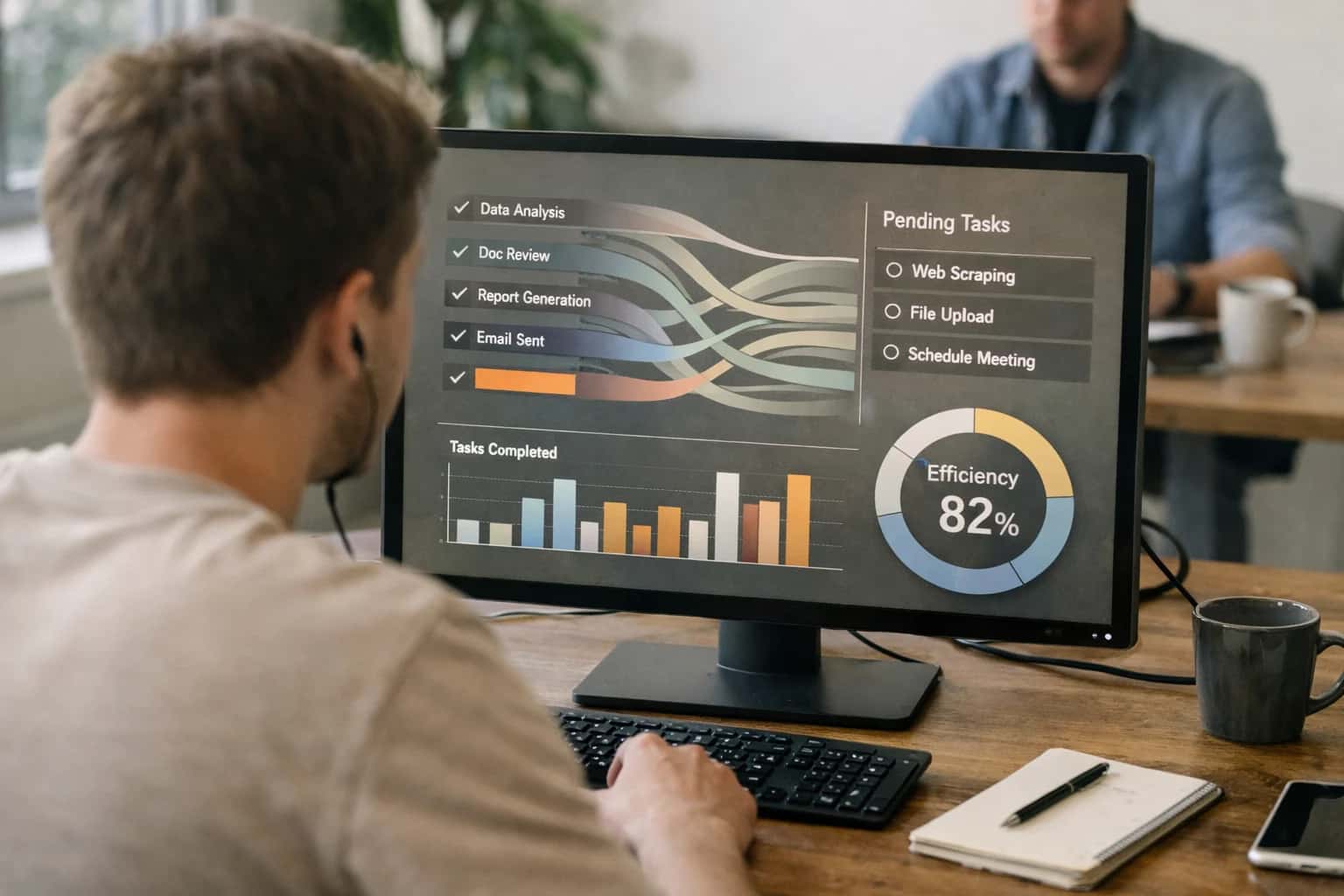
AGENT STATE MONITORING
What is an Execution Trace?
A detailed log of an autonomous agent's internal operations, essential for debugging and performance analysis in production.
In production, execution traces are critical for root cause analysis of failures, latency optimization, and compliance auditing. They enable engineers to reconstruct an agent's exact path, identify bottlenecks in planning loops, and validate actions against business logic. When integrated into a telemetry pipeline, traces feed into distributed tracing systems and interaction graphs, providing the visibility needed to assure deterministic execution in complex, multi-agent environments.
ANATOMY OF A TRACE
Key Components of an Execution Trace
An execution trace is a structured log of an agent's runtime operations. It is composed of several core data elements that, when combined, provide a complete picture of the agent's behavior for debugging and analysis.
01
Timeline of Operations
The foundational component is a chronological sequence of low-level operations. This includes:
- Function calls with entry and exit timestamps.
- Tool/API invocations and their results.
- Internal state mutations (e.g., variable updates).
- Decision points and branch selections. Each entry is a discrete event, forming a step-by-step replay of the agent's execution path. High-resolution timestamps enable precise latency analysis between steps.
02
Input/Output Payloads
Traces capture the exact data payloads flowing into and out of each operation. This includes:
- Input arguments passed to functions or tools.
- Return values and output objects.
- Error messages and stack traces from failures.
- LLM prompts and completions for reasoning steps. Storing full payloads is critical for debugging non-deterministic behavior, as it allows engineers to replay specific steps with the exact same data that caused an issue.
03
Span Context & Correlation
To follow execution across distributed systems, traces use span-based context propagation. Key concepts:
- Trace ID: A unique identifier for the entire end-to-end request.
- Span ID: A unique identifier for a single operation within the trace.
- Parent Span ID: Links child operations to their parent, creating a hierarchical tree. This structure allows the trace to follow an agent's work as it moves between internal modules, external APIs, and different services, providing a unified view of a potentially complex, distributed transaction.
04
Metadata and Tags
Execution traces are enriched with contextual metadata that classifies and describes the run. Common tags include:
- Agent ID and session ID for user/request attribution.
- Deployment version and environment (e.g., prod, staging).
- Cost attribution data like LLM model used and token counts.
- Custom business logic tags (e.g.,
transaction_type=refund). This metadata enables powerful filtering, aggregation, and alerting. For example, engineers can query all traces whereerror=trueandmodel=gpt-4to isolate issues to a specific model version.
05
Performance Metrics
Embedded within the trace are quantitative performance measurements. Essential metrics include:
- Duration of each span and the total trace.
- CPU/Memory usage sampled during execution.
- External service latency for API calls.
- Queue waiting time if the agent was throttled. These metrics transform the trace from a simple log into a performance profiling tool. Engineers can identify bottlenecks by comparing span durations and pinpoint inefficient sequences of operations.
06
Linkage to External Systems
A robust trace does not exist in isolation; it links to related observability data. This involves:
- Log Correlation: Embedding the Trace ID in application logs, allowing seamless navigation from a log error to the full trace.
- Metric Emission: Deriving metrics (e.g., span duration histograms) from traces for dashboards.
- Alert Integration: Using trace patterns (e.g., a specific error sequence) to trigger alerts.
- Storage in Tracing Backends: Traces are typically sent to dedicated systems like Jaeger, Zipkin, or commercial APM tools for querying and visualization.
AGENT STATE MONITORING
How Execution Tracing Works
An execution trace is a chronological log of the low-level operations, function calls, and state changes performed by an agent during a specific task, used for deep debugging and performance analysis.
An execution trace is a granular, time-ordered record of an autonomous agent's internal operations, capturing each function call, tool invocation, and state mutation. It provides a forensic-level view of the agent's decision path, analogous to a software debugger's step-through log. This trace is essential for root-cause analysis of failures, performance profiling to identify latency bottlenecks, and auditing for compliance and reproducibility in production systems.
Tracing is implemented via instrumentation that injects logging hooks into the agent's core execution loop. These hooks emit structured log events containing timestamps, input/output data, and the resulting agent state delta. The collected trace data is typically routed through an observability pipeline to a specialized backend for storage, querying, and visualization, enabling engineers to reconstruct the exact sequence of events that led to any given agent output or error.
EXECUTION TRACE
Frequently Asked Questions
An execution trace is a foundational concept in agentic observability, providing a granular, chronological record of an autonomous system's operations. These FAQs address its core purpose, structure, and practical applications for debugging and performance analysis.
An execution trace is a chronological, low-level log of the operations, function calls, and state changes performed by an autonomous agent during a specific task. It provides a step-by-step record of the agent's internal machinery, detailing every decision, tool invocation, and memory access. This granular data is essential for deep debugging, performance analysis, and auditing deterministic behavior in production environments. Unlike higher-level logs, a trace captures the causal sequence of events, allowing engineers to reconstruct exactly how a particular output or decision was reached.
Enabling Efficiency, Speed & Accuracy
Intelligent Analysis, Decision & Execution
We build AI systems for teams that need search across company data, workflow automation across tools, or AI features inside products and internal software.
Talk to Us
Search across company data
Give teams answers from docs, tickets, runbooks, and product data with sources and permissions.
Useful when people spend too long searching or get different answers from different systems.
Enterprise searchRAGPermissions
Read more
Automate internal workflows
Use AI to route work, draft outputs, trigger actions, and keep approvals and logs in place.
Useful when repetitive work moves across multiple tools and teams.
AI agentsWorkflow automationGovernance
Read more
Add AI to products and internal tools
Build assistants, guided actions, or decision support into the software your team or customers already use.
Useful when AI needs to be part of the product, not a separate tool.
AI integrationDecision supportModel routing
Read more
About the author
Prasad Kumkar
CEO & MD, Inference Systems
Prasad Kumkar is the CEO & MD of Inference Systems and writes about AI systems architecture, LLM infrastructure, model serving, evaluation, and production deployment. Over 5+ years, he has worked across computer vision models, L5 autonomous vehicle systems, and LLM research, with a focus on taking complex AI ideas into real-world engineering systems.
His work and writing cover AI systems, large language models, AI agents, multimodal systems, autonomous systems, inference optimization, RAG, evaluation, and production AI engineering.
LinkedIn
Limited slotsGet a Free AI Consultation
Partnered with leading AI, data, and software stack.





How We Work
Custom AI workflows for your Business
One-fit-all AI don't work for modern businesses. At Inferensys, we aim to understand your business & custom requirements; which we use to define most efficient agentic workflows, the data, and the tools for your business.
01
Review the use case
We understand the task, the users, and where AI can actually help.
Read more02
Pick the right approach
We define what needs search, automation, or product integration.
Read more03
Build the first useful version
We implement the part that proves the value first.
Read more04
Improve from there
We add the checks and visibility needed to keep it useful.
Read moreThe first call is a practical review of your use case and the right next step.
Talk to Us