Community detection is the algorithmic process of identifying groups of nodes—called communities, clusters, or modules—within a graph that are more densely connected internally than with the rest of the network. In the context of agent interaction graphs, this reveals teams or functional units of agents that communicate or collaborate more frequently with each other than with agents outside their group. This structural analysis is essential for understanding the modular architecture and information flow within a multi-agent system.

Glossary
Community Detection
Community detection is the algorithmic task of identifying groups of nodes within a graph that are more densely connected internally than with the rest of the network.
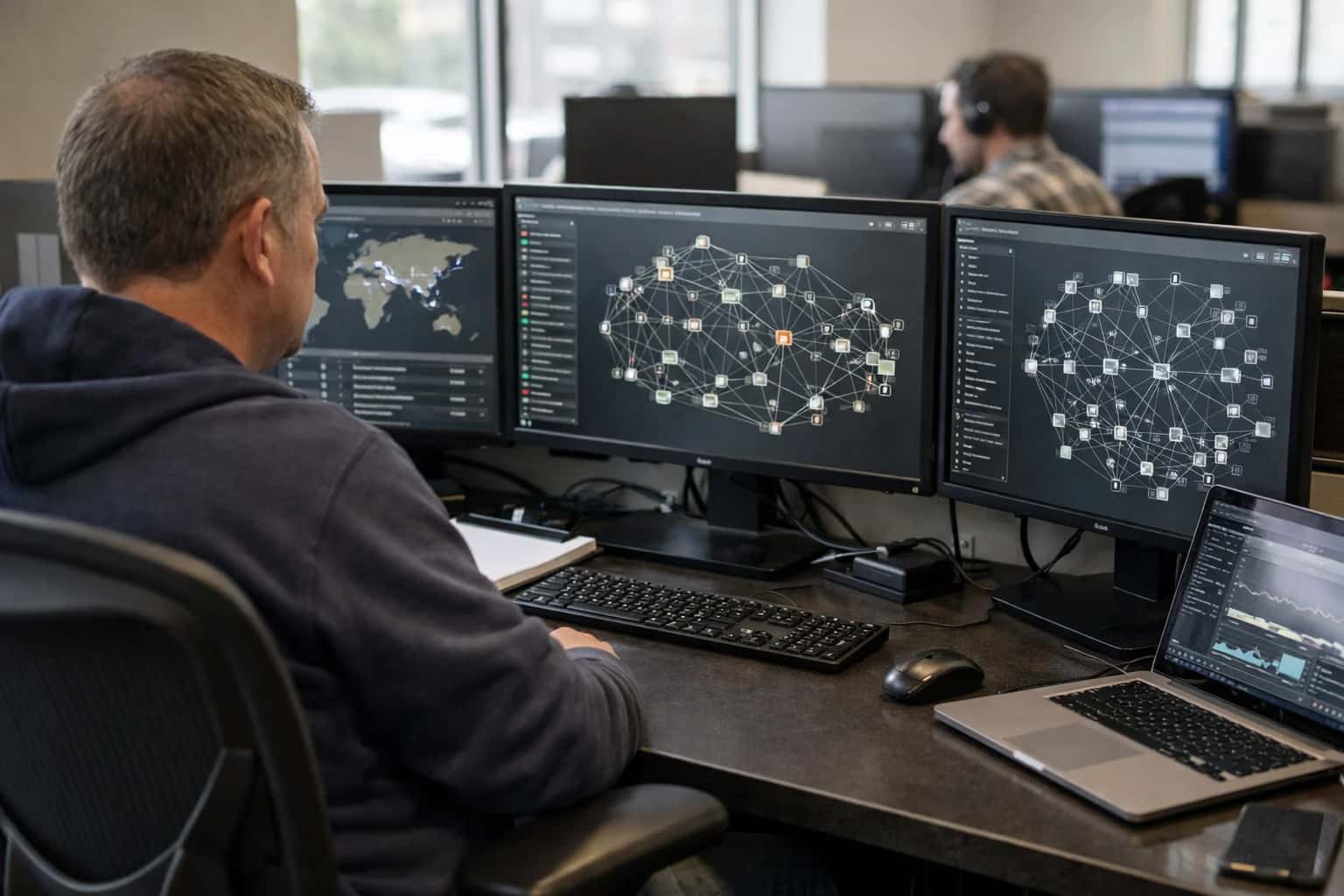
AGENT INTERACTION GRAPHS
What is Community Detection?
Community detection is a fundamental graph analysis task for identifying clusters within networks, crucial for understanding the modular structure of multi-agent systems.
Common algorithms for this task include modularity optimization (e.g., the Louvain method), which seeks partitions that maximize a quality function measuring intra-community edge density, and label propagation, which iteratively assigns nodes to the most common community among their neighbors. For temporal graphs of agent interactions, dynamic community detection tracks how these clusters form, dissolve, and evolve over time, providing critical observability into shifting team dynamics and collaboration patterns in autonomous systems.
ALGORITHM TAXONOMY
Key Community Detection Algorithms
Community detection algorithms identify clusters of densely connected nodes within a graph, revealing teams or functional groups in agent interaction networks. The choice of algorithm depends on the graph's scale, structure, and whether communities are overlapping or hierarchical.
01
Girvan-Newman Algorithm (Edge Betweenness)
A divisive hierarchical algorithm that progressively removes edges with the highest betweenness centrality to reveal community structure. It operates on the principle that inter-community edges have high betweenness.
- Process: Calculates edge betweenness for all edges, removes the edge(s) with the highest score, and recalculates. This repeats until no edges remain.
- Output: A dendrogram showing the hierarchical decomposition of the network.
- Use Case: Effective for analyzing the modular structure of smaller to medium-sized interaction graphs to find critical communication bridges between agent teams.
- Limitation: Computationally expensive for large graphs due to repeated betweenness calculations.
02
Louvain Method (Modularity Optimization)
A greedy, hierarchical algorithm that maximizes modularity, a measure of the density of links inside communities versus links between communities.
- Process: Iteratively moves nodes between communities to increase modularity, then aggregates nodes in the same community to form a new network, repeating the process.
- Key Metric: Modularity (Q), where Q > 0 indicates community structure. Values typically range from 0.3 to 0.7.
- Use Case: Extremely fast and scalable, ideal for detecting communities in large-scale agent telemetry graphs with millions of interactions.
- Output: Non-overlapping communities and a hierarchy of partitions.
03
Label Propagation Algorithm (LPA)
A near-linear time, semi-supervised algorithm where nodes adopt the label that is most frequent among their neighbors.
- Process: Each node is initialized with a unique label. Iteratively, each node updates its label to the one most common in its neighborhood. The process converges as labels propagate through dense clusters.
- Characteristics: Very fast, requires no prior optimization function, and can naturally identify overlapping communities in some variants.
- Use Case: Excellent for real-time or streaming analysis of dynamic agent interaction graphs where speed is critical.
- Limitation: Results can be somewhat random and unstable due to update order sensitivity.
04
Infomap
An information-theoretic algorithm that finds communities by compressing the description of information flow on the network, using the map equation.
- Principle: Models a random walker on the graph. The goal is to find a partition that minimizes the expected description length of the walker's path, effectively finding modules where the walker tends to stay longer.
- Strengths: Naturally handles weighted and directed edges, making it suitable for modeling asymmetric message flows between agents. Often finds more accurate partitions than modularity-based methods.
- Use Case: Analyzing directed communication graphs in multi-agent systems to find information bottlenecks and functional subunits.
05
Clique Percolation Method (CPM)
A method for finding overlapping communities based on the interconnection of k-cliques (complete subgraphs of size k).
- Process: Finds all cliques of size k in the network. Two k-cliques are considered adjacent if they share k-1 nodes. A community is defined as the union of all k-cliques that can be reached from each other through a series of adjacent k-cliques.
- Output: Communities where nodes can belong to multiple groups, reflecting agents that participate in several functional teams.
- Use Case: Identifying cross-functional agent teams or agents that serve as liaisons between different communities in an interaction network.
- Parameter: The clique size
kcontrols the granularity; higher k finds larger, more robust communities.
06
Spectral Clustering
A technique that uses the eigenvalues and eigenvectors of a graph matrix (like the Laplacian) to perform dimensionality reduction before clustering nodes in the eigenvector space.
- Process: Constructs a graph Laplacian matrix, computes the first k eigenvectors, and uses them as features to cluster nodes (e.g., with k-means).
- Mathematical Basis: Relies on the property that the multiplicity of the zero eigenvalue of the Laplacian equals the number of connected components. The next eigenvectors provide a basis for partitioning.
- Use Case: Effective for partitioning graphs where communities are not necessarily dense but are separated by minimal graph cuts. Useful for initial analysis of agent network topology.
- Consideration: Requires specifying the number of communities
kin advance and is less scalable for very large graphs.
COMMUNITY DETECTION
Algorithm Comparison for Agent Graphs
A comparison of common graph algorithms used to identify densely connected clusters (communities) of frequently interacting agents within an interaction graph.
| Algorithm / Metric | Louvain Method | Label Propagation | Girvan-Newman | Infomap |
|---|---|---|---|---|
Primary Mechanism | Modularity optimization via greedy local moving and aggregation | Iterative propagation of node labels based on neighbor majority | Iterative removal of high-betweenness edges | Compression of a random walk's description length using Huffman coding |
Graph Type | Undirected, weighted | Undirected, unweighted/weighted | Undirected, unweighted | Directed, weighted |
Time Complexity | O(n log² n) ~ O(n log n) | Near-linear O(m) | O(m² n) or O(n³) on sparse | O(m) |
Hierarchical Output | ||||
Resolution Limit | ||||
Handles Overlapping Communities | ||||
Scalability for Large Agent Graphs | High (used for billion-node graphs) | Very High | Low (suits small to medium graphs) | High |
Typical Use Case in Agent Systems | Identifying stable, long-term team structures | Real-time detection of emergent conversational clusters | Finding critical bottleneck agents whose removal fragments the network | Mapping information flow and functional modules in directed communication logs |
COMMUNITY DETECTION
Frequently Asked Questions
Community detection identifies clusters of densely connected nodes within a graph, revealing natural groupings in networks like agent communication systems. These questions address its core mechanisms, algorithms, and applications in multi-agent observability.
Community detection is the algorithmic task of identifying groups of nodes within a graph that are more densely connected internally than with the rest of the network. In the context of agent interaction graphs, this reveals clusters or teams of agents that communicate frequently with each other, forming functional sub-systems. The goal is to partition the graph into these communities (also called clusters or modules) to simplify analysis, improve system understanding, and optimize monitoring. This is a fundamental technique in network science and graph analytics for uncovering latent structure.
Enabling Efficiency, Speed & Accuracy
Intelligent Analysis, Decision & Execution
We build AI systems for teams that need search across company data, workflow automation across tools, or AI features inside products and internal software.
Talk to Us
Search across company data
Give teams answers from docs, tickets, runbooks, and product data with sources and permissions.
Useful when people spend too long searching or get different answers from different systems.
Enterprise searchRAGPermissions
Read more
Automate internal workflows
Use AI to route work, draft outputs, trigger actions, and keep approvals and logs in place.
Useful when repetitive work moves across multiple tools and teams.
AI agentsWorkflow automationGovernance
Read more
Add AI to products and internal tools
Build assistants, guided actions, or decision support into the software your team or customers already use.
Useful when AI needs to be part of the product, not a separate tool.
AI integrationDecision supportModel routing
Read more
About the author
Prasad Kumkar
CEO & MD, Inference Systems
Prasad Kumkar is the CEO & MD of Inference Systems and writes about AI systems architecture, LLM infrastructure, model serving, evaluation, and production deployment. Over 5+ years, he has worked across computer vision models, L5 autonomous vehicle systems, and LLM research, with a focus on taking complex AI ideas into real-world engineering systems.
His work and writing cover AI systems, large language models, AI agents, multimodal systems, autonomous systems, inference optimization, RAG, evaluation, and production AI engineering.
LinkedIn
Limited slotsGet a Free AI Consultation
Partnered with leading AI, data, and software stack.





How We Work
Custom AI workflows for your Business
One-fit-all AI don't work for modern businesses. At Inferensys, we aim to understand your business & custom requirements; which we use to define most efficient agentic workflows, the data, and the tools for your business.
01
Review the use case
We understand the task, the users, and where AI can actually help.
Read more02
Pick the right approach
We define what needs search, automation, or product integration.
Read more03
Build the first useful version
We implement the part that proves the value first.
Read more04
Improve from there
We add the checks and visibility needed to keep it useful.
Read moreThe first call is a practical review of your use case and the right next step.
Talk to Us