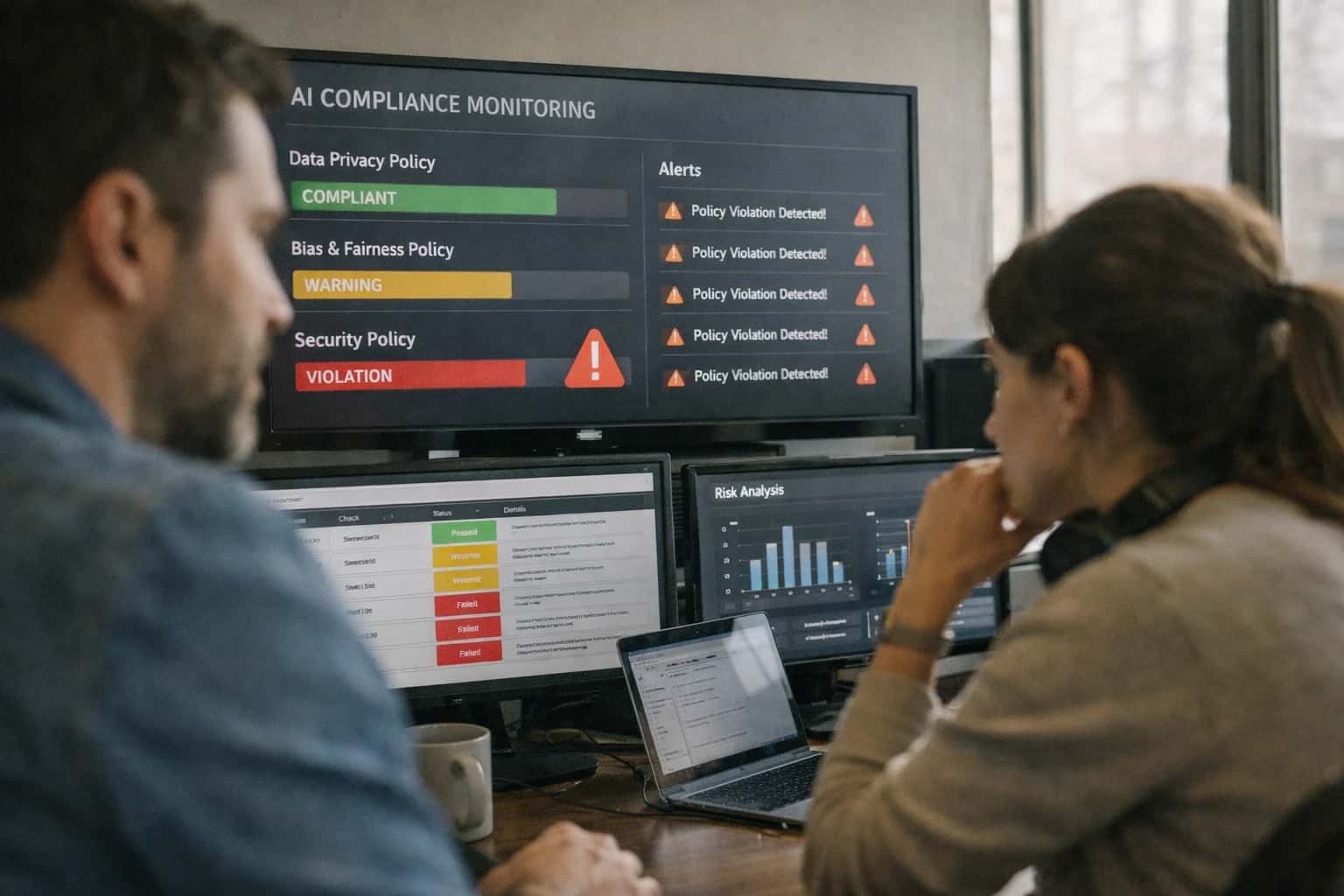
Cost overrun detection is the automated monitoring and alerting process that identifies when an AI agent's operational expenses exceed predefined budgetary thresholds in real-time. It is a core function of agent cost telemetry, focusing on key cost drivers like token consumption, API call rates, and compute unit usage. The system compares live spending against a token budget or compute budget to trigger alerts before financial limits are breached.

Glossary
Cost Overrun Detection
Cost overrun detection is the automated monitoring and alerting system that identifies when an AI agent's operational expenses exceed predefined budgetary thresholds in real-time.
AGENT COST TELEMETRY
What is Cost Overrun Detection?
Cost overrun detection is a critical component of agentic observability, providing automated financial safeguards for autonomous AI systems.
This capability enables proactive financial governance by providing cost traceability from an alert back to the specific agent session, tool call, or user request causing the overrun. It integrates with agent telemetry pipelines to monitor session costing and API call metering, allowing engineering and FinOps teams to implement throttling, fail-safes, or re-routing to more cost-effective models, ensuring deterministic control over operational expenditure.
AGENT COST TELEMETRY
Key Features of Cost Overrun Detection Systems
Modern cost overrun detection systems integrate real-time monitoring, predictive analytics, and automated governance to provide financial control over autonomous AI operations. These features enable enterprises to prevent budget breaches by identifying anomalous spend as it occurs.
01
Real-Time Token & API Spend Monitoring
These systems perform continuous telemetry collection on the primary cost drivers of AI agents: token consumption and external API calls. By instrumenting the agent's execution pipeline, they track metrics like tokens-per-second burn rate, cost-per-session, and API call latency and expense. This real-time visibility is essential for catching overruns before they escalate, as agentic workloads can incur costs orders of magnitude higher than expected in seconds.
02
Dynamic Budget Thresholds & Alerts
Detection is governed by configurable budgetary guardrails. Systems allow the definition of token budgets per agent, session, or project, and compute budgets over timeframes (e.g., daily, monthly). When consumption approaches or exceeds a threshold, the system triggers multi-channel alerts (e.g., Slack, PagerDuty, email). Advanced systems support tiered thresholds (warning, critical, hard stop) and can initiate automated cost containment actions, such as pausing an agent's execution.
03
Predictive Cost Forecasting
Leveraging historical cost attribution data and current usage trends, these systems project future spend. Using techniques like time-series analysis, they forecast if an agent's current trajectory will breach its compute budget before the period ends. This allows for preemptive intervention—such as scaling down non-critical tasks or reallocating resources—transforming detection from reactive to proactive financial management.
04
Anomaly Detection on Spend Patterns
Beyond simple threshold breaches, sophisticated systems use machine learning to establish a baseline of normal cost behavior for each agent. They then flag cost anomalies—unexpected spikes or dips in token usage or API spend that deviate from this pattern. This detects subtler issues like:
- Inefficient prompt patterns causing token waste.
- Cascading tool calls triggered by an error.
- API price changes or unexpected rate limits. This provides a deeper layer of financial observability.
05
Granular Cost Attribution & Traceability
Effective detection requires knowing why an overrun occurred. These systems provide end-to-end cost traceability by linking every unit of spend to its source. Features include:
- Session costing to aggregate all expenses for a single user request.
- A detailed token audit trail showing consumption per reasoning step.
- Resource attribution mapping GPU/CPU usage to specific tool calls.
- Spend attribution to projects, teams, or model versions. This granularity is critical for root-cause analysis and implementing cost allocation models.
06
Automated Governance & Policy Enforcement
The ultimate feature is closing the loop from detection to action. Systems can enforce cost governance policies automatically, such as:
- Dynamic compute allocation: Shifting budgets from low-priority to high-priority agents.
- Session termination: Halting agents that exceed a hard cost limit.
- Model fallback: Switching a costly primary model (e.g., GPT-4) to a more efficient one (e.g., a small language model) when budgets are tight. This transforms detection from a monitoring function into an active control system for FinOps.
AGENT COST TELEMETRY
How Cost Overrun Detection Works
Cost overrun detection is a critical component of agentic observability, providing real-time financial governance for autonomous AI systems.
Cost overrun detection is the automated monitoring and alerting process that identifies when an AI agent's operational expenses exceed predefined budgetary thresholds in real-time. It functions by continuously metering key cost drivers like token consumption, API call volume, and compute unit usage against a token budget or compute budget. When spending velocity indicates a threshold breach is imminent or has occurred, the system triggers an alert or executes a pre-configured mitigation action, such as terminating a session.
This capability relies on a telemetry pipeline that aggregates fine-grained cost attribution data from across an agent's execution. By establishing cost traceability to specific sessions, tool calls, or reasoning steps, it enables precise spend attribution and rapid root-cause analysis. Effective detection provides financial accountability, prevents budget blowouts, and is a foundational practice for Agentic Observability and Telemetry, allowing enterprises to deploy autonomous systems with financial confidence.
IMPLEMENTATION PATTERNS
Examples of Cost Overrun Detection in Practice
Cost overrun detection is implemented through automated monitoring systems that track key financial and computational metrics in real-time. These systems trigger alerts when spending deviates from established baselines or exceeds predefined thresholds.
01
Real-Time Token Burn Rate Monitoring
This is the most direct form of detection, where a telemetry pipeline continuously meters token consumption per agent session or per minute. Alerts fire when the burn rate exceeds a token budget threshold, such as 10,000 tokens per minute for a customer support agent. Systems track both input and output tokens, often using middleware that intercepts API calls to models like GPT-4 or Claude. This prevents a single runaway agent session from consuming an entire monthly compute credit allocation in hours.
02
Session Cost Threshold Violation
Detection systems enforce a maximum cost per session. For example, a document analysis agent may have a limit of $0.50 per request. The system aggregates all expenses for a session—including primary LLM tokens, retrieval-augmented generation calls to a vector database, and external API tool calls—in real-time. If the cumulative cost approaches (e.g., 80%) or exceeds the limit, the session is terminated or escalated, and an alert is sent to engineering and FinOps teams. This is critical for preventing infinite loops in agentic reasoning cycles.
03
Anomalous API Call Pattern Detection
Beyond simple thresholds, machine learning models analyze patterns in API call logging data to detect subtle overruns. For instance:
- A sudden 10x increase in calls to a paid translation API by a single agent.
- An agent making redundant, high-cost tool calls due to a logic error.
- Unusual latency spikes correlating with cost increases, indicating inefficient resource use. These systems establish a behavioral baseline for normal agent telemetry and use statistical process control to flag deviations, often catching issues before they breach hard budgetary limits.
04
Multi-Agent System Cascading Cost Alert
In multi-agent system orchestration, a cost overrun in one agent can cascade. Detection systems monitor the agent interaction graph. For example, if a 'planner' agent excessively sub-decomposes a task, it can spawn hundreds of 'worker' agents, each incurring cost. The system detects the abnormal fan-out, correlates the aggregate session costing across the agent swarm, and triggers a containment alert. This requires distributed trace collection to attribute cost across the entire workflow, not just individual components.
05
Budget vs. Actual Spend Forecasting Breach
Sophisticated systems perform continuous cost forecasting. They project end-of-period spend (e.g., daily, weekly) based on the current run rate. An alert is generated if the forecasted spend exceeds the allocated compute budget. For example, a system forecasting a $5,000 daily spend against a $3,000 budget would trigger a pre-emptive alert, allowing teams to throttle agent capacity or investigate inefficiencies before the actual overrun occurs. This leverages historical token accounting and resource metering data for predictive accuracy.
06
Granular Cost Driver Analysis & Alert
Detection drills into specific cost drivers. Instead of a generic overrun alert, the system identifies the root cause:
- Alert: "Cost overrun detected: 70% driven by increased context window usage in Agent X."
- Alert: "Spike attributed to expensive model fallback (GPT-4) due to errors in Claude-3 Haiku calls." This requires high cost granularity and cost traceability, linking financial spikes to specific code paths, model versions, or user prompts. It transforms an alert into an immediate diagnostic, accelerating remediation.
COST OVERRUN DETECTION
Frequently Asked Questions
Cost overrun detection is a critical component of Agent Cost Telemetry, enabling real-time financial governance of autonomous AI systems. This FAQ addresses common questions about its mechanisms, implementation, and strategic value for enterprise operations.
Cost overrun detection is an automated monitoring system that identifies when an AI agent's operational expenses exceed predefined budgetary thresholds in real-time. It works by continuously metering key cost drivers—such as token consumption, API call volume, and compute unit usage—against a token budget or compute budget. When consumption approaches or breaches a limit, the system triggers alerts or executes kill switches to halt the agent's execution, preventing unbounded spending. This process relies on instrumentation within the agent's telemetry pipeline to capture granular cost data and a rules engine to evaluate it against policy.
Enabling Efficiency, Speed & Accuracy
Intelligent Analysis, Decision & Execution
We build AI systems for teams that need search across company data, workflow automation across tools, or AI features inside products and internal software.
Talk to Us
Search across company data
Give teams answers from docs, tickets, runbooks, and product data with sources and permissions.
Useful when people spend too long searching or get different answers from different systems.
Enterprise searchRAGPermissions
Read more
Automate internal workflows
Use AI to route work, draft outputs, trigger actions, and keep approvals and logs in place.
Useful when repetitive work moves across multiple tools and teams.
AI agentsWorkflow automationGovernance
Read more
Add AI to products and internal tools
Build assistants, guided actions, or decision support into the software your team or customers already use.
Useful when AI needs to be part of the product, not a separate tool.
AI integrationDecision supportModel routing
Read more
About the author
Prasad Kumkar
CEO & MD, Inference Systems
Prasad Kumkar is the CEO & MD of Inference Systems and writes about AI systems architecture, LLM infrastructure, model serving, evaluation, and production deployment. Over 5+ years, he has worked across computer vision models, L5 autonomous vehicle systems, and LLM research, with a focus on taking complex AI ideas into real-world engineering systems.
His work and writing cover AI systems, large language models, AI agents, multimodal systems, autonomous systems, inference optimization, RAG, evaluation, and production AI engineering.
LinkedIn
Limited slotsGet a Free AI Consultation
Partnered with leading AI, data, and software stack.





How We Work
Custom AI workflows for your Business
One-fit-all AI don't work for modern businesses. At Inferensys, we aim to understand your business & custom requirements; which we use to define most efficient agentic workflows, the data, and the tools for your business.
01
Review the use case
We understand the task, the users, and where AI can actually help.
Read more02
Pick the right approach
We define what needs search, automation, or product integration.
Read more03
Build the first useful version
We implement the part that proves the value first.
Read more04
Improve from there
We add the checks and visibility needed to keep it useful.
Read moreThe first call is a practical review of your use case and the right next step.
Talk to Us