A Policy Compliance Log is a structured, immutable record that captures each time a governance rule is invoked to evaluate an agent's intended or completed action. Each entry documents the policy identifier, the agent action or state under evaluation, the compliance result (e.g., pass, fail, override), and a timestamp. This creates a verifiable chain of evidence for regulatory audits and internal governance, answering the critical question of why an agent was allowed or blocked from proceeding.

Glossary
Policy Compliance Log
A Policy Compliance Log is a specialized audit log that records instances where an autonomous agent's actions are evaluated against governance policies, including the policy invoked and the compliance result.
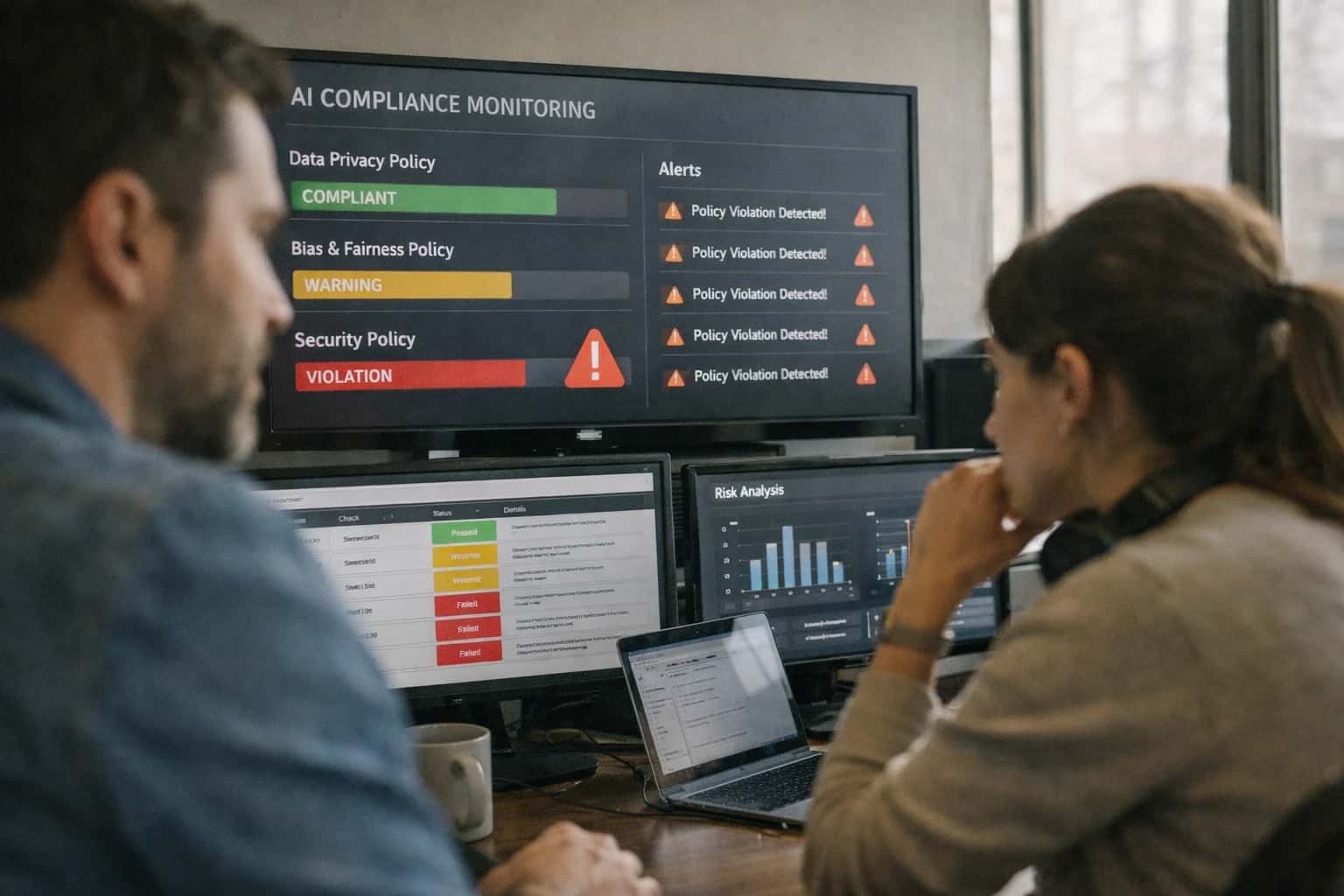
AGENT BEHAVIOR AUDITING
What is a Policy Compliance Log?
A Policy Compliance Log is a specialized audit trail that records instances where an autonomous agent's actions or decisions are evaluated against a set of governance policies.
This log is distinct from a general audit trail; it focuses specifically on the application of guardrails and business rules. It enables forensic state reconstruction to prove adherence to frameworks like the EU AI Act. By linking actions to specific policy checks, it provides deterministic execution proof for compliance officers and forms the basis for behavioral drift detection when policy violation patterns change over time.
DATA STRUCTURE
Key Components of a Policy Compliance Log Entry
A policy compliance log entry is a structured record documenting a single evaluation event where an agent's action or decision was checked against a governance rule. Each entry contains specific, verifiable fields to support auditing and forensic analysis.
01
Timestamp and Sequence ID
The Timestamp is a high-precision, coordinated universal time (UTC) record of when the policy evaluation occurred. The Sequence ID is a unique, monotonically increasing identifier that establishes the exact chronological order of events, critical for reconstructing causality and preventing log injection attacks.
- Example Timestamp Format:
2024-05-15T14:30:22.123456Z - Sequence ID Role: Guarantees total order of events, even when timestamps have millisecond-level collisions.
- Integrity Use: Used in cryptographic chaining (e.g., hash chains) to make log tampering evident.
02
Agent and Session Identifier
This component definitively links the log entry to the specific autonomous agent instance and its execution session. It answers 'who' performed the evaluated action.
- Agent ID: A unique identifier for the agent's deployed version and configuration (e.g.,
agent-purchase-approval-v2.1). - Session ID: A unique identifier for the specific execution context or user interaction (e.g.,
session-abc123-def456). - Purpose: Enables cross-session auditing and aggregates all compliance events for a single agent decision-making chain.
03
Invoked Policy and Rule
The core of the entry specifies the exact governance policy and the specific rule within it that was evaluated. This provides the legal or operational framework against which compliance was measured.
- Policy ID/Name: References the formal policy document (e.g.,
EU_AI_ACT_CHAPTER_3,Company_Spending_Policy_v5). - Rule ID/Logic: The precise conditional logic or rule identifier that was executed (e.g.,
RULE_MAX_APPROVAL_AMOUNT: 10000,CHECK_DATA_RETENTION_PERIOD). - Versioning: Includes policy version to account for rule changes over time.
04
Action Context and Input Data
A snapshot of the agent's intended action and the relevant input data that triggered the policy check. This provides the factual basis for the evaluation.
- Action Description: The agent's planned operation (e.g.,
execute_payment,generate_medical_summary,deny_loan_application). - Relevant Inputs: The specific data fields used in the policy evaluation, often sanitized or hashed for privacy (e.g.,
transaction_amount: 12500,user_age: 17,document_classification: CONFIDENTIAL). - Role: Enables forensic state reconstruction to re-evaluate the policy with the same inputs.
05
Compliance Result and Justification
Records the binary outcome of the policy check (COMPLIANT / NON_COMPLIANT) and the system-generated justification. The justification is the audit trail's reasoning, showing why the result was reached.
- Result: The deterministic output of the policy rule engine.
- Justification: A machine-readable trace of the rule logic evaluation (e.g.,
FAIL: transaction_amount (12500) > max_approval_amount (10000)). - Enforcement Action: May record the subsequent system action triggered by the result (e.g.,
ACTION: ESCALATE_TO_MANAGER,ACTION: BLOCK_AND_ALERT).
06
Cryptographic Attestation
A cryptographic seal that provides non-repudiation and tamper-evidence for the log entry. This transforms the record into a verifiable action record.
- Digital Signature: A signature generated using a private key (from the agent's secure module or a central log service) over a hash of the entry's core fields.
- Hash Chain Link: The entry's hash may be linked to the previous entry's hash, creating an immutable action ledger.
- Public Verification: Allows auditors to verify the entry's authenticity and integrity using a corresponding public key, providing a deterministic execution proof.
AGENT BEHAVIOR AUDITING
How Policy Compliance Logging Works in AI Systems
A Policy Compliance Log is a specialized audit log that records instances where an autonomous agent's actions were evaluated against governance policies, including the policy invoked and the compliance result.
A Policy Compliance Log is a specialized audit trail that records every instance an autonomous agent's planned or executed action is evaluated against a formal governance rule. Each entry captures the specific policy invoked, the contextual data assessed, the compliance result (pass/fail/conditional), and any enforcement action taken, such as blocking a request or requiring human approval. This creates a verifiable record for regulatory audits and internal governance, directly supporting requirements of frameworks like the EU AI Act.
Logging occurs at compliance checkpoints integrated into the agent's execution loop. The system evaluates actions against policy engines that encode rules for data privacy, ethical guidelines, or operational safety. Each log entry is often a signed audit record or verifiable action record to ensure non-repudiation. These logs feed into cross-session auditing and forensic timeline analysis, allowing investigators to reconstruct why an agent acted and prove it adhered to its governing constraints.
POLICY COMPLIANCE LOG
Frequently Asked Questions
Essential questions about Policy Compliance Logs, a critical component of Agent Behavior Auditing that provides a verifiable record of how autonomous agents adhere to governance rules.
A Policy Compliance Log is a specialized, immutable audit trail that records every instance where an autonomous agent's proposed or executed actions are evaluated against a set of governance policies. Each log entry captures the specific policy invoked, the context of the agent's state and action, and the binary or graded compliance result (e.g., ALLOW, DENY, WARNING). Its primary function is to provide a forensic record for regulatory audits, internal reviews, and deterministic execution proof, ensuring every agent decision can be justified against established rules.
Enabling Efficiency, Speed & Accuracy
Intelligent Analysis, Decision & Execution
We build AI systems for teams that need search across company data, workflow automation across tools, or AI features inside products and internal software.
Talk to Us
Search across company data
Give teams answers from docs, tickets, runbooks, and product data with sources and permissions.
Useful when people spend too long searching or get different answers from different systems.
Enterprise searchRAGPermissions
Read more
Automate internal workflows
Use AI to route work, draft outputs, trigger actions, and keep approvals and logs in place.
Useful when repetitive work moves across multiple tools and teams.
AI agentsWorkflow automationGovernance
Read more
Add AI to products and internal tools
Build assistants, guided actions, or decision support into the software your team or customers already use.
Useful when AI needs to be part of the product, not a separate tool.
AI integrationDecision supportModel routing
Read more
About the author
Prasad Kumkar
CEO & MD, Inference Systems
Prasad Kumkar is the CEO & MD of Inference Systems and writes about AI systems architecture, LLM infrastructure, model serving, evaluation, and production deployment. Over 5+ years, he has worked across computer vision models, L5 autonomous vehicle systems, and LLM research, with a focus on taking complex AI ideas into real-world engineering systems.
His work and writing cover AI systems, large language models, AI agents, multimodal systems, autonomous systems, inference optimization, RAG, evaluation, and production AI engineering.
LinkedIn
Limited slotsGet a Free AI Consultation
Partnered with leading AI, data, and software stack.





How We Work
Custom AI workflows for your Business
One-fit-all AI don't work for modern businesses. At Inferensys, we aim to understand your business & custom requirements; which we use to define most efficient agentic workflows, the data, and the tools for your business.
01
Review the use case
We understand the task, the users, and where AI can actually help.
Read more02
Pick the right approach
We define what needs search, automation, or product integration.
Read more03
Build the first useful version
We implement the part that proves the value first.
Read more04
Improve from there
We add the checks and visibility needed to keep it useful.
Read moreThe first call is a practical review of your use case and the right next step.
Talk to Us