A Compliance Checkpoint is a deterministic control mechanism inserted into an agent's operational loop. At this point, execution pauses, and the agent's current internal state, proposed action, and relevant contextual data are submitted for evaluation. This evaluation is performed against a predefined rule set derived from business policies, industry regulations (e.g., GDPR, EU AI Act), or security protocols. The checkpoint returns a binary pass/fail decision, and the agent proceeds only upon verification, ensuring actions align with governance frameworks before they are irreversibly executed.

Glossary
Compliance Checkpoint
A compliance checkpoint is a predefined point in an autonomous agent's execution flow where its state and pending actions are evaluated against regulatory or policy rules before proceeding.
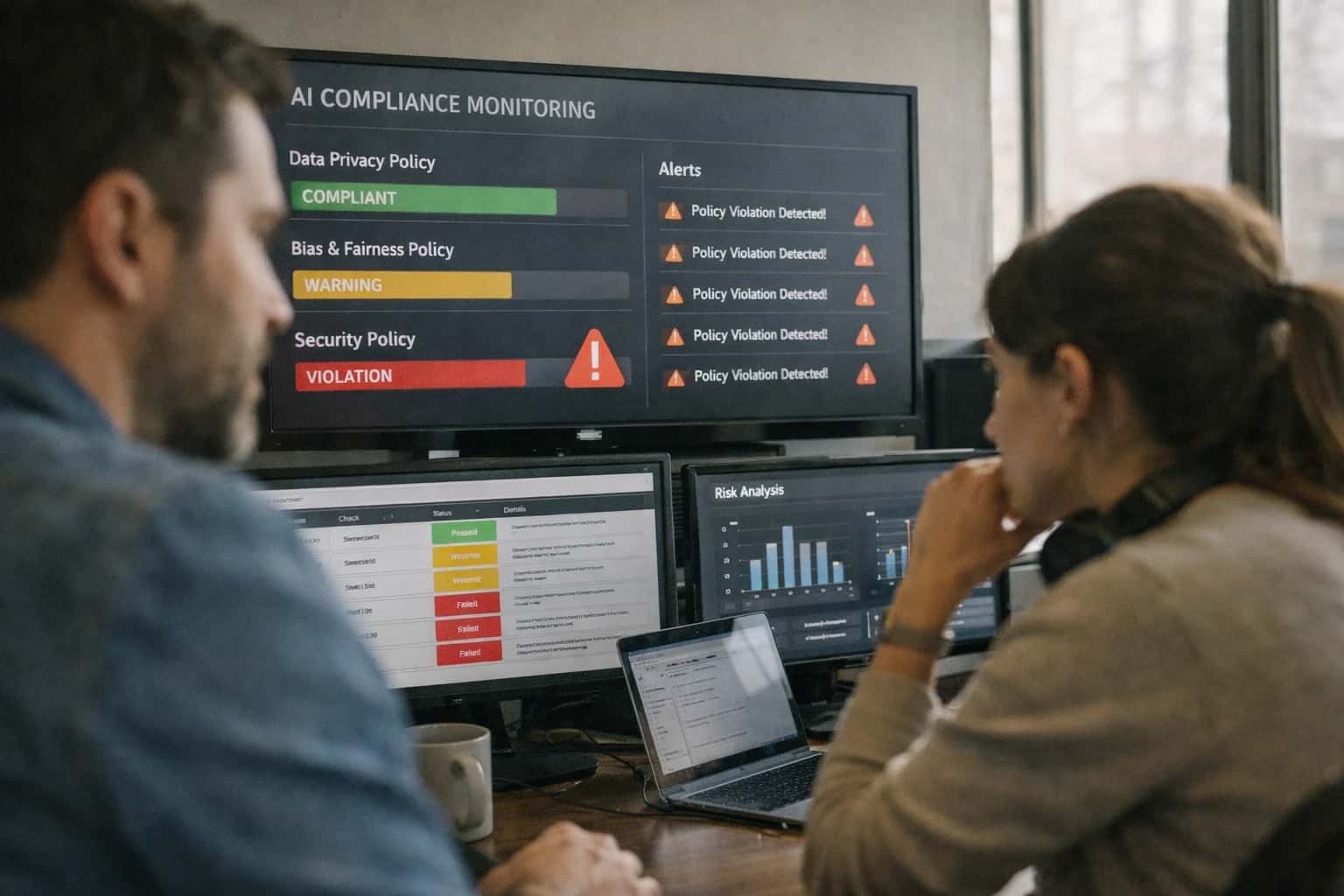
AGENT BEHAVIOR AUDITING
What is a Compliance Checkpoint?
A predefined point in an autonomous agent's execution flow where its state and pending actions are evaluated against regulatory or policy rules before proceeding.
The checkpoint's logic is typically declarative and externalized from the agent's core reasoning, often implemented as a policy-as-code engine or a call to a compliance microservice. This separation allows for centralized policy management and auditability. Each invocation creates an immutable Policy Compliance Log entry, recording the rule invoked, the agent's state snapshot, and the result. This provides a verifiable audit trail for regulatory reporting and forensic analysis, making compliance an integral, observable part of the agent's operational telemetry rather than a post-hoc review.
AGENT BEHAVIOR AUDITING
Core Characteristics of a Compliance Checkpoint
A compliance checkpoint is a critical control mechanism within an autonomous agent's workflow. It is a predefined, programmatic gate where the agent's state and intended actions are evaluated against a formal rule set before execution can proceed.
01
Pre-Action Evaluation Gate
A compliance checkpoint acts as a synchronous blocking gate inserted into the agent's execution flow. The agent's runtime is paused, and its pending action, current state, and relevant context are submitted for evaluation. Execution only resumes if the checkpoint returns an explicit approval; otherwise, the action is blocked, and an error or alternative path is triggered. This prevents non-compliant actions from ever being executed.
02
Rule-Based Policy Engine
At its core, a checkpoint is driven by a declarative policy engine. Rules are defined in a domain-specific language (DSL) or as code, specifying conditions that must be met. Common rule types include:
- Data Governance: "Is this action accessing PII? If yes, is there a logged legal basis?"
- Financial Controls: "Does this proposed trade exceed the single-counterparty limit?"
- Operational Safety: "Is the robotic arm's commanded trajectory within safe speed and torque boundaries?" The engine evaluates the agent's snapshot against all relevant, activated policies.
03
Deterministic & Auditable Outcome
A fundamental characteristic is determinism. Given the same agent state and action, the checkpoint must always produce the same compliance verdict. This is essential for debugging and regulatory proof. Every evaluation generates an immutable audit record detailing:
- The timestamp and checkpoint ID.
- The snapshot of the agent's state.
- The specific policy rules evaluated.
- The pass/fail result for each rule.
- The final allow/deny verdict. This record is written to a tamper-evident ledger, forming part of the agent's regulatory audit trail.
04
Integration with Agent State
The checkpoint must have privileged read access to the agent's internal state and memory to perform its evaluation. This includes:
- The agent's short-term working memory (conversation history, recent tool outputs).
- Its long-term memory (relevant facts retrieved from a vector database or knowledge graph).
- The parameters and context of the tool or API it is about to call. This deep integration allows the checkpoint to evaluate not just the superficial action, but the intent and context behind it, catching nuanced policy violations.
05
Low-Latency Enforcement
To be practical in production loops, a compliance checkpoint must impose minimal latency overhead. Evaluations are optimized for speed, often using compiled rule engines or pre-indexed policy sets. Typical latency goals are in the low millisecond range (< 10ms) to avoid degrading the agent's responsiveness. This is achieved through techniques like rule caching, parallel evaluation of independent rules, and avoiding synchronous calls to external services during the critical path.
06
Fail-Safe & Escalation Pathways
A robust checkpoint design includes defined failure modes and escalation protocols. If the checkpoint itself fails (e.g., policy engine error), the default behavior must be to deny the action (fail-closed), ensuring safety. For ambiguous or high-risk denials, the system may trigger an escalation pathway, such as:
- Queuing the action for human-in-the-loop review.
- Routing the agent to a sandboxed environment for safe testing.
- Invoking a remediation agent to adjust the plan and resubmit it for evaluation.
AGENT BEHAVIOR AUDITING
How Compliance Checkpoints Work
A compliance checkpoint is a critical control mechanism within an autonomous agent's execution flow, designed to enforce deterministic governance before an action is taken.
A compliance checkpoint is a predefined point in an agent's execution flow where its state and pending actions are evaluated against regulatory or policy rules before proceeding. This mechanism acts as a deterministic gate, halting execution to perform a policy compliance log check. The evaluation typically queries a rules engine against the agent's current context, including its intent-action mapping and proposed tool calls. A pass allows continuation; a fail triggers a predefined remediation, such as logging a violation, requesting human-in-the-loop approval, or terminating the session.
The checkpoint's architecture is built for audit trail generation and non-repudiation logging. Each evaluation creates a verifiable action record cryptographically linked to the agent's identity and the specific rule invoked. This creates an immutable chain of evidence for regulatory audit trail requirements. In multi-agent system orchestration, checkpoints coordinate across agents to prevent policy conflicts. Their placement is strategic, often before irreversible actions like API calls or state commits, ensuring deterministic execution proof and enabling forensic state reconstruction if needed.
COMPLIANCE CHECKPOINT
Frequently Asked Questions
A Compliance Checkpoint is a critical control mechanism in autonomous agent systems, designed to enforce deterministic execution and regulatory adherence. This FAQ addresses common technical and operational questions about implementing and managing these checkpoints.
A Compliance Checkpoint is a predefined, programmatic gate in an autonomous agent's execution flow where its current state, context, and pending actions are evaluated against a set of regulatory, security, or business policy rules before the agent is permitted to proceed. It works by intercepting the agent's execution cycle, serializing its state (including memory, tool call arguments, and reasoning steps), and submitting this data to a Policy Evaluation Engine. This engine runs deterministic checks—such as verifying data privacy compliance, checking for authorized tool use, or validating decision logic—and returns a pass/fail/governance override signal. If the checkpoint passes, execution continues; if it fails, the agent is halted or redirected to a safe, predefined remediation path, and the event is logged to an Immutable Action Ledger.
Enabling Efficiency, Speed & Accuracy
Intelligent Analysis, Decision & Execution
We build AI systems for teams that need search across company data, workflow automation across tools, or AI features inside products and internal software.
Talk to Us
Search across company data
Give teams answers from docs, tickets, runbooks, and product data with sources and permissions.
Useful when people spend too long searching or get different answers from different systems.
Enterprise searchRAGPermissions
Read more
Automate internal workflows
Use AI to route work, draft outputs, trigger actions, and keep approvals and logs in place.
Useful when repetitive work moves across multiple tools and teams.
AI agentsWorkflow automationGovernance
Read more
Add AI to products and internal tools
Build assistants, guided actions, or decision support into the software your team or customers already use.
Useful when AI needs to be part of the product, not a separate tool.
AI integrationDecision supportModel routing
Read more
About the author
Prasad Kumkar
CEO & MD, Inference Systems
Prasad Kumkar is the CEO & MD of Inference Systems and writes about AI systems architecture, LLM infrastructure, model serving, evaluation, and production deployment. Over 5+ years, he has worked across computer vision models, L5 autonomous vehicle systems, and LLM research, with a focus on taking complex AI ideas into real-world engineering systems.
His work and writing cover AI systems, large language models, AI agents, multimodal systems, autonomous systems, inference optimization, RAG, evaluation, and production AI engineering.
LinkedIn
Limited slotsGet a Free AI Consultation
Partnered with leading AI, data, and software stack.





How We Work
Custom AI workflows for your Business
One-fit-all AI don't work for modern businesses. At Inferensys, we aim to understand your business & custom requirements; which we use to define most efficient agentic workflows, the data, and the tools for your business.
01
Review the use case
We understand the task, the users, and where AI can actually help.
Read more02
Pick the right approach
We define what needs search, automation, or product integration.
Read more03
Build the first useful version
We implement the part that proves the value first.
Read more04
Improve from there
We add the checks and visibility needed to keep it useful.
Read moreThe first call is a practical review of your use case and the right next step.
Talk to Us