A Causal Action Graph is a directed graph data structure that explicitly models the cause-and-effect relationships between an autonomous agent's observations, internal states, decisions, and executed actions. It provides a formal, visual representation of an agent's operational logic, where nodes represent discrete events or states (e.g., 'sensor input received,' 'plan generated,' 'API tool called') and directed edges represent causal dependencies. This structure is foundational for agent behavior auditing, enabling systematic analysis and verification of deterministic execution paths.

Glossary
Causal Action Graph
A Causal Action Graph is a directed graph data structure that models the cause-and-effect relationships between an autonomous agent's observations, internal states, decisions, and executed actions for auditing and compliance.
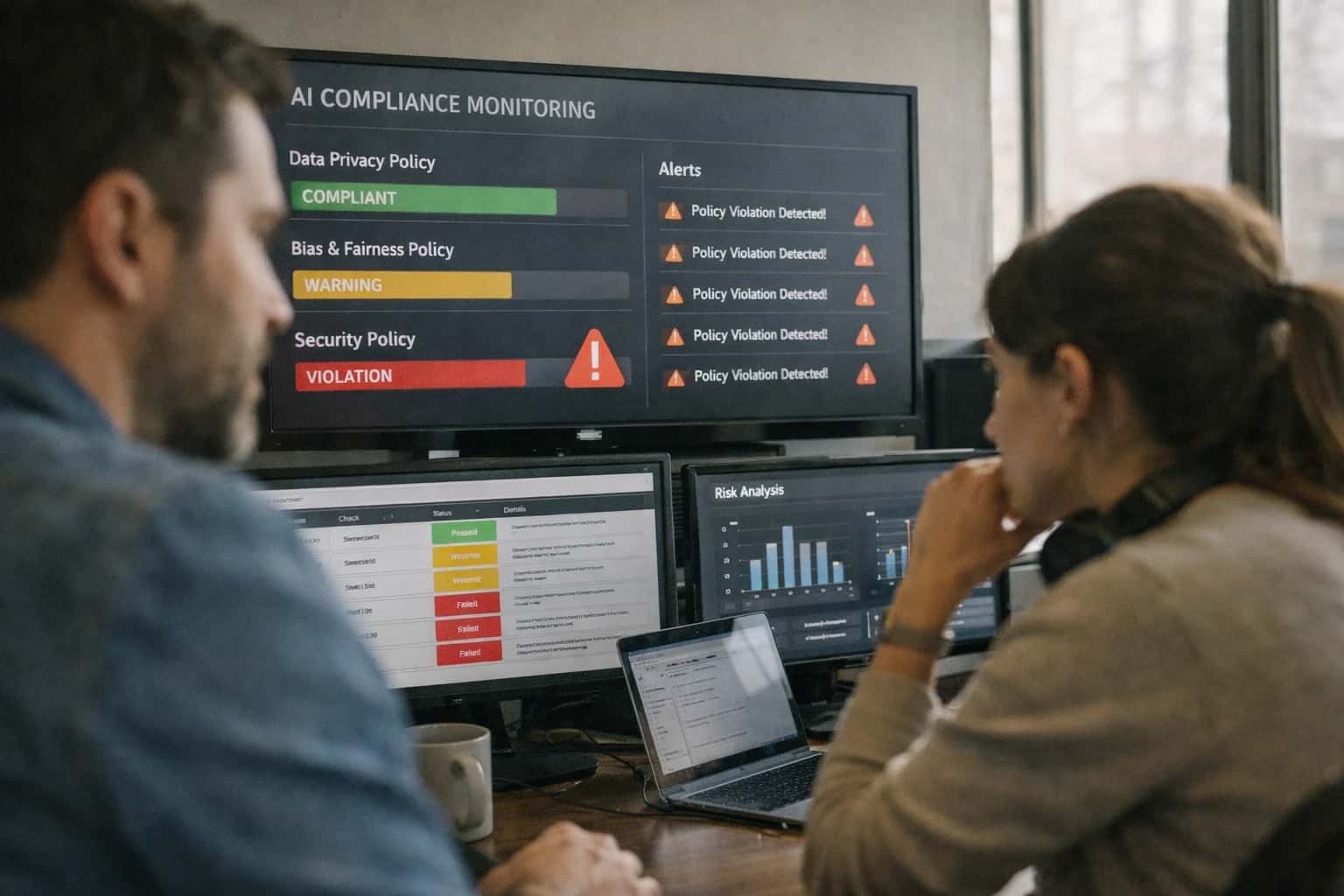
AGENT BEHAVIOR AUDITING
What is a Causal Action Graph?
A Causal Action Graph is a directed graph data structure used in agentic observability to model the cause-and-effect relationships between an autonomous agent's observations, internal states, decisions, and executed actions.
The graph's primary function is to establish action provenance and support forensic state reconstruction. By logging each node and edge, it creates an immutable, queryable record of why an action was taken. This is critical for compliance verification under frameworks like the EU AI Act, as it allows auditors to trace any final action back to its root causes. The graph differs from a simple audit trail by emphasizing the semantic relationships between logged events, not just their chronological sequence.
STRUCTURAL ELEMENTS
Core Components of a Causal Action Graph
A Causal Action Graph is a directed graph data structure that models the cause-and-effect relationships between an agent's observations, internal states, decisions, and executed actions. Its core components provide a formal, auditable representation of agentic behavior.
01
Nodes (Vertices)
Nodes represent the discrete states, events, or entities within the agent's operational lifecycle. Each node is a point-in-time snapshot of a specific condition.
- Observation Nodes: Represent raw sensory inputs or data received from the environment (e.g.,
sensor_reading=25.4,user_query="What is the forecast?"). - State Nodes: Represent the agent's internal, mutable condition at a given moment (e.g.,
working_memory={goal: 'book_flight'},belief_state={user_is_authenticated: true}). - Decision/Intent Nodes: Represent the selection of a specific goal, plan, or policy (e.g.,
selected_plan='Plan_A',inferred_intent='schedule_meeting'). - Action Nodes: Represent the execution of a concrete, observable operation (e.g.,
tool_call: 'execute_SQL_query',api_call: 'POST /transaction').
02
Edges (Directed Links)
Edges are the directed connections between nodes that explicitly model causality and temporal sequence. They answer "why" an event occurred.
- Causal Edges: Represent a direct cause-and-effect relationship (e.g.,
Observation: 'Low Battery'→Decision: 'Initiate Shutdown'). - Temporal Edges: Represent the chronological order of events, which may or may not imply direct causation.
- Conditional Edges: Represent dependencies where the effect occurs only if a specific condition is met at the source node.
- Probabilistic Edges: (In Bayesian variants) Represent causal relationships with an associated probability or strength, often derived from historical data.
03
Edge Attributes & Metadata
Each edge carries metadata that qualifies the nature of the causal relationship, providing essential context for auditing and analysis.
- Timestamp: Precise nanosecond timestamp of when the causal link was established or inferred.
- Confidence Score: A quantitative measure (e.g., 0.0 to 1.0) of the agent's certainty in the causal link.
- Triggering Rule/Policy: The identifier of the specific business rule, policy, or logical condition that authorized this causal step (e.g.,
policy_id: 'COMP-001'). - Evidence Reference: A pointer to the raw data or log entry that substantiates the edge's existence, enabling forensic verification.
04
Graph Root & Session Context
The root node anchors the graph to a specific execution context, providing the immutable starting conditions for causal analysis.
- Root Node: Typically contains the initial agent configuration, session ID, user identity, and the triggering prompt or event that initiated the agent's execution.
- Session Context: Metadata attached to the root, including environment variables, model version, deployment ID, and compliance framework tags (e.g.,
regulatory_scope: ['GDPR', 'HIPAA']). This context propagates through the graph, tagging all descendant nodes and edges.
05
Subgraphs & Hierarchical Decomposition
Complex actions are decomposed into subgraphs, creating a hierarchical structure that mirrors the agent's planning and task decomposition.
- Macro-Action Subgraph: A cluster of nodes and edges that collectively represent a single high-level action (e.g.,
'Process Invoice'). This subgraph has its own internal causal logic. - Tool Execution Subgraph: A specialized subgraph that models the detailed cause-and-effect within a single tool or API call, including pre-call validation, the request/response cycle, and post-call state updates.
- Reflection Loop Subgraph: A subgraph that captures the agent's self-evaluation and error correction cycles, showing how a prior state or output caused a re-planning or refinement decision.
06
Integrity & Verification Mechanisms
Components designed to ensure the graph is a tamper-evident, verifiable record of agentic causality.
- Cryptographic Hashes: Each node and edge contains a hash of its content and the hashes of its inbound edges. Altering any element breaks the chain.
- Merkle Tree Structure: The entire graph can be organized as a Merkle tree, where the root hash provides a single, verifiable fingerprint for the entire causal history.
- Attestation Signatures: Critical nodes (like action executions) can be signed by a trusted module or hardware security key, providing non-repudiation.
- Temporal Consistency Checks: Built-in validators ensure timestamps on edges follow a logical, non-decreasing sequence from the root to leaf nodes.
AGENT BEHAVIOR AUDITING
How a Causal Action Graph Works
A Causal Action Graph is a directed graph data structure used in agentic observability to model the cause-and-effect relationships between an autonomous agent's inputs, internal reasoning, decisions, and executed actions.
A Causal Action Graph is a directed graph where nodes represent discrete agent states, observations, decisions, and executed actions, while edges represent the causal dependencies between them. This structure provides a formal, machine-readable model of an agent's operational logic, enabling systematic audit trail analysis and forensic state reconstruction. It transforms a linear event log into a navigable network of provenance chains, explicitly showing why any action was taken.
During execution, each agent decision spawns new nodes and edges in the graph, creating a live map of its reasoning traceability. This allows engineers to perform root-cause analysis by traversing backwards from an outcome to its originating inputs or prompts. The graph is foundational for compliance checkpoint validation, deterministic execution proof, and detecting behavioral drift by comparing graph topologies over time against a known-good baseline.
CAUSAL ACTION GRAPH
Frequently Asked Questions
A Causal Action Graph is a foundational data structure for auditing autonomous agents. These questions address its core mechanics, applications, and role in enterprise observability.
A Causal Action Graph is a directed graph data structure that models the cause-and-effect relationships between an autonomous agent's observations, internal states, decisions, and executed actions. It provides a formal, auditable representation of an agent's behavior by explicitly linking actions (effects) back to the states, decisions, and external inputs (causes) that precipitated them. This creates a verifiable chain of provenance for every action an agent takes, which is essential for compliance, debugging, and understanding agent behavior in complex, multi-step tasks. Unlike a simple log or event stream, the graph enforces a structural relationship that makes causality explicit and queryable.
Enabling Efficiency, Speed & Accuracy
Intelligent Analysis, Decision & Execution
We build AI systems for teams that need search across company data, workflow automation across tools, or AI features inside products and internal software.
Talk to Us
Search across company data
Give teams answers from docs, tickets, runbooks, and product data with sources and permissions.
Useful when people spend too long searching or get different answers from different systems.
Enterprise searchRAGPermissions
Read more
Automate internal workflows
Use AI to route work, draft outputs, trigger actions, and keep approvals and logs in place.
Useful when repetitive work moves across multiple tools and teams.
AI agentsWorkflow automationGovernance
Read more
Add AI to products and internal tools
Build assistants, guided actions, or decision support into the software your team or customers already use.
Useful when AI needs to be part of the product, not a separate tool.
AI integrationDecision supportModel routing
Read more
About the author
Prasad Kumkar
CEO & MD, Inference Systems
Prasad Kumkar is the CEO & MD of Inference Systems and writes about AI systems architecture, LLM infrastructure, model serving, evaluation, and production deployment. Over 5+ years, he has worked across computer vision models, L5 autonomous vehicle systems, and LLM research, with a focus on taking complex AI ideas into real-world engineering systems.
His work and writing cover AI systems, large language models, AI agents, multimodal systems, autonomous systems, inference optimization, RAG, evaluation, and production AI engineering.
LinkedIn
Limited slotsGet a Free AI Consultation
Partnered with leading AI, data, and software stack.





How We Work
Custom AI workflows for your Business
One-fit-all AI don't work for modern businesses. At Inferensys, we aim to understand your business & custom requirements; which we use to define most efficient agentic workflows, the data, and the tools for your business.
01
Review the use case
We understand the task, the users, and where AI can actually help.
Read more02
Pick the right approach
We define what needs search, automation, or product integration.
Read more03
Build the first useful version
We implement the part that proves the value first.
Read more04
Improve from there
We add the checks and visibility needed to keep it useful.
Read moreThe first call is a practical review of your use case and the right next step.
Talk to Us