A Temporal Context Window is a bounded interval of past (and sometimes future) events that an autonomous system considers relevant for processing its current state or making a prediction. It functions as a rolling buffer or lookback period, defining the scope of the event stream or sequential memory that informs immediate reasoning. This window is a critical parameter in models like transformers, where temporal attention mechanisms weight the importance of information within it.

Glossary
Temporal Context Window
A bounded interval of past (and sometimes future) events that is considered relevant for processing the current state or making a prediction in autonomous AI systems.
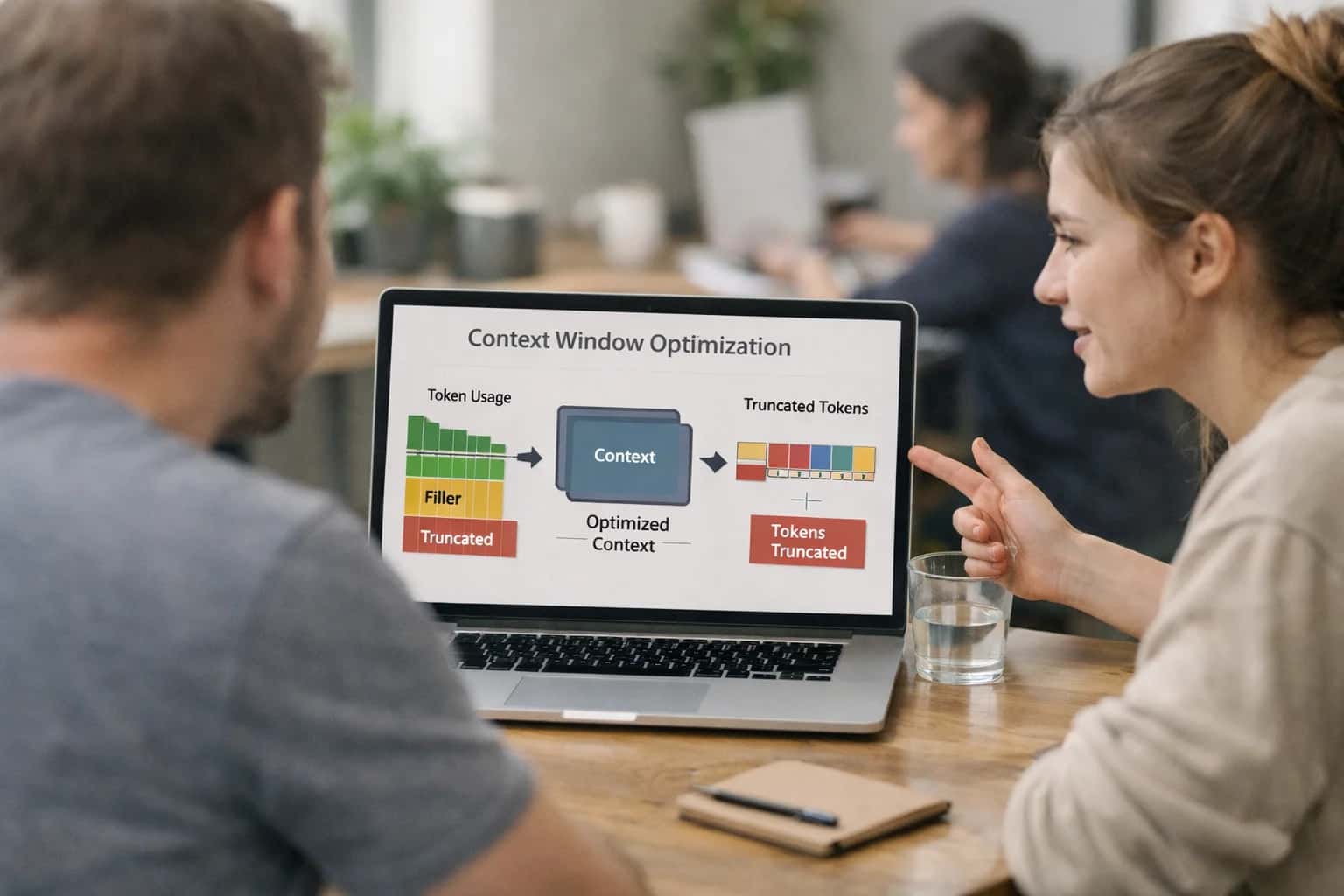
GLOSSARY
What is a Temporal Context Window?
A core concept in agentic memory and temporal reasoning, defining the relevant slice of past events for current decision-making.
Managing this window involves temporal chunking of experiences and time-aware retrieval from memory stores. In production systems, it is often implemented using a sequential buffer for short-term context and integrated with a time-series database (TSDB) or vector store for long-term, indexed recall. Effective window sizing balances computational constraints with the need for sufficient historical context to establish temporal dependencies and event causality.
TEMPORAL MEMORY SEQUENCING
Key Characteristics of Temporal Context Windows
A Temporal Context Window is a bounded interval of past (and sometimes future) events considered relevant for processing the current state or making a prediction. It is a core mechanism for managing sequential information in autonomous systems.
01
Fixed vs. Sliding Windows
Temporal context windows are implemented as either fixed or sliding intervals. A fixed window analyzes a predetermined, contiguous block of time (e.g., the last 24 hours of sensor data). A sliding window moves incrementally over a sequence, dropping the oldest data point and adding the newest with each step, which is essential for real-time stream processing and maintaining a rolling view of recent history.
02
Temporal Locality & Recency Bias
These windows operationalize the principle of temporal locality, where recently observed events are statistically more likely to be relevant to the immediate future. Systems often apply a recency bias, weighting newer information more heavily within the window. This is analogous to cache policies in computer architecture and is implemented in models using mechanisms like decaying attention scores or explicit time-based filters in retrieval.
03
Granularity and Resolution
The temporal granularity defines the resolution of the window—whether it segments time into milliseconds, seconds, days, or years. Choosing the correct granularity is critical:
- Fine granularity (e.g., microseconds) captures high-frequency patterns for algorithmic trading or signal processing.
- Coarse granularity (e.g., months) is used for trend analysis in business intelligence. Mismatched granularity can lead to aliasing, where high-frequency signals are lost, or excessive noise in the data.
04
Window Size and the Bias-Variance Trade-off
Selecting the window size involves a direct bias-variance trade-off. A small window has low bias (closely fits recent data) but high variance (is noisy and sensitive to short-term fluctuations). A large window has low variance (produces stable estimates) but high bias (may be slow to adapt to new trends or regime shifts). Optimal size is determined empirically for the task, balancing responsiveness with stability.
05
Overlap and Stride
For sliding windows, two key parameters control data sampling:
- Overlap: The amount of data shared between consecutive window positions. High overlap increases computational cost but provides smoother, more detailed temporal analysis.
- Stride: The step size by which the window advances. A stride of 1 processes every new data point, while a larger stride subsamples the sequence, reducing compute. These parameters are tuned based on the required temporal resolution versus available computational budget.
06
Integration with Model Architectures
Temporal context windows are fundamental to sequential models. Recurrent Neural Networks (RNNs) and Long Short-Term Memory (LSTM) networks have an implicit window defined by their hidden state's retention. Transformers use an explicit context window limit (e.g., 128K tokens) and employ temporal attention to weight past tokens. In agentic systems, this window is often managed externally via a sequential buffer that feeds curated recent history into the model's fixed input context.
TEMPORAL CONTEXT WINDOW
How It Works in Autonomous Agents
A Temporal Context Window is a bounded interval of past (and sometimes future) events that an autonomous agent considers relevant for processing its current state or making a prediction. It functions as a sliding, time-aware filter over the agent's memory and incoming data streams.
In autonomous agents, the temporal context window is a core mechanism for state management. It dynamically defines which past observations, actions, and environmental states are retrieved from memory and fed into the agent's reasoning engine at any given moment. This window slides forward with the agent's progression, ensuring the computational focus remains on the most temporally relevant information for the immediate task, such as navigating the next step in a plan or responding to a recent event.
Engineering this window involves time-aware retrieval from memory systems like vector databases or sequential buffers. The window's size and the weighting of items within it—often managed by temporal attention mechanisms—are critical hyperparameters. A properly configured window prevents cognitive overload by filtering out stale data while retaining essential sequential context, enabling coherent temporal reasoning over event chains without exceeding the fixed context limits of underlying models like Large Language Models (LLMs).
TEMPORAL CONTEXT WINDOW
Frequently Asked Questions
A Temporal Context Window is a bounded interval of past (and sometimes future) events considered relevant for processing the current state or making a prediction. This FAQ addresses its core mechanisms, engineering trade-offs, and role in autonomous systems.
A Temporal Context Window is a bounded interval of past (and sometimes future) events that is considered relevant for processing the current state or making a prediction. It acts as a sliding filter over a continuous event stream, determining which historical data points are loaded into a model's active working memory for inference. This concept is critical for systems that process sequential data, such as Large Language Models (LLMs) with fixed token limits, time-series forecasting models, and autonomous agents that must maintain situational awareness over extended operations. The window defines the operational 'horizon' of an agent's immediate recall, balancing computational feasibility with the need for sufficient historical context to make informed decisions.
Enabling Efficiency, Speed & Accuracy
Intelligent Analysis, Decision & Execution
We build AI systems for teams that need search across company data, workflow automation across tools, or AI features inside products and internal software.
Talk to Us
Search across company data
Give teams answers from docs, tickets, runbooks, and product data with sources and permissions.
Useful when people spend too long searching or get different answers from different systems.
Enterprise searchRAGPermissions
Read more
Automate internal workflows
Use AI to route work, draft outputs, trigger actions, and keep approvals and logs in place.
Useful when repetitive work moves across multiple tools and teams.
AI agentsWorkflow automationGovernance
Read more
Add AI to products and internal tools
Build assistants, guided actions, or decision support into the software your team or customers already use.
Useful when AI needs to be part of the product, not a separate tool.
AI integrationDecision supportModel routing
Read more
About the author
Prasad Kumkar
CEO & MD, Inference Systems
Prasad Kumkar is the CEO & MD of Inference Systems and writes about AI systems architecture, LLM infrastructure, model serving, evaluation, and production deployment. Over 5+ years, he has worked across computer vision models, L5 autonomous vehicle systems, and LLM research, with a focus on taking complex AI ideas into real-world engineering systems.
His work and writing cover AI systems, large language models, AI agents, multimodal systems, autonomous systems, inference optimization, RAG, evaluation, and production AI engineering.
LinkedIn
Limited slotsGet a Free AI Consultation
Partnered with leading AI, data, and software stack.





How We Work
Custom AI workflows for your Business
One-fit-all AI don't work for modern businesses. At Inferensys, we aim to understand your business & custom requirements; which we use to define most efficient agentic workflows, the data, and the tools for your business.
01
Review the use case
We understand the task, the users, and where AI can actually help.
Read more02
Pick the right approach
We define what needs search, automation, or product integration.
Read more03
Build the first useful version
We implement the part that proves the value first.
Read more04
Improve from there
We add the checks and visibility needed to keep it useful.
Read moreThe first call is a practical review of your use case and the right next step.
Talk to Us