A state transition is the change of a system—such as an autonomous agent or a software process—from one defined operational condition to another, triggered by an event or the satisfaction of a specific condition. This mechanism is formally modeled by a finite state machine (FSM), where the system's behavior is governed by a set of states, a set of possible transitions between them, and the rules that trigger those changes. In agentic systems, a transition often executes an action or updates the agent's internal context.

Glossary
State Transition
A state transition is the change of an agent from one defined operational state to another, triggered by an event or condition within a state machine.
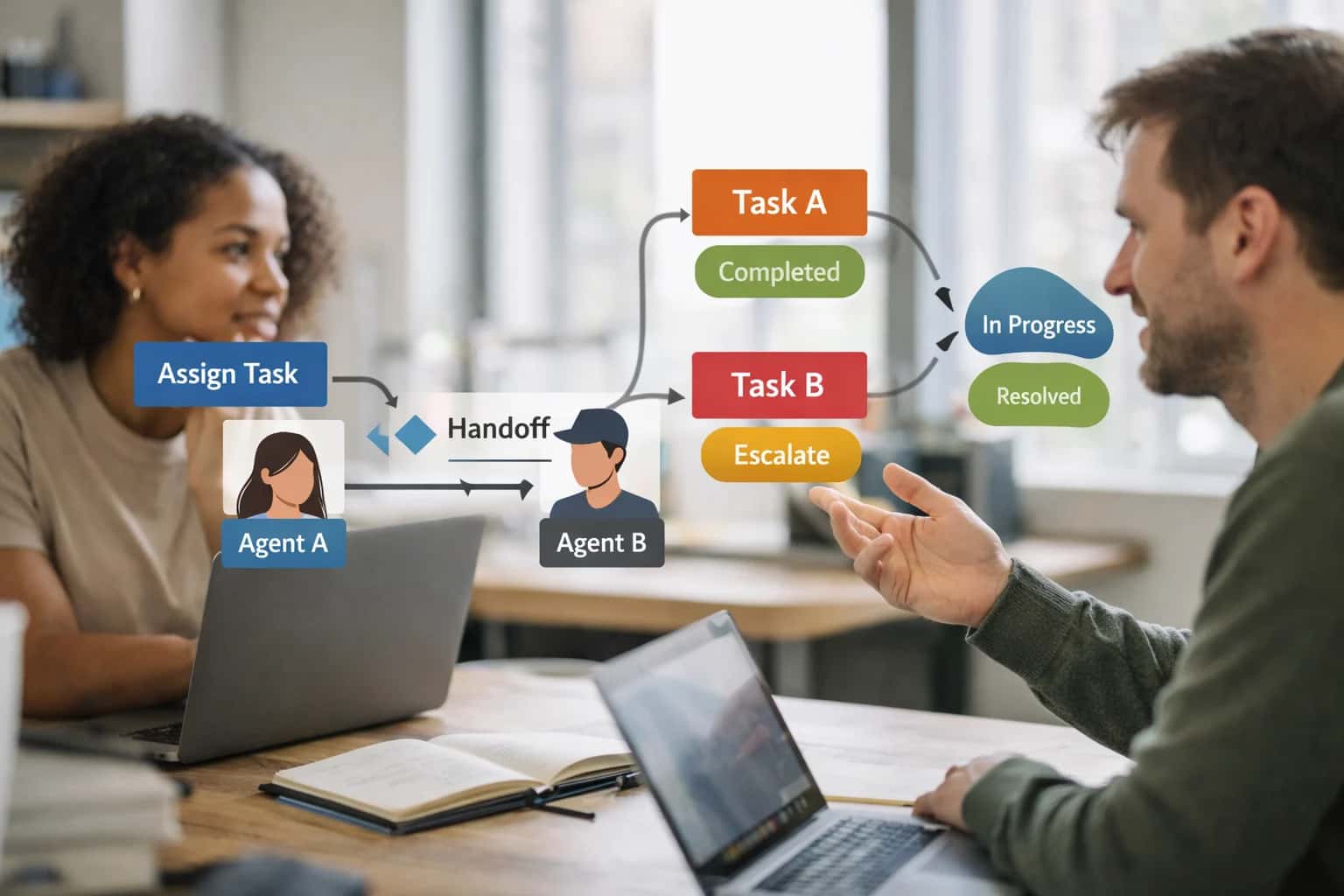
STATE MANAGEMENT FOR AGENTS
What is a State Transition?
A core concept in computer science and autonomous agent design, a state transition defines how a system changes in response to events.
For autonomous agents, managing state transitions is critical for deterministic, long-running workflows. Transitions are driven by events like user input, API responses, or internal reasoning cycles. Engineers implement this using state management protocols to ensure consistency, enable checkpointing for recovery, and support complex behaviors like rollback and synchronization in multi-agent systems. This forms the basis for reliable, auditable agentic operations.
STATE MANAGEMENT FOR AGENTS
Core Components of a State Transition
A state transition is the fundamental atomic operation within an agent's state machine. It is defined by a precise set of components that govern how and when an agent moves from one operational condition to another.
01
Source State
The source state is the defined operational condition from which a transition originates. It represents a stable, valid configuration of the agent's internal variables and context.
- It is a member of a finite set of possible states defined in the agent's state machine.
- The agent must be actively in this state for a transition to be eligible for triggering.
- The source state often has associated entry actions (executed when entering) and exit actions (executed when leaving).
02
Triggering Event
A triggering event is an external or internal occurrence that initiates the evaluation of a possible state transition. It is the catalyst for change.
- External Events: User input, API calls, messages from other agents, or sensor data.
- Internal Events: Completion of a subtask, a timer expiration, or a condition becoming true within the agent's own reasoning loop.
- The event carries a payload of data that can be used by guard conditions and transition actions.
03
Guard Condition
A guard condition is a boolean predicate that must evaluate to true for the transition to be taken. It acts as a gatekeeper, adding logical constraints beyond the mere occurrence of an event.
- Evaluates the event payload and the current agent state.
- Examples:
IF user_is_authenticated,IF inventory_count > 0,IF confidence_score >= 0.8. - If multiple transitions from a state are triggered by the same event, guard conditions determine which path is taken, enabling complex decision logic.
04
Transition Action
The transition action is the side-effect-producing code or procedure executed during the transition, after the source state's exit actions and before the target state's entry actions.
- It performs the actual work associated with the state change.
- Actions can include: updating internal variables, calling external tools or APIs, sending messages, or logging data.
- In frameworks, this is often a pure function that takes the current state and event payload and returns an updated state.
05
Target State
The target state is the defined operational condition to which the agent moves upon successful completion of the transition. It becomes the new source state for subsequent transitions.
- It must be a valid, defined state within the agent's state machine.
- The transition is not considered complete until the agent is fully operational in the target state, which may involve executing its entry actions.
- A target state can be the same as the source state, creating a self-transition often used for processing events without changing operational mode.
06
State Machine Context
The state machine context is the persistent data structure that holds the agent's extended state—variables, history, and session data—which is read and modified during transitions.
- This is distinct from the finite state itself, which is often just a label or enum.
- The context is passed to guard conditions and actions.
- It is the primary object that is serialized for persistence, checkpointed for recovery, and synchronized in distributed systems. Its integrity is critical for deterministic agent behavior.
STATE TRANSITION
Frequently Asked Questions
A state transition is the change of an agent from one defined state to another within a state machine, typically triggered by an event or condition. This glossary addresses common technical questions about implementing and managing state transitions in autonomous agent systems.
A state transition is the change of an autonomous agent from one defined operational state to another within a finite state machine (FSM), triggered by a specific event or the satisfaction of a predefined condition. This mechanism is fundamental to deterministic agent behavior, moving the system between discrete states like IDLE, PROCESSING, AWAITING_INPUT, or ERROR. The transition logic is typically encapsulated in a transition function that maps the current state and an input event to the next state and an optional output action. For example, an agent's transition from SEARCHING to ANALYZING might be triggered by the event QUERY_RESULTS_RECEIVED.
Enabling Efficiency, Speed & Accuracy
Intelligent Analysis, Decision & Execution
We build AI systems for teams that need search across company data, workflow automation across tools, or AI features inside products and internal software.
Talk to Us
Search across company data
Give teams answers from docs, tickets, runbooks, and product data with sources and permissions.
Useful when people spend too long searching or get different answers from different systems.
Enterprise searchRAGPermissions
Read more
Automate internal workflows
Use AI to route work, draft outputs, trigger actions, and keep approvals and logs in place.
Useful when repetitive work moves across multiple tools and teams.
AI agentsWorkflow automationGovernance
Read more
Add AI to products and internal tools
Build assistants, guided actions, or decision support into the software your team or customers already use.
Useful when AI needs to be part of the product, not a separate tool.
AI integrationDecision supportModel routing
Read more
About the author
Prasad Kumkar
CEO & MD, Inference Systems
Prasad Kumkar is the CEO & MD of Inference Systems and writes about AI systems architecture, LLM infrastructure, model serving, evaluation, and production deployment. Over 5+ years, he has worked across computer vision models, L5 autonomous vehicle systems, and LLM research, with a focus on taking complex AI ideas into real-world engineering systems.
His work and writing cover AI systems, large language models, AI agents, multimodal systems, autonomous systems, inference optimization, RAG, evaluation, and production AI engineering.
LinkedIn
Limited slotsGet a Free AI Consultation
Partnered with leading AI, data, and software stack.





How We Work
Custom AI workflows for your Business
One-fit-all AI don't work for modern businesses. At Inferensys, we aim to understand your business & custom requirements; which we use to define most efficient agentic workflows, the data, and the tools for your business.
01
Review the use case
We understand the task, the users, and where AI can actually help.
Read more02
Pick the right approach
We define what needs search, automation, or product integration.
Read more03
Build the first useful version
We implement the part that proves the value first.
Read more04
Improve from there
We add the checks and visibility needed to keep it useful.
Read moreThe first call is a practical review of your use case and the right next step.
Talk to Us