Semantic chunking is the process of segmenting a document into coherent units based on contextual meaning and topic boundaries, rather than arbitrary character or token counts. This method contrasts with naive approaches like fixed-size splitting, aiming to keep logically related information together. The goal is to optimize the relevance of retrieved information for large language models (LLMs) by ensuring each chunk is a self-contained, meaningful unit, which improves the accuracy of semantic search and the quality of generated responses.

Glossary
Semantic Chunking
Semantic chunking is the process of segmenting a document into coherent units based on contextual meaning and topic boundaries, rather than arbitrary character or token counts, to optimize retrieval for language models.
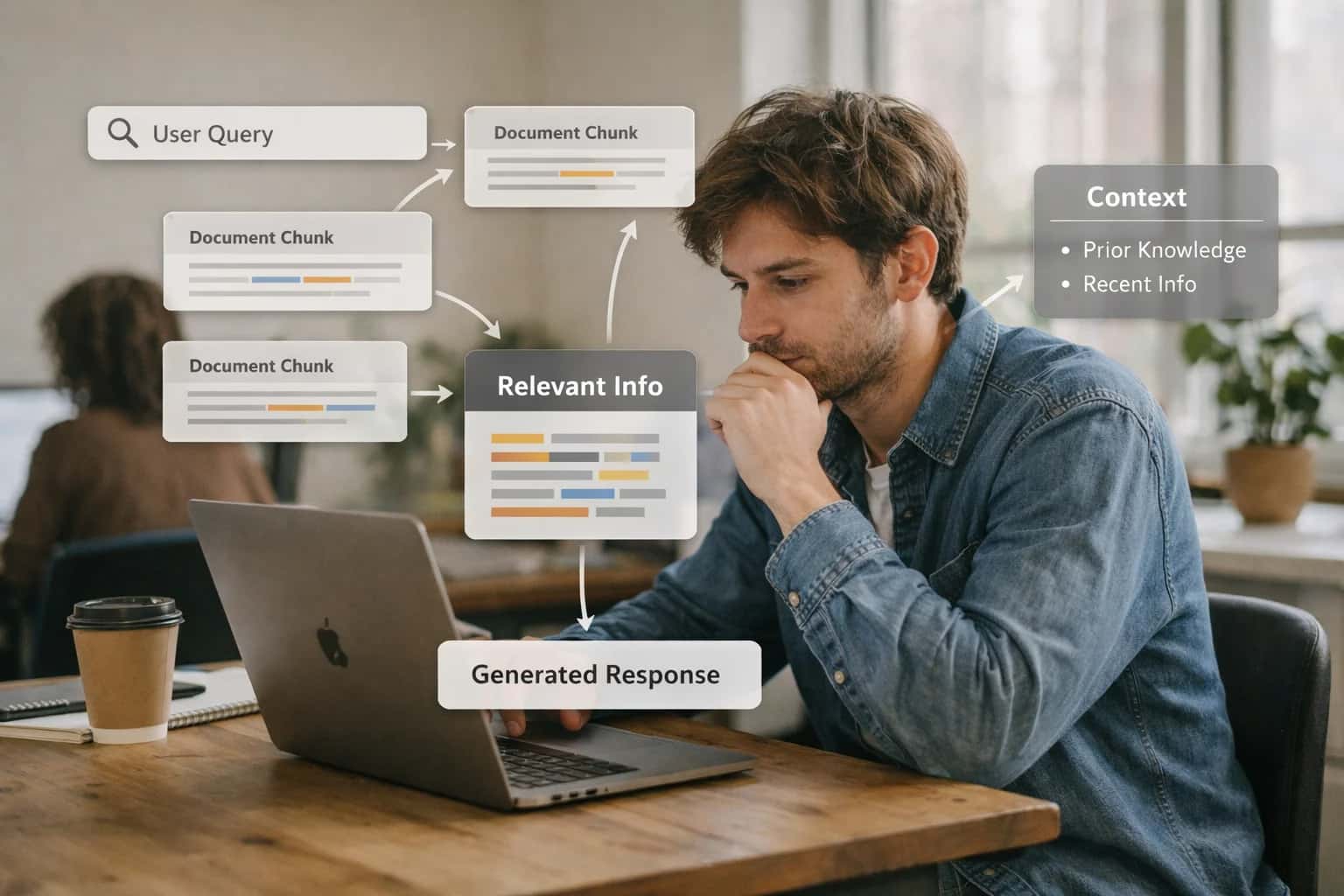
SEMANTIC INDEXING AND CHUNKING
What is Semantic Chunking?
Semantic chunking is a foundational technique in retrieval-augmented generation (RAG) and agentic memory systems for intelligently segmenting documents.
Common techniques include recursive character text splitting using separators (e.g., paragraphs, sentences), markdown header splitting to follow document structure, and advanced methods like embedding-based chunking which uses models like Sentence-BERT to identify semantic shifts. Effective chunking is critical for vector store performance, balancing chunk size for embedding quality with the need to preserve context, directly impacting retrieval-augmented generation (RAG) system accuracy and reducing hallucinations.
ENGINEERING METHODS
Key Semantic Chunking Techniques
Semantic chunking moves beyond simple character or token limits. These techniques segment text based on its inherent meaning and structure to optimize retrieval for language models and search systems.
01
Recursive Character Text Splitting
This algorithm uses a hierarchy of separators (e.g., \n\n, \n, . , ) to recursively split text until chunks are within a target size range. It prioritizes larger semantic units first, like paragraphs, before breaking them down further.
- Primary Use: General-purpose chunking where document structure is varied or unknown.
- Key Benefit: Balances semantic coherence with strict size constraints for fixed-context windows.
- Implementation: Libraries like LangChain and LlamaIndex provide configurable recursive splitters.
02
Semantic Boundary Detection
This technique identifies natural topic shifts within text to create chunks where internal content is maximally cohesive. It often uses sentence embeddings to measure similarity between adjacent blocks of text.
- Core Mechanism: Calculates cosine similarity between embedding vectors of sequential sentences or paragraphs. A significant drop indicates a likely topic boundary.
- Advantage: Produces chunks that align with the document's conceptual flow, not arbitrary length.
- Tool Example: The
semantic-text-splitterPython library implements this approach.
03
Content-Aware Splitting
This method leverages explicit document structure and markup to guide segmentation. It respects the author's intended organization.
- Markdown/HTML Header Splitting: Chunks are created at heading tags (
<h1>,#,##), producing sections that mirror the document outline. - Code Syntax Splitting: For technical documentation, splits can occur at function/class definitions or logical code blocks.
- Benefit: Preserves high-level semantic context and hierarchical relationships, which is critical for accurate retrieval.
04
Sliding Window with Overlap
A fixed-size window moves across the text, creating chunks with a specified character or token overlap between consecutive segments.
- Primary Use: Mitigating context fragmentation, where a key piece of information is cut in half at a chunk boundary.
- How it Works: A 1000-token window with a 200-token overlap ensures 200 tokens of context are repeated in the next chunk, preserving continuity.
- Trade-off: Increases total number of chunks and potential retrieval redundancy, which must be managed by downstream ranking.
05
Entity-Aware Chunking
This strategy uses Named Entity Recognition (NER) to inform split decisions, aiming to keep all mentions of a specific entity (person, organization, location) within a single chunk.
- Objective: Preserve the full contextual narrative around an entity for downstream tasks like question answering or relationship extraction.
- Process: The chunker analyzes entity density and proximity; it will avoid splitting text between closely clustered mentions of the same entity.
- Result: Improves the likelihood that a retrieved chunk contains complete information about a queried subject.
06
Algorithmic Text Segmentation
Classical NLP algorithms designed specifically for detecting topical boundaries in unstructured text.
- TextTiling Algorithm: An unsupervised method that analyzes patterns of lexical cohesion (term co-occurrence) across a moving window. It identifies 'valleys' in similarity scores as segment boundaries.
- C99 Algorithm: A linear segmentation algorithm that uses a rank matrix of sentences to identify coherent segments.
- Use Case: Effective for segmenting long-form narratives, transcripts, or articles where explicit structural markers are absent.
ALGORITHM OVERVIEW
How Semantic Chunking Works
Semantic chunking is the process of segmenting a document into coherent units based on contextual meaning and topic boundaries, rather than arbitrary character or token counts, to optimize the relevance of retrieved information for language models.
Semantic chunking algorithms analyze text to identify natural topic shifts, segmenting content where meaning changes. Unlike naive methods that split by fixed token windows, semantic approaches use techniques like embedding similarity, lexical cohesion analysis (e.g., TextTiling), or structural parsing (e.g., Markdown headers). The goal is to create self-contained chunks where internal sentences are semantically related, preserving context for downstream Retrieval-Augmented Generation (RAG) systems. This prevents information fragmentation and improves retrieval precision.
Implementation typically involves embedding sentences or paragraphs using models like Sentence-BERT and calculating cosine similarity between sequential units. A significant drop in similarity indicates a potential chunk boundary. Advanced methods incorporate named entity recognition to keep entity mentions together or use semantic role labeling for deeper understanding. The resulting chunks are then indexed in a vector store for efficient semantic search, forming the foundation for accurate, context-aware agentic memory and knowledge retrieval.
SEMANTIC CHUNKING
Frequently Asked Questions
Semantic chunking is the process of segmenting a document into coherent units based on the contextual meaning and topic boundaries, rather than arbitrary character or token counts, to optimize the relevance of retrieved information for language models. This glossary addresses common technical questions about its implementation and role in agentic systems.
Semantic chunking is the process of segmenting a document into coherent units based on the contextual meaning and topic boundaries, rather than arbitrary character or token counts. It works by analyzing the text's structure and content to identify natural breakpoints where the subject matter shifts, using techniques like sentence boundary detection, embedding similarity analysis, or lexical cohesion algorithms like TextTiling. The goal is to produce chunks where the internal content is semantically cohesive, which dramatically improves the precision of semantic search in Retrieval-Augmented Generation (RAG) systems by ensuring retrieved passages are self-contained and contextually relevant.
Enabling Efficiency, Speed & Accuracy
Intelligent Analysis, Decision & Execution
We build AI systems for teams that need search across company data, workflow automation across tools, or AI features inside products and internal software.
Talk to Us
Search across company data
Give teams answers from docs, tickets, runbooks, and product data with sources and permissions.
Useful when people spend too long searching or get different answers from different systems.
Enterprise searchRAGPermissions
Read more
Automate internal workflows
Use AI to route work, draft outputs, trigger actions, and keep approvals and logs in place.
Useful when repetitive work moves across multiple tools and teams.
AI agentsWorkflow automationGovernance
Read more
Add AI to products and internal tools
Build assistants, guided actions, or decision support into the software your team or customers already use.
Useful when AI needs to be part of the product, not a separate tool.
AI integrationDecision supportModel routing
Read more
About the author
Prasad Kumkar
CEO & MD, Inference Systems
Prasad Kumkar is the CEO & MD of Inference Systems and writes about AI systems architecture, LLM infrastructure, model serving, evaluation, and production deployment. Over 5+ years, he has worked across computer vision models, L5 autonomous vehicle systems, and LLM research, with a focus on taking complex AI ideas into real-world engineering systems.
His work and writing cover AI systems, large language models, AI agents, multimodal systems, autonomous systems, inference optimization, RAG, evaluation, and production AI engineering.
LinkedIn
Limited slotsGet a Free AI Consultation
Partnered with leading AI, data, and software stack.





How We Work
Custom AI workflows for your Business
One-fit-all AI don't work for modern businesses. At Inferensys, we aim to understand your business & custom requirements; which we use to define most efficient agentic workflows, the data, and the tools for your business.
01
Review the use case
We understand the task, the users, and where AI can actually help.
Read more02
Pick the right approach
We define what needs search, automation, or product integration.
Read more03
Build the first useful version
We implement the part that proves the value first.
Read more04
Improve from there
We add the checks and visibility needed to keep it useful.
Read moreThe first call is a practical review of your use case and the right next step.
Talk to Us