Query-aware chunking is a dynamic document segmentation strategy where the granularity or boundaries of text chunks are optimized at retrieval time based on the specific information need expressed in a user's query. Unlike static methods like semantic chunking or recursive character text splitting, it treats chunking as a retrieval-time optimization problem. The core mechanism involves re-evaluating or re-segmenting source documents—or their pre-computed embeddings—to create query-specific chunks that maximize the relevance of the information passed to a large language model in a retrieval-augmented generation pipeline.

Glossary
Query-Aware Chunking
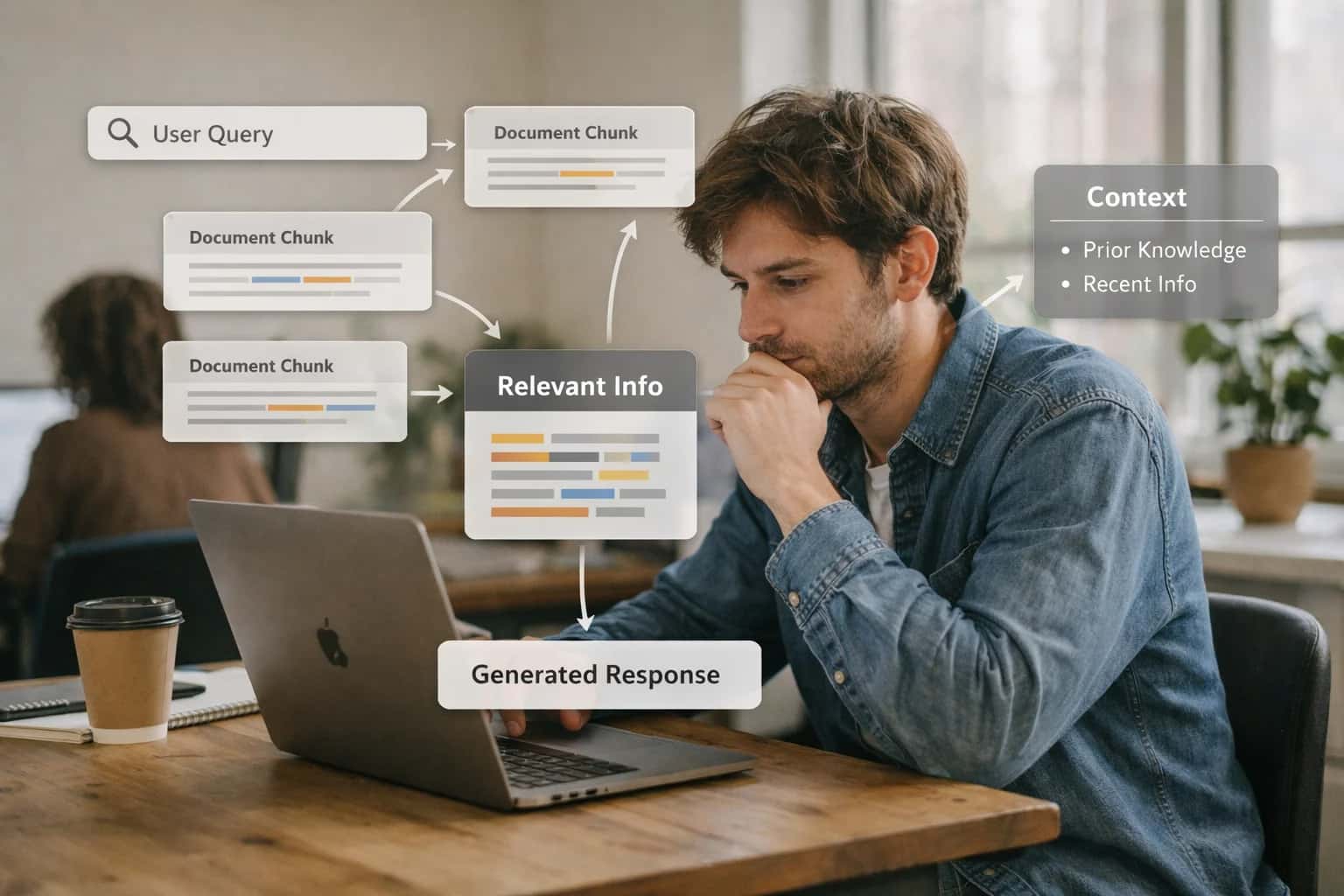
Query-aware chunking is a dynamic document segmentation approach where text splitting is optimized at retrieval time based on the specific information need expressed in a user's query.
SEMANTIC INDEXING AND CHUNKING
What is Query-Aware Chunking?
A dynamic document segmentation technique that optimizes retrieval for specific user queries.
This approach directly addresses the inherent tension in static chunking between chunk size and semantic coherence. A small, fixed chunk may miss broader context, while a large chunk can dilute key information. By dynamically adjusting, systems can retrieve a precise, self-contained answer. Implementation often involves techniques like embedding-based chunking with a sliding window re-scored by query similarity, or using a secondary model to identify the optimal segment boundaries given the query. It is a key technique within agentic memory and context management for improving answer precision.
DYNAMIC SEGMENTATION
Key Characteristics of Query-Aware Chunking
Query-aware chunking is a dynamic segmentation approach where document splitting is optimized or re-evaluated at retrieval time based on the specific information need expressed in a user's query. Unlike static chunking, it adapts the granularity and boundaries of text units to maximize relevance for each unique search.
01
Dynamic vs. Static Segmentation
The core distinction from traditional methods. Static chunking (e.g., recursive character splitting) segments documents once, offline, using fixed rules like token count or paragraph breaks. Query-aware chunking is a dynamic, on-the-fly process. It uses the query's intent to re-segment or select from pre-computed candidate chunks, ensuring the retrieved context is optimally sized and focused for the specific question.
- Static Example: A 10k-token document is pre-chunked into ten 1k-token segments.
- Dynamic Example: For the query "What was the cause of Event X?", the system identifies and retrieves the specific 500-token section discussing causality, ignoring adjacent administrative details.
02
Query-Dependent Chunk Granularity
The system adjusts the chunk size and semantic scope based on query complexity. A broad, overview query (e.g., "Summarize this paper") may trigger retrieval of larger, section-level chunks. A precise, factual query (e.g., "What is the value of constant Y on page 5?") triggers retrieval of much smaller, sentence or paragraph-level chunks to minimize noise.
This requires either:
- Multi-granular indexing: Storing the same content chunked at different sizes (e.g., sentence, paragraph, section).
- On-demand re-segmentation: Using the query to guide a real-time splitting algorithm on the raw text or a larger pre-chunk.
03
Semantic Boundary Optimization
Instead of splitting at arbitrary token limits, splits are made at semantically coherent boundaries informed by the query. This leverages NLP techniques to understand where topics shift.
Key techniques include:
- Embedding-based coherence scoring: Measuring cosine similarity between sentences; a significant drop indicates a topic shift and a potential chunk boundary.
- Entity tracking: Using Named Entity Recognition (NER) to avoid splitting chunks in the middle of a discussion about a key entity mentioned in the query.
- Syntax-aware splitting: Preferring splits at clause or sentence boundaries rather than mid-phrase.
04
Integration with Retrieval Scoring
Query-aware chunking is tightly coupled with the retrieval mechanism. The chunking process itself can be influenced by preliminary retrieval scores.
A common pattern is a two-stage process:
- Candidate Retrieval: Fetch a set of potentially relevant, coarsely-chunked documents or large sections using a fast index (e.g., BM25 or a dense vector index).
- Dynamic Re-chunking & Reranking: Within each top candidate, dynamically re-segment content around query terms or high-similarity regions. These new, query-focused chunks are then scored more accurately for final ranking.
This moves beyond simply retrieving pre-defined chunks to actively shaping the retrieval unit for precision.
05
Overlap and Context Preservation
To mitigate the risk of splitting critical context, query-aware strategies often employ intelligent overlap. Unlike the fixed-size overlap in sliding window approaches, the overlap is contextually determined.
- If a query term appears near the end of a semantic unit, the chunk may be extended to include the beginning of the next unit to preserve explanatory context.
- The system may create variable-sized overlapping chunks centered on high-relevance regions identified by the query, ensuring that related antecedents or consequents are included.
This ensures that retrieved chunks are self-contained enough for the LLM to interpret correctly, reducing context fragmentation.
06
Computational Trade-offs and Caching
The primary trade-off is between retrieval precision and computational latency. Dynamically chunking for every query is more expensive than fetching pre-indexed chunks.
Engineering optimizations include:
- Hybrid Caching: Storing frequently accessed query-chunk pairs or pre-computed embeddings for common query patterns.
- Approximate Pre-chunking: Creating a hierarchy of chunks (e.g., via semantic chunking or markdown header splitting) and then selecting the most appropriate level at query time, which is faster than full re-segmentation.
- Efficient Boundary Detection: Using lightweight models or algorithms (like TextTiling) for real-time semantic boundary detection rather than full document re-embedding.
The goal is to minimize added latency while maximizing the relevance gain from dynamic adaptation.
DYNAMIC SEGMENTATION
How Query-Aware Chunking Works
Query-aware chunking is a dynamic retrieval-time segmentation strategy that optimizes document splitting based on a specific user query.
Query-aware chunking is a dynamic document segmentation approach where the splitting of source material is optimized or re-evaluated at retrieval time based on the specific information need expressed in a user's query. Unlike static methods that create fixed chunks during indexing, this technique adapts chunk boundaries to maximize the relevance of the retrieved context for a given question. It is a core component of advanced Retrieval-Augmented Generation (RAG) architectures aiming to improve answer precision by retrieving more focused information.
The process typically involves an initial coarse indexing of the source corpus. Upon receiving a query, the system performs a first-pass retrieval to identify relevant regions. It then applies a more granular, query-informed segmentation algorithm—such as re-splitting text around detected named entities or semantic role structures mentioned in the query—to extract optimal context. This method directly addresses the limitations of pre-defined chunks, which may split critical information across boundaries, thereby enhancing the semantic coherence of the context provided to the language model for generation.
CHUNKING STRATEGIES
Query-Aware vs. Static Chunking: A Technical Comparison
A feature-by-feature comparison of dynamic, query-aware segmentation against traditional static chunking methods, highlighting architectural trade-offs for retrieval-augmented generation systems.
| Feature / Metric | Query-Aware Chunking | Static Chunking |
|---|---|---|
Chunking Granularity | Dynamic, query-dependent | Fixed, pre-determined |
Retrieval Context Preservation | High (chunks optimized for query semantics) | Variable (depends on initial split quality) |
Computational Overhead at Index Time | Low to none | Low |
Computational Overhead at Query Time | High (requires on-the-fly segmentation or re-ranking) | None |
Index Storage Footprint | Typically larger (stores multiple chunking strategies or raw text) | Smaller (stores only pre-computed chunks) |
Optimal For | Complex, multi-faceted queries; high-recall scenarios | Simple, predictable queries; low-latency requirements |
Integration Complexity | High (requires tight coupling of retriever and chunker) | Low (decoupled pipeline) |
Handling of Long Documents | Excellent (can re-segment based on query focus) | Poor (fixed chunks may miss cross-boundary context) |
Resilience to Query Formulation | High (semantic understanding mitigates keyword mismatch) | Low (relies on lexical overlap within static chunks) |
Common Implementation Pattern | Re-ranking of sentence-windows, dynamic boundary prediction | Recursive character splitting, fixed-size sliding windows |
QUERY-AWARE CHUNKING
Frequently Asked Questions
Query-aware chunking is a dynamic segmentation approach where document splitting is optimized or re-evaluated at retrieval time based on the specific information need expressed in a user's query. This FAQ addresses its core mechanisms, trade-offs, and implementation.
Query-aware chunking is a dynamic document segmentation strategy where the boundaries of text chunks are determined or adjusted at retrieval time based on the semantic content of a user's specific query. Unlike static methods like recursive character text splitting that create fixed chunks offline, this approach evaluates the query against the source document to identify the most semantically coherent unit of text that answers the information need. It works by using the query as a guide to re-segment or select from pre-computed candidate chunks, often employing embedding similarity or attention mechanisms to find optimal start and end points that maximize relevance for the retrieval-augmented generation (RAG) pipeline.
Enabling Efficiency, Speed & Accuracy
Intelligent Analysis, Decision & Execution
We build AI systems for teams that need search across company data, workflow automation across tools, or AI features inside products and internal software.
Talk to Us
Search across company data
Give teams answers from docs, tickets, runbooks, and product data with sources and permissions.
Useful when people spend too long searching or get different answers from different systems.
Enterprise searchRAGPermissions
Read more
Automate internal workflows
Use AI to route work, draft outputs, trigger actions, and keep approvals and logs in place.
Useful when repetitive work moves across multiple tools and teams.
AI agentsWorkflow automationGovernance
Read more
Add AI to products and internal tools
Build assistants, guided actions, or decision support into the software your team or customers already use.
Useful when AI needs to be part of the product, not a separate tool.
AI integrationDecision supportModel routing
Read more
About the author
Prasad Kumkar
CEO & MD, Inference Systems
Prasad Kumkar is the CEO & MD of Inference Systems and writes about AI systems architecture, LLM infrastructure, model serving, evaluation, and production deployment. Over 5+ years, he has worked across computer vision models, L5 autonomous vehicle systems, and LLM research, with a focus on taking complex AI ideas into real-world engineering systems.
His work and writing cover AI systems, large language models, AI agents, multimodal systems, autonomous systems, inference optimization, RAG, evaluation, and production AI engineering.
LinkedIn
Limited slotsGet a Free AI Consultation
Partnered with leading AI, data, and software stack.





How We Work
Custom AI workflows for your Business
One-fit-all AI don't work for modern businesses. At Inferensys, we aim to understand your business & custom requirements; which we use to define most efficient agentic workflows, the data, and the tools for your business.
01
Review the use case
We understand the task, the users, and where AI can actually help.
Read more02
Pick the right approach
We define what needs search, automation, or product integration.
Read more03
Build the first useful version
We implement the part that proves the value first.
Read more04
Improve from there
We add the checks and visibility needed to keep it useful.
Read moreThe first call is a practical review of your use case and the right next step.
Talk to Us