A Memory Audit Trail is a chronological, immutable log that records all access, modification, and administrative events within an agentic memory system. It provides a verifiable history for security forensics, regulatory compliance (e.g., GDPR, HIPAA), and operational debugging. Unlike general telemetry, it focuses on data lineage and access control, capturing who accessed what data, when, and for what purpose, forming a critical component of agentic observability.

Glossary
Memory Audit Trail
A memory audit trail is a chronological, immutable log that records all access and modification events within an agentic memory system for security, compliance, and debugging purposes.
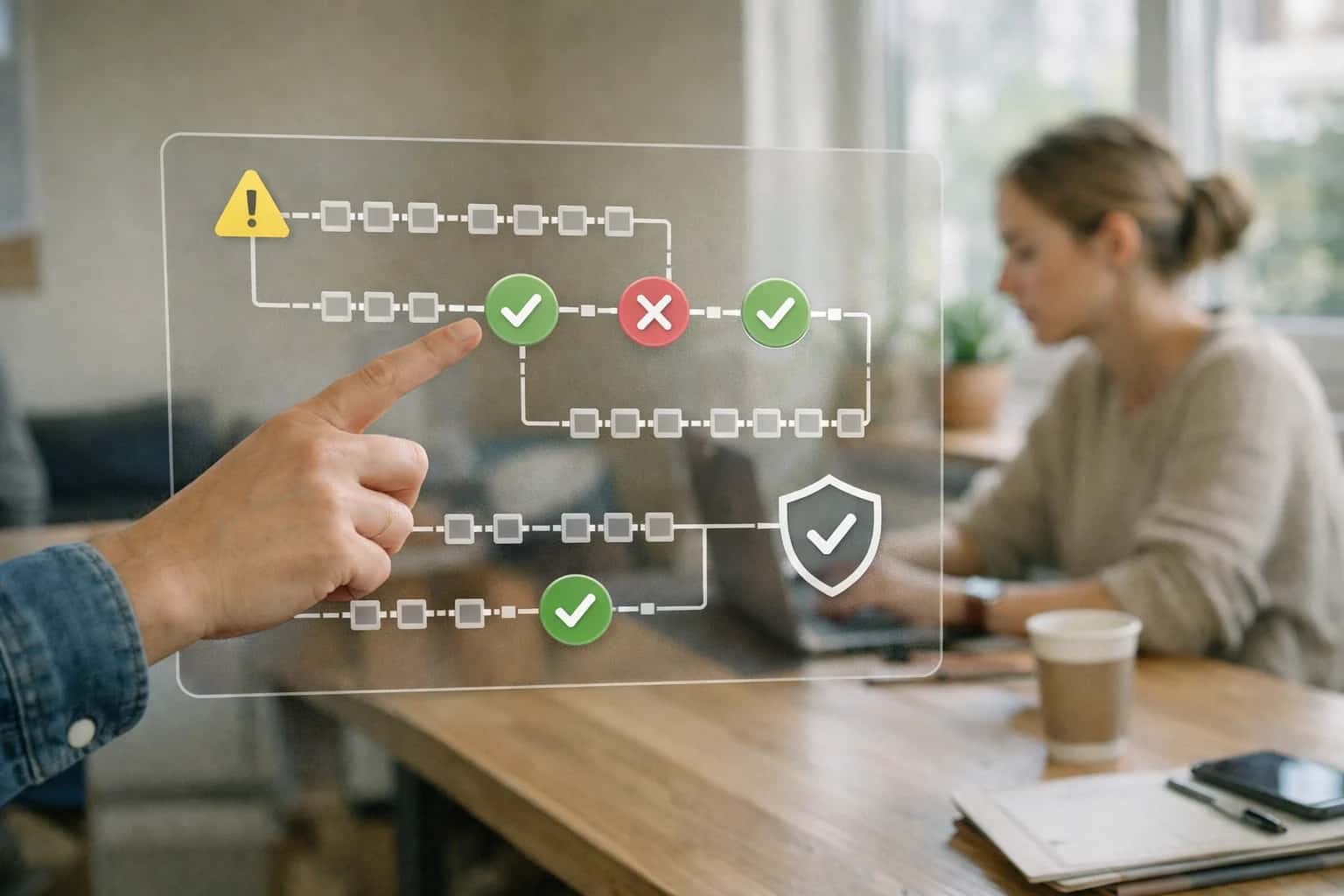
MEMORY OBSERVABILITY AND APIS
What is a Memory Audit Trail?
A technical definition of the immutable log that records all access and modification events within an agentic memory system.
The trail is generated by instrumenting the Memory Write API and Memory Query API, logging events like data inserts, updates, deletions, and retrievals. Each entry is timestamped and tagged with a memory correlation ID to trace request lifecycles. This log is essential for enforcing memory retention policies, conducting memory consistency checks, and populating specialized memory compliance logs required for enterprise governance of autonomous systems.
ENGINEERING PRIMER
Key Characteristics of a Memory Audit Trail
A memory audit trail is not merely a log file; it is a foundational security and observability primitive for agentic systems. Its design directly impacts debuggability, compliance posture, and system trust. These characteristics define its core engineering requirements.
01
Chronological & Immutable Sequencing
The audit trail is a strictly ordered, append-only log where each event is timestamped and given a monotonically increasing sequence number. Immutability is enforced at the system level, preventing tampering or deletion of historical records. This creates a verifiable timeline essential for forensic analysis and establishing causality in complex, multi-step agent operations.
- Example: Event #1052 (Write) must always precede Event #1053 (Read) in the log, establishing that the read accessed newly written data.
- Implementation: Often built on Write-Ahead Logging (WAL) or immutable ledger technologies.
02
Comprehensive Event Capture
The trail must capture a complete set of CRUD (Create, Read, Update, Delete) operations and system-level actions. This includes:
- Data Access: Every semantic query, vector search, and key-based retrieval.
- Data Mutation: All writes, updates, and deletions, including the before-and-after state where applicable.
- Administrative Actions: Schema changes, policy updates, and user/role management.
- Security Events: Authentication attempts, authorization failures, and policy violations.
Without this comprehensiveness, the audit trail contains blind spots that undermine its purpose.
03
Rich Contextual Metadata
Each log entry is enriched with metadata that answers the critical questions of who, what, when, where, and why. This transforms a simple log into an auditable record.
- Actor Identity: The agent, user, or service principal that initiated the action.
- Resource Identifier: The specific memory namespace, collection, or record ID targeted.
- Temporal Data: High-precision timestamp and operation duration.
- Request Context: The originating session ID, correlation ID, and the agent's current goal or task.
- Environmental Data: Service version, host identifier, and deployment region.
This metadata enables powerful filtering and aggregation during investigations.
04
Integrity Verification via Cryptography
To be a trusted record, the audit trail must provide cryptographic proof of its integrity. This is typically achieved through a hash chain or Merkle tree structure.
- Hash Chaining: The cryptographic hash of each log entry includes the hash of the previous entry. Altering any historical event breaks the chain for all subsequent events.
- Digital Signing: Periodic anchoring of the log's state hash to an external, trusted system (e.g., a blockchain or timestamping authority) provides non-repudiation.
- Use Case: During a compliance audit, an auditor can re-compute the hash chain to verify no entries have been modified since the last anchor point.
05
Structured for Machine Analysis
Audit trails are designed first for programmatic querying and analysis, not just human reading. Events are logged in a structured data format like JSON or Protocol Buffers with a well-defined schema.
- Enables: Automated alerting for suspicious patterns (e.g., rapid sequential failures from a single actor).
- Facilitates: Integration with Security Information and Event Management (SIEM) systems like Splunk or Datadog.
- Supports: Complex aggregations, such as "show all memory accesses by Agent X to sensitive namespace Y in the last 24 hours."
- Contrasts with unstructured plain-text logs, which are difficult to parse reliably at scale.
06
Performance & Scalability Isolation
The auditing subsystem must be architecturally isolated from the primary memory system's performance-critical path. Writing audit events must not block or significantly slow down core memory operations (reads/writes).
- Common Pattern: Audit events are written asynchronously to a dedicated, high-throughput stream (e.g., Apache Kafka, Amazon Kinesis).
- Backpressure Handling: The system must have strategies to handle scenarios where the audit sink is slower than the event generation rate, such as buffering with graceful degradation.
- Scalability: The audit storage layer must scale independently to handle the high volume of fine-grained events generated by a fleet of active agents.
MEMORY OBSERVABILITY AND APIS
How a Memory Audit Trail Works
A memory audit trail is a foundational component of agentic observability, providing a tamper-evident record of all interactions with an agent's memory system.
A memory audit trail is a chronological, immutable log that records every access, modification, creation, and deletion event within an agentic memory system. It functions as a system of record for debugging anomalous agent behavior, enforcing security policies via access control logs, and demonstrating regulatory compliance (e.g., GDPR, HIPAA) by proving data lineage and purpose. Each log entry is timestamped and includes the operation type, target memory identifier, and the correlation ID of the originating agent request.
The trail is generated by instrumenting the Memory Write API and Memory Query API, capturing events before they are committed to the underlying vector database or knowledge graph. For production systems, these logs are streamed to a centralized log aggregation platform, enriched with contextual metadata, and often integrated with OpenTelemetry for Memory traces. This creates a unified observability picture, allowing engineers to reconstruct the complete state of an agent's memory at any point in its operational history for forensic analysis.
MEMORY AUDIT TRAIL
Frequently Asked Questions
A memory audit trail is a foundational component of agentic observability, providing an immutable record of all interactions with an agent's memory system. This FAQ addresses its core functions, implementation, and importance for security and debugging.
A memory audit trail is a chronological, immutable log that records every access, modification, creation, and deletion event within an agentic memory system. It functions as the definitive source of truth for security auditing, compliance verification, and operational debugging. Unlike general telemetry, an audit trail is designed to be tamper-evident, providing a forensic record of who (or which agent) did what, to which data, and when. This is critical for tracing the lineage of an agent's decisions, investigating security incidents, and proving adherence to data governance regulations like GDPR or HIPAA.
Enabling Efficiency, Speed & Accuracy
Intelligent Analysis, Decision & Execution
We build AI systems for teams that need search across company data, workflow automation across tools, or AI features inside products and internal software.
Talk to Us
Search across company data
Give teams answers from docs, tickets, runbooks, and product data with sources and permissions.
Useful when people spend too long searching or get different answers from different systems.
Enterprise searchRAGPermissions
Read more
Automate internal workflows
Use AI to route work, draft outputs, trigger actions, and keep approvals and logs in place.
Useful when repetitive work moves across multiple tools and teams.
AI agentsWorkflow automationGovernance
Read more
Add AI to products and internal tools
Build assistants, guided actions, or decision support into the software your team or customers already use.
Useful when AI needs to be part of the product, not a separate tool.
AI integrationDecision supportModel routing
Read more
About the author
Prasad Kumkar
CEO & MD, Inference Systems
Prasad Kumkar is the CEO & MD of Inference Systems and writes about AI systems architecture, LLM infrastructure, model serving, evaluation, and production deployment. Over 5+ years, he has worked across computer vision models, L5 autonomous vehicle systems, and LLM research, with a focus on taking complex AI ideas into real-world engineering systems.
His work and writing cover AI systems, large language models, AI agents, multimodal systems, autonomous systems, inference optimization, RAG, evaluation, and production AI engineering.
LinkedIn
Limited slotsGet a Free AI Consultation
Partnered with leading AI, data, and software stack.





How We Work
Custom AI workflows for your Business
One-fit-all AI don't work for modern businesses. At Inferensys, we aim to understand your business & custom requirements; which we use to define most efficient agentic workflows, the data, and the tools for your business.
01
Review the use case
We understand the task, the users, and where AI can actually help.
Read more02
Pick the right approach
We define what needs search, automation, or product integration.
Read more03
Build the first useful version
We implement the part that proves the value first.
Read more04
Improve from there
We add the checks and visibility needed to keep it useful.
Read moreThe first call is a practical review of your use case and the right next step.
Talk to Us