Knowledge distillation is a model compression technique where a compact 'student' model is trained to mimic the predictive behavior and internal representations of a larger, pre-trained 'teacher' model. The core mechanism involves using the teacher's softened output probabilities (logits) as training targets, which contain richer 'dark knowledge' about class relationships than hard one-hot labels. This process transfers the teacher's generalization ability, often allowing the student to match or exceed the teacher's performance despite having far fewer parameters.

Glossary
Knowledge Distillation
Knowledge distillation is a model compression technique where a smaller 'student' model is trained to mimic the behavior of a larger, more complex 'teacher' model, transferring its knowledge for efficient deployment.
MODEL COMPRESSION
What is Knowledge Distillation?
A technique for transferring learned capabilities from a large model to a smaller, more efficient one.
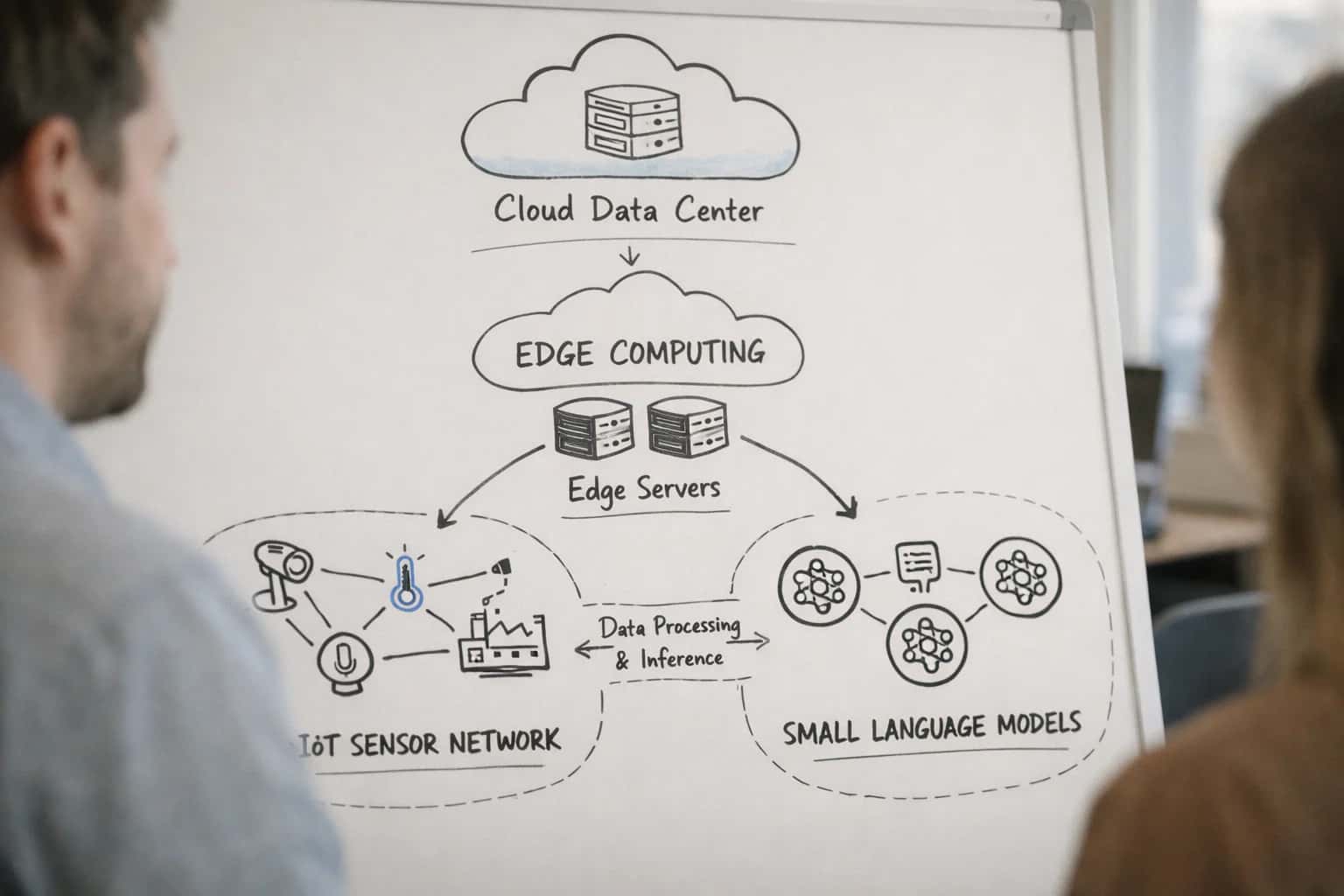
In agentic memory and context management, distillation is critical for deploying performant models on edge devices with strict memory and latency constraints. It enables the creation of specialized small language models (SLMs) from larger foundation models, facilitating efficient on-device inference for autonomous agents. The technique is often combined with other compression methods like pruning and quantization within a deep compression pipeline to maximize the performance-to-footprint ratio for production systems.
MECHANISMS
Core Components of Knowledge Distillation
Knowledge distillation is a model compression technique where a smaller 'student' model is trained to mimic the behavior of a larger, more complex 'teacher' model. Its effectiveness relies on several key engineering components.
01
Teacher-Student Architecture
The fundamental framework consists of two models. The teacher model is a large, pre-trained, and highly accurate network (e.g., an ensemble or a massive transformer). The student model is a smaller, more efficient architecture designed for deployment. The core objective is to transfer the generalized knowledge—represented not just by final predictions but by the teacher's internal representations and decision boundaries—from the teacher to the student, enabling the student to achieve comparable performance with a fraction of the parameters and computational cost.
02
Soft Targets & Temperature Scaling
Instead of using hard, one-hot labels (e.g., [0, 0, 1, 0]), distillation employs soft targets. The teacher's final softmax layer output is softened using a temperature parameter (T). The softmax function becomes: softmax(z_i) = exp(z_i / T) / Σ_j exp(z_j / T).
- High Temperature (T > 1): Produces a softer probability distribution, revealing the teacher's relative confidence across classes (e.g., a cat image might have high probability for 'cat' but non-zero for 'lynx' and 'tiger'). This dark knowledge is the key information transferred.
- Low Temperature (T = 1): Reverts to the standard softmax. The student is trained on a weighted loss that combines the soft targets (with high T) and the hard targets, gradually annealing T down to 1.
03
Distillation Loss Function
The student is trained using a composite loss function that balances learning from the teacher's soft predictions and the ground-truth data. The canonical Knowledge Distillation (KD) loss (Hinton et al.) is:
L_KD = α * L_soft + (1 - α) * L_hard
- L_soft (Distillation Loss): Typically the Kullback-Leibler (KL) Divergence between the softened student logits and the softened teacher logits. This forces the student to match the teacher's probability distribution.
- L_hard (Student Loss): The standard cross-entropy loss between the student's (hard) predictions and the true labels.
- α: A weighting hyperparameter. Advanced variants incorporate additional losses, such as matching intermediate feature maps or attention matrices from transformer layers, leading to hint-based or attention-based distillation.
04
Intermediate Representation Matching
Beyond final logits, effective distillation often requires the student to mimic the teacher's internal activations. This involves defining a loss on intermediate layers. Common techniques include:
- Hint Learning: A regression loss (e.g., Mean Squared Error) is applied between the outputs of a guided intermediate layer in the teacher (the 'hint') and a corresponding guided layer in the student.
- Attention Transfer: For Transformers, the attention maps (which encode relational information between tokens) from the teacher's layers are used as targets for the student's layers via a loss function.
- Feature Map Matching: For CNNs, the Gram matrices or normalized feature maps from convolutional layers are matched. This forces the student to learn similar feature representations, improving generalization.
05
Offline vs. Online Distillation
This defines the training regimen relationship between teacher and student.
- Offline Distillation: The standard, two-stage process. The teacher is fully pre-trained and frozen. Its predictions are pre-computed or generated on-the-fly to train the student. This is simple but requires a large, pre-existing teacher.
- Online Distillation: A single-stage process where the teacher and student are trained jointly and simultaneously. Often, the 'teacher' is an ensemble of students or a larger model co-trained with the student. This is useful when a powerful pre-trained teacher is unavailable. Self-distillation is a variant where the same architecture acts as both teacher and student, often by distilling knowledge from deeper layers to shallower ones within the same network.
06
Application in Agentic Memory
In the context of Agentic Memory and Context Management, knowledge distillation is a critical memory compression technique. It enables the deployment of efficient, smaller models for memory-related tasks on edge devices or within latency-sensitive agent loops. Key applications include:
- Distilled Embedding Models: Creating small, fast embedding models for real-time semantic search within vector databases.
- Distilled Retrieval Models: Compressing large cross-encoders or re-rankers used in Retrieval-Augmented Generation (RAG) pipelines.
- Distilled Policy Networks: In reinforcement learning agents, compressing a large teacher policy that has learned complex behaviors into a small student policy suitable for on-device execution.
- Context Summarization Models: Using distillation to create efficient models that can summarize past agent interactions to fit within a limited context window.
TRAINING MECHANISM
How Knowledge Distillation Works: The Training Process
Knowledge distillation is a model compression technique where a smaller 'student' model is trained to mimic the behavior of a larger, more complex 'teacher' model, transferring its knowledge.
The process begins by training or selecting a large, high-performance teacher model. This model generates soft labels—probability distributions over classes—for a transfer dataset, often the original training data. These soft labels, produced via a softmax function with a high temperature parameter (T), contain richer, inter-class relational information ("dark knowledge") than simple one-hot encoded hard labels. This softened output is the target knowledge to be transferred.
A smaller student model is then trained on the same data with a composite loss function. The distillation loss measures the difference (e.g., Kullback-Leibler divergence) between the student's softened predictions and the teacher's soft labels. A student loss (e.g., cross-entropy) typically aligns the student with the original hard labels. The student learns to approximate the teacher's generalization function by minimizing the weighted sum of these losses, effectively compressing the teacher's knowledge into a more efficient architecture.
KNOWLEDGE DISTILLATION
Frequently Asked Questions
Knowledge distillation is a core technique for compressing large AI models, enabling efficient deployment. These FAQs address its mechanisms, applications, and relationship to other memory compression methods within autonomous systems.
Knowledge distillation is a model compression technique where a smaller, more efficient 'student' model is trained to mimic the predictive behavior and internal representations of a larger, more complex 'teacher' model. It works by using the teacher's output logits (pre-softmax activations) or intermediate feature maps as a soft target during the student's training, alongside or instead of the standard hard labels. The key mechanism is the use of a high temperature parameter (T) in the softmax function applied to the teacher's logits, which produces a softer probability distribution that contains richer dark knowledge about the relationships between classes. The student is trained to minimize a loss function (e.g., Kullback-Leibler divergence) that measures the difference between its softened output distribution and the teacher's, effectively transferring the teacher's generalized knowledge.
Enabling Efficiency, Speed & Accuracy
Intelligent Analysis, Decision & Execution
We build AI systems for teams that need search across company data, workflow automation across tools, or AI features inside products and internal software.
Talk to Us
Search across company data
Give teams answers from docs, tickets, runbooks, and product data with sources and permissions.
Useful when people spend too long searching or get different answers from different systems.
Enterprise searchRAGPermissions
Read more
Automate internal workflows
Use AI to route work, draft outputs, trigger actions, and keep approvals and logs in place.
Useful when repetitive work moves across multiple tools and teams.
AI agentsWorkflow automationGovernance
Read more
Add AI to products and internal tools
Build assistants, guided actions, or decision support into the software your team or customers already use.
Useful when AI needs to be part of the product, not a separate tool.
AI integrationDecision supportModel routing
Read more
About the author
Prasad Kumkar
CEO & MD, Inference Systems
Prasad Kumkar is the CEO & MD of Inference Systems and writes about AI systems architecture, LLM infrastructure, model serving, evaluation, and production deployment. Over 5+ years, he has worked across computer vision models, L5 autonomous vehicle systems, and LLM research, with a focus on taking complex AI ideas into real-world engineering systems.
His work and writing cover AI systems, large language models, AI agents, multimodal systems, autonomous systems, inference optimization, RAG, evaluation, and production AI engineering.
LinkedIn
Limited slotsGet a Free AI Consultation
Partnered with leading AI, data, and software stack.





How We Work
Custom AI workflows for your Business
One-fit-all AI don't work for modern businesses. At Inferensys, we aim to understand your business & custom requirements; which we use to define most efficient agentic workflows, the data, and the tools for your business.
01
Review the use case
We understand the task, the users, and where AI can actually help.
Read more02
Pick the right approach
We define what needs search, automation, or product integration.
Read more03
Build the first useful version
We implement the part that proves the value first.
Read more04
Improve from there
We add the checks and visibility needed to keep it useful.
Read moreThe first call is a practical review of your use case and the right next step.
Talk to Us