Context summarization is a memory compression technique for long-context models that creates a condensed representation of past information to manage context window limits. It functions as a form of lossy compression, selectively preserving salient facts, decisions, and entity relationships from a prior interaction history. This condensed context is then re-injected into the model's limited input window, enabling extended multi-turn reasoning without exceeding token constraints.

Glossary
Context Summarization
Context summarization is a memory compression technique for long-context AI models that creates a condensed representation of past information to manage context window limits.
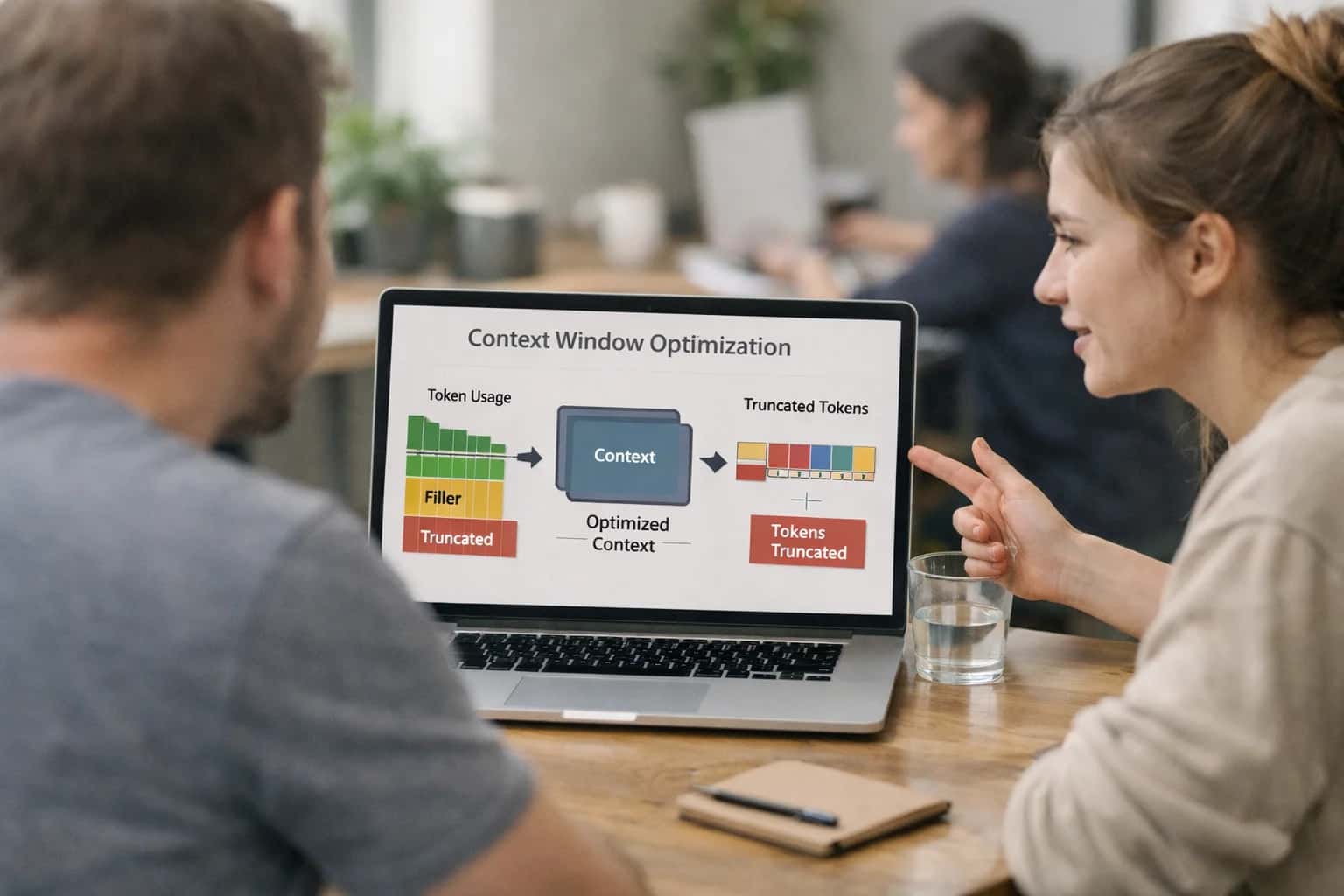
MEMORY COMPRESSION TECHNIQUE
What is Context Summarization?
A core technique in agentic memory management for overcoming fixed context window limits in large language models.
The technique is fundamental to agentic memory and context management, allowing autonomous systems to maintain state over long operational timeframes. Implementation involves extractive or abstractive summarization models and is closely related to hierarchical memory structures and memory update and eviction policies. Effective summarization balances information fidelity against compression ratio to preserve critical reasoning chains.
MEMORY COMPRESSION TECHNIQUE
Core Characteristics of Context Summarization
Context summarization is a memory compression technique for long-context models that creates a condensed representation of past information to manage context window limits. It is a critical engineering component for enabling extended, stateful agentic workflows.
01
Definition and Primary Goal
Context summarization is the process of generating a concise, information-dense representation of a prior conversation or text sequence to fit within a model's limited context window. Its primary goal is to preserve the semantic essence and critical facts from the original content, enabling long-term continuity in multi-turn interactions without exceeding token limits.
- Core Mechanism: An LLM is prompted to read a segment of past dialogue or text and output a structured summary.
- Key Distinction: Unlike simple truncation, it aims for lossy compression with high fidelity, prioritizing salient information, decisions, and entity states.
02
Triggering and Update Strategies
Summarization is not continuous; it is triggered by specific conditions within the agent's state management loop. Common strategies include:
- Fixed-Length Rolling Windows: Summarize once the conversation exceeds a pre-defined token count (e.g., every 4K tokens).
- Topic Shift Detection: Trigger a summary when the model or a classifier detects a significant change in conversational subject.
- Strategic Checkpoints: Summarize after a major agentic action is completed (e.g., after a tool-calling sequence or a planning step).
The new summary then replaces the older, detailed context, effectively creating a rolling memory buffer.
03
Architectural Integration Points
Summarization functions within a larger agentic memory architecture. Key integration points are:
- Short-Term Memory (Context Window): The live, detailed context of the immediate interaction.
- Long-Term Memory (Vector Store/Knowledge Graph): Summaries, along with their embeddings, can be persisted to a vector database for later semantic retrieval, connecting compression to retrieval-augmented generation (RAG).
- Episodic Memory: Summaries can serve as discrete, timestamped records of past episodes or sessions, forming a searchable history.
This creates a hierarchical memory structure where summarization bridges the volatile context window with persistent storage.
04
Prompt Engineering for Fidelity
The quality of the summary is dictated by the prompt architecture. Effective prompts instruct the model to:
- Extract Key Entities and Facts: Preserve names, dates, numbers, and decisions.
- Maintain Conversational Flow: Note who said what and the outcome of discussions.
- Discard Irrelevancies: Omit greetings, filler words, and tangential details.
- Use Structured Formats: Output in JSON, bullet points, or a consistent narrative style to aid later parsing.
Example prompt structure: "Summarize the following conversation, focusing on the user's core request, the agent's determined plan, and any specific data points mentioned..."
05
Challenges and Trade-offs
Implementing context summarization involves navigating several engineering trade-offs:
- Information Loss vs. Compression: The core tension. Over-summarization can lose nuanced instructions or conditional logic.
- Hallucination Risk: The summarizing LLM may introduce facts not present in the original context.
- Computational Overhead: The act of summarization consumes tokens and compute cycles, adding latency.
- State Coherence: Ensuring the agent's understanding remains consistent after context has been replaced by a summary is non-trivial.
These challenges make evaluation-driven development critical, requiring metrics for summary accuracy and downstream task performance.
06
Related Compression Techniques
Context summarization is one method within a broader toolkit of memory compression techniques. It is often used in conjunction with:
- Pruning & Quantization: Applied to the underlying LLM itself to reduce its footprint.
- Key-Value (KV) Caching: Optimizes inference speed but doesn't reduce the fundamental context length.
- Sparse Attention: Allows models to attend to longer contexts by sparsifying the attention matrix.
- Embedding Compression: Reduces the size of vectors stored in long-term memory.
Unlike these model-level optimizations, context summarization operates at the application and state management layer, making it a flexible tool for agent designers.
CONTEXT SUMMARIZATION
Frequently Asked Questions
Context summarization is a critical technique for managing the limited context windows of large language models, enabling autonomous agents to operate over extended conversations or tasks. These FAQs address its core mechanisms, applications, and engineering trade-offs.
Context summarization is a memory compression technique that creates a condensed, abstract representation of past information within a long interaction to manage the finite context window of a language model. It works by periodically analyzing the accumulated conversation history or task state, extracting key entities, decisions, and outcomes, and generating a concise textual summary. This summary is then prepended to the ongoing context, replacing verbose raw history, which allows the model to maintain a coherent long-term state without exceeding its token limit. Common implementations use the model itself to generate the summary via a dedicated summarization prompt, or employ a separate, smaller summarization model.
Enabling Efficiency, Speed & Accuracy
Intelligent Analysis, Decision & Execution
We build AI systems for teams that need search across company data, workflow automation across tools, or AI features inside products and internal software.
Talk to Us
Search across company data
Give teams answers from docs, tickets, runbooks, and product data with sources and permissions.
Useful when people spend too long searching or get different answers from different systems.
Enterprise searchRAGPermissions
Read more
Automate internal workflows
Use AI to route work, draft outputs, trigger actions, and keep approvals and logs in place.
Useful when repetitive work moves across multiple tools and teams.
AI agentsWorkflow automationGovernance
Read more
Add AI to products and internal tools
Build assistants, guided actions, or decision support into the software your team or customers already use.
Useful when AI needs to be part of the product, not a separate tool.
AI integrationDecision supportModel routing
Read more
About the author
Prasad Kumkar
CEO & MD, Inference Systems
Prasad Kumkar is the CEO & MD of Inference Systems and writes about AI systems architecture, LLM infrastructure, model serving, evaluation, and production deployment. Over 5+ years, he has worked across computer vision models, L5 autonomous vehicle systems, and LLM research, with a focus on taking complex AI ideas into real-world engineering systems.
His work and writing cover AI systems, large language models, AI agents, multimodal systems, autonomous systems, inference optimization, RAG, evaluation, and production AI engineering.
LinkedIn
Limited slotsGet a Free AI Consultation
Partnered with leading AI, data, and software stack.





How We Work
Custom AI workflows for your Business
One-fit-all AI don't work for modern businesses. At Inferensys, we aim to understand your business & custom requirements; which we use to define most efficient agentic workflows, the data, and the tools for your business.
01
Review the use case
We understand the task, the users, and where AI can actually help.
Read more02
Pick the right approach
We define what needs search, automation, or product integration.
Read more03
Build the first useful version
We implement the part that proves the value first.
Read more04
Improve from there
We add the checks and visibility needed to keep it useful.
Read moreThe first call is a practical review of your use case and the right next step.
Talk to Us