StreamingLLM is a framework enabling language models trained on a finite context window to process infinite-length text streams without fine-tuning. It achieves this by identifying and leveraging attention sinks—the initial tokens of a sequence that receive disproportionately high attention scores—to stabilize the attention mechanism. The framework maintains a fixed-size cache using a sliding window of recent tokens combined with these critical initial tokens, allowing for constant memory usage and computational cost regardless of stream length.

Glossary
StreamingLLM
StreamingLLM is a framework that enables language models trained with a finite context window to generalize to infinite-length text streams without fine-tuning, by leveraging attention sinks and a sliding window cache.
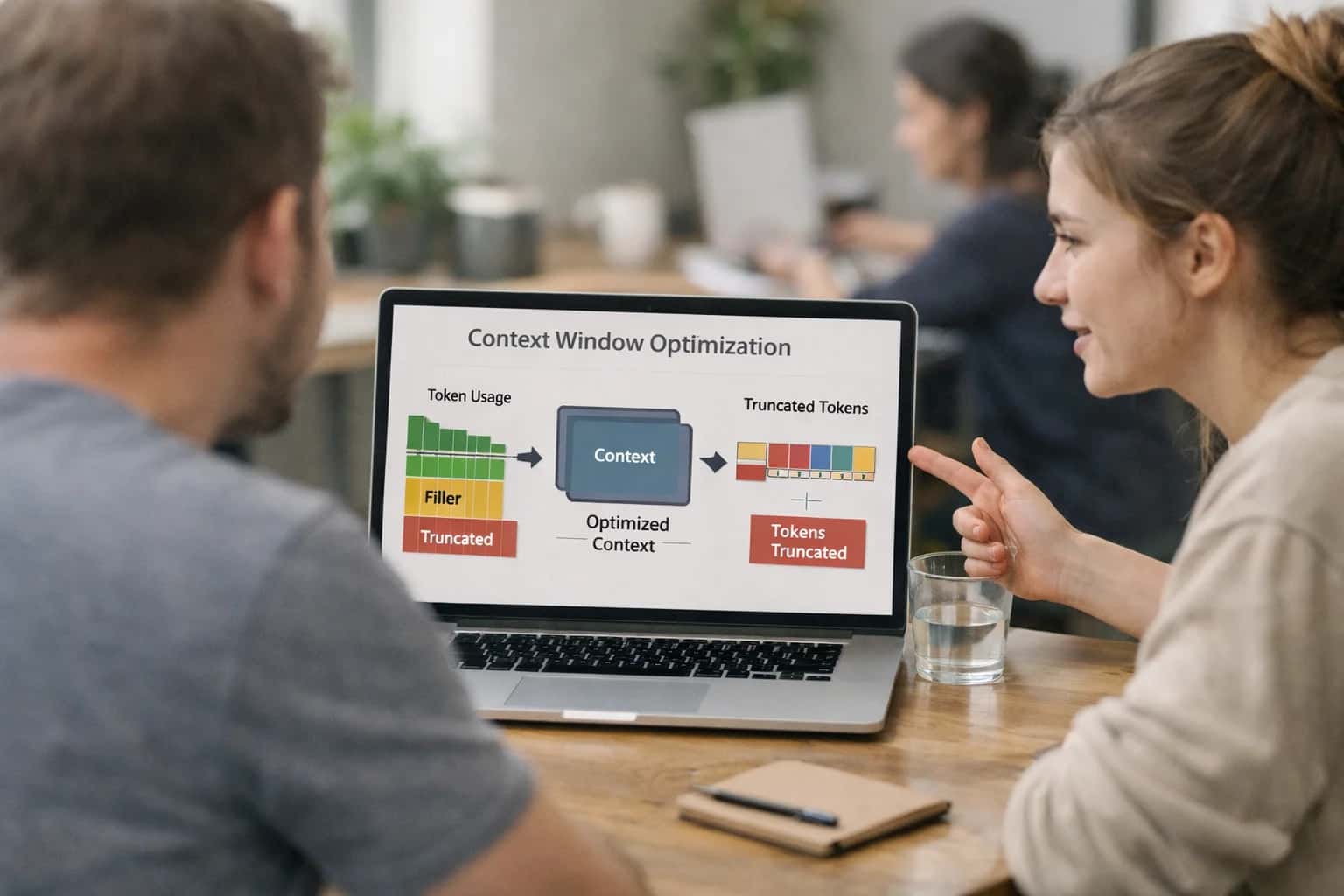
CONTEXT WINDOW MANAGEMENT
What is StreamingLLM?
StreamingLLM is a framework that enables language models trained with a finite context window to generalize to infinite-length text streams without fine-tuning.
The core innovation addresses the performance collapse that occurs in standard models when text exceeds their trained window. By preserving a few initial tokens as anchors, StreamingLLM prevents attention score drift and maintains generation quality. This makes it essential for agentic workflows involving long dialogues, continuous document processing, or real-time data streams, providing a practical solution to the context window limitation without expensive model retraining or complex context compression techniques.
STREAMINGLLM
Core Technical Mechanisms
StreamingLLM is a framework that enables language models trained with a finite context window to generalize to infinite-length text streams without fine-tuning, by leveraging attention sinks and a sliding window cache.
01
Attention Sink Phenomenon
The attention sink is the core observation enabling StreamingLLM. Researchers discovered that in decoder-only transformers, the initial tokens of a sequence (especially the first token) receive disproportionately high, stable attention scores from all subsequent tokens, regardless of semantic relevance. This occurs because the Softmax operation in attention requires a distribution across all keys; initial tokens act as a "sink" to absorb this residual attention. StreamingLLM exploits this by permanently keeping these initial tokens (e.g., four tokens) in the cache to stabilize the attention distribution, preventing catastrophic forgetting when the cache slides.
02
Sliding Window with Sink Tokens
StreamingLLM combines a sliding window attention mechanism with fixed attention sink tokens. The cache maintains:
- Fixed Sink Tokens: The first few tokens (and often the [BOS] token) are pinned and never evicted.
- Rolling Recent Tokens: A FIFO (First-In-First-Out) queue of the most recent tokens, up to the model's original trained window size. As new tokens are generated, the oldest token in the rolling window is evicted, but the sink tokens remain. This structure provides a constant memory footprint (O(1)) for infinite-length generation, as the cache size is capped at the original training length.
03
KV Cache Management
The framework provides a deterministic policy for managing the Key-Value (KV) Cache. Instead of recomputing keys and values for all previous tokens—which scales O(N²) in attention—StreamingLLM's cache strategy ensures only a fixed number of KV pairs are stored. The eviction logic is simple: when adding a new token's KV pair to the full cache, discard the oldest token's KV pair from the rolling window segment (but never from the sink segment). This enables efficient autoregressive generation for streams millions of tokens long, as computational cost per step remains constant.
04
Generalization Without Fine-Tuning
A key advantage is that StreamingLLM requires no fine-tuning of the base language model. It works with off-the-shelf models like Llama-2 and GPT-NeoX trained with finite positional encodings (e.g., 4K tokens). The method relies on the model's inherent attention patterns rather than modifying its weights. This is in contrast to methods like Position Interpolation (PI) or YaRN, which require continued training. StreamingLLM demonstrates that stable infinite-length generation is possible by correctly managing the cache, not by extending the model's inherent positional understanding.
05
Contrast with Context Window Extension
StreamingLLM solves a different problem than context length extrapolation techniques (e.g., PI, NTK-aware scaling). Those methods aim to understand longer sequences by modifying positional encodings, allowing the model to attend to and reason over a coherent long context (e.g., a 100K token document). StreamingLLM enables generation within an infinite stream but only maintains a coherent understanding within its recent sliding window. It excels in conversational agents or document streaming where only the most recent context is critical, not in tasks requiring synthesis of information dispersed over a vast context.
06
Practical Implementation & Limitations
Implementation involves modifying the inference engine's cache management logic. Key parameters are the number of sink tokens (typically 4) and the rolling window size (often the model's native context size).
Limitations include:
- Limited Long-Range Coherence: The model cannot recall information beyond the sliding window.
- Performance on Long-Context Tasks: It underperforms on tasks requiring information from the distant past (e.g., QA over a long document).
- Dependency on Initial Tokens: The method assumes the presence of initial sink tokens; starting generation mid-stream may require inserting dummy tokens. It is ideal for endless dialogue, real-time log processing, and long-form writing assistance.
CONTEXT WINDOW MANAGEMENT
How StreamingLLM Works
StreamingLLM is a framework that enables language models trained with a finite context window to generalize to infinite-length text streams without fine-tuning.
StreamingLLM works by leveraging the attention sink phenomenon and a sliding window cache. It preserves a few initial tokens as stable "sinks" for attention scores, which prevents catastrophic forgetting during generation. Concurrently, it maintains a rolling cache of recent tokens, allowing the model to focus on the most relevant recent context while discarding older information beyond the original training window.
This architecture enables infinite-length inference by fixing the KV Cache size. The model attends to the attention sinks plus the sliding window, ensuring stable attention distributions. This approach avoids the quadratic computational cost of full attention and eliminates the need for costly retraining or positional encoding modifications, making it highly efficient for real-time, long-context applications like chatbots and document streaming.
STREAMINGLLM
Frequently Asked Questions
StreamingLLM is a framework enabling language models to handle infinite-length text without retraining. These questions address its core mechanisms, applications, and technical trade-offs for engineers implementing long-context agentic systems.
StreamingLLM is a framework that enables language models trained with a finite context window to generalize to infinite-length text streams without any fine-tuning. It works by leveraging two key insights: the attention sink phenomenon and a sliding window cache. During inference, StreamingLLM keeps the initial few tokens (the attention sink) and a rolling window of the most recent tokens permanently in the KV Cache. This stable "sink" of initial tokens absorbs the model's residual attention, preventing catastrophic forgetting and generation collapse, while the sliding window provides recent context. This combination allows for stable, continuous generation on texts far longer than the model's original training context.
Enabling Efficiency, Speed & Accuracy
Intelligent Analysis, Decision & Execution
We build AI systems for teams that need search across company data, workflow automation across tools, or AI features inside products and internal software.
Talk to Us
Search across company data
Give teams answers from docs, tickets, runbooks, and product data with sources and permissions.
Useful when people spend too long searching or get different answers from different systems.
Enterprise searchRAGPermissions
Read more
Automate internal workflows
Use AI to route work, draft outputs, trigger actions, and keep approvals and logs in place.
Useful when repetitive work moves across multiple tools and teams.
AI agentsWorkflow automationGovernance
Read more
Add AI to products and internal tools
Build assistants, guided actions, or decision support into the software your team or customers already use.
Useful when AI needs to be part of the product, not a separate tool.
AI integrationDecision supportModel routing
Read more
About the author
Prasad Kumkar
CEO & MD, Inference Systems
Prasad Kumkar is the CEO & MD of Inference Systems and writes about AI systems architecture, LLM infrastructure, model serving, evaluation, and production deployment. Over 5+ years, he has worked across computer vision models, L5 autonomous vehicle systems, and LLM research, with a focus on taking complex AI ideas into real-world engineering systems.
His work and writing cover AI systems, large language models, AI agents, multimodal systems, autonomous systems, inference optimization, RAG, evaluation, and production AI engineering.
LinkedIn
Limited slotsGet a Free AI Consultation
Partnered with leading AI, data, and software stack.





How We Work
Custom AI workflows for your Business
One-fit-all AI don't work for modern businesses. At Inferensys, we aim to understand your business & custom requirements; which we use to define most efficient agentic workflows, the data, and the tools for your business.
01
Review the use case
We understand the task, the users, and where AI can actually help.
Read more02
Pick the right approach
We define what needs search, automation, or product integration.
Read more03
Build the first useful version
We implement the part that proves the value first.
Read more04
Improve from there
We add the checks and visibility needed to keep it useful.
Read moreThe first call is a practical review of your use case and the right next step.
Talk to Us