Dynamic context is a real-time, adaptive context management strategy where the content within a language model's fixed context window is continuously updated, filtered, or summarized based on the evolving state of a task or conversation. Unlike static context loading, it treats the window as a working memory buffer, actively prioritizing the most relevant tokens—such as recent dialogue turns, critical task parameters, or retrieved facts—while deprioritizing or compressing less immediately useful information. This is fundamental to agentic workflows, where an autonomous system must maintain coherent state over extended interactions without exceeding strict token limits.

Glossary
Dynamic Context
Dynamic context is an adaptive context management approach where the content within a model's working window is continuously updated, filtered, or summarized in real-time based on the evolving needs of a task or conversation.
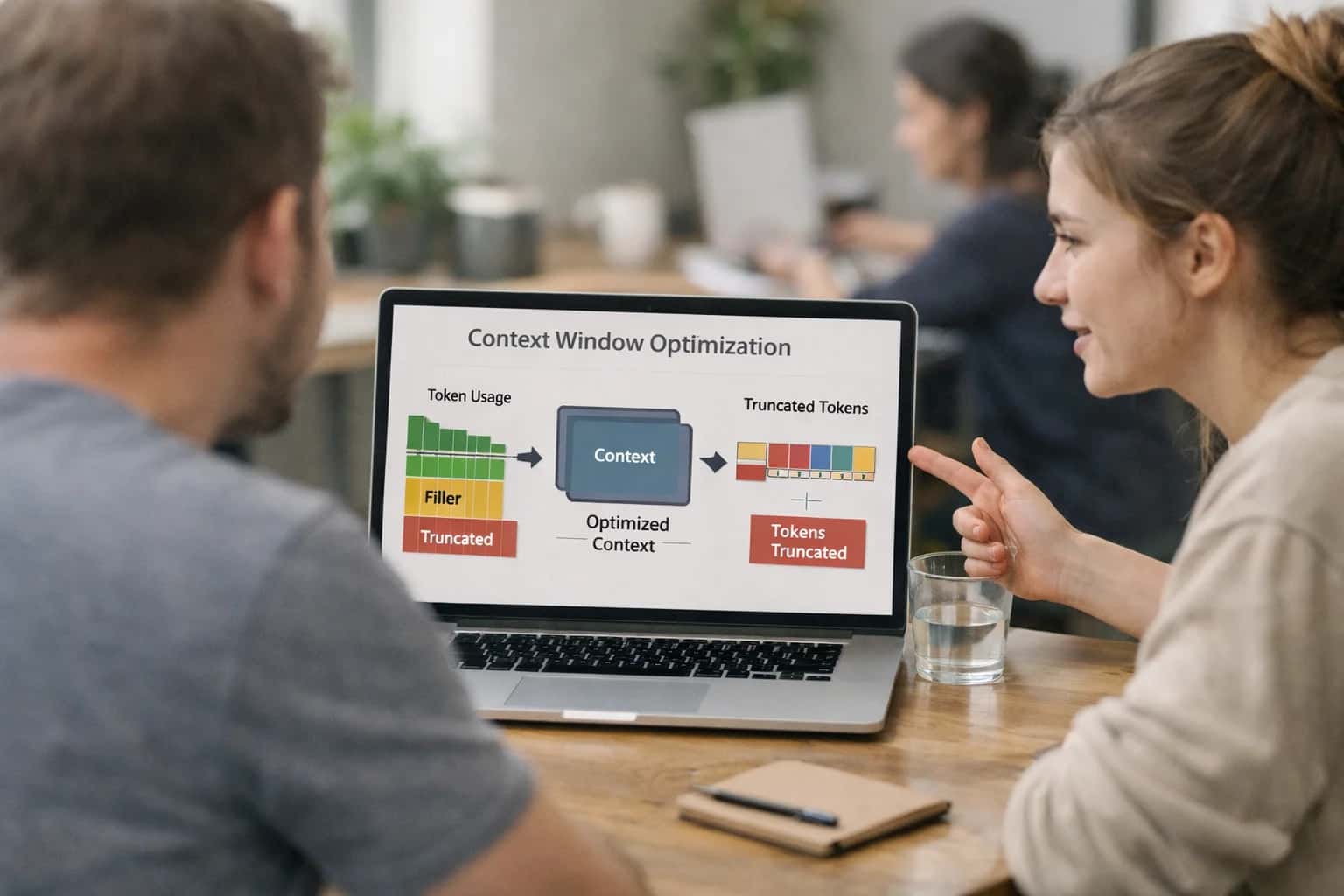
CONTEXT WINDOW MANAGEMENT
What is Dynamic Context?
Dynamic context is an adaptive engineering approach for managing the limited working memory of a transformer-based language model.
Implementation relies on techniques like context summarization, semantic filtering, and intelligent cache eviction policies (e.g., LRU). Engineers orchestrate these operations using Context Management APIs to dynamically inject, remove, or compress information. The goal is context window optimization: maximizing the semantic utility per token to ground the model's responses in the most pertinent data at each step, thereby preventing context window saturation and maintaining task coherence over long horizons without manual truncation.
ENGINEERING METHODS
Core Techniques for Implementing Dynamic Context
Dynamic context is implemented through a suite of algorithmic and architectural techniques that enable real-time adaptation of a model's working memory. These methods focus on selective retention, compression, and intelligent retrieval to maximize the utility of a fixed token budget.
01
Semantic Retrieval & RAG
This is the foundational technique for dynamic context. Instead of loading an entire corpus, a retrieval-augmented generation (RAG) system uses a query to fetch only the most relevant document chunks from a vector database. The process involves:
- Query Encoding: The user's question or the agent's current state is converted into a vector embedding.
- Similarity Search: The system performs a nearest-neighbor search (e.g., using cosine similarity) against pre-indexed document embeddings.
- Context Injection: The top-k most relevant chunks are inserted into the model's prompt. This ensures the context window contains only high-utility, task-specific information, dynamically updating with each new query.
02
Hierarchical & Recursive Summarization
This technique progressively condenses long context. A hierarchical summarization pipeline processes information in stages:
- Chunk-Level Summaries: Individual document segments are first summarized.
- Roll-Up Summaries: Those segment summaries are then aggregated and summarized again at a chapter or document level.
- Conversation Memory: In multi-turn dialogues, past exchanges are periodically summarized into a conversation summary that is carried forward, while raw turn history is evicted. This creates a recursive memory structure where only compressed representations of past context are retained, freeing tokens for new interaction.
03
Attention-Based Filtering & Gating
This method uses the model's own attention mechanisms or learned classifiers to dynamically weight or filter context. Key approaches include:
- Relevance Scoring: A lightweight classifier or cross-attention scores assess the relevance of each context chunk to the current query. Low-scoring chunks are deprioritized or removed.
- Soft Gating: Implemented via mixture-of-experts-style architectures, where a gating network decides how much to "attend to" different pieces of context, effectively blending them dynamically.
- Token-Level Pruning: Advanced systems can prune individual tokens within the context that receive minimal attention, performing lossy compression at a granular level based on the model's own focus.
04
Sliding Window with Attention Sinks
For processing infinite data streams, a sliding window maintains a fixed-size cache of the most recent tokens. The StreamingLLM framework identified that stable generation requires retaining a few initial tokens as attention sinks—anchor points that absorb residual attention. The dynamic context is thus composed of:
- Attention Sink Tokens: The first 1-4 tokens of the stream, always kept in cache.
- Recent Token Window: A FIFO (First-In-First-Out) buffer of the latest N tokens.
- Eviction Policy: As new tokens arrive, the oldest tokens outside the sink and window are evicted. This provides a constant-memory, dynamic view of an arbitrarily long conversation or document.
05
Contextual Prompt Compression (LLM-Generated)
Here, a smaller/faster compressor LLM is tasked with rewriting or distilling the raw context into a more token-efficient form before passing it to the primary reasoner LLM. Techniques include:
- Instruction-Based Compression: "Summarize this dialogue history into a concise paragraph focusing on unresolved user requests."
- Extractive to Abstractive: Converting lists of facts into a coherent narrative.
- Lossless Compression via Instructions: Using prompts like "Convert the following JSON into a minimal, single-line string without spaces." This dynamic re-encoding can drastically reduce token count while attempting to preserve informational fidelity, tailored to the needs of the downstream task.
06
Metadata-Driven Context Routing
This architectural technique uses structured metadata to dynamically assemble context. Instead of embedding full text, the system indexes chunks with attributes like topic, entity, timestamp, source, and priority. At runtime:
- Query Analyzer: Parses the user request to extract target metadata filters (e.g.,
time > last_week,topic == 'billing'). - Graph Traversal: If using a knowledge graph, it traverses relationships to find connected, relevant concepts.
- Hybrid Search: Combines vector similarity with metadata filtering to retrieve precisely the context that matches both semantic meaning and logical constraints. The composition of the context window is therefore a dynamic query result.
MECHANISM
How Dynamic Context Works: The Feedback Loop
Dynamic context is not a static buffer but an active, feedback-driven system that continuously adapts the information within a model's working memory.
Dynamic context implements a feedback loop where the model's outputs and the evolving state of the task directly inform which information is retained, summarized, or fetched next. This loop typically involves real-time monitoring of context utility, triggering selective retrieval from external memory or the eviction of low-relevance tokens. The goal is to maintain a high information density within the fixed context window, ensuring each token contributes maximally to the current objective.
This adaptive management is governed by heuristic policies or learned relevance scoring mechanisms. For example, an agent may compress a completed sub-task into a summary, evict the raw dialogue, and retrieve new documents based on the latest query. This creates a stateful, rolling context that mirrors working memory, allowing the system to operate over long horizons without hitting context window saturation and losing critical information.
DYNAMIC CONTEXT
Frequently Asked Questions
Dynamic context is an adaptive approach to managing the limited working memory of language models. It involves real-time filtering, summarization, and prioritization of information within the context window based on the evolving needs of a task or conversation.
Dynamic context is an adaptive context management approach where the content within a model's working window is continuously updated, filtered, or summarized in real-time based on the evolving needs of a task or conversation. It works by implementing a feedback loop where the agent's current state, recent actions, and the immediate goal determine which pieces of information from a larger corpus (like a vector database or knowledge graph) are most relevant to retrieve and inject into the limited context window. Unlike static context, which loads a fixed set of information, dynamic context employs algorithms to evict less relevant tokens, summarize past interactions, or prioritize new retrievals, ensuring the model always operates on the most pertinent data.
Enabling Efficiency, Speed & Accuracy
Intelligent Analysis, Decision & Execution
We build AI systems for teams that need search across company data, workflow automation across tools, or AI features inside products and internal software.
Talk to Us
Search across company data
Give teams answers from docs, tickets, runbooks, and product data with sources and permissions.
Useful when people spend too long searching or get different answers from different systems.
Enterprise searchRAGPermissions
Read more
Automate internal workflows
Use AI to route work, draft outputs, trigger actions, and keep approvals and logs in place.
Useful when repetitive work moves across multiple tools and teams.
AI agentsWorkflow automationGovernance
Read more
Add AI to products and internal tools
Build assistants, guided actions, or decision support into the software your team or customers already use.
Useful when AI needs to be part of the product, not a separate tool.
AI integrationDecision supportModel routing
Read more
About the author
Prasad Kumkar
CEO & MD, Inference Systems
Prasad Kumkar is the CEO & MD of Inference Systems and writes about AI systems architecture, LLM infrastructure, model serving, evaluation, and production deployment. Over 5+ years, he has worked across computer vision models, L5 autonomous vehicle systems, and LLM research, with a focus on taking complex AI ideas into real-world engineering systems.
His work and writing cover AI systems, large language models, AI agents, multimodal systems, autonomous systems, inference optimization, RAG, evaluation, and production AI engineering.
LinkedIn
Limited slotsGet a Free AI Consultation
Partnered with leading AI, data, and software stack.





How We Work
Custom AI workflows for your Business
One-fit-all AI don't work for modern businesses. At Inferensys, we aim to understand your business & custom requirements; which we use to define most efficient agentic workflows, the data, and the tools for your business.
01
Review the use case
We understand the task, the users, and where AI can actually help.
Read more02
Pick the right approach
We define what needs search, automation, or product integration.
Read more03
Build the first useful version
We implement the part that proves the value first.
Read more04
Improve from there
We add the checks and visibility needed to keep it useful.
Read moreThe first call is a practical review of your use case and the right next step.
Talk to Us