A digital twin is a virtual, data-driven model of a physical entity or system that is synchronized via a continuous, bidirectional data flow. This integration of Internet of Things (IoT) sensors, operational data, and simulation software creates a living digital counterpart. It serves as a foundational world model for an autonomous agent, providing a sandbox for what-if analysis, predictive maintenance, and performance optimization without risking the physical asset.

Glossary
Digital Twin
A digital twin is a virtual, dynamic replica of a physical system, process, or product that is continuously updated with real-world data, used for simulation, analysis, monitoring, and optimization.
WORLD MODEL LEARNING
What is a Digital Twin?
A digital twin is a virtual, dynamic replica of a physical system, process, or product that is continuously updated with real-world data, used for simulation, analysis, monitoring, and optimization.
The core value lies in its closed-loop functionality: the twin ingests real-time telemetry to reflect current state, while simulations run within the model can generate control signals or operational adjustments fed back to the physical system. This enables predictive analytics, Model Predictive Control (MPC), and training for embodied intelligence systems in a risk-free environment. It is a key enabler for Industry 4.0, smart cities, and complex system design.
ARCHITECTURAL LAYERS
Core Components of a Digital Twin
A digital twin is a multi-layered software architecture that creates a dynamic, data-driven virtual counterpart of a physical entity. Its core components form a closed-loop system for simulation, monitoring, and optimization.
01
Physical Entity & Sensors
The foundational layer is the real-world asset (e.g., a jet engine, a factory floor, a power grid) instrumented with IoT sensors and actuators. These devices provide the continuous, real-time data stream (telemetry) that fuels the digital twin. Key data types include:
- Operational Data: Temperature, pressure, vibration, RPM.
- Environmental Data: Ambient conditions, location (GPS).
- Control Signals: Commands sent to actuators in the physical system.
02
Data Ingestion & Integration Layer
This component is the data pipeline that aggregates, cleans, and contextualizes raw sensor data. It handles high-velocity, high-volume data streams from heterogeneous sources. Core functions include:
- Protocol Adaptation: Connecting to MQTT, OPC-UA, and proprietary industrial protocols.
- Time-Series Processing: Aligning data streams with precise timestamps.
- Data Fusion: Combining sensor data with enterprise data from ERP, MES, and CAD systems to provide business context (e.g., maintenance schedules, design specs).
03
Virtual Model (The 'Twin')
This is the high-fidelity digital representation itself. It exists in two primary forms:
- Geometric Model: A 3D CAD or BIM (Building Information Modeling) representation of the physical structure.
- Behavioral/Physics Model: A mathematical or machine learning model that simulates the asset's dynamics, performance, and degradation. This can range from finite element analysis (FEA) models to neural networks trained on historical operational data. The model's accuracy defines the twin's predictive power.
04
Analytics & Simulation Engine
The computational brain of the digital twin. This component uses the virtual model and live/ historical data to perform what-if analysis, predictive maintenance, and optimization. Key techniques include:
- Physics-Based Simulation: Running computational fluid dynamics or stress tests.
- AI/ML Analytics: Applying anomaly detection algorithms, remaining useful life (RUL) prediction, and reinforcement learning to optimize control policies.
- Model Predictive Control (MPC): Using the twin as a forward model to calculate optimal actuator setpoints.
05
Synchronization & State Management
This is the mechanism that maintains bi-directional alignment between the physical and digital entities. It ensures the virtual model's state reflects the real world. Key processes are:
- State Estimation: Using sensor data to infer the true, often unobservable, state of the physical asset (a latent state).
- Data Assimilation: Techniques like Kalman filters update the model's internal state with new observations.
- Command Propagation: Sending optimized control actions or alerts derived in the digital space back to the physical system's actuators or human operators.
06
User Interface & Visualization
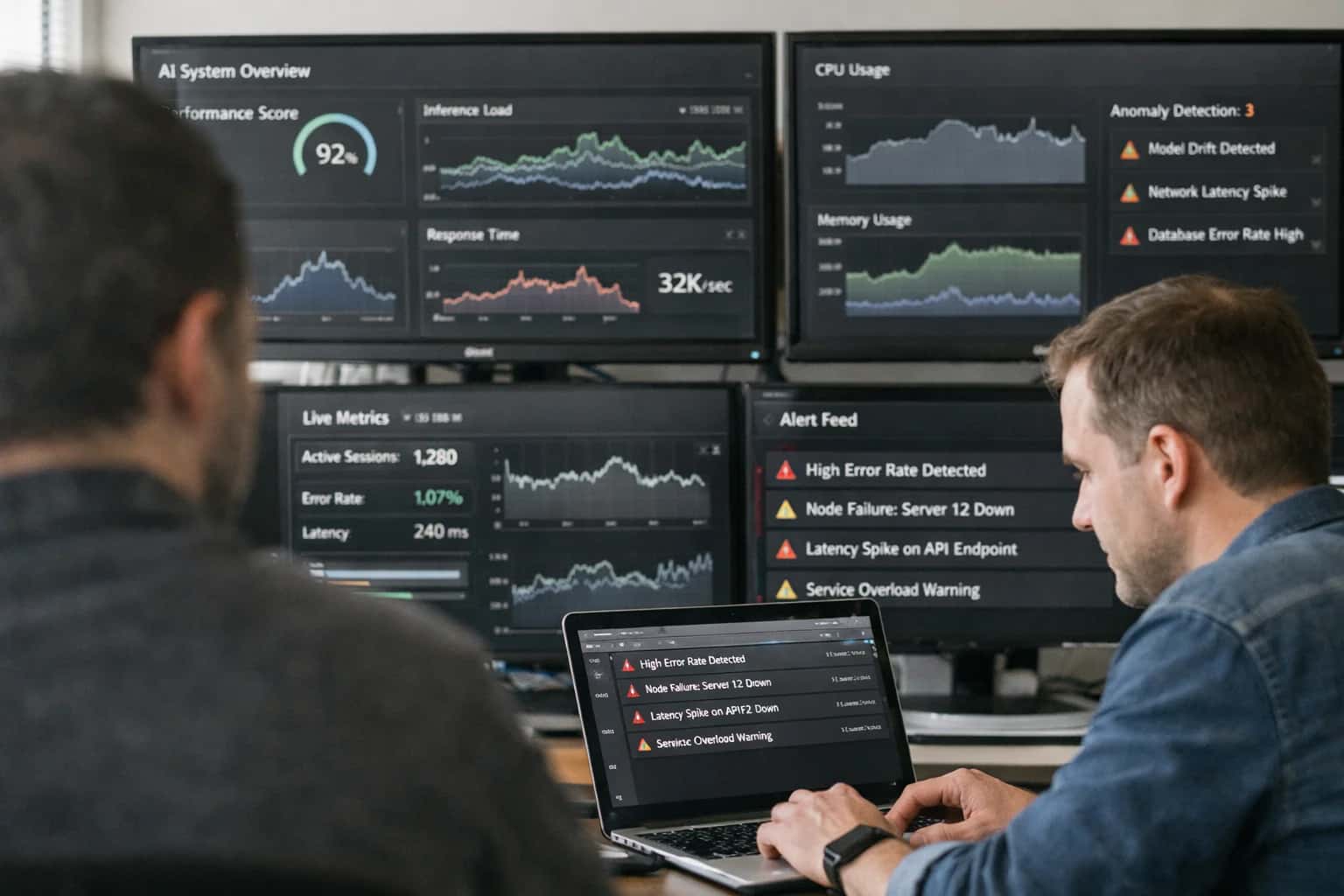
The human-facing layer that provides situational awareness and enables interaction. It transforms complex model outputs into actionable insights through:
- Dashboards: Real-time KPIs, health scores, and alerts.
- 3D/AR/VR Visualization: Immersive exploration of the asset, often highlighting stress points or predicted failure locations.
- Collaboration Tools: Allowing engineers in different locations to jointly analyze scenarios and annotate the model. This layer is critical for decision support.
DIGITAL TWIN
Frequently Asked Questions
A Digital Twin is a virtual, dynamic replica of a physical system, process, or product that is continuously updated with real-world data, used for simulation, analysis, monitoring, and optimization. This FAQ addresses its core mechanisms, applications, and relationship to advanced AI concepts like World Models.
A Digital Twin is a virtual, dynamic replica of a physical system, process, or product that is continuously synchronized with its real-world counterpart via data streams. It works by integrating Internet of Things (IoT) sensors, operational data, and contextual information to create a living simulation model. This model is hosted in a computational environment where it can be analyzed, manipulated, and used to run predictive simulations. The core mechanism is a closed-loop data pipeline: sensors on the physical asset feed real-time telemetry (e.g., temperature, vibration, throughput) into the virtual model, which updates its state. Analytics and AI algorithms then process this state to generate insights, predict failures, or optimize performance, with recommendations potentially fed back to control the physical system.
Enabling Efficiency, Speed & Accuracy
Intelligent Analysis, Decision & Execution
We build AI systems for teams that need search across company data, workflow automation across tools, or AI features inside products and internal software.
Talk to Us
Search across company data
Give teams answers from docs, tickets, runbooks, and product data with sources and permissions.
Useful when people spend too long searching or get different answers from different systems.
Enterprise searchRAGPermissions
Read more
Automate internal workflows
Use AI to route work, draft outputs, trigger actions, and keep approvals and logs in place.
Useful when repetitive work moves across multiple tools and teams.
AI agentsWorkflow automationGovernance
Read more
Add AI to products and internal tools
Build assistants, guided actions, or decision support into the software your team or customers already use.
Useful when AI needs to be part of the product, not a separate tool.
AI integrationDecision supportModel routing
Read more
About the author
Prasad Kumkar
CEO & MD, Inference Systems
Prasad Kumkar is the CEO & MD of Inference Systems and writes about AI systems architecture, LLM infrastructure, model serving, evaluation, and production deployment. Over 5+ years, he has worked across computer vision models, L5 autonomous vehicle systems, and LLM research, with a focus on taking complex AI ideas into real-world engineering systems.
His work and writing cover AI systems, large language models, AI agents, multimodal systems, autonomous systems, inference optimization, RAG, evaluation, and production AI engineering.
LinkedIn
Limited slotsGet a Free AI Consultation
Partnered with leading AI, data, and software stack.





How We Work
Custom AI workflows for your Business
One-fit-all AI don't work for modern businesses. At Inferensys, we aim to understand your business & custom requirements; which we use to define most efficient agentic workflows, the data, and the tools for your business.
01
Review the use case
We understand the task, the users, and where AI can actually help.
Read more02
Pick the right approach
We define what needs search, automation, or product integration.
Read more03
Build the first useful version
We implement the part that proves the value first.
Read more04
Improve from there
We add the checks and visibility needed to keep it useful.
Read moreThe first call is a practical review of your use case and the right next step.
Talk to Us