Plan recognition is the inverse of planning: it is the computational process of inferring an agent's high-level goals, intentions, and potential future actions from a sequence of observed low-level actions or environmental states. This task is fundamental to Theory of Mind (ToM) modeling, allowing an AI system to attribute mental states to others. It operates under the assumption that observed behavior is generated by some underlying, often rational, planning process, and works backwards to hypothesize the most likely objectives.

Glossary
Plan Recognition
Plan recognition is the computational task of inferring an agent's high-level plans and goals from a sequence of observed low-level actions.
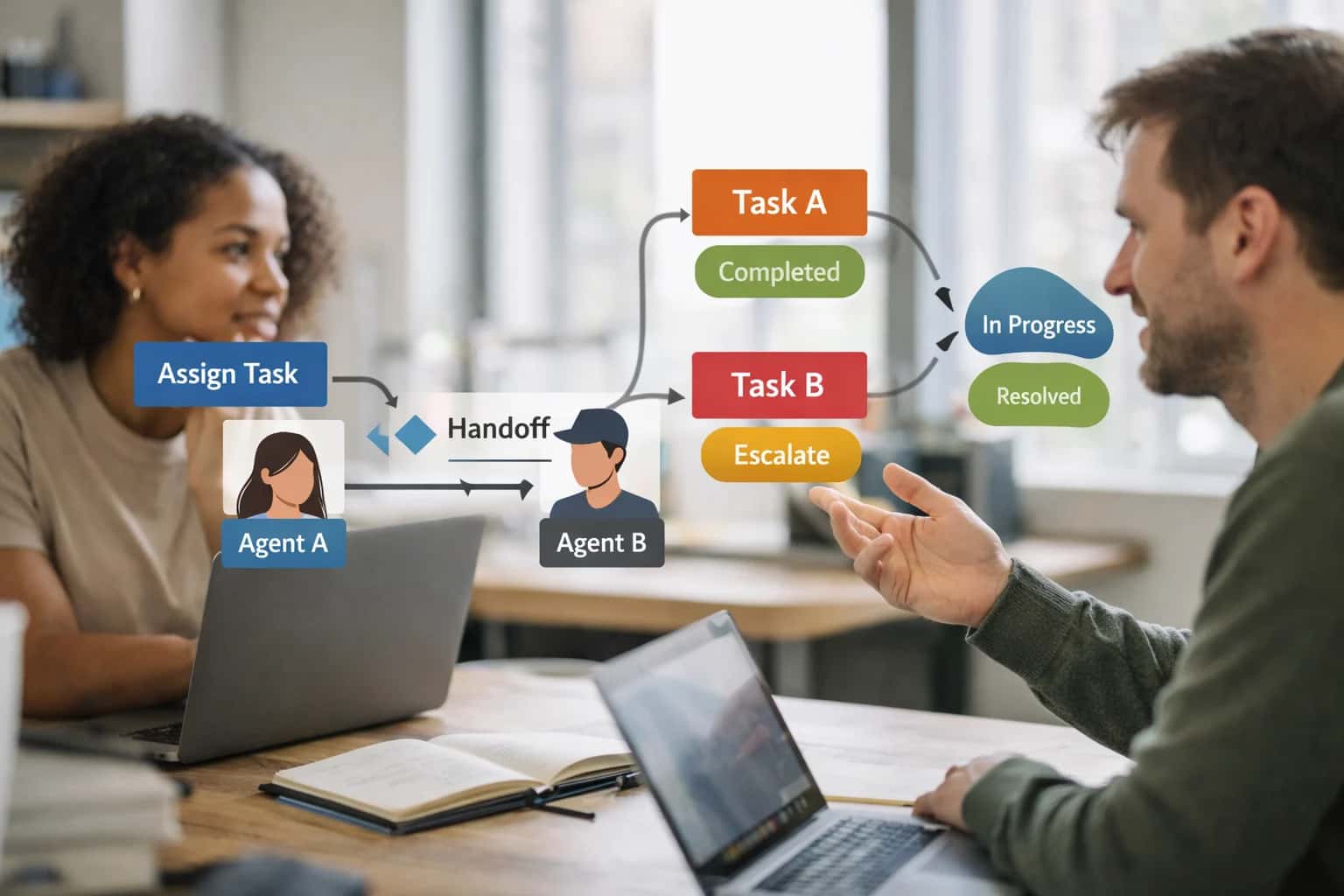
THEORY OF MIND MODELING
What is Plan Recognition?
Plan recognition is a core task in artificial intelligence and cognitive modeling, enabling systems to infer the goals and strategies of other agents from their observable behavior.
Key approaches include inverse planning, which uses Bayesian inference to find the goals that best explain the actions, and grammar-based or library-based methods that match observations against known plan templates. Applications are extensive, spanning human-computer interaction for proactive assistance, multi-agent systems for coordination and prediction, adversarial reasoning in security, and narrative understanding in computational linguistics. Effective plan recognition often requires modeling the agent's beliefs, capabilities, and the environment's constraints.
THEORY OF MIND MODELING
Core Characteristics of Plan Recognition
Plan recognition is the inverse of planning: it involves inferring an agent's high-level goals and the sequence of intended actions (the plan) from a stream of observed low-level behaviors. This glossary section details its defining technical attributes.
01
Inverse Problem to Planning
Plan recognition is fundamentally an inverse planning problem. While automated planning generates a sequence of actions to achieve a goal, plan recognition works backwards from observed actions to hypothesize the most likely goal and plan. This is typically framed as a probabilistic inference task, often using Bayesian reasoning to evaluate the posterior probability of different plans given the observations and a model of the agent's planning process.
02
Keypad & Library Domain Examples
Classic examples illustrate the ambiguity inherent in observation.
- Keypad Problem: Observing the sequence
[1, 4, 7]on a telephone keypad is consistent with multiple goals: dialing the number147, typing the word'GHP'using multi-tap, or even a failed attempt to press8(located at the center of 1, 4, and 7). - Library Domain: An agent is observed moving to a room, picking up a book, and going to a checkout desk. The goal could be to
borrow the book,return the book, orcheck a reference. The true plan is under-specified by the actions alone, requiring context to disambiguate.
03
Plan-Library vs. Plan-Generation
Two primary computational approaches exist:
- Plan-Library Approach: Compares observations against a pre-enumerated library of known plans. It is efficient but limited to recognized scenarios. Used in script recognition and structured environments.
- Plan-Generation Approach: Uses a generative model of the agent's planning (e.g., a planner simulator) to dynamically generate candidate plans that explain the observations. This is more flexible and can handle novel situations but is computationally more expensive.
04
Key Assumptions: Rationality & Plan Cost
Algorithms rely on core assumptions about the observed agent:
- Rationality Assumption: The agent is executing a plan that is approximately optimal or rational with respect to its goals. This allows the recognizer to prune implausible, highly inefficient plans.
- Plan Cost: Many algorithms incorporate a cost metric for actions (e.g., time, effort). They infer that the agent is likely pursuing a goal that justifies the incurred cost, and that cheaper plans explaining the same observations are more probable.
05
Relationship to Intent Recognition
Plan recognition is closely related but distinct from intent recognition. Intent recognition aims to identify the high-level goal or desire (the why), such as 'want to drink coffee'. Plan recognition infers the specific sequence of actions intended to achieve that goal (the how), such as 'walk to kitchen, grind beans, brew pot'. In integrated systems, plan recognition often serves as the mechanism to operationalize a recognized intent.
06
Applications: Assistive Tech & Security
Plan recognition enables proactive systems:
- Assistive Technology: Smart homes can predict a resident's goal (e.g., preparing a meal) and automate subsequent steps (preheat oven) or offer help if a step is missed.
- Security & Monitoring: Identifying anomalous sequences of actions in network logs (
port scan, vulnerability probe, data exfiltration) that constitute an attack plan. - Human-Computer Interaction: Anticipating user needs in software interfaces by recognizing task patterns, enabling shortcut suggestions or automated macro completion.
THEORY OF MIND MODELING
How Plan Recognition Works
Plan recognition is a core capability in Theory of Mind modeling, enabling AI systems to infer the goals and strategies of other agents from observed behavior.
Plan recognition is the inverse of automated planning: it is the process of inferring an agent's high-level goals and the sequence of intended actions (a plan) from a stream of observed low-level actions or environmental states. This is a form of abductive reasoning, where the system hypothesizes the most likely explanation for the observed behavior. Core approaches include logic-based parsing, which matches actions to a predefined library of plans, and probabilistic methods like inverse planning, which use Bayesian inference to reason backwards from actions, assuming the observed agent is approximately rational.
Effective plan recognition is foundational for cooperative AI and adversarial mindreading. In cooperative settings, such as human-AI teamwork, it allows an assistant to anticipate needs and offer relevant support. In adversarial scenarios, like strategic games, it enables prediction and counter-strategies. The complexity scales with partial observability, noisy sensors, and the need for recursive modeling—where the recognizing agent must consider that the observed agent may itself be performing plan recognition. Advanced systems integrate plan recognition with belief-desire-intention (BDI) models and multi-agent epistemic logic to reason about nested mental states.
PLAN RECOGNITION
Frequently Asked Questions
Plan recognition is a core capability in AI, enabling systems to infer the goals and strategies of other agents. This FAQ addresses key technical questions about its mechanisms, applications, and relationship to broader cognitive architectures.
Plan recognition is the inverse of planning: it is the task of inferring an agent's high-level plans and goals from a sequence of observed low-level actions or environmental effects. It works by comparing the observed actions against a library of possible plans or a generative model of agent behavior, often using probabilistic or logical reasoning to find the most likely explanation. Core approaches include parsing-based recognition, which matches observations to predefined plan schemas, and planning-based recognition, which uses an inverse planner to reason backwards from actions to the goals that would rationally cause them, typically employing Bayesian inference or maximum likelihood estimation.
Enabling Efficiency, Speed & Accuracy
Intelligent Analysis, Decision & Execution
We build AI systems for teams that need search across company data, workflow automation across tools, or AI features inside products and internal software.
Talk to Us
Search across company data
Give teams answers from docs, tickets, runbooks, and product data with sources and permissions.
Useful when people spend too long searching or get different answers from different systems.
Enterprise searchRAGPermissions
Read more
Automate internal workflows
Use AI to route work, draft outputs, trigger actions, and keep approvals and logs in place.
Useful when repetitive work moves across multiple tools and teams.
AI agentsWorkflow automationGovernance
Read more
Add AI to products and internal tools
Build assistants, guided actions, or decision support into the software your team or customers already use.
Useful when AI needs to be part of the product, not a separate tool.
AI integrationDecision supportModel routing
Read more
About the author
Prasad Kumkar
CEO & MD, Inference Systems
Prasad Kumkar is the CEO & MD of Inference Systems and writes about AI systems architecture, LLM infrastructure, model serving, evaluation, and production deployment. Over 5+ years, he has worked across computer vision models, L5 autonomous vehicle systems, and LLM research, with a focus on taking complex AI ideas into real-world engineering systems.
His work and writing cover AI systems, large language models, AI agents, multimodal systems, autonomous systems, inference optimization, RAG, evaluation, and production AI engineering.
LinkedIn
Limited slotsGet a Free AI Consultation
Partnered with leading AI, data, and software stack.





How We Work
Custom AI workflows for your Business
One-fit-all AI don't work for modern businesses. At Inferensys, we aim to understand your business & custom requirements; which we use to define most efficient agentic workflows, the data, and the tools for your business.
01
Review the use case
We understand the task, the users, and where AI can actually help.
Read more02
Pick the right approach
We define what needs search, automation, or product integration.
Read more03
Build the first useful version
We implement the part that proves the value first.
Read more04
Improve from there
We add the checks and visibility needed to keep it useful.
Read moreThe first call is a practical review of your use case and the right next step.
Talk to Us