Runtime monitoring is a critical component of Constitutional AI and agentic observability, providing the telemetry layer that enables automated governance and safety enforcement in production. It functions as a system of governance hooks and safety classifiers that intercept data flows to perform principle adherence scoring, harm classification, and jailbreak detection. This creates a verifiable audit trail for compliance, debugging, and preemptive algorithmic cybersecurity.

Glossary
Runtime Monitoring
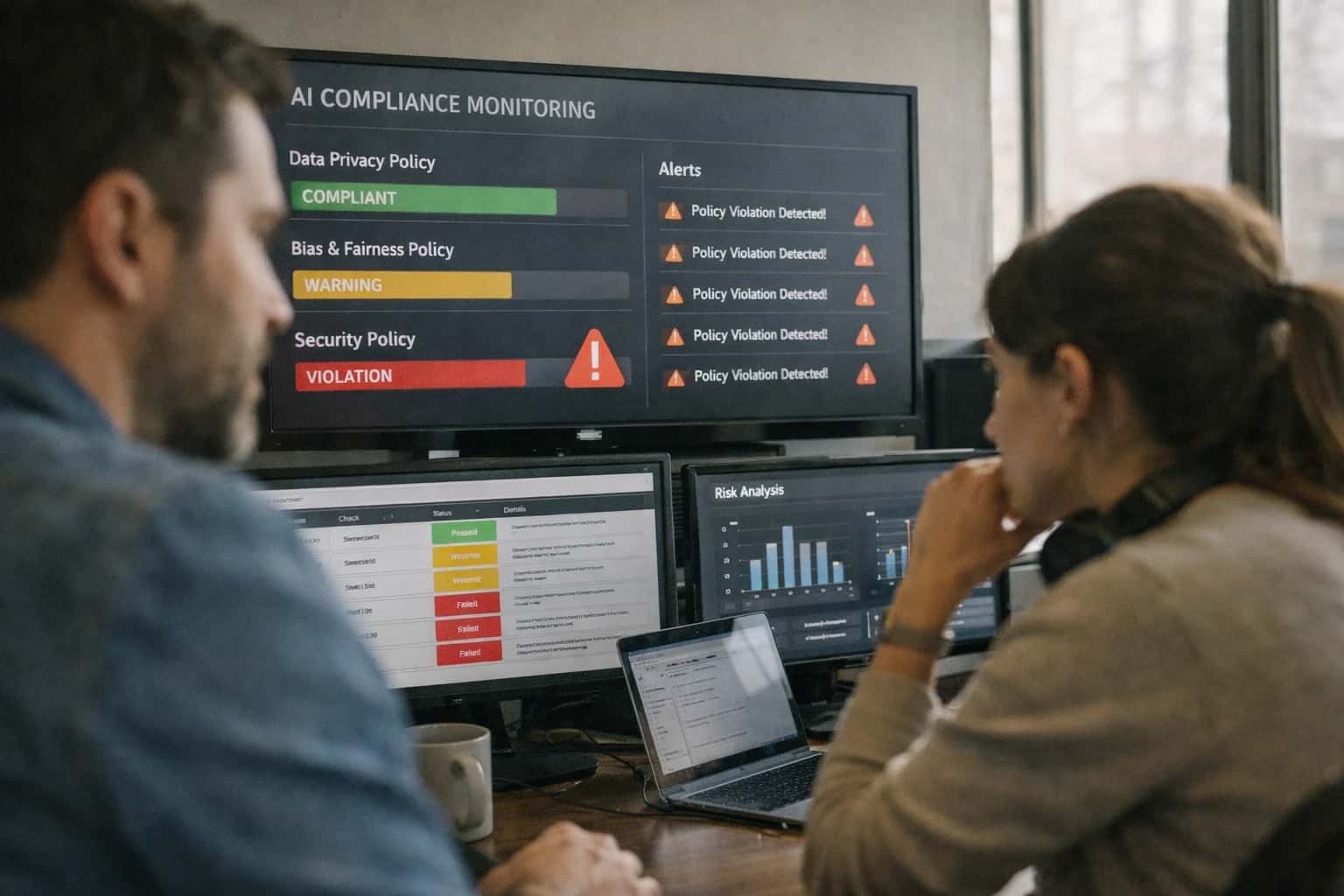
Runtime monitoring is the continuous, real-time observation of an AI agent's inputs, outputs, and internal states during execution to detect policy violations, performance drift, or adversarial attacks for potential intervention.
CONSTITUTIONAL AI
What is Runtime Monitoring?
Runtime monitoring is the continuous, real-time observation of an AI agent's inputs, outputs, and internal states during execution to detect policy violations, performance drift, or adversarial attacks for potential intervention.
The mechanism operates by applying policy-as-code rules to the agent's chain-of-thought reasoning and final outputs, enabling explainable refusal and controlled generation. It is distinct from offline evaluation, as it must act with low latency to enable real-time intervention—such as blocking a harmful action or triggering a self-critique loop—without disrupting operational continuity. This capability is foundational for deploying autonomous systems that require deterministic execution under enterprise AI governance frameworks.
ARCHITECTURAL ELEMENTS
Key Components of a Runtime Monitoring System
A runtime monitoring system for AI agents is a multi-layered architecture designed to observe, evaluate, and potentially intervene in autonomous execution in real-time. Its components work in concert to ensure safety, compliance, and performance.
01
Input/Output Interceptors
Input/Output Interceptors are the first line of monitoring, acting as middleware that captures all data entering and exiting the AI agent. They perform initial validation and sanitization before passing data to the core model or returning results to the user.
- Primary Function: Log raw prompts, tool calls, and final agent outputs for audit trails.
- Key Capability: Apply input validation rules to detect malformed requests or obvious policy violations before processing.
- Example: An interceptor might flag a user prompt containing SQL injection patterns before it reaches an agent with database access.
02
Safety & Policy Classifiers
Safety & Policy Classifiers are specialized machine learning models or rule-based engines that analyze agent inputs, internal states, and outputs for specific categories of risk or non-compliance.
- Primary Function: Continuously score content for toxicity, bias, factual inaccuracy, or deviation from operational guidelines.
- Key Capability: Perform harm classification and jailbreak detection in real-time.
- Architecture: Often run as separate, lightweight models (e.g., a safety classifier) parallel to the main agent to minimize latency impact.
03
State & Telemetry Probes
State & Telemetry Probes are instrumentation points embedded within the agent's cognitive loop (planning, execution, reflection) to capture internal decision-making metrics.
- Primary Function: Emit granular telemetry on token usage, confidence scores, loop iterations, and tool execution latency.
- Key Capability: Enable performance drift detection by tracking metrics like planning time or reasoning steps against established baselines.
- Data Output: Streams time-series data to observability backends (e.g., Prometheus, Datadog) for real-time dashboards and alerting.
04
Governance Hooks & Intervention Layer
The Governance Hooks & Intervention Layer is the system's decision engine. It aggregates signals from classifiers and probes to enforce policies and execute predefined actions.
- Primary Function: Implement refusal mechanisms, trigger automated corrections, or initiate human-in-the-loop escalations.
- Key Capability: Executes policy-as-code rules. For example, a hook might block an output if the safety classifier score exceeds a threshold or if a chain-of-thought suggests unethical reasoning.
- Critical Feature: Must operate with deterministic, low-latency logic to not bottleneck agent response times.
05
Audit Trail & Immutable Logging
Audit Trail & Immutable Logging is the persistent storage layer that records a complete, tamper-evident history of the agent's session for compliance, debugging, and post-hoc analysis.
- Primary Function: Audit trail generation that links user inputs, internal agent states, classifier scores, governance actions, and final outputs into a single trace.
- Key Capability: Supports explainable refusal by storing the specific rule or principle that triggered an intervention.
- Storage: Typically uses write-once databases or blockchain-adjacent ledgers to ensure non-repudiation for regulatory audits.
06
Observability Dashboard & Alerting
The Observability Dashboard & Alerting component is the human-facing interface that provides real-time visibility into agent health, policy adherence, and anomaly detection.
- Primary Function: Visualize key metrics (request volume, principle adherence scoring, latency) and surface active alerts.
- Key Capability: Configure alerting rules (e.g., PagerDuty, Slack webhooks) for critical events like a spike in policy violations or performance degradation.
- User Role: Used by AI operators, security teams, and governance leads to monitor system integrity and respond to incidents.
RUNTIME MONITORING
Frequently Asked Questions
Runtime monitoring is the continuous, real-time observation of an AI agent's execution to ensure safety, performance, and compliance. These FAQs address its core mechanisms, implementation, and role in enterprise AI governance.
Runtime monitoring is the continuous, real-time observation and analysis of an AI agent's inputs, outputs, internal states, and execution traces during its operational lifecycle. It functions as a real-time audit layer that detects policy violations, performance anomalies, security threats, and behavioral drift as they occur, enabling immediate logging, alerting, or automated intervention. Unlike static pre-deployment testing, runtime monitoring provides live telemetry on a system's behavior in dynamic, unpredictable production environments. Its primary components include sensor instrumentation to collect data, detector models (e.g., safety classifiers) to analyze it, and actuator mechanisms (e.g., governance hooks) to enforce policies.
Enabling Efficiency, Speed & Accuracy
Intelligent Analysis, Decision & Execution
We build AI systems for teams that need search across company data, workflow automation across tools, or AI features inside products and internal software.
Talk to Us
Search across company data
Give teams answers from docs, tickets, runbooks, and product data with sources and permissions.
Useful when people spend too long searching or get different answers from different systems.
Enterprise searchRAGPermissions
Read more
Automate internal workflows
Use AI to route work, draft outputs, trigger actions, and keep approvals and logs in place.
Useful when repetitive work moves across multiple tools and teams.
AI agentsWorkflow automationGovernance
Read more
Add AI to products and internal tools
Build assistants, guided actions, or decision support into the software your team or customers already use.
Useful when AI needs to be part of the product, not a separate tool.
AI integrationDecision supportModel routing
Read more
About the author
Prasad Kumkar
CEO & MD, Inference Systems
Prasad Kumkar is the CEO & MD of Inference Systems and writes about AI systems architecture, LLM infrastructure, model serving, evaluation, and production deployment. Over 5+ years, he has worked across computer vision models, L5 autonomous vehicle systems, and LLM research, with a focus on taking complex AI ideas into real-world engineering systems.
His work and writing cover AI systems, large language models, AI agents, multimodal systems, autonomous systems, inference optimization, RAG, evaluation, and production AI engineering.
LinkedIn
Limited slotsGet a Free AI Consultation
Partnered with leading AI, data, and software stack.





How We Work
Custom AI workflows for your Business
One-fit-all AI don't work for modern businesses. At Inferensys, we aim to understand your business & custom requirements; which we use to define most efficient agentic workflows, the data, and the tools for your business.
01
Review the use case
We understand the task, the users, and where AI can actually help.
Read more02
Pick the right approach
We define what needs search, automation, or product integration.
Read more03
Build the first useful version
We implement the part that proves the value first.
Read more04
Improve from there
We add the checks and visibility needed to keep it useful.
Read moreThe first call is a practical review of your use case and the right next step.
Talk to Us