The traditional financial close is a high-stakes bottleneck plagued by manual data aggregation from disparate systems, error-prone reconciliations, and a frantic race against reporting deadlines. This process ties up senior finance talent in repetitive tasks for days, delaying strategic analysis and increasing the risk of compliance errors. The pain is not just operational; it's a direct hit to business agility and decision velocity, as leaders wait for accurate numbers to guide their next move.

Use Case
End-to-End Financial Close Automator
An autonomous AI agent that orchestrates the entire month-end close, from data aggregation to report generation, compressing the cycle from days to hours and reducing costs by 60%.
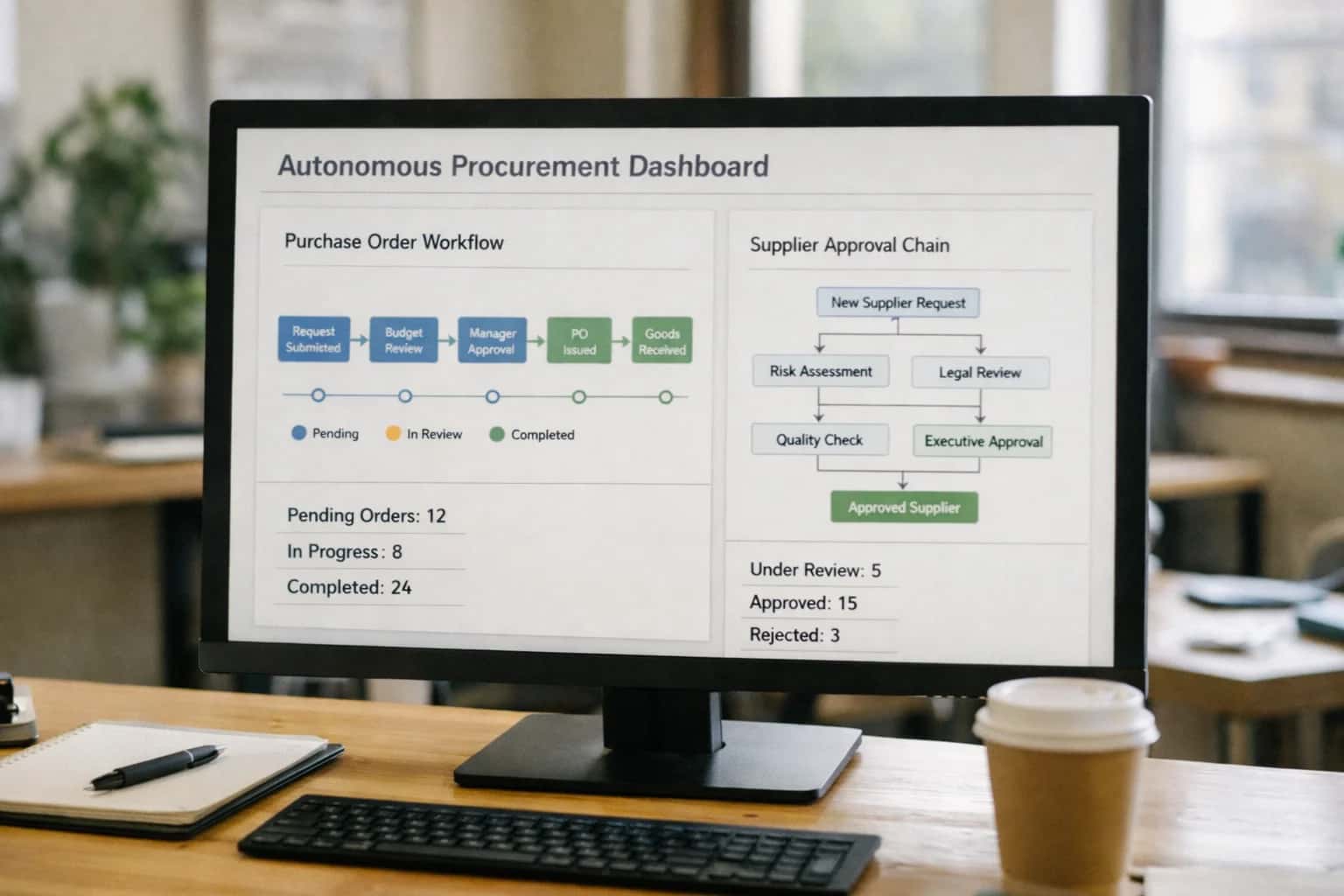
FROM MANUAL STRUGGLE TO AUTONOMOUS EXECUTION
What is End-to-End Financial Close Automator Used For?
The month-end close is a critical but notoriously painful process, consuming valuable time and resources while delaying strategic insights. An End-to-End Financial Close Automator transforms this bottleneck into a competitive advantage.
An End-to-End Financial Close Automator acts as a virtual accounting team, autonomously orchestrating the entire workflow. It aggregates data from ERPs, banks, and sub-ledgers, performs reconciliations, posts adjusting journal entries, and generates preliminary reports—all guided by LLM reasoning to handle exceptions. This compresses the close cycle from days to hours, slashing labor costs by up to 70% and freeing finance professionals for high-value analysis like the insights provided by our Virtual Financial Planning & Analysis (FP&A) Advisor. The result is faster, more accurate financial intelligence.
END-TO-END FINANCIAL CLOSE
Common Use Cases: Where the Automator Delivers ROI
The month-end close is a high-stakes, labor-intensive process prone to delays and errors. Our Financial Close Automator acts as a virtual controller, orchestrating the entire workflow from data aggregation to report generation. Here’s where it delivers tangible business value.
01
Automated Journal Entry Creation & Reconciliation
Eliminate manual data entry and spreadsheet errors. The agent autonomously:
- Aggregates data from ERP, bank feeds, and sub-ledgers.
- Applies business rules to generate and post standard and adjusting journal entries.
- Performs real-time reconciliation, flagging discrepancies for human review.
Real-World Impact: A manufacturing client reduced manual journal entry work by 80%, compressing the reconciliation phase from 3 days to 4 hours.
02
Intercompany Transaction Matching & Elimination
Resolve the most complex and time-consuming close task autonomously. The agent:
- Continuously matches invoices and loans between entities throughout the period.
- Automatically calculates and posts elimination entries.
- Maintains a clear, immutable audit trail for each transaction.
ROI Driver: Slashes the intercompany reconciliation process from a multi-day, multi-person effort to a fully automated overnight task, eliminating consolidation bottlenecks.
03
Dynamic Financial Report Generation
Move from static, after-the-fact reporting to dynamic, on-demand insights. The automator:
- Pulls validated close data to populate P&L, Balance Sheet, and Cash Flow templates.
- Generates management commentary by analyzing variances against forecast and prior periods.
- Securely distributes finalized reports to stakeholders via email or portals.
Business Value: Leadership receives preliminary financials on day 2 of the close instead of day 7, enabling faster strategic decision-making.
04
Continuous Close & Real-Time Flux Analysis
Transform the close from a monthly event to a continuous process. The system provides:
- Daily soft-close snapshots for critical accounts, providing early warning of issues.
- Automated flux analysis that explains significant balance changes using natural language.
- Proactive alerts sent to accountants for anomalies that require investigation.
Competitive Advantage: Finance shifts from historical bookkeeping to forward-looking analysis, supporting a faster, more agile business rhythm.
05
Audit-Ready Workpaper & Trail Automation
Drastically reduce the cost and stress of internal and external audits. The agent:
- Autonomously compiles supporting documentation for every transaction and journal entry.
- Constructs a chronological, context-rich audit trail that is immutable and easily searchable.
- Pre-populates standard audit request (PBC) lists, cutting preparation time by over 70%.
ROI Justification: Reduces audit fees through efficiency and minimizes disruptive ad-hoc requests to your finance team.
06
Compliance & Policy Enforcement
Embed controls directly into the workflow. The automator acts as a virtual enforcer:
- Validates all entries against GAAP/IFRS standards and internal accounting policies.
- Ensures proper segregation of duties by managing automated approval workflows.
- Generates compliance certifications automatically as each close task is completed.
Risk Mitigation: Provides continuous assurance, reducing the risk of material errors and significant audit findings, protecting corporate reputation.
END-TO-END FINANCIAL CLOSE AUTOMATOR
How It Works: The Agentic Orchestration Layer
The month-end close is a high-stakes, high-pressure ritual. Our Agentic Orchestration Layer transforms this manual marathon into an autonomous sprint, delivering auditable results in hours instead of days.
The financial close is a fragile, multi-day process plagued by manual data aggregation from disparate ERPs, error-prone journal entry adjustments, and frantic reconciliations. This operational friction ties up senior staff, delays strategic reporting, and creates significant compliance risk. Every day added to the close cycle is a day of delayed business insight and increased exposure.
Our orchestrator deploys a team of specialized AI agents as a virtual close manager. One agent aggregates and validates data, another applies complex accounting rules to propose entries, while a third performs reconciliations and generates preliminary reports. This agentic workflow compresses the close from days to hours, ensuring 100% policy adherence and freeing your team for high-value analysis. Explore our broader vision for Agentic Enterprise Orchestration and see how it enables Outcome-Based AI Service Models.
Enabling Efficiency, Speed & Accuracy
Intelligent Analysis, Decision & Execution
We build AI systems for teams that need search across company data, workflow automation across tools, or AI features inside products and internal software.
Talk to Us
Search across company data
Give teams answers from docs, tickets, runbooks, and product data with sources and permissions.
Useful when people spend too long searching or get different answers from different systems.
Enterprise searchRAGPermissions
Read more
Automate internal workflows
Use AI to route work, draft outputs, trigger actions, and keep approvals and logs in place.
Useful when repetitive work moves across multiple tools and teams.
AI agentsWorkflow automationGovernance
Read more
Add AI to products and internal tools
Build assistants, guided actions, or decision support into the software your team or customers already use.
Useful when AI needs to be part of the product, not a separate tool.
AI integrationDecision supportModel routing
Read moreEND-TO-END FINANCIAL CLOSE AUTOMATOR
Implementation Roadmap: From Pilot to Full Autonomy
A strategic, phased approach to deploying an autonomous financial close agent, designed to deliver rapid ROI while mitigating risk and building internal confidence.
01
Phase 1: The Pilot - Prove Value on a Single Sub-Ledger
Start with a contained, high-volume process like accounts payable reconciliation or fixed asset depreciation. This phase is about proving the AI's ability to autonomously execute a defined workflow with human-in-the-loop verification. Key activities include:
- Process Mapping: Define the exact steps, data sources, and validation rules.
- Agent Configuration: Train the orchestration agent on your specific chart of accounts and policies.
- Parallel Run: Execute the process manually and via the AI agent for 1-2 cycles, comparing outputs.
Real-World Example: A manufacturing client automated intercompany reconciliations for one subsidiary, reducing a 3-day manual task to 45 minutes with 99.8% accuracy, justifying immediate expansion.
02
Phase 2: Scale to Core Close Modules
Expand the agent's scope to orchestrate multiple interdependent close activities. This phase targets compressing the close timeline and reducing manual effort.
- Integrate Key Systems: Connect the agent to ERP (e.g., SAP, Oracle), consolidation tools, and data lakes.
- Enable Cross-Process Reasoning: The agent now handles sequences like accruals → journal entries → trial balance review.
- Implement Control Gates: Define thresholds for automated approval vs. human escalation.
Quantifiable Benefit: Clients typically see a 40-60% reduction in the time spent on these core modules within 2-3 months, freeing senior accountants for exception handling and analysis.
03
Phase 3: Full Process Orchestration & Continuous Learning
The agent becomes the primary orchestrator of the entire month-end close. It autonomously sequences tasks, manages dependencies, and learns from corrections to improve future cycles.
- End-to-End Workflow: From data aggregation and validation to preliminary reporting and audit trail generation.
- Predictive Alerting: The agent identifies potential discrepancies (e.g., outlier journal entries) before the close is finalized.
- Knowledge Capture: Human overrides and adjustments are fed back to refine the agent's logic.
Outcome: Close cycles are compressed from 10-12 days to 2-3 days, enabling faster reporting and strategic decision-making.
04
Phase 4: Strategic Autonomy & Proactive Insight
The system evolves from a process automator to a strategic financial intelligence platform. The agent provides predictive analytics and prescriptive recommendations.
- Anomaly Explanation: Automatically researches and explains the root cause of variances.
- Scenario Modeling: Projects the impact of operational decisions on the close (e.g., a large, late invoice).
- Natural Language Interaction: Finance leadership queries the close status and drivers conversationally.
Business Value: This shifts the finance team's role from historical reporting to forward-looking business partnership, directly impacting strategic planning and competitive agility.
05
ROI Justification: The Hard Numbers for Your Business Case
Justifying investment requires moving beyond efficiency gains to tangible financial impact. A typical business case includes:
- Direct Cost Savings: 60-80% reduction in manual processing costs (FTE reallocation).
- Working Capital Improvement: Faster close enables quicker billing and collections, improving DSO.
- Risk Mitigation: Near-elimination of manual errors and late filings, avoiding regulatory penalties.
- Audit Cost Reduction: 50-70% less time spent on audit preparation due to immutable, AI-generated audit trails.
Payback Period: Most enterprises achieve full ROI in 6-9 months post full deployment, with annual run-rate savings in the millions.
06
Overcoming Key Implementation Challenges
Acknowledging and planning for hurdles is critical for success. Common challenges and our mitigation strategies:
- Data Quality & Silos: Start with a well-understood data stream. The agent can be configured to flag and request missing data.
- Change Management: Position the AI as a 'virtual team member' that handles repetitive work, not a replacement. Involve the finance team in design from Day 1.
- Governance & Control: Maintain a clear audit log of all AI actions and decisions. Implement role-based approval workflows for high-risk adjustments.
Critical Success Factor: Partner with a provider like Inference Systems that offers outcome-based service models, aligning success with your business results.

About the author
Prasad Kumkar
CEO & MD, Inference Systems
Prasad Kumkar is the CEO & MD of Inference Systems and writes about AI systems architecture, LLM infrastructure, model serving, evaluation, and production deployment. Over 5+ years, he has worked across computer vision models, L5 autonomous vehicle systems, and LLM research, with a focus on taking complex AI ideas into real-world engineering systems.
His work and writing cover AI systems, large language models, AI agents, multimodal systems, autonomous systems, inference optimization, RAG, evaluation, and production AI engineering.
LinkedIn
Limited slotsGet a Free AI Consultation
Partnered with leading AI, data, and software stack.





How We Work
Custom AI workflows for your Business
One-fit-all AI don't work for modern businesses. At Inferensys, we aim to understand your business & custom requirements; which we use to define most efficient agentic workflows, the data, and the tools for your business.
01
Review the use case
We understand the task, the users, and where AI can actually help.
Read more02
Pick the right approach
We define what needs search, automation, or product integration.
Read more03
Build the first useful version
We implement the part that proves the value first.
Read more04
Improve from there
We add the checks and visibility needed to keep it useful.
Read moreThe first call is a practical review of your use case and the right next step.
Talk to Us