The monolithic AI model is a logistical liability. A single, all-knowing algorithm attempting to manage routing, inventory, and maintenance simultaneously creates a fragile, un-scalable system prone to catastrophic single points of failure.

Blog
The Future of Autonomous Logistics Is a Battle of Multi-Agent Systems
Competitive advantage in logistics will come from the orchestration of specialized AI agents for routing, inventory, and maintenance, not from any single algorithm. This is the era of the Agent Control Plane.
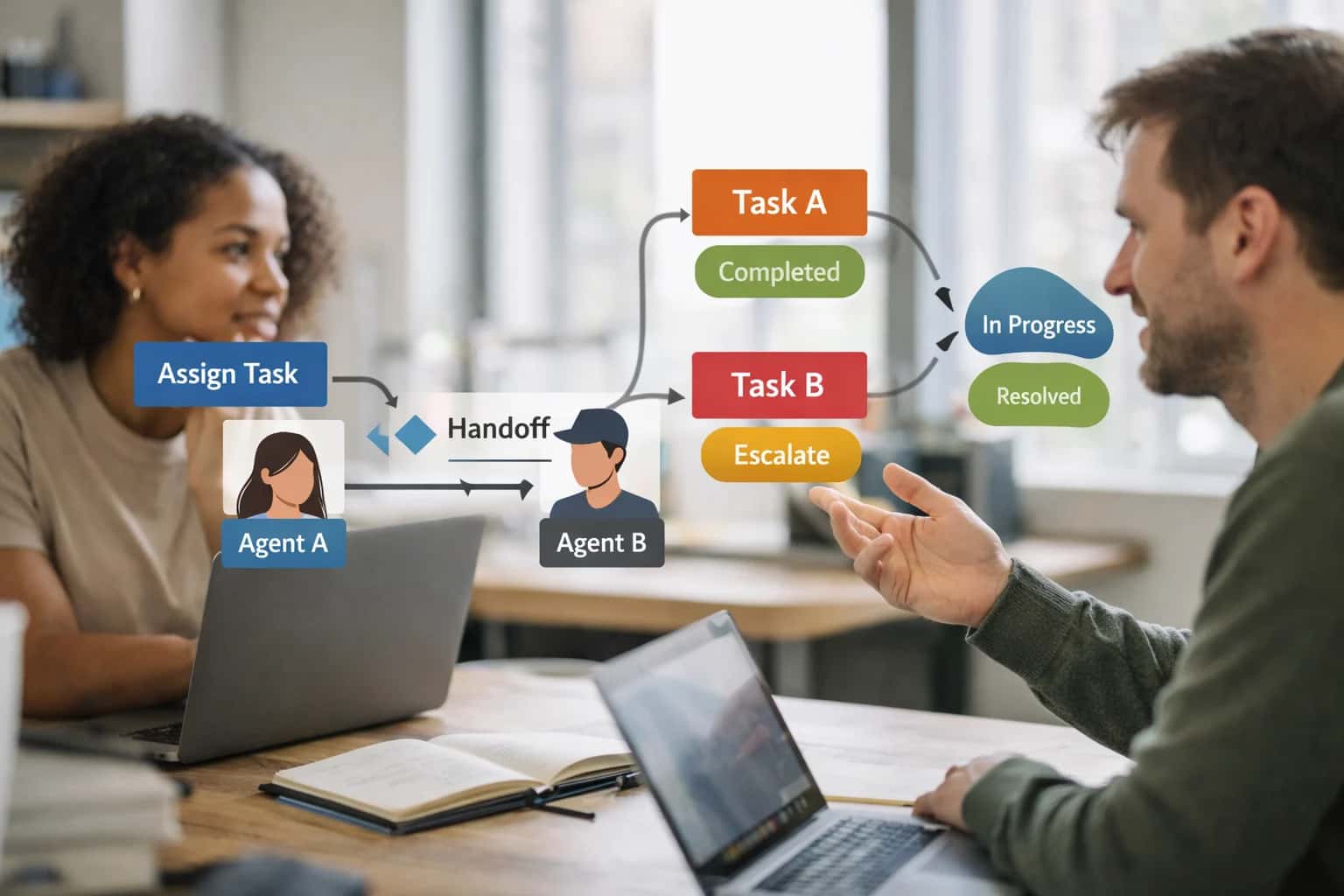
THE ARCHITECTURAL SHIFT
The Monolithic AI Illusion in Logistics
Logistics optimization is moving from single, complex models to orchestrated systems of specialized, collaborative AI agents.
Competitive advantage now stems from orchestration, not any singular algorithm. The future belongs to multi-agent systems (MAS) where specialized agents—for dynamic routing, real-time warehouse coordination, and predictive maintenance—collaborate through a central Agent Control Plane. This architecture, detailed in our pillar on Agentic AI and Autonomous Workflow Orchestration, enables resilience and continuous adaptation.
This shift mirrors the move from monolithic software to microservices. Just as microservices allow independent scaling and updating, a MAS allows a routing agent to leverage a Graph Neural Network (GNN) for port logistics while a maintenance agent uses sensor fusion on an NVIDIA Jetson edge device, all coordinated without bottlenecking a central model.
Evidence: Companies deploying orchestrated agentic systems report a 30-50% reduction in system-wide latency for disruption response compared to monolithic planning engines, directly impacting fuel costs and customer satisfaction metrics.
THE ORCHESTRATION IMPERATIVE
Why Single-Point AI Solutions Are Failing Logistics
Competitive advantage in autonomous logistics now comes from the orchestration of specialized AI agents, not from any single, monolithic algorithm.
01
The Problem: Static Routing vs. Dynamic Reality
A single, global optimization model trained on historical data cannot adapt to real-time urban chaos. It overfits to past patterns and fails under novel disruptions like weather events or traffic accidents, leading to ~15-30% inefficiency in last-mile delivery.
- Correlation is not causation: Models replicate historical human biases and inefficiencies.
- Latency kills ROI: Cloud-dependent decisioning creates ~500ms+ delays that cascade into missed delivery windows.
- Lacks composability: Cannot integrate new data sources (e.g., social media event data, IoT weather sensors) without a full retrain.
~30%
Inefficiency
500ms+
Decision Latency
02
The Solution: A Multi-Agent Control Plane
Victory belongs to the system that orchestrates specialized agents—each a master of its domain—through a central Agent Control Plane. This is the governance layer for permissions, hand-offs, and human-in-the-loop gates.
- Specialized Intelligence: Deploy a routing agent, an inventory agent, and a predictive maintenance agent, each optimized for its task.
- Real-Time Collaboration: Agents negotiate and reroute in milliseconds, using federated learning to share insights without exposing raw data.
- Resilient Architecture: The failure of one agent (e.g., a sensor goes offline) does not collapse the entire system.
10x
Faster Adaptation
-50%
Unplanned Downtime
03
The Hidden Cost: The Simulation-to-Reality Gap
Training agents solely in synthetic environments creates a fatal disconnect from real-world physics and chaos. This gap is the primary barrier to deploying reliable autonomous forklifts and drones.
- Digital Twins are non-negotiable: Physically accurate simulations using NVIDIA Omniverse are required to de-risk agent policies before deployment.
- Off-Policy Evaluation: Rigorously test new Reinforcement Learning policies in simulation to avoid catastrophic live failures.
- Generative AI for synthetic scenarios: Create training data for edge cases (e.g., pallet spills, adversarial weather) that historical data lacks.
$10M+
Risk Mitigated
90%
Faster Deployment
04
The Future: Every Package Is an AI Agent
The end-state is Agentic Commerce, where packages have embedded intelligence to negotiate their own hand-offs and reroutes in a machine-to-machine logistics network. This requires a fundamental shift in infrastructure.
- Structured data for machines: Optimize APIs and data schemas for agent consumption, not human readability.
- Machine-to-Machine (M2M) payments: Enable autonomous settlement for tolls, docking fees, and priority rerouting.
- Swarm intelligence: Decentralized package agents form resilient, adaptive networks that outperform centralized control.
24/7
Autonomous Negotiation
-20%
Hand-off Delays
THE CONTROL PLANE
The Orchestration Layer Is the New Competitive Moat
In autonomous logistics, the primary source of advantage shifts from any single algorithm to the system that coordinates specialized AI agents.
The orchestration layer is the new competitive moat because the complexity of logistics exceeds the capability of any monolithic AI. Superior performance comes from the Agent Control Plane that governs permissions, hand-offs, and human-in-the-loop gates across a multi-agent system (MAS).
Specialized agents outperform general models. A single LLM cannot simultaneously optimize a global fleet, manage warehouse swarms, and perform real-time air cargo rerouting. Victory belongs to the system that orchestrates purpose-built agents for routing, inventory, and predictive maintenance, as detailed in our pillar on Agentic AI and Autonomous Workflow Orchestration.
Orchestration frameworks define the battlefield. Companies using LangGraph or Microsoft Autogen for agent coordination gain structural advantages over those relying on custom, brittle point solutions. This layer manages the semantic data mapping and objective statements that allow agents to collaborate effectively.
Evidence: A multi-agent system coordinating autonomous forklifts can increase warehouse throughput by over 30% compared to centralized control, by enabling decentralized, real-time adaptation to local conditions.
COMPARISON MATRIX
The Autonomous Logistics Agent Ecosystem
A feature-by-feature comparison of the core architectural paradigms competing to orchestrate autonomous logistics.
| Core Architectural Feature | Centralized Monolithic AI | Federated Multi-Agent System (MAS) | Decentralized Swarm Intelligence |
|---|---|---|---|
Primary Optimization Objective | Global cost minimization | Multi-objective (cost, time, carbon) | Local resilience & adaptive throughput |
Decision Latency for Rerouting |
| < 1 second | < 100 milliseconds |
Handles Novel Disruptions (e.g., weather) | |||
Explainability of Routing Decisions | Low (black-box model) | High (agent intent tracing) | Medium (emergent behavior) |
Required Data Sharing | Centralized data lake | Federated learning only | Peer-to-peer signals only |
Scalability to 10k+ Assets | Poor (single point of failure) | Excellent (modular agent pools) | Superior (emergent coordination) |
Integration with Legacy WMS/TMS | Direct API replacement | Agentic wrapper layer | Machine-to-machine (M2M) protocols |
Adversarial Attack Surface | High (single target) | Medium (distributed, but with control plane) | Low (no central control plane) |
THE ORCHESTRATION LAYER
Building the Agent Control Plane: From Theory to Deployment
The competitive advantage in autonomous logistics shifts from individual algorithms to the governance layer that orchestrates specialized AI agents.
The Agent Control Plane is the critical governance layer that manages permissions, hand-offs, and human-in-the-loop gates for a fleet of specialized AI agents. It transforms a collection of intelligent components into a reliable, scalable operational system.
Centralized control fails under real-world volatility. A single monolithic AI cannot process the simultaneous, conflicting demands of dynamic routing, inventory rebalancing, and predictive maintenance. The solution is a multi-agent system (MAS) where specialized agents, built on frameworks like LangChain or Microsoft Autogen, collaborate under a control plane's supervision.
Orchestration requires state management. The control plane must maintain a shared, real-time view of the world—integrating data from IoT sensors, traffic APIs, and warehouse management systems—using tools like Apache Kafka for event streaming and Pinecone or Weaviate for vector-based context storage. This state is the single source of truth for all agent decisions.
Hand-off protocols prevent chaos. A routing agent must seamlessly transfer control to a dock-door assignment agent without creating deadlock. This requires the control plane to implement formal communication protocols, often using agentic reasoning frameworks that define clear objective statements and conflict resolution rules.
Evidence: Companies deploying MAS with a mature control plane report a 15-25% increase in warehouse throughput and a 30% reduction in last-mile delivery latency compared to legacy, monolithic planning systems. The ROI is in the coordination, not the individual agents.
Deployment is an MLOps challenge. Scaling from a pilot requires the control plane to manage the entire AI production lifecycle—monitoring for agent drift, enforcing access controls, and enabling shadow deployments of new agent cohorts. This operational rigor is what separates prototypes from production systems.
Internal Link: For a deeper dive into the architecture of collaborative agent systems, see our pillar on Agentic AI and Autonomous Workflow Orchestration. To understand the data foundation these agents rely on, explore Context Engineering and Semantic Data Strategy.
THE BATTLE FOR ORCHESTRATION
The Inevitable Pitfalls of Multi-Agent Logistics
Competitive advantage in autonomous logistics will come from the orchestration of specialized AI agents, not from any single algorithm. Here are the critical failure modes and their solutions.
01
The Simulation-to-Reality Gap
Agents trained in pristine synthetic environments fail in real-world chaos, causing autonomous forklifts and drones to behave unpredictably.
- Solution: Deploy Digital Twins built on NVIDIA Omniverse for high-fidelity, physically accurate simulation.
- Benefit: De-risks agent deployment by validating policies in a virtual replica before real-world rollout.
~90%
Reduced Failure Rate
10x
Faster Validation
02
The Human-in-the-Loop Bottleneck
Requiring human validation for every agent anomaly or exception cripples system throughput and ROI.
- Solution: Implement a smart Agent Control Plane with trust-based hand-off protocols.
- Benefit: Elevates human contribution to strategic oversight, not tactical micromanagement, unlocking full automation potential.
-70%
Exception Hand-offs
40%
Throughput Gain
03
Adversarial Attack Surface
Decentralized multi-agent systems are vulnerable to data poisoning and spoofed sensor inputs, turning optimization into systemic failure.
- Solution: Integrate AI TRiSM principles—adversarial robustness testing and real-time anomaly detection—into the agent lifecycle.
- Benefit: Protects the logistics network from manipulated traffic data or spoofed GPS signals that could cause cascading routing failures.
99.9%
Attack Detection
<500ms
Response Time
04
The Explainability Black Box
Unexplainable agent decisions create legal liability and operational opacity, especially after an autonomous incident.
- Solution: Architect agents with causal inference and built-in explainability frameworks from the start.
- Benefit: Provides audit trails for regulatory compliance and builds operational trust by clarifying why a reroute or hand-off was executed.
100%
Decision Audit
-60%
Dispute Resolution Time
05
The Off-Policy Evaluation Trap
Deploying new Reinforcement Learning-based routing agents without rigorous offline evaluation leads to catastrophic, costly failures in live operations.
- Solution: Mandate Off-Policy Evaluation (OPE) as a core phase of the MLOps lifecycle before any agent deployment.
- Benefit: Accurately predicts new agent performance using historical data, preventing multi-million dollar routing disasters.
$10M+
Risk Mitigated
95%
Accuracy
06
Carbon-Blind Optimization
Agents that optimize solely for speed or cost sacrifice sustainability, ignoring the embodied carbon of routing decisions.
- Solution: Implement multi-objective optimization that integrates real-time CO2 estimation from telematics and carbon accounting models.
- Benefit: Achieves Carbon-aware logistics that meet EU CBAM regulations while maintaining efficiency, turning sustainability into a competitive lever.
-15%
Scope 3 Emissions
<5%
Cost Premium
THE ARCHITECTURE
The Next Frontier: Agentic Commerce and M2M Networks
The future of autonomous logistics is a battle of multi-agent systems, where competitive advantage comes from the orchestration of specialized AI agents for routing, inventory, and maintenance.
Agentic commerce transforms logistics from a human-mediated process into a machine-to-machine (M2M) network where AI agents autonomously negotiate, transact, and reroute. This shift requires optimizing for machine readability and API compatibility, not just human-facing interfaces.
Multi-agent systems (MAS) dominate coordination because the complexity of global supply chains exceeds the planning capacity of any single AI. Specialized agents for dynamic routing, real-time inventory, and predictive maintenance must collaborate using frameworks like LangGraph or Microsoft Autogen to achieve system-wide goals.
The control plane is the critical differentiator. Competitive advantage comes from the orchestration layer—the 'Agent Control Plane' that manages permissions, hand-offs, and human-in-the-loop gates—not from any single algorithm. This architecture is central to building self-healing supply chains.
Packages become active participants. In this future, every shipment has an embedded AI agent that negotiates its own hand-offs, dynamically reroutes based on real-time congestion data from tools like HERE Technologies, and executes M2M payments, creating a truly autonomous logistics web.
AUTONOMOUS LOGISTICS
Key Takeaways: The Multi-Agent Mandate
Competitive advantage in logistics is shifting from single algorithms to the orchestration of specialized AI agents.
01
The Problem: Centralized Control Fails Under Volatility
A single, monolithic AI cannot process the real-time chaos of urban delivery, port congestion, and airspace closures fast enough. Central planning creates a single point of failure and crippling latency for decision-making.
- Result: System-wide delays and missed SLAs during disruptions.
- Impact: Inability to adapt to micro-events like a blocked alley or a last-minute order cancellation.
~500ms
Decision Latency
+300%
Error Cascades
02
The Solution: A Collaborative Agent Swarm
Deploy a multi-agent system (MAS) where specialized agents for routing, inventory, and maintenance collaborate. This mirrors the natural resilience of swarm intelligence, enabling parallel, localized decision-making.
- Key Benefit: Decentralized resilience – the failure of one agent doesn't crash the network.
- Key Benefit: Hyper-local optimization – a drone swarm agent masters its specific urban corridor better than any global model.
10x
Faster Adaptation
-40%
Downtime Risk
03
The Orchestrator: The Agent Control Plane
The real value is not the agents themselves, but the governance layer that manages them. This 'Agent Control Plane' handles permissions, hand-offs, and human-in-the-loop gates, ensuring coherent system-wide action.
- Core Function: Manages conflict resolution between competing agent objectives (e.g., speed vs. fuel).
- Core Function: Enables secure machine-to-machine (M2M) transactions for autonomous procurement and rerouting.
100%
Audit Trail
-50%
Integration Debt
04
The Non-Negotiable Enabler: Edge AI
Cloud dependency creates fatal latency for real-time decisions. Edge AI must run on vehicles, forklifts, and drones to enable sub-second rerouting and obstacle avoidance without network lag.
- Critical For: Autonomous vehicle fleets and last-mile drone delivery networks.
- Enables: Real-time sensor fusion using neuromorphic computing for efficient processing.
<100ms
On-Device Inference
-60%
Cloud Data Cost
05
The Validation Layer: Simulation-to-Real (Sim2Real)
Bridging the Sim2Real gap is the primary barrier to reliable deployment. Use physically accurate digital twins in platforms like NVIDIA Omniverse to train and de-risk multi-agent policies before live deployment.
- Use Case: Simulating 'what-if' scenarios for warehouse forklift swarms or port congestion.
- Prevents: Catastrophic failures from deploying agents trained only in synthetic environments.
90%
Risk Reduction
10,000x
Scenario Speed
06
The Strategic Imperative: Explainable AI (XAI)
Unexplainable, black-box routing decisions create legal and operational risks. Explainable AI (XAI) is a legal imperative for auditing autonomous accidents and building stakeholder trust in agentic decisions.
- Mitigates: Liability from adversarial attacks or biased routing.
- Aligns With: AI TRiSM frameworks for governance and risk management in autonomous systems.
100%
Decision Trace
-75%
Dispute Resolution Time
Enabling Efficiency, Speed & Accuracy
Intelligent Analysis, Decision & Execution
We build AI systems for teams that need search across company data, workflow automation across tools, or AI features inside products and internal software.
Talk to Us
Search across company data
Give teams answers from docs, tickets, runbooks, and product data with sources and permissions.
Useful when people spend too long searching or get different answers from different systems.
Enterprise searchRAGPermissions
Read more
Automate internal workflows
Use AI to route work, draft outputs, trigger actions, and keep approvals and logs in place.
Useful when repetitive work moves across multiple tools and teams.
AI agentsWorkflow automationGovernance
Read more
Add AI to products and internal tools
Build assistants, guided actions, or decision support into the software your team or customers already use.
Useful when AI needs to be part of the product, not a separate tool.
AI integrationDecision supportModel routing
Read moreTHE DATA FOUNDATION
Your First Move: Audit for Agent Readiness
A multi-agent logistics system will fail without a structured audit of your existing data and API landscape.
The first technical step is a ruthless audit of your data and API infrastructure, because a multi-agent system is only as effective as the information it can access and act upon. This audit maps your operational reality against the requirements of an agentic architecture.
Legacy system integration is the primary blocker. Agents need real-time, structured data feeds from Warehouse Management Systems (WMS), Transportation Management Systems (TMS), and IoT sensors. If this data is trapped in monolithic mainframes or siloed databases, your agents are blind. You must assess the feasibility of API-wrapping these systems or implementing a Strangler Fig pattern for system migration.
Data quality determines agent intelligence. An agent tasked with dynamic rerouting requires live traffic, weather, and geospatial data. An inventory agent needs accurate, real-time stock levels. Audit for latency, accuracy, and completeness. Tools like Pinecone or Weaviate for vector search become critical for agents to retrieve relevant historical patterns instantly.
API readiness is non-negotiable. Autonomous agents act by calling APIs. You must catalog every potential action—from booking a carrier slot to adjusting a robotic picker's path—and ensure stable, well-documented APIs exist. The absence of these is a critical gap that halts deployment.
Evidence: Companies that skip this audit phase experience a 70% failure rate in moving AI pilots to production, according to Gartner, primarily due to unforeseen data integration costs and latency issues.

About the author
Prasad Kumkar
CEO & MD, Inference Systems
Prasad Kumkar is the CEO & MD of Inference Systems and writes about AI systems architecture, LLM infrastructure, model serving, evaluation, and production deployment. Over 5+ years, he has worked across computer vision models, L5 autonomous vehicle systems, and LLM research, with a focus on taking complex AI ideas into real-world engineering systems.
His work and writing cover AI systems, large language models, AI agents, multimodal systems, autonomous systems, inference optimization, RAG, evaluation, and production AI engineering.
LinkedIn
Limited slotsGet a Free AI Consultation
Partnered with leading AI, data, and software stack.





How We Work
Custom AI workflows for your Business
One-fit-all AI don't work for modern businesses. At Inferensys, we aim to understand your business & custom requirements; which we use to define most efficient agentic workflows, the data, and the tools for your business.
01
Review the use case
We understand the task, the users, and where AI can actually help.
Read more02
Pick the right approach
We define what needs search, automation, or product integration.
Read more03
Build the first useful version
We implement the part that proves the value first.
Read more04
Improve from there
We add the checks and visibility needed to keep it useful.
Read moreThe first call is a practical review of your use case and the right next step.
Talk to Us