Simulation intelligence is the core value. The industrial metaverse's primary output is optimized decisions, not immersive experiences. While VR offers visualization, AI-driven simulation within a physically accurate digital twin enables predictive scenario modeling and autonomous decision-making that directly impacts throughput and cost.

Blog
The Future of the Industrial Metaverse Is Not Virtual Reality, It's Simulation Intelligence
The core value of the industrial metaverse lies in AI-driven simulation and optimization, not immersive visualization. This article explains how Simulation Intelligence enables predictive scenario modeling and autonomous decision-making for factories and supply chains.
THE CORE VALUE
VR is a Distraction, Simulation is the Engine
The industrial metaverse's primary output is optimized decisions, not immersive experiences, driven by AI-powered simulation intelligence.
VR addresses human perception, simulation addresses system physics. VR is a display technology for a single user; simulation engines like NVIDIA Omniverse and physics frameworks model material stress, fluid dynamics, and thermal properties at scale. This deterministic backbone is what allows AI to train and validate control policies in a risk-free virtual environment.
The ROI is in the loop, not the headset. Investment should prioritize the simulation-to-actuation loop, where AI agents run millions of 'what-if' scenarios to optimize factory layouts or supply chain flows. The value is captured when these insights drive autonomous systems or prescriptive alerts for human operators, a process detailed in our analysis of AI-driven 'what-if' simulation loops.
Evidence: NVIDIA's industrial focus. NVIDIA's pivot from consumer GPUs to its Omniverse platform and OpenUSD framework underscores the market shift. Their partnerships with Siemens and BMW focus on building simulation-first digital twins for manufacturing, not VR showrooms, cementing simulation as the essential AI operating system for industry.
FROM VISUALIZATION TO AUTONOMY
Three Trends Driving the Simulation Intelligence Shift
The industrial metaverse's core value is shifting from immersive VR to AI-driven simulation that enables predictive modeling and autonomous decision-making.
01
The Problem: Silos Between IoT Data and Simulation Models
Treating live sensor data and the digital twin as separate systems creates a fatal context gap. AI cannot correlate cause and effect, rendering predictive insights useless.
- Solution: Converge IoT platforms with the simulation engine using OpenUSD as the unifying data layer.
- Result: Enables real-time, causally accurate simulation loops where AI can diagnose root causes and prescribe actions.
-50%
Diagnosis Time
100ms
Data Sync Latency
02
The Problem: Static Models Cannot Discover Optimal Policies
A digital twin that only visualizes or replays data is a costly dashboard. It cannot autonomously learn to improve system performance.
- Solution: Integrate Reinforcement Learning (RL) as the core engine for autonomous digital twins.
- Result: AI agents run millions of 'what-if' simulation loops in a risk-free environment to discover and validate optimal control strategies for throughput, energy, and maintenance.
10x
Scenario Speed
+15%
System Efficiency
03
The Problem: Proprietary Engines Create Strategic Fragility
Vendor-locked simulation tools and data formats prevent the integration of best-in-class AI models and create long-term technical debt.
- Solution: Architect around open standards, specifically NVIDIA Omniverse and the OpenUSD framework.
- Result: Enables a composable AI stack, allowing you to plug in specialized models for physics, computer vision, and predictive analytics without platform constraints.
-70%
Integration Cost
Open
Architecture
THE EVOLUTION
From Static Model to Autonomous AI Nervous System
The digital twin is evolving from a passive visualization into an autonomous AI nervous system that senses, predicts, and prescribes actions for the physical world.
The digital twin is the AI nervous system. It moves beyond a static 3D model to become a real-time, autonomous control plane that senses, predicts, and prescribes actions for the physical world. This evolution is powered by the integration of NVIDIA Omniverse and the OpenUSD framework, which provide the essential simulation and interoperability layer.
Static models lack predictive agency. A traditional CAD model or basic visualization is a snapshot; it cannot run 'what-if' scenarios or learn from data. The autonomous nervous system continuously ingests IoT sensor streams, applies physics-based simulation, and uses AI to optimize outcomes like throughput or energy efficiency in real-time.
Reinforcement Learning (RL) is the core engine. RL agents operating within the twin environment discover optimal control policies through millions of simulated trials, a process impossible and prohibitively risky in the real world. This turns the twin from a diagnostic tool into a prescriptive AI platform.
Evidence: Companies deploying AI-driven digital twins report 15-20% increases in operational throughput and 30% reductions in unplanned downtime through predictive maintenance. Frameworks like PyTorch and TensorFlow are now being integrated directly into simulation loops within platforms like Omniverse to enable this autonomous learning.
COMPARISON MATRIX
The Simulation Intelligence Stack: Core Components and AI Models
A feature and capability comparison of the core technologies that constitute a Simulation Intelligence platform for the Industrial Metaverse.
| Core Component / AI Model | NVIDIA Omniverse & OpenUSD | Proprietary Visualization Suite | IoT Platform with Basic 3D |
|---|---|---|---|
Physics Simulation Fidelity | Deterministic, multi-physics (NVIDIA PhysX, Flow, Blast) | Visual approximation only | None or rudimentary |
Universal Scene Description (USD) Support | Native foundation for data composition & interchange | Proprietary format only | |
Real-Time Data Synchronization Latency | < 100 ms for sensor-to-twin sync |
| ~1-5 sec |
AI Model Integration Layer | Native connectors for PyTorch, TensorFlow, RLlib | Limited or custom API required | Basic data export only |
Multi-Agent System (MAS) Orchestration | |||
Reinforcement Learning (RL) Training Environment | Physically accurate sandbox for policy training | Not designed for RL | |
Explainable AI (XAI) & Causal Inference Tools | Integrated for model audit & safety (AI TRiSM) | Post-hoc analysis only | |
Edge AI Inference & Low-Latency Control Loops | NVIDIA Jetson/IGX orchestration via Omniverse | Cloud-only rendering | Gateway-based, limited control |
BEYOND VISUALIZATION
Simulation Intelligence in Action: Use Cases Beyond Hype
The industrial metaverse's core value is AI-driven simulation for predictive optimization and autonomous decision-making, not immersive VR.
01
The Problem: Catastrophic Factory Downtime from Unplanned Failures
Reactive maintenance leads to multi-million dollar production halts and safety incidents. Traditional predictive models fail to capture complex, interacting failure modes across interconnected systems.
- The Solution: A continuously learning digital shadow that ingests real-time sensor data (vibration, thermal, acoustic) to model precise asset degradation curves.
- Key Benefit: Shift from schedule-based to condition-based maintenance, predicting failures with >95% accuracy weeks in advance.
- Key Benefit: Enable prescriptive maintenance workflows, where the AI automatically generates and prioritizes work orders for technicians.
-40%
Downtime
>95%
Prediction Accuracy
02
The Problem: Multi-Million Dollar Waste from Inefficient Factory Layouts
Static factory floors cannot adapt to new product lines or demand shifts, causing bottlenecks, excess WIP inventory, and ~15% throughput loss.
- The Solution: AI-driven 'what-if' simulation loops within a NVIDIA Omniverse-powered digital twin, running millions of generative layout scenarios.
- Key Benefit: Autonomous optimization for conflicting goals: maximize throughput, minimize energy use, and ensure worker safety.
- Key Benefit: Achieve real-time layout adaptation; the system proposes validated floor plan changes in response to live order data.
+20%
Throughput
-15%
Energy Cost
03
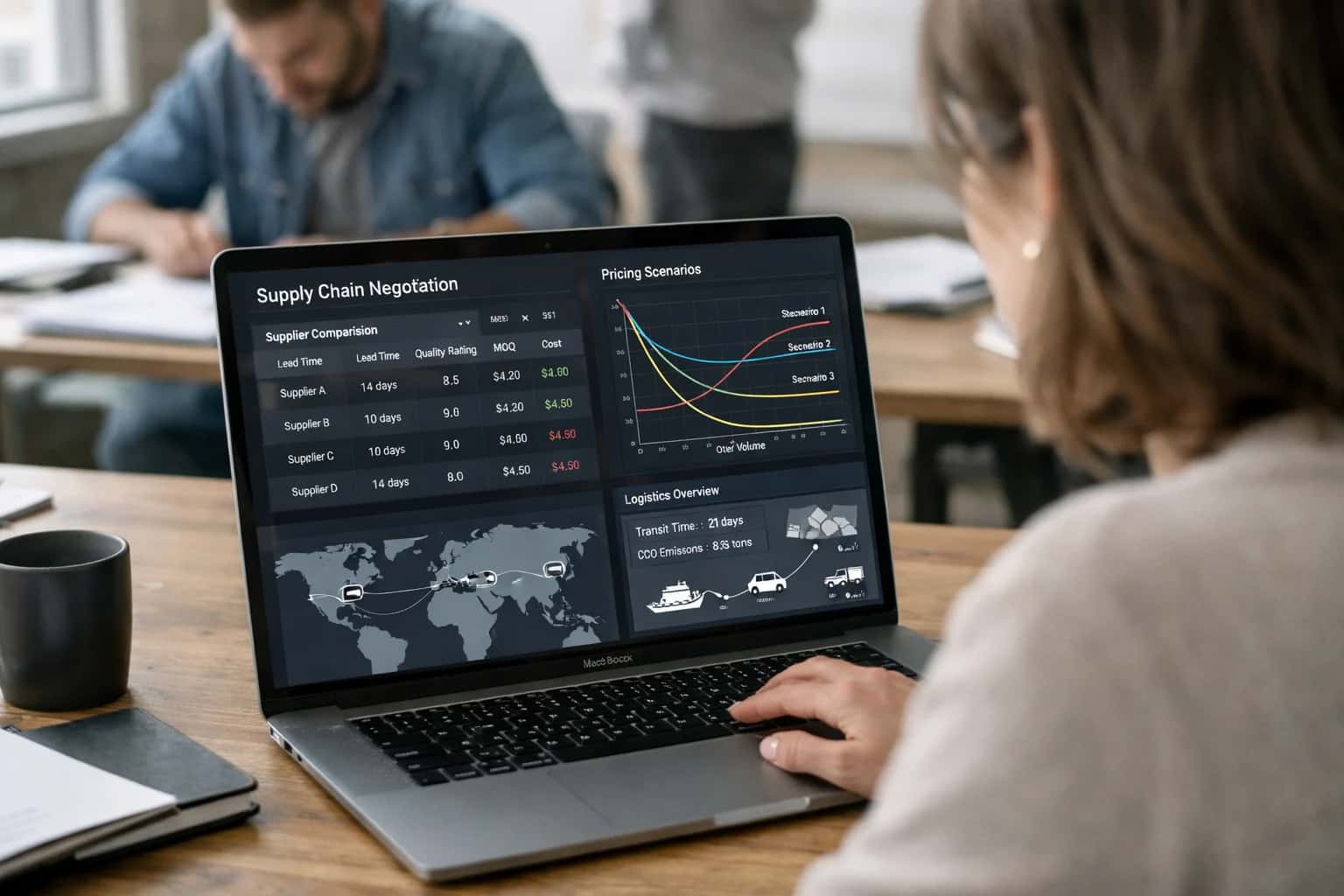
The Problem: Supply Chain Fragility from Siloed, Reactive Planning
Disconnected planning tools create blind spots. A port delay in Shanghai cascades into a $10M+ stockout in Stuttgart weeks later.
- The Solution: A federated network of AI-powered digital twins using multi-agent systems (MAS) to negotiate and self-optimize across organizational boundaries.
- Key Benefit: Predictive visibility: Model disruption propagation using Graph Neural Networks (GNNs) to understand relational dependencies between suppliers and logistics hubs.
- Key Benefit: Enable autonomous rerouting and rebalancing; agent swarms renegotiate contracts and redirect shipments in real-time based on simulated outcomes.
-30%
Excess Inventory
50% Faster
Recovery from Shocks
04
The Problem: Grid Instability from Renewable Integration and Peak Demand
The transition to variable renewables like wind and solar creates voltage fluctuations and risk of cascading blackouts. Legacy SCADA systems are reactive, not predictive.
- The Solution: A grid-scale digital twin powered by reinforcement learning (RL) that simulates physics and market dynamics to balance load in real-time.
- Key Benefit: Dynamic grid optimization: The AI discovers and executes optimal control policies for energy storage dispatch and demand response.
- Key Benefit: Predictive maintenance for critical assets like turbines and transformers, extending asset life and preventing catastrophic failures.
+25%
Renewable Integration
-$100M
Prevented Blackout Cost
05
The Problem: Zero-Latency Quality Control in High-Speed Production
Human inspectors and offline sampling miss ~3% of defects, leading to recalls and brand damage. Latency in sending data to the cloud for analysis is prohibitive for real-time correction.
- The Solution: Edge AI models for computer vision and spectral analysis embedded directly within the production line's digital twin.
- Key Benefit: Real-time, in-line defect detection with sub-millisecond latency, enabling immediate robotic rejection or process adjustment.
- Key Benefit: Root cause analysis: The system correlates defects with upstream process parameters (temperature, pressure, speed) within the twin to prevent future occurrences.
99.99%
Defect Catch Rate
-60%
Scrap/Rework
06
The Problem: The 'Simulation Gap' Between Digital Twin and Physical Reality
Latency and data drift between the physical asset and its virtual model create a 'hallucinating' twin that renders AI predictions useless and operational decisions risky.
- The Solution: An AI 'nervous system' built on robust MLOps and high-fidelity data synchronization, using causal inference models to detect and correct anomalies.
- Key Benefit: Closed-loop autonomy: Edge AI decisioning ensures the twin's state is continuously validated and corrected against ground truth, maintaining physically accurate simulation.
- Key Benefit: Explainable AI (XAI) frameworks provide audit trails for every AI-prescribed action, a non-negotiable requirement for safety and compliance in regulated industries.
<100ms
State Sync Latency
100%
Auditable Decisions
THE DATA
The Hard Truth: Why Most Digital Twins Fail as AI Platforms
Digital twins fail as AI platforms because they are built as visualization projects, not as high-fidelity, data-first simulation engines.
Most digital twins fail because they prioritize immersive 3D visualization over the high-fidelity data synchronization and deterministic physics simulation that AI models require. A beautiful model with lagging or inaccurate data is a liability, not an intelligence platform.
They lack a unified physics backbone. AI-driven optimization and reinforcement learning demand a deterministic simulation environment. Tools like NVIDIA Omniverse and the OpenUSD framework provide this essential layer, turning disparate models into a cohesive, physically accurate world for AI to train and operate within.
They treat IoT as a separate system. A true AI platform requires a converged data fabric where sensor streams feed the twin in real-time. Silos between IoT platforms and the digital twin create an insurmountable context gap, preventing AI from understanding operational cause and effect. This is a core challenge addressed in our guide on real-time data synchronization.
They ignore the inference economics. Running complex AI models, like Graph Neural Networks for supply chain analysis or time-series forecasters for predictive maintenance, requires optimized compute. A successful twin architecture uses hybrid cloud AI strategies, keeping sensitive 'crown jewel' data on-prem while leveraging cloud scale for model training and batch simulation.
FROM VIRTUALIZATION TO AUTONOMY
Key Takeaways: The Path to Simulation Intelligence
The industrial metaverse's core value is not immersive VR, but AI-driven simulation that enables predictive modeling and autonomous decision-making.
01
The Problem: Digital Twins Are Data Integrity Stress Tests
A real-time digital twin exposes every flaw in your data pipelines. Latency and drift between the physical asset and its virtual model create a 'simulation gap' that renders AI predictions useless.
- Key Benefit: Forces robust MLOps and high-fidelity data synchronization.
- Key Benefit: Identifies infrastructure weaknesses before they cause operational failures.
~500ms
Max Tolerable Latency
>99%
Data Fidelity Required
02
The Solution: A Unified Physics Engine Backbone
Accurate simulation of material stress, fluid dynamics, and thermal properties requires a deterministic physics backbone. Disparate visualization tools cannot provide the consistency needed for valid AI training and reinforcement learning outcomes.
- Key Benefit: Enables physically accurate simulation for robotics and control systems.
- Key Benefit: Serves as the single source of truth for all AI-driven 'what-if' scenarios.
10x
More Simulation Scenarios
-70%
Reduced Model Error
03
The Architecture: OpenUSD and NVIDIA Omniverse
OpenUSD (Universal Scene Description) is the non-negotiable data layer for composing complex twins from diverse sources. NVIDIA Omniverse provides the essential simulation, rendering, and interoperability layer that turns disparate AI models into a cohesive platform.
- Key Benefit: Prevents costly vendor lock-in and ensures long-term AI model agility.
- Key Benefit: Enables true integration of multi-modal AI agents and tools.
$10B+
Ecosystem Value
Interop
Core Capability
04
The Intelligence: Multi-Agent Systems for Autonomous Optimization
The future of factory and supply chain optimization lies in swarms of AI agents operating within the twin. Each agent controls a sub-process, collaboratively optimizing for conflicting goals like speed, cost, and sustainability through continuous simulation loops.
- Key Benefit: Enables real-time layout changes and throughput optimization impossible with static models.
- Key Benefit: Forms the basis for federated networks of AI twins that negotiate across organizational boundaries.
24/7
Autonomous Operation
Million+
Daily Scenarios
05
The Mandate: Explainable AI (XAI) for Safety and Compliance
When an AI prescribes a shutdown or a capital change via the twin, engineers must audit the causal chain. Unexplained AI decisions create unacceptable regulatory risk in sectors like pharmaceuticals or aerospace.
- Key Benefit: Mitigates compliance cost of black-box AI in regulated industries.
- Key Benefit: Turns AI reasoning into a safety requirement, not an optional feature.
100%
Audit Trail
XAI
Non-Negotiable
06
The Frontier: Reinforcement Learning for Autonomous Discovery
Reinforcement Learning (RL) is the missing engine for true autonomy. It allows digital twins to not just simulate outcomes, but to discover and learn optimal control policies through trial and error in a risk-free virtual environment.
- Key Benefit: Enables self-optimizing logistics networks and grid-scale energy balancing.
- Key Benefit: Drives the shift from predictive maintenance to prescriptive, continuously learning digital shadows.
RL
Core Engine
Zero-Risk
Training Environment
Enabling Efficiency, Speed & Accuracy
Intelligent Analysis, Decision & Execution
We build AI systems for teams that need search across company data, workflow automation across tools, or AI features inside products and internal software.
Talk to Us
Search across company data
Give teams answers from docs, tickets, runbooks, and product data with sources and permissions.
Useful when people spend too long searching or get different answers from different systems.
Enterprise searchRAGPermissions
Read more
Automate internal workflows
Use AI to route work, draft outputs, trigger actions, and keep approvals and logs in place.
Useful when repetitive work moves across multiple tools and teams.
AI agentsWorkflow automationGovernance
Read more
Add AI to products and internal tools
Build assistants, guided actions, or decision support into the software your team or customers already use.
Useful when AI needs to be part of the product, not a separate tool.
AI integrationDecision supportModel routing
Read moreTHE SHIFT
Stop Visualizing, Start Simulating
The industrial metaverse's core value is not immersive VR, but AI-driven simulation that enables predictive modeling and autonomous decision-making.
The industrial metaverse's primary output is not a 3D visualization, but an actionable simulation intelligence that predicts outcomes and prescribes optimizations. This shift moves the focus from human-centric viewing to machine-driven analysis.
Visualization is a cost center. Rendering photorealistic VR environments consumes compute for human interpretation. Simulation is a profit engine. AI agents running millions of 'what-if' scenarios in platforms like NVIDIA Omniverse directly optimize throughput, energy use, and capital planning.
The benchmark is physical accuracy, not graphical fidelity. A twin's value is determined by the deterministic precision of its integrated physics engine, which validates AI training for real-world control systems. Inaccurate simulation creates catastrophic simulation gaps.
Evidence: Companies using simulation intelligence for predictive maintenance report a 25-30% reduction in unplanned downtime. The ROI stems from AI discovering failure patterns invisible to human analysts monitoring a visualization.

About the author
Prasad Kumkar
CEO & MD, Inference Systems
Prasad Kumkar is the CEO & MD of Inference Systems and writes about AI systems architecture, LLM infrastructure, model serving, evaluation, and production deployment. Over 5+ years, he has worked across computer vision models, L5 autonomous vehicle systems, and LLM research, with a focus on taking complex AI ideas into real-world engineering systems.
His work and writing cover AI systems, large language models, AI agents, multimodal systems, autonomous systems, inference optimization, RAG, evaluation, and production AI engineering.
LinkedIn
Limited slotsGet a Free AI Consultation
Partnered with leading AI, data, and software stack.





How We Work
Custom AI workflows for your Business
One-fit-all AI don't work for modern businesses. At Inferensys, we aim to understand your business & custom requirements; which we use to define most efficient agentic workflows, the data, and the tools for your business.
01
Review the use case
We understand the task, the users, and where AI can actually help.
Read more02
Pick the right approach
We define what needs search, automation, or product integration.
Read more03
Build the first useful version
We implement the part that proves the value first.
Read more04
Improve from there
We add the checks and visibility needed to keep it useful.
Read moreThe first call is a practical review of your use case and the right next step.
Talk to Us