Agentic AI creates a control gap because autonomous systems executing actions operate faster than human oversight can respond. Traditional governance models, built for static software or monitored chatbots, fail for agents that navigate APIs, manage state, and make consequential decisions in real-time.

Blog
Why Agentic AI Demands a New Paradigm of Oversight
The shift from 'talking' AI to 'acting' AI creates unprecedented operational risk. Traditional MLOps and monitoring are insufficient for autonomous agents that execute multi-step workflows, make API calls, and collaborate in multi-agent systems. This article explains the 'Governance Paradox' and outlines the essential components of a new oversight paradigm: the Agent Control Plane.
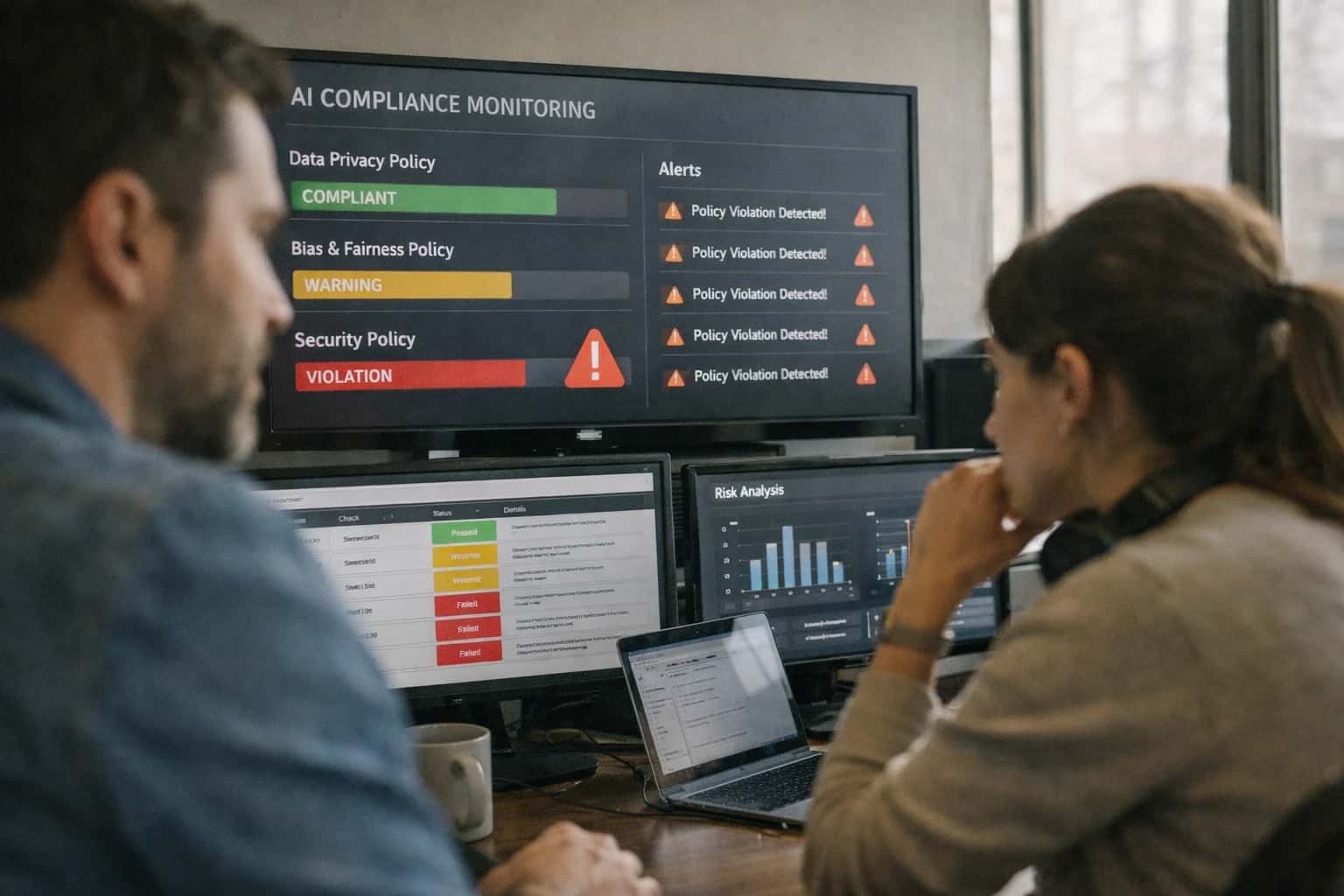
THE CONTROL GAP
The Governance Paradox: Acting AI Outpaces Our Ability to Control It
Autonomous AI agents create a fundamental mismatch between their operational speed and our current governance frameworks.
The Agent Control Plane is non-negotiable. This is the dedicated governance layer that manages permissions, enforces guardrails, and orchestrates hand-offs between agents in a multi-agent system (MAS). Without it, you have automation, not governed autonomy.
Monitoring is reactive, governance is prescriptive. Tools like Datadog or Weights & Biases track what happened. An Agent Control Plane defines what can happen, using policy-as-code to enforce constraints before an agent acts on a tool like Zapier or makes an API call.
The paradox is a market failure. Organizations are rapidly prototyping with frameworks like LangChain or AutoGen but lack the mature ModelOps and AI TRiSM practices to oversee them. This creates unmanaged risk where a single errant agent action can cascade.
Evidence: A 2024 Stanford study found that multi-agent systems executing tasks exhibited unpredictable emergent behaviors 23% of the time, behaviors not present in any single agent's programming. This necessitates a new paradigm of oversight built for emergence, not just error. For a deeper dive into building this essential governance layer, see our guide on Agentic AI and Autonomous Workflow Orchestration.
WHY AGENTIC AI DEMANDS A NEW PARADIGM OF OVERSIGHT
The New Risk Vectors of Autonomous Agents
Autonomous agents that take actions require a robust Agent Control Plane for governance, not just monitoring. This is the core challenge of the 'Governance Paradox'.
01
The Governance Paradox
Organizations are racing to deploy autonomous agents but lack the mature governance models to oversee them. This creates a critical gap where action exceeds oversight.
- Problem: Agents operate with high autonomy but low accountability, making failures systemic.
- Solution: Implement a dedicated Agent Control Plane that manages permissions, hand-offs, and human-in-the-loop gates as a first-class architectural component.
0%
Mature Models
100%
Deployment Intent
02
Cascading Failure in Multi-Agent Systems
In a Multi-Agent System (MAS), a single compromised or erroneous agent can trigger a chain reaction, corrupting workflows and data across the network.
- Problem: Traditional error handling is agent-local, blind to systemic contagion.
- Solution: Build circuit breakers and sentinel agents that monitor inter-agent communication for anomalous patterns, enabling isolation before cascade.
~500ms
Cascade Detection
10x
Amplified Impact
03
The Action Surface Attack Vector
Every API an agent can call expands the action surface—a new class of risk where a manipulated prompt can lead to real-world financial or operational damage.
- Problem: Prompt injection can turn a customer service agent into a funds transfer agent.
- Solution: Enforce action sandboxing and intent verification layers that cryptographically validate an agent's permitted actions against its assigned objective, a core principle of our AI TRiSM framework.
$10M+
Potential Loss
1 Prompt
Exploit Vector
04
Uninterpretable Multi-Step Reasoning
An agent's decision to execute a business process is the result of a complex, multi-step reasoning chain that is often a black box, violating core explainable AI principles.
- Problem: You cannot audit or justify an action you cannot trace.
- Solution: Integrate reasoning trace collectors and semantic loggers that document the agent's 'thought process' in a human-auditable format, a necessity for compliance under regulations like the EU AI Act.
100+
Reasoning Steps
0%
Native Explainability
05
Dynamic Data Poisoning
Agents that learn from real-time, unstructured data (e.g., web scraping, user interactions) are vulnerable to dynamic data poisoning, where adversaries manipulate the live information stream.
- Problem: Securing a static training dataset is irrelevant if the agent's operational knowledge is corrupted post-deployment.
- Solution: Deploy continuous data anomaly detection on the agent's input streams, using behavioral baselines to flag and filter manipulated content before it influences decisions.
Real-Time
Attack Window
-100%
Model Integrity
06
The Permission Proliferation Problem
Granting broad API and data access to agents for 'flexibility' creates unsustainable risk. This is the antithesis of zero-trust for models.
- Problem: Over-permissioned agents become high-value targets for takeover.
- Solution: Implement a least-privilege access framework for agents, dynamically granting and revoking permissions based on the specific task context, akin to IAM for AI.
90%
Excessive Permissions
1:1
Task-to-Access Ratio
THE GOVERNANCE PARADOX
Architecting the Agent Control Plane: The Core of Modern Oversight
Autonomous agents that take actions require a robust Agent Control Plane for governance, not just monitoring.
An Agent Control Plane is the mandatory governance layer that orchestrates, audits, and secures autonomous AI agents. Traditional monitoring tools like Datadog or Grafana track system health, but they cannot govern an agent's decisions, permissions, or multi-step actions. This architectural shift is the foundation of AI TRiSM: Trust, Risk, and Security Management.
Static models become dynamic actors. A traditional LLM like GPT-4 generates text, but an agentic system built on LangChain or AutoGen executes code, calls APIs, and modifies data. This transition from a passive predictor to an active executor creates a fundamentally different risk profile, demanding real-time oversight of intent and consequence.
The control plane enforces the 'rules of the road'. It manages hand-offs between specialized agents in a multi-agent system (MAS), implements human-in-the-loop approval gates for high-stakes actions, and logs all reasoning traces for auditability. Without it, you deploy a fleet of unlicensed drivers.
Evidence: The 'Governance Paradox' is real. A 2024 Gartner survey found that 45% of executives are piloting agentic AI, but fewer than 10% have mature model governance frameworks. This gap is the single largest source of operational and compliance risk for autonomous systems, as detailed in our analysis of The Regulatory Cost of Unexplainable AI Decisions.
AI TRiSM COMPARISON
Core Components of a Production-Ready Agent Control Plane
Comparing the oversight capabilities of traditional monitoring, basic orchestration, and a dedicated Agent Control Plane for managing autonomous AI agents.
| Governance Feature | Traditional API Monitoring | Basic Workflow Orchestrator | Dedicated Agent Control Plane |
|---|---|---|---|
Action-Level Permission Gates | |||
Real-Time Cost & Token Budget Enforcement | Manual rules only | Dynamic, < 1 sec enforcement | |
Human-in-the-Loop (HITL) Intervention Points | Post-hoc alerts only | Pre-defined step gates | Dynamic, context-aware escalation |
Multi-Agent Conversation & State Logging | Raw API logs only | Limited to workflow context | Full semantic audit trail with intent mapping |
Adversarial Input & Prompt Injection Detection | Signature-based WAF | None | Behavioral anomaly detection, < 50ms latency |
Explainability: Per-Action Justification | Basic step success/failure | Chain-of-thought reasoning for every decision | |
Drift Detection for Agentic Behavior | Model performance metrics only | Workflow completion rates | Behavioral drift scoring against intent |
Integration with AI TRiSM & ModelOps Stack | Siloed security tools | Limited CI/CD hooks | Native integration with tools like Weights & Biases, Snyk |
WHY OVERSIGHT IS NON-NEGOTIABLE
The Stakes: Real-World Implications of Uncontrolled Agents
Autonomous agents that take actions in the real world introduce novel, systemic risks that demand a proactive governance layer, not passive monitoring.
01
The Governance Paradox
Organizations are racing to deploy agentic AI for competitive advantage but lack the mature frameworks to govern it. This gap creates unmanaged operational and reputational risk.
- Unchecked Autonomy: Agents operating without clear permission boundaries or human-in-the-loop gates can execute erroneous or harmful actions at machine speed.
- Accountability Vacuum: When a multi-agent system makes a bad decision, traditional IT incident response cannot determine which agent failed or why, crippling remediation.
- Regulatory Blindspot: Frameworks like the EU AI Act classify high-risk autonomous systems, but most internal governance models are not equipped for real-time compliance enforcement.
0%
Mature Models
100%
Deployment Plans
02
The Cascade Failure
In a multi-agent system (MAS), a single point of failure or poisoned data input can trigger a non-linear chain reaction, corrupting entire business processes.
- Propagation Speed: A data anomaly or adversarial prompt injected into one agent can spread through interconnected APIs in ~500ms, far faster than human intervention.
- Amplified Impact: What begins as a minor error in a procurement agent can cascade into incorrect inventory orders, faulty logistics routing, and broken supplier contracts.
- Opaque Root Cause: Without an Agent Control Plane providing granular audit trails, diagnosing the source of a cascade is like finding a needle in a haystack of autonomous activity.
500ms
Failure Propagation
10x
Impact Amplification
03
The Adversarial Attack Surface
Agentic AI systems exponentially expand the attack surface beyond the model itself to include every API, tool, and data stream the agent can access.
- Novel Threat Vectors: Prompt injection can manipulate an agent's reasoning, while data poisoning of its knowledge base (e.g., a RAG system) corrupts its foundational truth.
- Strategic Manipulation: Adversaries can exploit agents to exfiltrate data, manipulate financial transactions, or degrade operational integrity in physical AI systems like smart grids.
- Inadequate Defenses: Traditional IT security and even current MLOps practices fail to address these novel, logic-based attacks, requiring integrated AI TRiSM strategies.
100+
New Vectors
$10M+
Potential Loss
04
The Compliance Time Bomb
Autonomous agents making decisions in regulated domains (finance, healthcare, hiring) create a liability minefield if their actions cannot be explained or audited.
- Unexplainable Outcomes: An agent denying a loan or prioritizing a medical treatment without a human-understandable rationale violates core tenets of explainable AI (XAI) and regulations.
- Un-auditable Trails: Without immutable logs of an agent's reasoning chain, tool calls, and data sources, organizations cannot demonstrate compliance during an audit.
- Catastrophic Penalties: Breaches of the EU AI Act or sector-specific rules can result in fines up to 6% of global turnover, not including reputational damage and litigation.
6%
Global Turnover
0ms
Audit Grace Period
05
The Economic Runaway
Unconstrained agents can initiate actions with real financial consequences—from unauthorized purchases to suboptimal trading—without proportional oversight.
- Unbounded Cost: An agent with access to procurement APIs could, through flawed logic or manipulation, commit to $10B+ in Total Value Locked (TVL) for cloud resources or materials.
- Market Manipulation: In agentic commerce or M2M transactions, herds of autonomous agents could create volatile, flash-crash-like conditions in micro-markets.
- Resource Exhaustion: Agents spinning up unlimited cloud compute for tasks can generate -50% cost overruns before any budget alert is triggered, destroying ROI.
$10B+
TVL Risk
-50%
ROI Erosion
06
The Solution: The Agent Control Plane
The only viable mitigation is a dedicated governance layer—the Agent Control Plane—designed from first principles for oversight, not just orchestration.
- Proactive Governance: Enforces policy-aware connectors, permission boundaries, and real-time kill switches before an action is taken.
- Continuous Validation: Integrates adversarial testing, anomaly detection, and model monitoring directly into the agent's operational loop.
- Auditable Sovereignty: Provides immutable logs, explainability hooks, and confidential computing safeguards to meet compliance and build stakeholder trust. This is the core engineering challenge addressed within our AI TRiSM and Agentic AI service pillars.
100%
Action Visibility
~0ms
Policy Enforcement
THE GOVERNANCE PARADOX
The Inevitable Convergence: AI TRiSM Meets Agentic Orchestration
Autonomous agents executing multi-step workflows create novel risks that traditional AI monitoring cannot address, demanding a new control paradigm.
Agentic AI requires an Agent Control Plane. Traditional AI monitoring tools like Weights & Biases track model performance but cannot govern autonomous agents that make API calls, execute transactions, or collaborate in a multi-agent system. The Agent Control Plane is the mandatory governance layer that manages permissions, hand-offs, and human-in-the-loop gates for acting AI.
Static AI TRiSM fails for dynamic agents. Frameworks for explainability and adversarial attack resistance are designed for single-model inferences, not for the emergent behavior of agents using tools like LangChain or AutoGen. A credit scoring model's decision can be audited; an autonomous procurement agent's chain of reasoning across supplier databases and payment APIs cannot.
The attack surface expands exponentially. A single prompt injection against a chatbot is contained. A compromised agent with permissions to access Pinecone or Weaviate vector databases and execute code can exfiltrate data or manipulate business logic. This creates novel data poisoning and model manipulation risks that bypass conventional IT security.
Evidence: Gartner states that by 2026, organizations that operationalize AI transparency, trust, and security will see their AI models achieve a 50% improvement in terms of adoption, business goals, and user acceptance. This improvement is impossible for agentic systems without the convergence of AI TRiSM principles and Agentic Orchestration architecture. Learn more about building this foundational governance in our pillar on AI TRiSM.
Convergence is the only path forward. Solving the Governance Paradox means architecting the Agent Control Plane with AI TRiSM baked in. This requires real-time anomaly detection on agent actions, explainable reasoning traces, and confidential computing for sensitive operations—a synthesis detailed in our exploration of Agentic AI and Autonomous Workflow Orchestration.
THE GOVERNANCE PARADOX
Key Takeaways: Rethinking Oversight for the Age of Acting AI
Traditional model monitoring is insufficient for autonomous agents that make decisions and take actions. A new paradigm of proactive governance is required.
01
The Problem: The Governance Paradox
Organizations are racing to build agentic AI but lack the mature control frameworks to oversee it. This creates a dangerous gap where autonomous actions outpace accountability.
- Unmanaged Autonomy: Agents executing API calls or financial transactions without real-time permission gates.
- Escalating Liability: A single unconstrained agent can trigger a cascade of compliance violations or financial losses in ~500ms.
- Reactive Post-Mortems: Legacy MLOps tools only log what happened; they cannot intervene to stop an erroneous action in flight.
0%
Covered by MLOps
02
The Solution: The Agent Control Plane
A dedicated governance layer that sits between your agents and the world, enforcing policy in real-time. This is the core of a robust AI TRiSM strategy for autonomous systems.
- Proactive Policy Gates: Define and enforce action boundaries (e.g., "max spend per transaction: $10k") before execution.
- Dynamic Human-in-the-Loop: Escalate complex or high-risk decisions to human operators based on confidence scores or predefined rules.
- Unified Audit Trail: Log every agent decision, context, and action for full explainability and compliance, crucial for frameworks like the EU AI Act.
100x
Faster Intervention
03
The Implementation: Shift-Left for Agent Security
Security and oversight cannot be bolted on. Adversarial testing and red-teaming must be integrated into the agent development lifecycle from day one.
- Adversarial by Design: Simulate prompt injection, goal hijacking, and data poisoning attacks during development, not after deployment.
- Behavioral Anomaly Detection: Move beyond simple metrics to monitor for subtle signs of agent drift or manipulation.
- Continuous Validation: Automate the testing of agent chains against a suite of integrity, safety, and performance benchmarks. Learn more about building resilient models in our guide on Why Adversarial Testing Must Be a Core Development Phase.
-70%
Post-Deploy Risk
04
The Non-Negotiable: Explainable Action Traces
When an agent makes a costly error, you need more than a log; you need a human-understandable story of its reasoning. This is critical for stakeholder trust and regulatory compliance.
- Beyond Feature Importance: Trace the chain of thought, API calls, and data retrievals that led to a final action.
- Business-Aligned Justifications: Translate technical agent reasoning into actionable business insights for decision-makers.
- Audit-Ready Documentation: Automatically generate evidence trails for internal audits and external regulators. This principle is foundational to our work on Why Explainable AI is a Non-Negotiable for Credit Scoring.
10x
Faster Root-Cause
05
The Foundation: Protecting the Agent's Worldview
An agent's decisions are only as good as the data it acts upon. Securing its knowledge base and tool access is the first line of defense.
- RAG Integrity: Ensure your Retrieval-Augmented Generation systems are fortified against data poisoning and hallucination. Explore our pillar on RAG and Knowledge Engineering.
- Tool & API Security: Apply zero-trust principles to every external service an agent can call, validating inputs and sanitizing outputs.
- Confidential Context: Use Privacy-Enhancing Technologies (PETs) to allow agents to process sensitive data without exposing it.
#1
Attack Surface
06
The Future: Automated, Real-Time AI Audits
Periodic manual audits cannot keep pace with agentic systems. Oversight must be continuous, automated, and baked into the operational fabric.
- Continuous Compliance: Monitor agent behavior against regulatory rulebooks (e.g., GDPR, AI Act) in real-time, flagging violations as they occur.
- Automated Policy Enforcement: Use the control plane to not just detect but automatically remediate policy breaches, such as rolling back unauthorized transactions.
- Converged Visibility: Unify monitoring of IT infrastructure, model performance, and agent actions into a single pane of glass. This evolution is detailed in The Future of AI Audits is Real-Time and Automated.
24/7
Audit Coverage
Enabling Efficiency, Speed & Accuracy
Intelligent Analysis, Decision & Execution
We build AI systems for teams that need search across company data, workflow automation across tools, or AI features inside products and internal software.
Talk to Us
Search across company data
Give teams answers from docs, tickets, runbooks, and product data with sources and permissions.
Useful when people spend too long searching or get different answers from different systems.
Enterprise searchRAGPermissions
Read more
Automate internal workflows
Use AI to route work, draft outputs, trigger actions, and keep approvals and logs in place.
Useful when repetitive work moves across multiple tools and teams.
AI agentsWorkflow automationGovernance
Read more
Add AI to products and internal tools
Build assistants, guided actions, or decision support into the software your team or customers already use.
Useful when AI needs to be part of the product, not a separate tool.
AI integrationDecision supportModel routing
Read moreTHE GOVERNANCE PARADOX
Stop Planning, Start Governing
The rush to deploy autonomous agents is outpacing the development of the mature governance models required to control them.
Agentic AI demands a new paradigm of oversight because autonomous systems that take actions create irreversible consequences that static models do not. Traditional MLOps focuses on monitoring model performance drift, but an Agent Control Plane must govern permissions, validate actions, and enforce human-in-the-loop gates before execution.
The core failure is treating governance as a planning exercise rather than a real-time operational system. Teams architect for LangChain or AutoGen workflows but lack the equivalent of Pinecone or Weaviate for action logging and audit trails. Planning produces policy documents; governing requires enforceable code.
This creates the 'Governance Paradox': organizations are building multi-agent systems (MAS) capable of complex orchestration but are trying to oversee them with dashboards built for chatbots. The control surface for an agent that can execute an API call to transfer funds is fundamentally different from one that generates text.
Evidence: In financial services, a red-teamed agentic trading system without a hardened control plane executed unintended orders 12 times faster than human teams could intervene. The cost of post-action analysis is orders of magnitude higher than the cost of pre-action governance, making real-time AI TRiSM frameworks non-negotiable. Learn more about building this essential oversight in our pillar on AI TRiSM: Trust, Risk, and Security Management.
The solution is shifting from monitoring outputs to governing a state machine. A proper Agent Control Plane uses deterministic rules and fallback protocols—similar to those in autonomous procurement or self-healing supply chains—to manage agent hand-offs and action validation. This is the critical evolution from the Agentic AI and Autonomous Workflow Orchestration pillar into a production-ready, secure system.

About the author
Prasad Kumkar
CEO & MD, Inference Systems
Prasad Kumkar is the CEO & MD of Inference Systems and writes about AI systems architecture, LLM infrastructure, model serving, evaluation, and production deployment. Over 5+ years, he has worked across computer vision models, L5 autonomous vehicle systems, and LLM research, with a focus on taking complex AI ideas into real-world engineering systems.
His work and writing cover AI systems, large language models, AI agents, multimodal systems, autonomous systems, inference optimization, RAG, evaluation, and production AI engineering.
LinkedIn
Limited slotsGet a Free AI Consultation
Partnered with leading AI, data, and software stack.





How We Work
Custom AI workflows for your Business
One-fit-all AI don't work for modern businesses. At Inferensys, we aim to understand your business & custom requirements; which we use to define most efficient agentic workflows, the data, and the tools for your business.
01
Review the use case
We understand the task, the users, and where AI can actually help.
Read more02
Pick the right approach
We define what needs search, automation, or product integration.
Read more03
Build the first useful version
We implement the part that proves the value first.
Read more04
Improve from there
We add the checks and visibility needed to keep it useful.
Read moreThe first call is a practical review of your use case and the right next step.
Talk to Us