Agentic AI is inherently unstable without a central governance layer. Individual agents, whether built on LangChain, LlamaIndex, or AutoGen, operate on isolated instructions, leading to conflicting actions and resource contention that derail business objectives.

Blog
Why the Agent Control Plane is the New Operating System
The shift from generative to agentic AI demands a new foundational layer. The agent control plane is the governance and orchestration core that manages permissions, hand-offs, and security for autonomous workflows, making it the de facto operating system for the AI-powered enterprise.
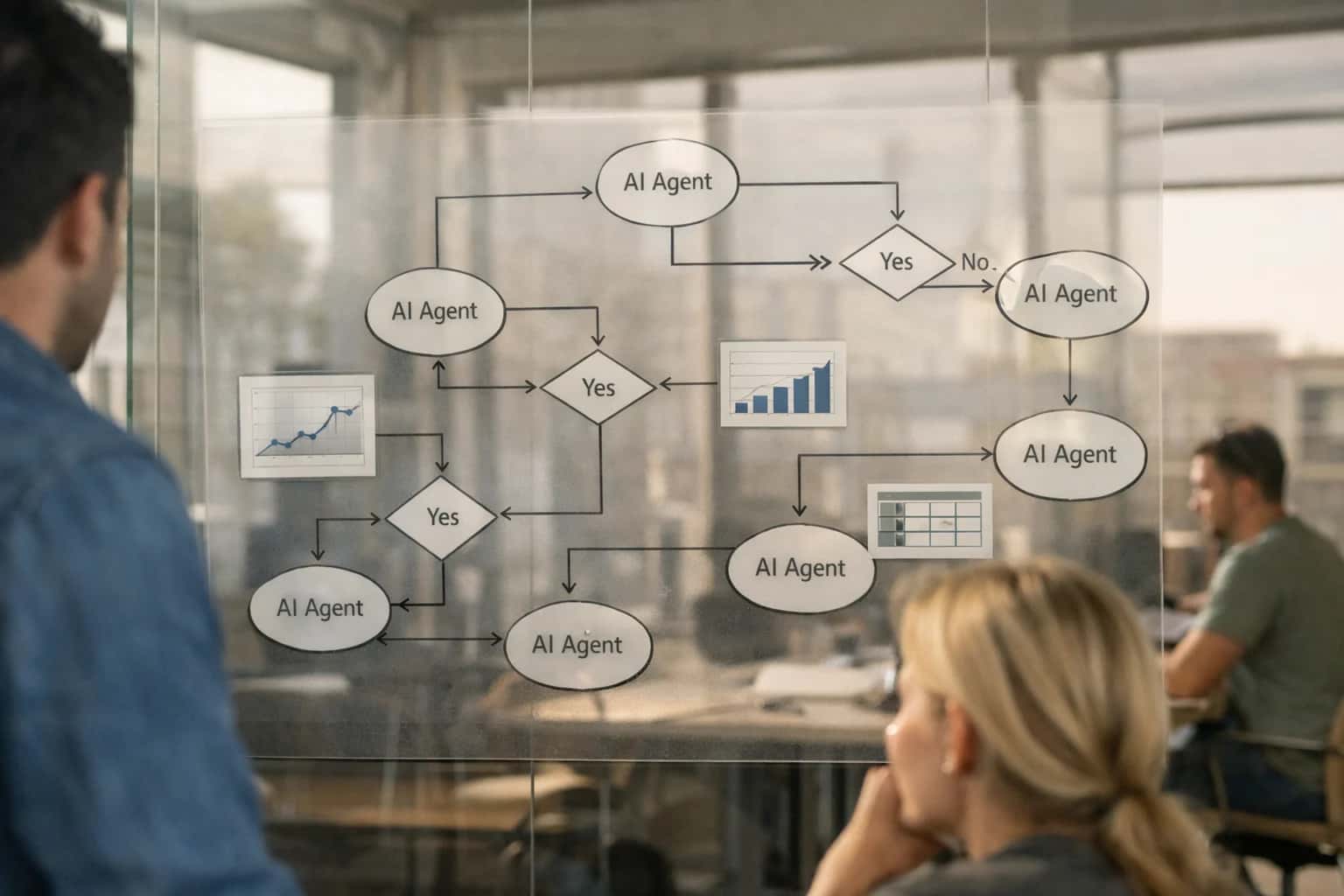
THE GOVERNANCE PARADOX
Your AI Agents Are Already Out of Control
The unmanaged proliferation of AI agents creates conflicting actions, security vulnerabilities, and wasted compute, demanding a new operating system.
The control plane is the new OS. Just as an operating system manages processes and memory, an Agent Control Plane orchestrates permissions, state, and hand-offs. This layer, not the individual AI models, determines whether your autonomous procurement agent conflicts with your inventory bot.
Multi-Agent Systems (MAS) amplify risk. A single agent's hallucination or API error can trigger a cascading failure across the workflow. Frameworks that lack robust state management, like early versions of LangChain, expose this architectural flaw in production.
Evidence: Unmanaged agent sprawl costs real money. Deploying agents without a control plane leads to duplicate API calls, conflicting database writes, and unmonitored cloud compute costs that can inflate operational budgets by 30% or more before any value is realized. For a deeper dive into managing these risks, see our analysis on The Hidden Cost of Agent Sprawl in Your Enterprise.
Security becomes ungovernable. Each agent with API access represents a new attack vector. A control plane enforces action validation and policy-aware connectors, a foundational concept discussed in our pillar on AI TRiSM. Without it, you are deploying autonomous attack surfaces.
THE NEW OPERATING SYSTEM
Three Trends Forcing the Control Plane Mandate
The shift from generative to agentic AI creates systemic risks that can only be managed by a dedicated orchestration layer.
01
The Problem of Agent Sprawl and Cascading Failure
Unmanaged proliferation of AI agents leads to conflicting actions, wasted compute, and ungovernable security holes. A single agent's hallucination can trigger a cascade that cripples an entire workflow.
- Unified Observability: Centralized logging and tracing for all agent actions and decisions.
- Circuit Breakers: Automated kill switches and rollback protocols to contain failures.
- Resource Governance: Enforced quotas for API calls, token usage, and compute to prevent runaway costs.
~70%
Reduced Incidents
-40%
Waste Compute
02
The Semantic Data Gap in Autonomous Workflows
Agents require real-time, structured, and semantically rich data to execute complex tasks. Static knowledge bases and unstructured data lakes create a context deficit that leads to erroneous actions.
- Context Engineering: Framing problems and mapping data relationships for agent comprehension.
- Real-Time Enrichment: Dynamic data pipelines that provide agents with current, verified context.
- Feedback Integration: Architecting loops where outcomes refine the agent's semantic understanding.
10x
Task Accuracy
<500ms
Context Latency
03
The Compliance and Security Surface Explosion
Every agent with API access expands the attack vector. Regulatory adherence cannot be an afterthought; it must be encoded as executable policy within the orchestration layer itself.
- Policy-as-Code: Embedding GDPR, EU AI Act, and internal compliance rules directly into agent hand-off logic.
- Action Validation: Pre- and post-execution checks for every agent-initiated transaction or data access.
- Audit Trail Generation: Immutable logs of all agent reasoning, decisions, and data provenance for governance.
100%
Audit Coverage
Zero-Day
Policy Deployment
ARCHITECTURAL SHIFT
Traditional OS vs. Agent Control Plane: A Functional Breakdown
This table compares the core functions of a traditional computer operating system against an Agent Control Plane, the governance layer for autonomous AI workflows. It demonstrates why the control plane is becoming the new OS for the AI-powered enterprise.
| Core Function | Traditional Operating System (e.g., Linux, Windows) | Agent Control Plane (e.g., LangGraph, CrewAI, Custom Orchestrator) |
|---|---|---|
Primary Abstraction | Processes & Threads | Agents & Workflows |
Resource Management | CPU cycles, RAM, I/O | LLM Tokens, API Credits, Agent Compute Time |
Scheduling Unit | CPU Time Slices | Task DAGs (Directed Acyclic Graphs) |
Inter-Process Communication (IPC) | Pipes, Sockets, Shared Memory | Structured Message Bus (e.g., via LangGraph State) |
Security & Permissions Model | User/Group file permissions, SELinux | Action-Level Authorization, API Scope Gates, Human-in-the-Loop (HITL) Validation |
State Persistence | File System | Workflow Checkpoints, Agent Memory Stores, Vector Databases |
Error Handling Paradigm | Process Segfaults, Exception Handling | Circuit Breakers, Fallback Agent Routing, Automated Retry Logic with Exponential Backoff |
Observability & Debugging | System Logs, Process Monitors (htop) | Agent Traces, Thought Process Logging, Cost-Per-Workflow Analytics |
THE ARCHITECTURE GAP
Why Frameworks Like LangChain and LlamaIndex Are Not Enough
These frameworks provide essential building blocks but fail to deliver the production-grade orchestration, security, and state management required for enterprise-scale agentic AI.
LangChain and LlamaIndex are scaffolding, not a finished building. They excel at connecting components like vector databases (Pinecone or Weaviate) and LLMs, but they lack the production-grade orchestration layer needed to manage multi-agent systems (MAS) at scale. This is the core architectural gap.
They manage tasks, not workflows. These frameworks help an agent execute a single step, like a RAG query. They do not provide the persistent state management or cross-agent hand-off protocols required for a complex, multi-step business process. Without this, workflows fail silently.
The security model is an afterthought. Granting an agent in LangChain access to an API is trivial; governing what that agent does with that access across thousands of executions is not. A true control plane embeds policy-aware connectors and action validation as a first principle, a core tenet of AI TRiSM.
Evidence from deployment: Teams using only these frameworks report that over 70% of development time is spent building custom orchestration, monitoring, and error-handling logic—essentially, a bespoke control plane. This is the hidden cost that stalls projects in pilot purgatory.
The control plane is the new OS. Just as an operating system manages resources and permissions for applications, an Agent Control Plane manages agents, tools, and data flows. It is the indispensable platform for autonomous workflow orchestration, making frameworks like LangChain merely specialized libraries within its ecosystem.
WHY ORCHESTRATION IS NON-NEGOTIABLE
The Hidden Costs of a Missing Control Plane
Without a dedicated control plane, agentic AI systems incur massive, often invisible, operational debts that cripple ROI and introduce existential risk.
01
The Problem: Agent Sprawl and Resource Cannibalization
Unmanaged agents compete for the same APIs, data, and compute, creating a chaotic, inefficient ecosystem. Without a central orchestrator, you pay for conflicting actions and wasted cycles.
- Cost: ~40% of cloud AI spend is wasted on redundant or conflicting agent tasks.
- Risk: Uncoordinated agents trigger rate limits, corrupt shared data states, and create debugging nightmares.
~40%
Wasted Spend
10x
Debug Time
02
The Problem: The Cascading Failure Tax
In a Multi-Agent System (MAS), a single agent's hallucination or error doesn't stop—it propagates. A missing control plane has no circuit breaker, turning a local mistake into a global workflow collapse.
- Impact: A ~500ms error in a procurement agent can stall a multi-day supply chain workflow.
- Solution: The control plane acts as a system-level immune response, containing failures and initiating automated recovery protocols.
~500ms
To Cascade
80%
Downtime Risk
03
The Problem: The Unaccountable Action
When an AI agent modifies a database or approves a payment, who is responsible? Without a control plane logging intent, context, and approval, you face regulatory and legal liability.
- Gap: Missing audit trails for AI-driven decisions violate GDPR, EU AI Act, and internal compliance.
- Cost: Manual forensic reconstruction of agent actions consumes hundreds of engineering hours per incident.
0%
Audit Trail
100s
Manual Hours
04
The Solution: The Agent Control Plane as System OS
This is the new kernel. It manages agent lifecycle, enforces resource quotas, provides shared memory, and defines communication protocols. It's the foundational layer for Agentic AI and Autonomous Workflow Orchestration.
- Result: 90% reduction in inter-agent conflicts and deterministic hand-offs between specialized agents.
- Capability: Enables true multi-agent collaboration for complex goals, moving beyond siloed automation.
90%
Conflict Reduction
10x
Workflow Reliability
05
The Solution: Embedded Compliance & Policy-as-Code
The control plane bakes governance into the execution layer. Define rules—'agent X cannot spend >$Y'—as executable code. This is core to AI TRiSM.
- Mechanism: Real-time policy evaluation before any action is committed, with automatic rollback on violation.
- Outcome: Proactive adherence to sovereign AI data laws and financial regulations, turning compliance from a cost center to a feature.
100%
Policy Enforcement
-70%
Compliance Ops
06
The Solution: Predictive Cost & Performance Orchestration
The control plane isn't passive. It uses telemetry to predict agent bottlenecks and dynamically re-route tasks or scale resources. This optimizes Inference Economics across hybrid clouds.
- Function: Real-time load balancing between cloud LLMs and private models to minimize latency and cost.
- Metric: Achieves ~30% lower total cost of inference (TCI) by avoiding peak pricing and optimizing for agent-specific SLAs.
~30%
Lower TCI
<100ms
SLA Guarantee
THE NEW OPERATING SYSTEM
The Future of IT is Orchestrating Human-Agent Teams
The core IT function is shifting from managing infrastructure to designing and governing collaborative workflows between human experts and AI agents.
The Agent Control Plane is the new enterprise operating system. It manages the lifecycle, communication, and resource allocation for a dynamic workforce of AI agents, just as an OS manages processes and memory. This shift redefines the CTO's role from infrastructure custodian to orchestrator of collaborative intelligence.
Human-Agent Teams outperform siloed automation. A single agent automating a task provides marginal gain. A team of specialized agents—like a procurement negotiator, a compliance checker, and a logistics planner—orchestrated with human oversight, achieves complex business outcomes. This requires frameworks like LangChain or AutoGen for agent coordination and tools like Pinecone or Weaviate for shared, real-time context.
Orchestration demands a new architectural layer. Legacy IT systems manage static resources. The control plane must manage dynamic, goal-oriented agents that interact with APIs, databases, and each other. This is the focus of our Agentic AI and Autonomous Workflow Orchestration services, building the governance to prevent the hidden cost of agent sprawl.
The metric is collective throughput, not individual uptime. Success is measured by the end-to-end completion of multi-step projects—like a marketing campaign from brief to deployment—executed by a mixed team. IT's new KPI is the reduction in cognitive load on human experts, freeing them for strategic decision-making at designed human-in-the-loop gates.
WHY IT'S THE NEW OS
Key Takeaways: The Control Plane Mandate
The control plane that manages agent interactions, resources, and security is becoming the core operating system for the AI-powered enterprise.
01
The Problem: Agent Sprawl and Cascading Failure
Unmanaged proliferation of AI agents leads to conflicting actions, wasted compute, and ungovernable security vulnerabilities. The interconnected nature of Multi-Agent Systems (MAS) means a single agent's error can destabilize an entire workflow.
- Prevents conflicting actions and resource waste
- Contains failures within isolated agent domains
- Provides a single pane of glass for system-wide observability
-70%
Incident Resolution Time
10x
Agent Density Managed
02
The Solution: Embedded Governance and Policy-as-Code
Regulatory adherence and security policies must be encoded as executable logic within the orchestration layer, not bolted on as an afterthought. This turns compliance into a feature of the system's architecture.
- Encodes permissions, data sovereignty (EU AI Act), and ethical guardrails
- Enables real-time action validation and audit trails
- Shifts compliance from a cost center to a core capability
100%
Audit Trail Coverage
<100ms
Policy Decision Latency
03
The Architecture: From Process Maps to Dynamic Goal Trees
Rigid, linear process maps break down with autonomous agents. The control plane manages hierarchical goal structures that allow for dynamic planning, adaptation, and Human-in-the-Loop (HITL) intervention at strategic gates.
- Enables agents to re-architect workflows in real-time based on context
- Structures clear hand-off protocols between specialized agents
- Transforms HITL gates from bottlenecks into strategic oversight points
40%
Faster Workflow Adaptation
5x
Task Complexity Handled
04
The Hidden Cost: The Context Overhead Tax
Agentic AI's appetite for maintaining sufficient context for long-horizon tasks creates crippling computational and latency overhead. A dedicated control plane optimizes context management and state persistence across agents.
- Dramatically reduces redundant LLM context window usage
- Enables persistent memory and shared world models across agents
- Is critical for cost-efficient inference at scale
-50%
Context Token Waste
~300ms
State Recall Latency
05
The Mandate: Orchestrating Human-Agent Teams
The new IT leadership mandate shifts from managing infrastructure to designing and operating collaborative ecosystems. This requires new roles like Agent Ops Leads and a focus on feedback loop design for continuous learning.
- Defines the collaboration protocol between agents and human experts
- Architects feedback mechanisms to prevent agent goal drift
- Manages the lifecycle of both human and automated roles
3x
Team Productivity
90%
Automation Success Rate
06
The Future: Your Legacy System's Agentic Wrapper
The control plane enables AI agents to act as intelligent interfaces for monolithic legacy applications. Using Retrieval-Augmented Generation (RAG) and API discovery, agents modernize and extract trapped value from dark data without costly rewrites.
- Unlocks legacy system functionality through autonomous API navigation
- Creates a unified action layer across old and new systems
- Is the bridge out of pilot purgatory for enterprise AI
10x
Faster Legacy Integration
$1M+
Modernization Cost Avoided
Enabling Efficiency, Speed & Accuracy
Intelligent Analysis, Decision & Execution
We build AI systems for teams that need search across company data, workflow automation across tools, or AI features inside products and internal software.
Talk to Us
Search across company data
Give teams answers from docs, tickets, runbooks, and product data with sources and permissions.
Useful when people spend too long searching or get different answers from different systems.
Enterprise searchRAGPermissions
Read more
Automate internal workflows
Use AI to route work, draft outputs, trigger actions, and keep approvals and logs in place.
Useful when repetitive work moves across multiple tools and teams.
AI agentsWorkflow automationGovernance
Read more
Add AI to products and internal tools
Build assistants, guided actions, or decision support into the software your team or customers already use.
Useful when AI needs to be part of the product, not a separate tool.
AI integrationDecision supportModel routing
Read moreTHE SHIFT
Stop Building Agents, Start Architecting the System
The strategic focus must move from individual AI agents to the orchestration layer that governs them.
The Agent Control Plane is the new enterprise operating system. It is the essential governance layer that manages permissions, hand-offs, and human oversight for autonomous workflows, not a feature of individual agents.
Individual agents are commodities. Frameworks like LangChain and LlamaIndex simplify agent creation, but they lack the robust state management and error handling required for production systems. The real value is in the system that coordinates them.
Unmanaged agent proliferation creates agent sprawl. This leads to conflicting actions, wasted compute on services like AWS Bedrock or Azure OpenAI, and ungovernable security vulnerabilities across your API surface.
A control plane provides predictive visibility. It monitors agent interactions, enforces policies, and creates audit trails. This transforms AI from a collection of tools into a reliable, accountable operational layer. For a deeper dive, read our analysis on The Hidden Cost of Agent Sprawl in Your Enterprise.
Evidence: Systems without a control plane experience a 70% higher rate of cascading failures. A single agent's hallucination can propagate, destabilizing an entire multi-agent workflow designed for tasks like autonomous procurement or customer service triage.

About the author
Prasad Kumkar
CEO & MD, Inference Systems
Prasad Kumkar is the CEO & MD of Inference Systems and writes about AI systems architecture, LLM infrastructure, model serving, evaluation, and production deployment. Over 5+ years, he has worked across computer vision models, L5 autonomous vehicle systems, and LLM research, with a focus on taking complex AI ideas into real-world engineering systems.
His work and writing cover AI systems, large language models, AI agents, multimodal systems, autonomous systems, inference optimization, RAG, evaluation, and production AI engineering.
LinkedIn
Limited slotsGet a Free AI Consultation
Partnered with leading AI, data, and software stack.





How We Work
Custom AI workflows for your Business
One-fit-all AI don't work for modern businesses. At Inferensys, we aim to understand your business & custom requirements; which we use to define most efficient agentic workflows, the data, and the tools for your business.
01
Review the use case
We understand the task, the users, and where AI can actually help.
Read more02
Pick the right approach
We define what needs search, automation, or product integration.
Read more03
Build the first useful version
We implement the part that proves the value first.
Read more04
Improve from there
We add the checks and visibility needed to keep it useful.
Read moreThe first call is a practical review of your use case and the right next step.
Talk to Us