Edge AI security demands a zero-trust architecture, where no network request is inherently trusted. Every edge node is a potential attack surface, requiring strict verification for all communications and access. This is achieved through mutual TLS (mTLS) for encrypted, authenticated connections and a robust device identity framework like SPIFFE/SPIRE. These components form the bedrock of a secure grid, ensuring that only authorized workloads and nodes can participate in the inference network, as detailed in our guide on How to Architect a Resilient AI Grid for Critical Infrastructure.

Guide
Setting Up Edge AI Security and Zero-Trust Access Control
A developer guide to building a zero-trust security architecture for distributed AI inference grids. Implement mutual TLS, SPIFFE/SPIRE for device identity, fine-grained RBAC, and secure model encryption to protect edge workloads.
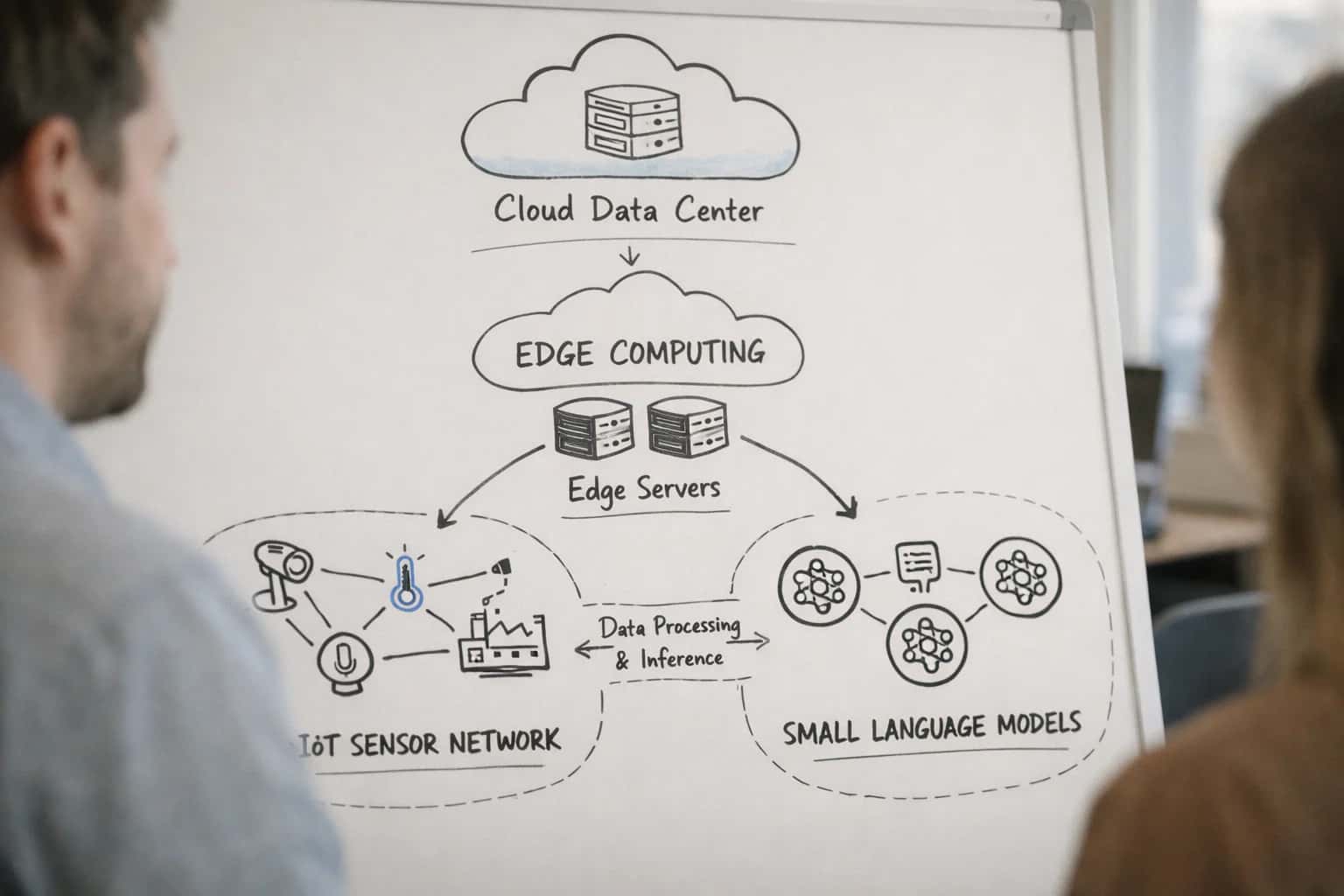
A secure, zero-trust architecture is the non-negotiable foundation for any distributed AI grid. This guide explains the core principles and immediate first steps.
Beyond network security, you must implement fine-grained access control. Use role-based access control (RBAC) to define which users or services can deploy models, access specific datasets, or query inference endpoints. Encrypt models at rest and in transit, and consider hardware-based Trusted Execution Environments (TEEs) for highly sensitive workloads. This layered approach protects against data exfiltration and unauthorized model execution, creating a secure perimeter around every asset in your distributed system, a concept further explored in our pillar on Confidential Computing and Hardware-Based TEEs.
ZERO-TRUST FOUNDATIONS
Core Security Concepts for Edge AI
Secure your distributed AI grid by implementing these foundational security patterns. Each concept is a critical component for protecting models, data, and communications at the edge.
03
Fine-Grained RBAC for Models & Data
Define and enforce Role-Based Access Control (RBAC) policies that govern who or what can access specific AI models, datasets, or inference endpoints.
- Map SPIFFE identities to roles within a central policy engine like Open Policy Agent (OPA).
- Create policies such as:
Only nodes in 'factory-floor' group can invoke the 'defect-detection' model. - Integrate RBAC decisions into your API gateways and model serving layers (e.g., Triton Inference Server).
04
Secure Model Encryption & Key Management
Protect proprietary AI models from theft or tampering on edge devices using encryption-at-rest and in-transit.
- Encrypt model files (e.g.,
.onnx,.pt) using AES-256-GCM before distribution. - Use a Hardware Security Module (HSM) or cloud KMS (e.g., AWS KMS, Google Cloud KMS) to manage encryption keys.
- Decrypt models in memory only at inference time, leveraging Trusted Execution Environments (TEEs) like Intel SGX for the highest assurance where supported.
05
Zero-Trust Network Segmentation
Apply the zero-trust principle of 'never trust, always verify' by segmenting your edge network. Treat every node as untrusted and isolate workloads.
- Use Kubernetes Network Policies to enforce strict ingress/egress rules between pods, even on the same node.
- Implement micro-segmentation with a service mesh to create secure communication channels.
- This limits lateral movement, containing the blast radius if a single edge device is compromised.
06
Audit Logging & Anomaly Detection
Establish comprehensive, immutable audit trails for all security-critical events across the edge grid. Use these logs for proactive threat detection.
- Log: authentication attempts, model access, policy decisions, and configuration changes.
- Forward logs to a secured, centralized SIEM (e.g., Elasticsearch, Splunk) for correlation.
- Implement anomaly detection models to flag unusual behavior, such as a node suddenly requesting models outside its normal profile.
FOUNDATION
Step 1: Establish Device Identity with SPIFFE/SPIRE
This step creates the bedrock of a zero-trust edge AI grid by giving every compute node, from cloud VMs to far-edge devices, a cryptographically verifiable, machine-generated identity.
In a distributed AI grid, traditional perimeter security fails. SPIFFE (Secure Production Identity Framework For Everyone) defines a standard for workload identity, while SPIRE (SPIFFE Runtime Environment) is the production-ready implementation. SPIRE issues and rotates SVIDs (SPIFFE Verifiable Identity Documents) as X.509 certificates or JWT tokens. This creates a universal identity layer where every edge node and service can mutually authenticate, forming the basis for mTLS connections detailed in our guide on Setting Up Edge AI Security and Zero-Trust Access Control.
Deploy SPIRE agents on all edge nodes and a SPIRE server in a secure, highly available cluster. Configure node attestation (e.g., using AWS/Azure instance metadata, TPMs, or join tokens) to prove a node's initial trustworthiness. Then, define workload attestation policies (e.g., process path, Kubernetes pod labels) so the agent can issue specific identities to workloads. This identity is the prerequisite for all subsequent security controls, including the fine-grained RBAC and secure model access covered in related guides.
ZERO-TRUST IMPLEMENTATION
Edge AI Security Tool Comparison
A comparison of core security frameworks and tools for implementing a zero-trust architecture in distributed AI grids.
| Security Layer / Feature | SPIFFE/SPIRE | Istio with mTLS | OpenZiti |
|---|---|---|---|
Workload Identity Foundation | |||
Mutual TLS (mTLS) Automation | |||
Fine-Grained RBAC for Models | Via OPA/SPIFFE | Via Envoy Filters | Native Policy Engine |
Encrypted Overlay Network | |||
Built-in API Gateway & L7 Proxy | |||
Hardware Root of Trust Integration | Experimental | Vendor Dependent | Via TPM/HSM |
Latency Overhead | < 1 ms | 3-5 ms | 2-4 ms |
Primary Deployment Model | Identity Control Plane | Service Mesh Sidecar | Full Stack Overlay |
Enabling Efficiency, Speed & Accuracy
Intelligent Analysis, Decision & Execution
We build AI systems for teams that need search across company data, workflow automation across tools, or AI features inside products and internal software.
Talk to Us
Search across company data
Give teams answers from docs, tickets, runbooks, and product data with sources and permissions.
Useful when people spend too long searching or get different answers from different systems.
Enterprise searchRAGPermissions
Read more
Automate internal workflows
Use AI to route work, draft outputs, trigger actions, and keep approvals and logs in place.
Useful when repetitive work moves across multiple tools and teams.
AI agentsWorkflow automationGovernance
Read more
Add AI to products and internal tools
Build assistants, guided actions, or decision support into the software your team or customers already use.
Useful when AI needs to be part of the product, not a separate tool.
AI integrationDecision supportModel routing
Read moreTROUBLESHOOTING
Common Mistakes
Deploying AI at the edge introduces unique security challenges. These are the most frequent and critical mistakes teams make when implementing zero-trust access control for distributed AI grids.
This is typically caused by a mismatch between your mutual TLS (mTLS) configuration and your SPIFFE/SPIRE identity framework. Edge nodes must present a valid X.509 certificate that includes a SPIFFE ID as a URI SAN (Subject Alternative Name). The common mistake is issuing static certificates or using IP-based authentication, which violates zero-trust principles.
Fix: Ensure your certificate authority (like SPIRE Server) dynamically issues short-lived certificates to each node. The verifier (e.g., an Envoy proxy sidecar) must be configured to validate the SPIFFE ID in the certificate against an allow list. Test the full chain: spire-agent health → certificate issuance → mTLS handshake.

About the author
Prasad Kumkar
CEO & MD, Inference Systems
Prasad Kumkar is the CEO & MD of Inference Systems and writes about AI systems architecture, LLM infrastructure, model serving, evaluation, and production deployment. Over 5+ years, he has worked across computer vision models, L5 autonomous vehicle systems, and LLM research, with a focus on taking complex AI ideas into real-world engineering systems.
His work and writing cover AI systems, large language models, AI agents, multimodal systems, autonomous systems, inference optimization, RAG, evaluation, and production AI engineering.
LinkedIn
Limited slotsGet a Free AI Consultation
Partnered with leading AI, data, and software stack.





How We Work
Custom AI workflows for your Business
One-fit-all AI don't work for modern businesses. At Inferensys, we aim to understand your business & custom requirements; which we use to define most efficient agentic workflows, the data, and the tools for your business.
01
Review the use case
We understand the task, the users, and where AI can actually help.
Read more02
Pick the right approach
We define what needs search, automation, or product integration.
Read more03
Build the first useful version
We implement the part that proves the value first.
Read more04
Improve from there
We add the checks and visibility needed to keep it useful.
Read moreThe first call is a practical review of your use case and the right next step.
Talk to Us