The traditional annual skills audit is a reactive snapshot, leaving organizations vulnerable to market shifts. You face a constant churn of emerging technologies and evolving roles, making it impossible to manually track who can do what. This leads to costly external hiring for skills you may already possess internally, project delays due to talent shortages, and strategic initiatives stalled by capability gaps. The pain point is a workforce that is misaligned with the business roadmap, creating a direct drag on innovation and competitive advantage.

Use Case
Dynamic Skill Gap Analysis
AI-powered real-time mapping of workforce skills against strategic goals to pinpoint critical gaps and prioritize upskilling investments with clear, quantifiable ROI.
STRATEGIC WORKFORCE PLANNING
What is Dynamic Skill Gap Analysis Used For?
Dynamic Skill Gap Analysis is the AI-powered process of continuously mapping your workforce's current capabilities against future strategic needs to identify critical deficiencies before they impact growth.
Our AI-driven solution continuously analyzes data from performance reviews, project outcomes, learning platforms, and job descriptions to build a real-time, living skills inventory. It pinpoints precise gaps—such as a shortage of prompt engineers for your new GenAI initiative—and quantifies the ROI of targeted upskilling versus external hiring. This enables data-evidenced investment in proactive learning paths and intelligent internal mobility, transforming your talent strategy from a cost center into a driver of agility. For a deeper look at proactive development, see our insights on Proactive Learning Path Recommendations.
DYNAMIC SKILL GAP ANALYSIS
Common Use Cases: From Reactive to Strategic
Move from annual, static skills inventories to a real-time, strategic view of your workforce's capabilities against future business needs.
01
Strategic Workforce Planning
Align talent strategy with business goals by identifying critical skill shortages before they impact projects. AI continuously maps current employee skills against future product roadmaps and market demands.
- Example: A financial services firm used dynamic analysis to identify a 40% gap in cloud security skills ahead of a major digital transformation, enabling targeted hiring and upskilling that prevented a 6-month project delay.
- ROI Driver: Enables proactive investment in high-impact areas, avoiding costly project overruns and lost market opportunities.
02
Targeted Upskilling with Clear ROI
Prioritize L&D budgets by quantifying the business impact of closing specific skill gaps. AI models calculate the return on upskilling by linking skills to productivity, innovation, and revenue metrics.
- Example: A manufacturer pinpointed that upskilling 50 engineers in predictive maintenance analytics would reduce unplanned downtime by 15%, delivering a 3x ROI on training costs within one year.
- ROI Driver: Shifts L&D from a cost center to a strategic investment with measurable financial outcomes.
03
Merger & Acquisition Talent Integration
Accelerate post-merger synergy realization by rapidly analyzing and integrating the combined workforce's skills. AI identifies redundant roles, critical talent retention risks, and complementary skill sets across organizations.
- Example: During a tech acquisition, dynamic analysis identified overlapping QA teams but a critical shortage in DevOps talent within the acquired company, guiding a restructuring that preserved $2M in annual salary costs while filling a strategic gap.
- ROI Driver: Reduces integration time, protects key intellectual capital, and uncovers hidden value in the talent portfolio.
04
Future-Proofing Against Technological Disruption
Continuously monitor the emergence of new technologies (e.g., quantum-ready algorithms, sustainable compute) and assess your organization's readiness. AI benchmarks your workforce against industry trends and competitor skill profiles.
- Example: An automotive supplier used gap analysis to discover a lack of expertise in battery chemistry and AI-driven supply chain resilience, prompting a strategic partnership and internal academy that secured a key electric vehicle contract.
- ROI Driver: Builds competitive insulation and ensures the organization can capitalize on next-wave innovations.
05
Personalized Career Pathing & Retention
Boost employee engagement and reduce attrition by providing data-evidenced, personalized development roadmaps. AI links individual skill profiles to internal mobility opportunities and future role requirements.
- Example: By showing high-potential analysts clear, AI-generated paths to data science roles—including specific courses and mentorship—a retail company increased retention of critical tech talent by 25%.
- ROI Driver: Directly addresses the #1 reason for turnover (lack of growth) while internally filling strategic roles at a fraction of external hiring costs.
06
Compliance & Audit-Ready Skill Reporting
Automate the documentation of workforce competencies for regulated industries (e.g., finance, aerospace, healthcare). AI maintains a verifiable, real-time audit trail of skills certifications and proficiency levels.
- Example: A defense contractor used the system to automatically generate evidence of certified cybersecurity skills across projects, reducing manual audit preparation by 200+ hours annually and ensuring continuous contract compliance.
- ROI Driver: Mitigates regulatory risk, avoids hefty fines, and streamlines compliance overhead.
DYNAMIC SKILL GAP ANALYSIS
How It Works: The AI-Powered Process
Traditional workforce planning is a reactive, time-consuming exercise based on outdated data. AI transforms this into a continuous, strategic process that directly links talent development to business outcomes.
The pain point is strategic misalignment. Most organizations operate with a static, rear-view mirror view of their workforce capabilities. This leads to reactive hiring for urgent needs, wasted training budgets on irrelevant skills, and a growing chasm between employee skills and the innovation required for competitive advantage. Manual skills inventories are obsolete upon completion, creating blind spots that hinder growth.
The AI fix is real-time, predictive mapping. Our platform continuously analyzes internal data (performance, projects, learning) and external market trends to create a living skills ontology. It dynamically compares current capabilities against future strategic goals, pinpointing critical gaps with precision. The outcome is a prioritized, ROI-focused upskilling roadmap, enabling proactive talent development that can reduce external hiring costs by 30% and accelerate time-to-productivity for new initiatives. Explore how this connects to broader Agentic HCM workflows and Proactive Learning Path Recommendations.
Enabling Efficiency, Speed & Accuracy
Intelligent Analysis, Decision & Execution
We build AI systems for teams that need search across company data, workflow automation across tools, or AI features inside products and internal software.
Talk to Us
Search across company data
Give teams answers from docs, tickets, runbooks, and product data with sources and permissions.
Useful when people spend too long searching or get different answers from different systems.
Enterprise searchRAGPermissions
Read more
Automate internal workflows
Use AI to route work, draft outputs, trigger actions, and keep approvals and logs in place.
Useful when repetitive work moves across multiple tools and teams.
AI agentsWorkflow automationGovernance
Read more
Add AI to products and internal tools
Build assistants, guided actions, or decision support into the software your team or customers already use.
Useful when AI needs to be part of the product, not a separate tool.
AI integrationDecision supportModel routing
Read moreDYNAMIC SKILL GAP ANALYSIS
Implementation Roadmap: From Pilot to Scale
Moving from a reactive training budget to a strategic, ROI-driven upskilling engine requires a phased approach. This roadmap outlines how to pilot, validate, and scale Dynamic Skill Gap Analysis to secure executive buy-in and deliver measurable business impact.
01
Phase 1: Strategic Pilot & Baseline ROI
Start with a focused pilot on a high-impact team, such as your software engineering or sales force. Map current skills against the product roadmap or sales targets to identify the most critical 2-3 skill gaps. Use this data to justify a targeted upskilling investment. Real-world example: A fintech pilot identified a critical gap in cloud security skills ahead of a new product launch. A $50k targeted training program prevented a 6-month delay, delivering an estimated $2M in accelerated revenue and proving the model's value.
02
Phase 2: Process Integration & Leadership Dashboards
Integrate the analysis with existing HR systems (LMS, HRIS) to automate data collection. Build executive dashboards that visualize the organization's skill health against strategic goals. This shifts the conversation from cost to strategic readiness. Key benefits include:
- Proactive budget justification for L&D based on closing priority gaps.
- Reduced talent acquisition costs by identifying internal candidates for future roles.
- Enhanced agility to pivot training resources as business priorities change.
03
Phase 3: Predictive Modeling & Proactive Reskilling
Leverage AI to move from analyzing current gaps to predicting future ones. Model the impact of new technologies, competitor moves, or regulatory changes on your required skill portfolio. This enables proactive reskilling programs before productivity dips. For instance, a manufacturing firm used predictive modeling to reskill 200 plant technicians in IoT maintenance 12 months before new smart machinery arrived, avoiding $1.5M in potential downtime and contractor fees.
04
Phase 4: Full-Scale Orchestration & Agentic HCM
At scale, Dynamic Skill Gap Analysis becomes the intelligence layer for an Agentic HCM system. Autonomous agents use real-time gap data to:
- Automatically recommend and enroll employees in personalized learning paths.
- Trigger internal mobility alerts when an employee's skills match an open role.
- Orchestrate workflows that link skill development directly to project staffing and succession planning, creating a closed-loop talent ecosystem.
05
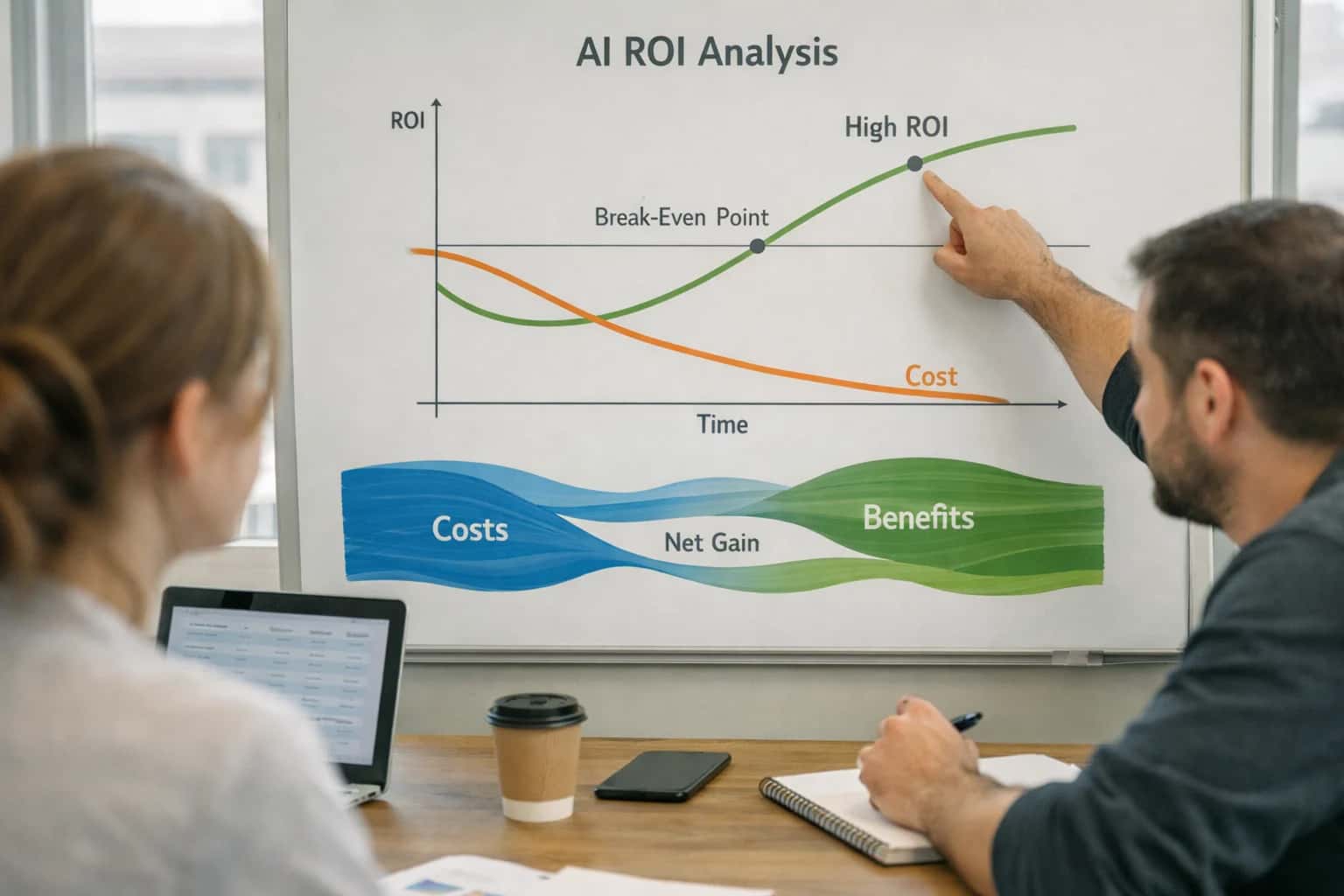
Quantifying the ROI: The Business Case
To secure funding, translate analysis into hard numbers. Primary ROI drivers:
- Reduced External Hiring Costs: Fill 20% more roles internally, saving $30k+ per hire on recruiter fees and ramp-up time.
- Increased Productivity: Close critical skill gaps 50% faster, reducing project delays and time-to-market.
- Mitigated Attrition Risk: Proactive career pathing based on skill development can reduce voluntary turnover by 15%, saving millions in replacement costs.
- Strategic Alignment: Ensure 100% of your training budget directly supports upcoming business objectives, eliminating waste.
06
Overcoming Common Scaling Challenges
Acknowledge and plan for hurdles to ensure sustainable scale. Critical success factors:
- Data Quality & Integration: Start with clean, integrated data from HRIS, LMS, and project tools. Poor data undermines trust.
- Change Management: Frame this as a tool for employee career growth, not surveillance. Transparency is key.
- Leadership Buy-In: Use pilot results to create champions in Finance, Operations, and Business Units.
- Ethical Governance: Implement clear policies on data use, bias auditing, and employee privacy to maintain trust and compliance.

About the author
Prasad Kumkar
CEO & MD, Inference Systems
Prasad Kumkar is the CEO & MD of Inference Systems and writes about AI systems architecture, LLM infrastructure, model serving, evaluation, and production deployment. Over 5+ years, he has worked across computer vision models, L5 autonomous vehicle systems, and LLM research, with a focus on taking complex AI ideas into real-world engineering systems.
His work and writing cover AI systems, large language models, AI agents, multimodal systems, autonomous systems, inference optimization, RAG, evaluation, and production AI engineering.
LinkedIn
Limited slotsGet a Free AI Consultation
Partnered with leading AI, data, and software stack.





How We Work
Custom AI workflows for your Business
One-fit-all AI don't work for modern businesses. At Inferensys, we aim to understand your business & custom requirements; which we use to define most efficient agentic workflows, the data, and the tools for your business.
01
Review the use case
We understand the task, the users, and where AI can actually help.
Read more02
Pick the right approach
We define what needs search, automation, or product integration.
Read more03
Build the first useful version
We implement the part that proves the value first.
Read more04
Improve from there
We add the checks and visibility needed to keep it useful.
Read moreThe first call is a practical review of your use case and the right next step.
Talk to Us