
Differences
Local-First AI Agent Stacks
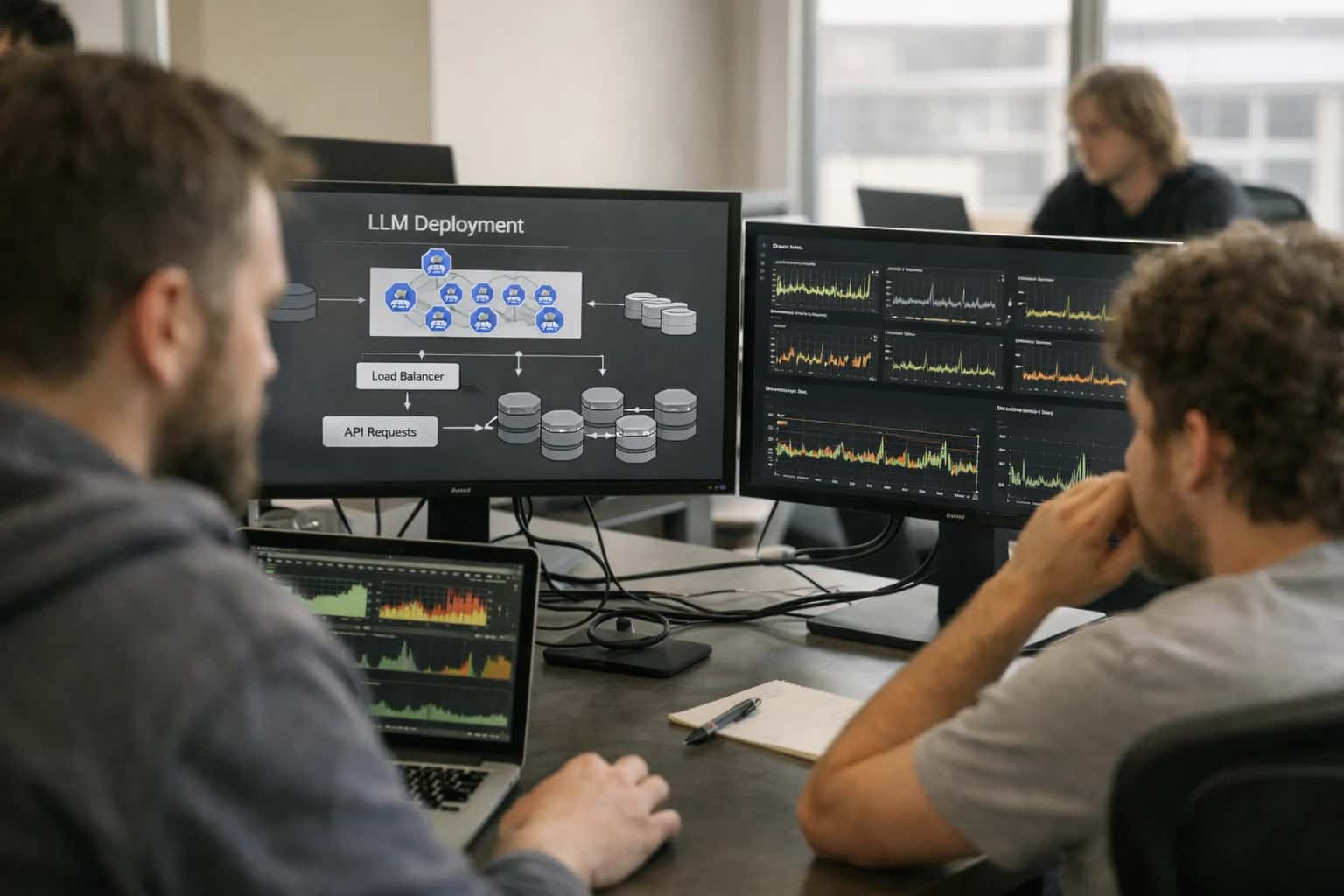
Local-First AI Agent Stacks
Comparisons related to deployment patterns keeping sensitive agent work local with controlled cloud escalation. Target: security-conscious CTOs evaluating private inference vs hybrid routing architectures.
Ollama vs LM Studio: Local Model Serving
Compares Ollama's CLI-first, API-centric local model server against LM Studio's GUI-driven, developer-desktop approach for running SLMs locally. Focuses on ease of setup, API compatibility, resource consumption, and suitability for agentic workflows versus individual experimentation.
llama.cpp vs vLLM: Local Inference Engine
Evaluates llama.cpp's CPU-optimized, minimal-dependency inference against vLLM's GPU-accelerated, high-throughput serving for local SLM deployments. Focuses on hardware flexibility, token generation speed, memory efficiency, and production readiness for on-prem agent stacks.
PrivateGPT vs AnythingLLM: Private Document AI
Compares PrivateGPT's fully local, air-gapped document ingestion and Q&A against AnythingLLM's hybrid approach supporting multiple LLM providers and vector databases. Focuses on data residency guarantees, ingestion pipeline robustness, and ease of building a private RAG agent.
LangChain vs LlamaIndex: Local RAG Framework
Analyzes LangChain's general-purpose agent and chain architecture against LlamaIndex's data-centric ingestion and retrieval optimization for building local RAG applications. Focuses on abstraction complexity, retrieval accuracy, and integration with local vector stores and SLMs.
ChromaDB vs Qdrant: Local Vector Database
Compares ChromaDB's developer-friendly, embedded-first vector store against Qdrant's performance-tuned, production-grade vector database for on-premise RAG deployments. Focuses on ease of local setup, query latency at scale, filtering capabilities, and resource overhead.
CrewAI vs AutoGen: Local Multi-Agent Framework
Evaluates CrewAI's role-based, sequential agent orchestration against AutoGen's conversational, event-driven multi-agent patterns for building private agent teams. Focuses on local execution support, debugging complexity, and control over agent communication flows.
n8n vs Dify: Self-Hosted AI Workflow
Compares n8n's technical workflow automation with extensive API connectors against Dify's AI-native visual platform for building and hosting private LLM applications. Focuses on self-hosting complexity, AI-specific features like prompt engineering, and suitability for agentic backend orchestration.
ONNX Runtime vs OpenVINO: Edge SLM Inference
Analyzes ONNX Runtime's cross-platform, framework-agnostic inference against OpenVINO's Intel-optimized toolkit for deploying SLMs on edge devices. Focuses on hardware compatibility, model conversion overhead, and inference latency on CPUs, GPUs, and NPUs.
MLC LLM vs llama.cpp: Mobile SLM Deployment
Compares MLC LLM's universal deployment approach targeting mobile GPUs against llama.cpp's lightweight, CPU-centric inference for on-device SLMs. Focuses on mobile performance, battery impact, and support for diverse phone hardware in local agent applications.
Local-First Agent Stack vs API-First Agent Stack: Architecture Decision
Evaluates the fundamental architectural trade-off between building agents with fully local models and storage against relying on cloud-based LLM APIs with local orchestration. Focuses on data privacy, latency, cost predictability, model quality, and operational complexity for security-conscious enterprises.
Hybrid Routing (Local SLM + Cloud LLM) vs Pure Local Inference: Cost-Latency Strategy
Compares a smart routing architecture that escalates complex tasks to cloud foundation models against a fully local inference approach using only on-prem SLMs. Focuses on cost optimization, task accuracy, failover behavior, and maintaining data residency for sensitive workloads.
Private RAG with Cloud LLM vs Fully Local LLM: Data Residency Trade-off
Analyzes the security and performance implications of using a local vector store with a cloud-based LLM for retrieval-augmented generation against running the entire stack locally. Focuses on the actual data exposure risk, model quality gap, and compliance with strict regulatory requirements.
NVIDIA Jetson Orin vs Raspberry Pi AI Kit: Edge Agent Hardware
Compares NVIDIA's powerful, CUDA-enabled edge AI platform against Raspberry Pi's accessible, low-cost AI accelerator for running local SLM agents. Focuses on inference throughput, power consumption, model support, and total cost for deploying physical agent systems.
Docker Compose vs K3s: Local AI Stack Orchestration
Evaluates Docker Compose's simplicity for single-node deployments against K3s' lightweight Kubernetes distribution for orchestrating multi-component local AI stacks. Focuses on configuration complexity, resource overhead, scaling capabilities, and suitability for home labs versus enterprise edge servers.
Open WebUI vs AnythingLLM: Local Agent UI
Compares Open WebUI's feature-rich, OpenAI-compatible chat interface designed for Ollama against AnythingLLM's document-centric, multi-LLM workspace for interacting with local AI. Focuses on user experience, RAG capabilities, multi-modal support, and management of local models.
Partnered with leading AI, data, and software stack.





How We Work
Custom AI workflows for your Business
One-fit-all AI don't work for modern businesses. At Inferensys, we aim to understand your business & custom requirements; which we use to define most efficient agentic workflows, the data, and the tools for your business.
01
Review the use case
We understand the task, the users, and where AI can actually help.
Read more02
Pick the right approach
We define what needs search, automation, or product integration.
Read more03
Build the first useful version
We implement the part that proves the value first.
Read more04
Improve from there
We add the checks and visibility needed to keep it useful.
Read moreThe first call is a practical review of your use case and the right next step.
Talk to Us