
Differences
Inference Serving Engines
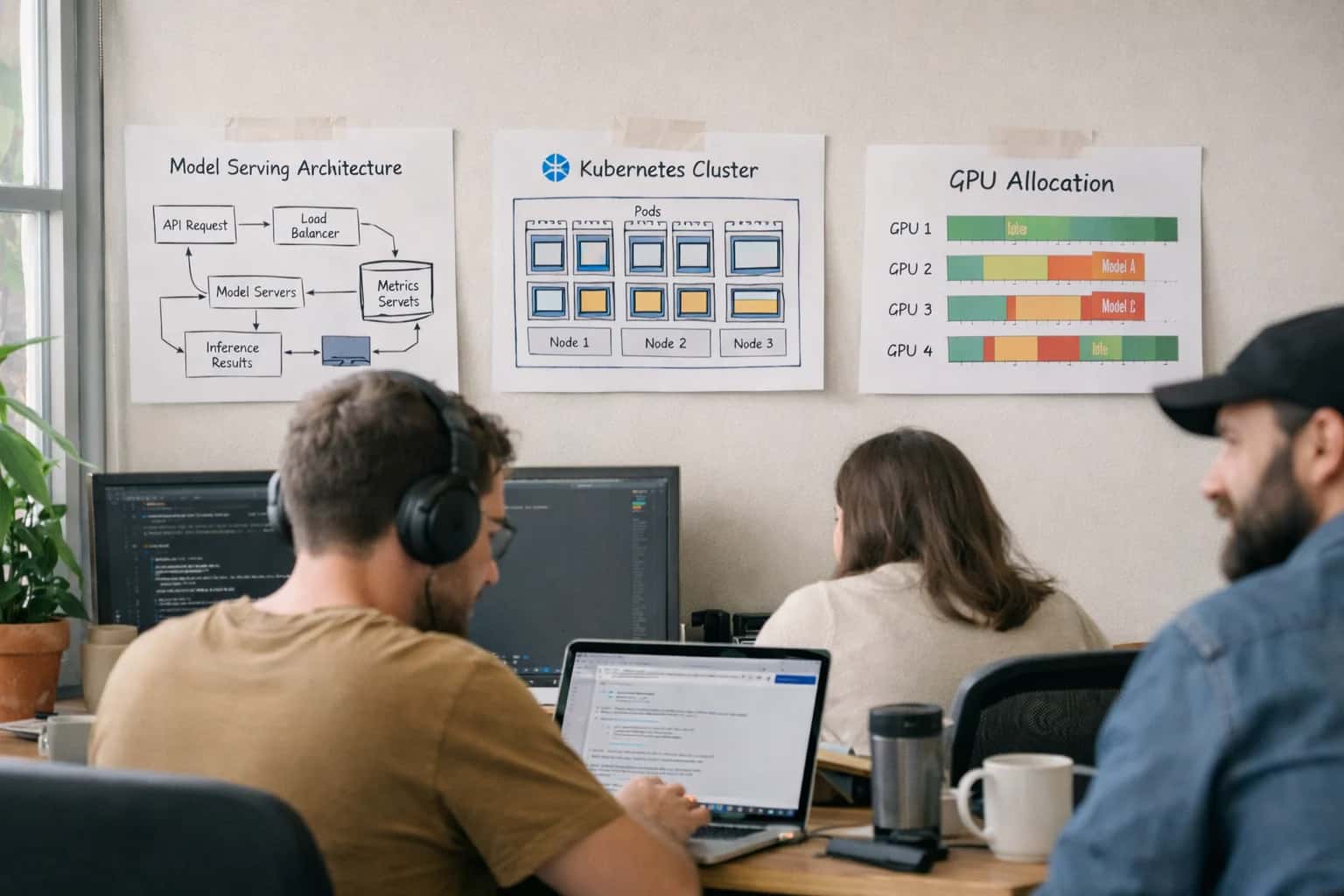
Inference Serving Engines
Comparisons related to high-throughput serving infrastructure optimized for small model fleets. Target: infrastructure leads evaluating vLLM, TensorRT-LLM, and Triton for SLM-specific serving patterns.
vLLM vs TensorRT-LLM
A direct comparison of the two leading high-throughput LLM serving engines. vLLM's PagedAttention versus TensorRT-LLM's NVIDIA-optimized kernels for maximizing tokens-per-second on GPU clusters.
vLLM vs SGLang
Comparing the PagedAttention pioneer against the emerging SGLang runtime, focusing on structured generation, RadixAttention caching, and performance for complex agentic SLM workloads.
vLLM vs Ollama
Evaluating the production-grade vLLM server against the developer-friendly Ollama for local SLM deployment, contrasting GPU utilization, quantization support, and operational overhead.
vLLM vs Hugging Face TGI
A comparison of vLLM's high-throughput architecture versus Hugging Face's native Text Generation Inference server for serving SLMs, focusing on latency, model compatibility, and ecosystem lock-in.
TensorRT-LLM vs Ollama
Contrasting NVIDIA's highly optimized TensorRT-LLM engine with Ollama's simplicity for deploying quantized SLMs, analyzing the trade-off between raw performance and ease of setup.
TensorRT-LLM vs Triton Inference Server
Comparing NVIDIA's dedicated LLM engine against its general-purpose Triton Inference Server for SLM serving, focusing on specialized optimizations versus multi-model orchestration capabilities.
llama.cpp vs Ollama
A detailed comparison of the underlying llama.cpp runtime against the user-friendly Ollama wrapper for local SLM inference, focusing on CPU/GPU hybrid execution and quantization flexibility.
llama.cpp vs vLLM
Comparing the CPU-first llama.cpp runtime against the GPU-optimized vLLM engine for serving small language models, analyzing throughput, hardware requirements, and deployment environments.
SGLang vs Hugging Face TGI
Evaluating the next-generation SGLang runtime against the established Hugging Face TGI for SLM serving, focusing on structured output generation, prefix caching, and multi-modal model support.
Triton Inference Server vs BentoML
Comparing NVIDIA's Triton Inference Server against the BentoML framework for packaging and deploying SLMs, focusing on multi-framework support, scaling policies, and MLOps integration.
vLLM vs DeepSpeed-MII
A comparison of vLLM's PagedAttention against Microsoft's DeepSpeed-MII for low-latency SLM inference, analyzing dynamic batching, model parallelism, and integration with the DeepSpeed ecosystem.
TensorRT-LLM vs llama.cpp
Contrasting NVIDIA's closed-source, GPU-optimized TensorRT-LLM against the open-source, cross-platform llama.cpp for deploying quantized SLMs across diverse hardware targets.
Ollama vs Hugging Face TGI
Comparing the local-first Ollama tool against the server-focused Hugging Face TGI for running SLMs, focusing on developer experience, API compatibility, and production readiness.
vLLM vs Ray Serve
Evaluating the specialized vLLM engine against the general-purpose Ray Serve framework for deploying SLMs, analyzing operational complexity, resource scheduling, and inference-specific optimizations.
TensorRT-LLM vs SGLang
A performance-focused comparison of NVIDIA's TensorRT-LLM and the SGLang runtime for serving SLMs, analyzing kernel optimization, memory efficiency, and structured output capabilities.
llama.cpp vs Hugging Face TGI
Comparing the lightweight llama.cpp runtime against the full-featured Hugging Face TGI for SLM deployment, focusing on resource-constrained environments versus robust, multi-user serving.
Triton Inference Server vs KServe
Comparing NVIDIA's Triton Inference Server against the KServe serverless framework for SLM inference on Kubernetes, focusing on autoscaling, model mesh, and cloud-native deployment patterns.
SGLang vs llama.cpp
Evaluating the GPU-centric SGLang runtime against the CPU/GPU hybrid llama.cpp for SLM inference, analyzing performance characteristics, hardware compatibility, and use-case fit.
Partnered with leading AI, data, and software stack.





How We Work
Custom AI workflows for your Business
One-fit-all AI don't work for modern businesses. At Inferensys, we aim to understand your business & custom requirements; which we use to define most efficient agentic workflows, the data, and the tools for your business.
01
Review the use case
We understand the task, the users, and where AI can actually help.
Read more02
Pick the right approach
We define what needs search, automation, or product integration.
Read more03
Build the first useful version
We implement the part that proves the value first.
Read more04
Improve from there
We add the checks and visibility needed to keep it useful.
Read moreThe first call is a practical review of your use case and the right next step.
Talk to Us