
Differences
Hybrid Cloud Routing Layers
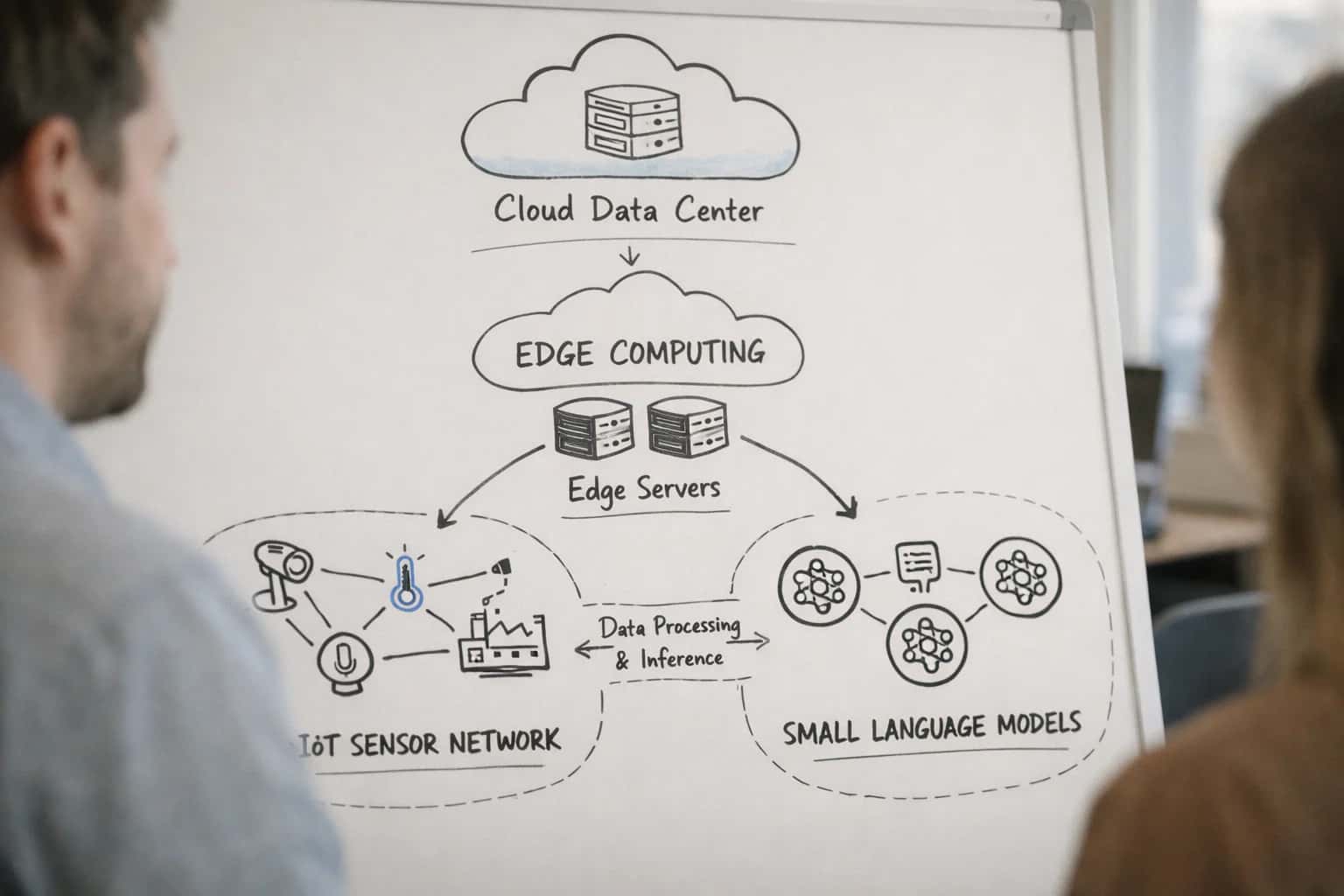
Hybrid Cloud Routing Layers
Comparisons related to inference placement optimizers that split workloads between edge SLMs and cloud foundation models. Target: infrastructure architects designing latency-sensitive, cost-optimized deployment topologies.
Edge SLM Inference vs Cloud Foundation Model Inference
Compares the latency, cost, and data privacy trade-offs of processing AI tasks locally on edge devices with small language models versus sending requests to large, cloud-hosted foundation models. Essential for architects designing real-time, sensitive, or cost-conscious applications.
Smart Router vs Static Model Endpoint
Evaluates dynamic, policy-aware routing layers that distribute requests across SLMs and foundation models against the simplicity and predictability of hardcoding a single model endpoint. Focuses on cost optimization, failure handling, and architectural complexity.
Semantic Cache vs Direct Model Inference
Analyzes the trade-off between reusing cached responses for semantically similar queries versus performing a fresh inference call every time. Covers cost savings, latency reduction, and the risk of serving stale or inaccurate information in high-volume agent workflows.
Model Distillation vs On-the-Fly Routing
Compares two strategies for leveraging large models' intelligence in smaller, cheaper deployments: preemptively distilling a large model into a task-specific SLM versus dynamically routing simple queries to an SLM and complex ones to a foundation model at runtime.
Hybrid Cloud Router vs Pure Edge Deployment
Weighs a hybrid architecture that intelligently escalates complex tasks to the cloud against a fully local deployment where all inference happens on-device. The core debate centers on balancing maximum data privacy and offline capability against access to superior cloud intelligence.
On-Prem SLM Inference vs SaaS Foundation Model API
Compares the total cost of ownership, control, and compliance of self-hosting small language models on private infrastructure against the convenience and cutting-edge capability of consuming a commercial foundation model via a SaaS API.
LoRA-Adapted SLM vs General-Purpose Foundation Model
Evaluates the performance of a small, fine-tuned model adapted to a niche domain with LoRA against a massive, general-purpose foundation model on the same task. Focuses on accuracy, inference cost, and deployment speed for specialized enterprise use cases.
vLLM for SLM Fleets vs TensorRT-LLM for Foundation Models
Compares two leading inference serving engines optimized for different workloads: vLLM's high-throughput serving for fleets of small models versus TensorRT-LLM's optimized performance for single, massive foundation models on NVIDIA hardware.
LLM Gateway vs Custom API Connector
Analyzes the build-vs-buy decision for model abstraction, comparing feature-rich, centralized LLM gateways that provide routing, security, and observability against lightweight, bespoke API connectors built in-house for specific providers.
Fallback to SLM vs Fallback to Static Response
Compares graceful degradation strategies when a primary cloud model is unavailable or times out: failing over to a less capable but functional local SLM versus returning a pre-written static message. Focuses on user experience and business continuity.
Guardrail Integration in Router vs Guardrail in Agent
Evaluates the optimal placement for content safety and policy enforcement, comparing a centralized guardrail layer in the model router against embedding guardrails directly within the agent's reasoning logic. Covers latency, maintenance, and security consistency.
Context Engineering for SLM vs Context Engineering for Foundation Model
Compares the distinct strategies for crafting prompts and retrieved context for small models with limited context windows against the expansive, long-context capabilities of frontier models. Focuses on retrieval precision versus summarization breadth.
Private RAG with SLM vs Cloud RAG with Foundation Model
Analyzes two retrieval-augmented generation architectures: a fully private stack using a local SLM and vector store versus a cloud-based stack using a powerful foundation model and cloud database. The key trade-off is data sovereignty versus answer quality.
Agent Observability for Routed Workflows vs Standard LLM Logging
Compares specialized observability platforms that trace requests across complex routing decisions and multi-model calls against basic logging that only captures a single model's input and output. Essential for debugging failures in hybrid cloud routing layers.
Approval-Gate Pattern vs Risk-Threshold-Based Routing
Evaluates two human-in-the-loop strategies for high-stakes agent actions: a hard approval gate that requires human sign-off for specific tool calls versus a dynamic routing policy that escalates to a human only when a calculated risk score exceeds a threshold.
Partnered with leading AI, data, and software stack.





How We Work
Custom AI workflows for your Business
One-fit-all AI don't work for modern businesses. At Inferensys, we aim to understand your business & custom requirements; which we use to define most efficient agentic workflows, the data, and the tools for your business.
01
Review the use case
We understand the task, the users, and where AI can actually help.
Read more02
Pick the right approach
We define what needs search, automation, or product integration.
Read more03
Build the first useful version
We implement the part that proves the value first.
Read more04
Improve from there
We add the checks and visibility needed to keep it useful.
Read moreThe first call is a practical review of your use case and the right next step.
Talk to Us