A Warehouse Control System (WCS) excels at real-time machine coordination because it operates on a sub-second latency loop. Its primary function is to direct physical equipment—conveyors, sorters, and automated storage and retrieval systems (AS/RS)—by executing deterministic commands. For example, a WCS typically handles 500+ telegrams per second (TPS) to manage PLC-level communication, ensuring that a diverter arm fires at the exact millisecond a carton passes a photo-eye.

Difference
Warehouse Control System (WCS) vs Warehouse Execution System (WES)
A technical comparison for automation directors distinguishing real-time machine control (WCS) from higher-level workflow orchestration (WES), focusing on latency requirements, decision-making scope, and ERP integration points.
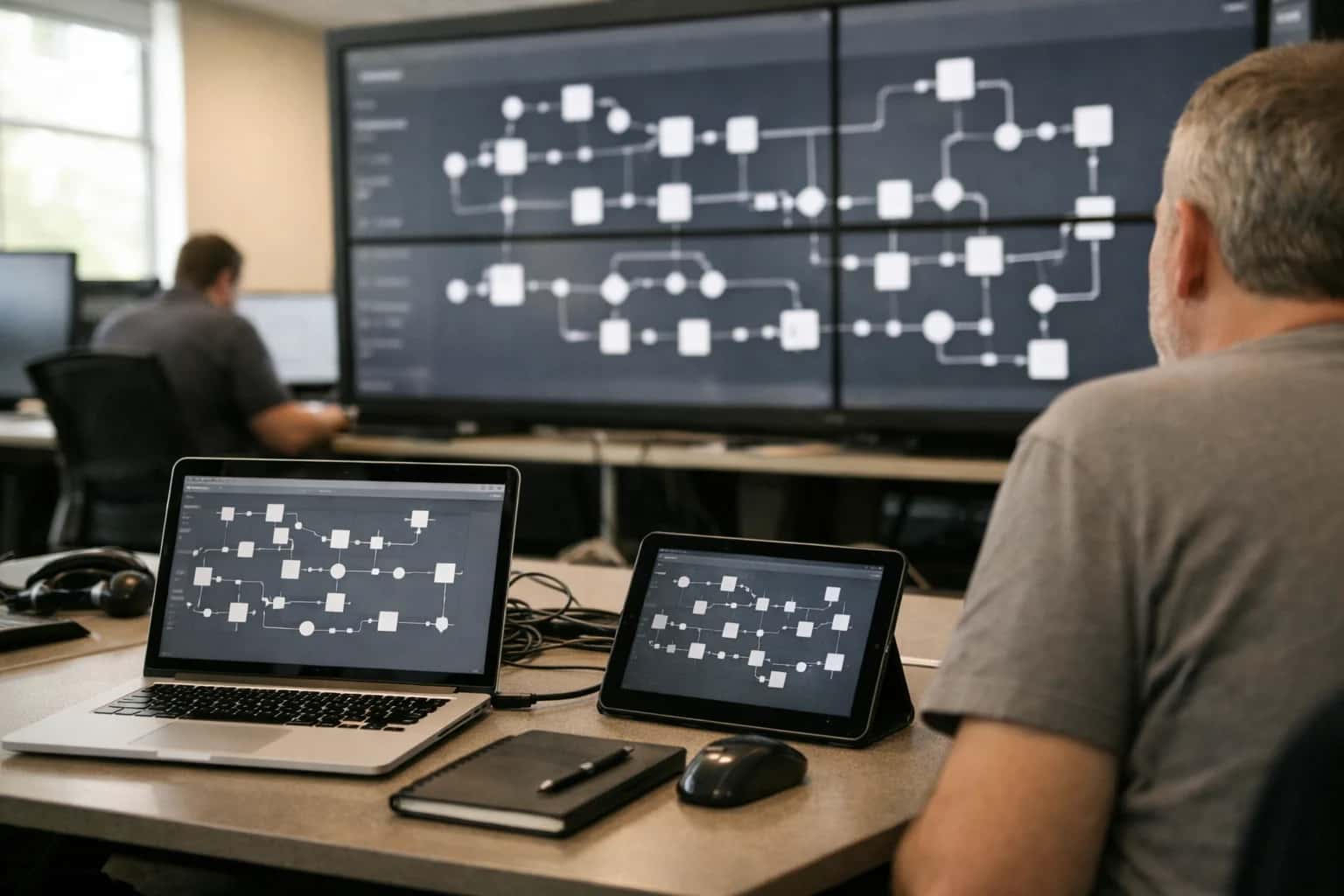
THE ANALYSIS
Introduction
Distinguishing the real-time machine control layer from the higher-level workflow orchestration engine in automated warehouses.
A Warehouse Execution System (WES) takes a different approach by sitting above the WCS, orchestrating work release and resource balancing across multiple automation zones. Instead of controlling a single sorter, a WES might decide which batch of orders to release to the sorter based on carrier cutoff times or labor availability. This results in a trade-off: a WES introduces a slightly higher latency (often measured in seconds, not milliseconds) but provides the business logic layer that prevents bottlenecks from forming across disparate systems.
The key trade-off: If your priority is deterministic, low-latency equipment control to maximize throughput on a specific piece of hardware, choose a WCS. If you prioritize dynamic wave management, cross-zone task interleaving, and integrating automated equipment with manual workflows, choose a WES. A modern warehouse often requires both, with the WES acting as the brain and the WCS as the central nervous system.
HEAD-TO-HEAD COMPARISON
Feature Comparison
Direct comparison of core capabilities distinguishing real-time machine control from higher-level workflow orchestration.
| Metric | Warehouse Control System (WCS) | Warehouse Execution System (WES) |
|---|---|---|
Decision Latency | < 50ms | 500ms - 5s |
Primary Scope | Equipment & Sub-Systems | Workflow & Labor |
Integration Depth | PLC/SCADA Level | ERP/WMS Level |
Path Optimization | Real-time traffic control | Batch wave planning |
Exception Handling | Automated equipment reroute | Human-in-the-loop resolution |
State Awareness | Live sensor data | Transactional status |
Typical Deployment | On-Premise Server | Cloud-Native or Hybrid |
Multi-Agent Coordination |
WCS vs. WES: Core Trade-offs
TL;DR Summary
The fundamental difference is scope and latency. A Warehouse Control System (WCS) is a real-time traffic cop for material handling equipment. A Warehouse Execution System (WES) is a workflow optimizer that bridges the gap between rigid WMS batch waves and real-time floor events. Choose based on whether you need to optimize machine speed or human/machine workflow.
01
Choose WCS for Sub-Second Machine Control
Specific advantage: Deterministic, low-latency communication (often < 50ms) directly with PLCs, conveyors, and sorters. This matters for high-throughput automation where a 100ms delay causes a jam. A WCS excels at maximizing equipment utilization rates (OEE) by executing real-time routing decisions that a WES or WMS cannot make fast enough.
02
Choose WES for Dynamic Workflow Orchestration
Specific advantage: Intelligent order release and task interleaving across both automated and manual zones. This matters for labor and inventory optimization. A WES can re-prioritize a robot's task based on a hot order, or direct a worker to a closer pick location, blending WMS-level planning with WCS-level awareness without hard-coding the logic into the equipment layer.
03
WCS Limitation: No Business Logic
Trade-off: A WCS is functionally blind to order priority, inventory value, or labor productivity. It only executes the move commands it receives. If your operational bottleneck is not machine speed but wave synchronization or resource balancing, a standalone WCS will not solve it. You will need a WES layer to inject business context into material flow.
04
WES Limitation: Not a Real-Time Safety Controller
Trade-off: A WES typically operates on a 1-5 second decision cycle. It is not designed to handle emergency stops, collision avoidance between high-speed shuttles, or deterministic conveyor merge logic. For safety-rated equipment coordination, you must still rely on a WCS or a dedicated PLC network. A WES optimizes the plan; the WCS executes the move safely.
HEAD-TO-HEAD COMPARISON
Latency and Throughput Benchmarks
Direct comparison of real-time control performance versus workflow orchestration throughput in warehouse automation.
| Metric | Warehouse Control System (WCS) | Warehouse Execution System (WES) |
|---|---|---|
Control Loop Latency | < 50 ms | 500 ms – 2 sec |
Decision Scope | Single device/zone | Multi-zone facility-wide |
Transaction Throughput | 10,000+ events/sec | 500–1,000 orders/hr |
Integration Layer | PLC / SCADA | ERP / WMS API |
State Persistence | Volatile (in-memory) | Durable (database) |
Failure Mode | Immediate halt | Graceful degradation |
Typical Deployment | On-premise server | Cloud or on-premise VM |
Contender A Pros
WCS: Pros and Cons
Key strengths and trade-offs at a glance.
01
Sub-Millisecond Equipment Control
Deterministic real-time performance: A WCS directly interfaces with PLCs and material handling equipment (MHE) like conveyors and sorters, achieving control-loop latencies often under 10ms. This matters for high-throughput automation where a 100ms delay causes physical pile-ups or missed diverts.
02
Simplified, Hardened Architecture
Single-vendor reliability: WCS software is typically purpose-built for a specific set of hardware, creating a tightly integrated and highly stable stack. This matters for 24/7 operational uptime in facilities where a software crash directly halts physical goods movement, reducing complex integration debugging.
03
Predictable, Low-Latency Execution
No decision-making overhead: A WCS executes pre-defined rules without the computational cost of optimization algorithms. This matters for cost-sensitive, repetitive workflows where the path is always known (e.g., 'always send carton A to lane 3'), ensuring consistent jitter-free behavior.
Enabling Efficiency, Speed & Accuracy
Intelligent Analysis, Decision & Execution
We build AI systems for teams that need search across company data, workflow automation across tools, or AI features inside products and internal software.
Talk to Us
Search across company data
Give teams answers from docs, tickets, runbooks, and product data with sources and permissions.
Useful when people spend too long searching or get different answers from different systems.
Enterprise searchRAGPermissions
Read more
Automate internal workflows
Use AI to route work, draft outputs, trigger actions, and keep approvals and logs in place.
Useful when repetitive work moves across multiple tools and teams.
AI agentsWorkflow automationGovernance
Read more
Add AI to products and internal tools
Build assistants, guided actions, or decision support into the software your team or customers already use.
Useful when AI needs to be part of the product, not a separate tool.
AI integrationDecision supportModel routing
Read moreCHOOSE YOUR PRIORITY
When to Choose WCS vs WES
WCS for Real-Time Control
Strengths: A WCS operates at the sub-second level, executing direct machine commands to conveyors, sorters, and AS/RS. It is the only choice when deterministic, low-latency responses are non-negotiable for safety and throughput. Verdict: Choose WCS if your bottleneck is physical machine cycle time and you require microsecond response to PLC events.
WES for Workflow Speed
Strengths: A WES optimizes task sequences and order release logic to prevent bottlenecks before they hit the equipment layer. It accelerates decision-making on what to do next, but relies on the WCS to execute how to do it. Verdict: Choose WES if your latency challenge is decision latency (e.g., waveless order release) rather than physical equipment signal latency.
THE ANALYSIS
Verdict
A data-driven breakdown of the architectural trade-offs between real-time machine control and higher-level workflow orchestration to guide your warehouse software investment.
A Warehouse Control System (WCS) excels at real-time, deterministic machine control because its architecture is designed for sub-second latency. For example, a WCS directly communicates with a sorter's programmable logic controller (PLC) to execute a divert decision in under 50 milliseconds, a non-negotiable requirement for high-throughput unit sortation. This tight coupling to physical hardware makes it the only viable choice for closed-loop automation where a delayed signal means a physical jam or a safety incident.
A Warehouse Execution System (WES) takes a different approach by orchestrating work across both automated and manual zones, optimizing at the business-process level rather than the machine level. This results in a trade-off: a WES introduces higher latency (often 1-5 seconds) for decision-making but gains the ability to dynamically re-prioritize a task based on an order's shipping cutoff or a labor shortage in a packing zone. It bridges the gap between a rigid WCS and a transactional Enterprise Resource Planning (ERP) system.
The key trade-off: If your priority is maximizing the throughput of a high-speed, integrated automation island (e.g., a cross-belt sorter or an AS/RS), choose a WCS for its microsecond-level determinism. If you prioritize dynamic workflow balancing across a hybrid environment of robots, cobots, and human pickers to meet same-day delivery SLAs, choose a WES. For many large operations, the modern architecture is a layered one: a WES for order release optimization and a WCS for real-time equipment execution.

About the author
Prasad Kumkar
CEO & MD, Inference Systems
Prasad Kumkar is the CEO & MD of Inference Systems and writes about AI systems architecture, LLM infrastructure, model serving, evaluation, and production deployment. Over 5+ years, he has worked across computer vision models, L5 autonomous vehicle systems, and LLM research, with a focus on taking complex AI ideas into real-world engineering systems.
His work and writing cover AI systems, large language models, AI agents, multimodal systems, autonomous systems, inference optimization, RAG, evaluation, and production AI engineering.
LinkedIn
Limited slotsGet a Free AI Consultation
Partnered with leading AI, data, and software stack.





How We Work
Custom AI workflows for your Business
One-fit-all AI don't work for modern businesses. At Inferensys, we aim to understand your business & custom requirements; which we use to define most efficient agentic workflows, the data, and the tools for your business.
01
Review the use case
We understand the task, the users, and where AI can actually help.
Read more02
Pick the right approach
We define what needs search, automation, or product integration.
Read more03
Build the first useful version
We implement the part that proves the value first.
Read more04
Improve from there
We add the checks and visibility needed to keep it useful.
Read moreThe first call is a practical review of your use case and the right next step.
Talk to Us