Mujin Controller excels at providing a complete, teachless automation ecosystem because it combines perception, motion planning, and real-time control into a single, unified platform. For example, in complex depalletizing tasks with mixed SKUs, Mujin's integrated approach can reduce system integration time by up to 80% compared to traditional teach-pendant methods, as it eliminates the need for separate vision, planning, and robot controller programming.

Difference
Mujin Controller vs Realtime Robotics RapidPlan
A head-to-head comparison for VPs of Manufacturing Engineering evaluating a full-stack, teachless industrial robot controller against a hardware-accelerated collision-free motion planning processor for complex multi-robot workcells.
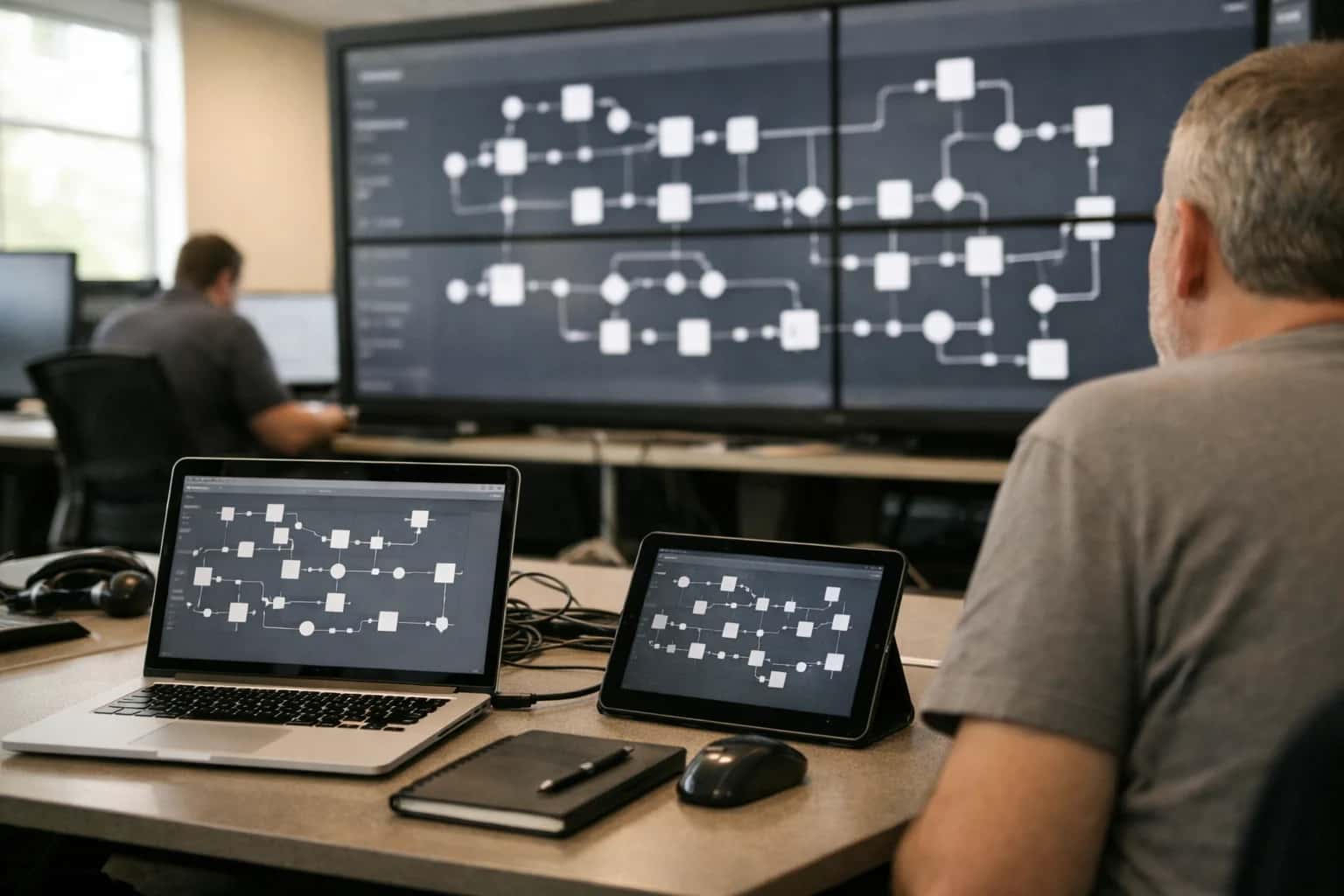
THE ANALYSIS
Introduction
A data-driven comparison of two fundamentally different approaches to industrial robot control: a full-stack, teachless automation platform versus a hardware-accelerated motion planning processor.
Realtime Robotics RapidPlan takes a different approach by focusing exclusively on hardware-accelerated, collision-free motion planning as a middleware layer. This results in a best-in-class planning speed, generating optimized, collision-free trajectories in under a millisecond for multi-robot workcells. The trade-off is that it functions as a powerful planning processor, not a full automation stack, requiring integration with external perception systems and robot controllers.
The key trade-off: If your priority is a single-vendor, turnkey solution that simplifies the deployment of complex logistics tasks like bin picking and depalletizing, choose Mujin Controller. If you prioritize ultra-fast, deterministic motion planning for a highly customized, multi-robot cell where you want to select your own perception and control hardware, choose Realtime Robotics RapidPlan.
HEAD-TO-HEAD COMPARISON
Feature Comparison Matrix
Direct comparison of core architectural and performance metrics for industrial robot control.
| Metric | Mujin Controller | Realtime Robotics RapidPlan |
|---|---|---|
Core Architecture | Full-stack, teachless perception & motion | Hardware-accelerated collision-free motion planning |
Path Planning Latency (6-axis) | ~100-500ms (scene-dependent) | < 1ms (per trajectory optimization) |
Multi-Robot Coordination | Centralized workcell planning | Native, real-time multi-robot collision avoidance |
Primary Programming Method | 3D scene-based, no-code teachless | RapidPlan processor + standard robot code |
Dynamic Obstacle Avoidance | ||
Bin Picking Capability | Native, integrated 3D vision | |
Hardware Dependency | Standard industrial PC | Custom RapidPlan processor (FPGA/GPU) |
Typical Deployment Complexity | High (full workcell modeling) | Medium (processor integration) |
Mujin Controller vs Realtime Robotics RapidPlan
TL;DR Summary
A high-level comparison of a full-stack, teachless industrial robot controller against a hardware-accelerated collision-free motion planning processor for multi-robot workcells.
01
Mujin Controller: Full-Stack, Teachless Automation
Unified platform for perception, planning, and control: Mujin eliminates the need for robot teaching by combining 3D vision, real-time motion planning, and a universal controller in one system. This matters for high-mix, low-volume logistics where SKU variability makes traditional programming infeasible. Key advantage: Deploy complex depalletizing or bin-picking cells without writing robot-specific code.
02
Mujin Controller: Hardware-Agnostic Integration
Brand-independent architecture: Mujin's controller works with major robot arms (FANUC, ABB, KUKA, Yaskawa) and standard PLCs, avoiding vendor lock-in. This matters for brownfield deployments where a facility already has a mix of robot brands. Trade-off: The full-stack approach requires a higher initial software investment and a longer integration cycle compared to a point solution for motion planning.
03
RapidPlan: Hardware-Accelerated Collision Avoidance
Sub-millisecond motion planning: RapidPlan uses a dedicated processor to generate collision-free trajectories in real-time, enabling dynamic obstacle avoidance for multiple robots sharing a workspace. This matters for high-density workcells where robots operate in close proximity and cannot be fenced off. Key advantage: Achieve cycle time reductions of 15-30% by eliminating safety-rated monitored stops.
04
RapidPlan: Lightweight Integration Layer
Plugs into existing robot controllers: RapidPlan acts as a real-time path planner that sits between the robot's native controller and the application layer, requiring no rip-and-replace of existing automation. This matters for automotive OEMs and Tier 1 suppliers who need to retrofit collision avoidance into existing lines. Trade-off: RapidPlan focuses exclusively on motion planning; it does not provide perception, grasping algorithms, or task-level autonomy, requiring separate integration of vision and end-effector systems.
HEAD-TO-HEAD COMPARISON
Performance and Throughput Specifications
Direct comparison of key metrics and features.
| Metric | Mujin Controller | Realtime Robotics RapidPlan |
|---|---|---|
Motion Planning Paradigm | Teachless, Autonomous Motion Planning | Hardware-Accelerated Collision-Free Path Planning |
Path Planning Speed (Typical) | 1-5 seconds (complex bin picking) | < 1 ms per trajectory |
Multi-Robot Coordination | ||
Hardware Dependency | Standard Industrial PC | Custom FPGA/GPU Acceleration Hardware |
Primary Optimization Goal | Autonomous task completion without teaching | Real-time, collision-free trajectory optimization |
Dynamic Obstacle Avoidance | ||
Integration Complexity | Full-stack controller replacement | Middleware layer between controller and robot |
Contender A Pros
Mujin Controller: Pros and Cons
Key strengths and trade-offs at a glance for the Mujin Controller, a full-stack, teachless industrial robot controller.
01
Teachless, Full-Stack Automation
Autonomous motion planning: Mujin's core differentiator is its ability to autonomously generate all robot motions from a 3D CAD model of the workcell, eliminating the need for manual point-to-point teaching. This matters for high-mix, low-volume manufacturing where reprogramming time kills ROI. The platform handles perception, motion planning, and real-time control in a unified stack, reducing integration complexity.
02
Rapid Deployment and Reconfiguration
Time-to-production: Users report deploying complex bin-picking and palletizing cells in days, not weeks. The system's ability to automatically detect collisions and plan singularity-free paths means a new SKU or pallet pattern can be introduced by simply updating the CAD model. This matters for logistics and e-commerce operations facing seasonal SKU volatility.
03
Multi-Brand Hardware Agnosticism
Universal controller: Mujin is not tied to a specific robot manufacturer. It can control industrial arms from FANUC, ABB, KUKA, and Yaskawa, providing a single programming environment across a heterogeneous fleet. This matters for system integrators and large manufacturers seeking to avoid vendor lock-in and standardize their programming workflow.
CHOOSE YOUR PRIORITY
When to Choose Which Platform
Mujin Controller for Greenfield Workcells
Strengths: The Mujin Controller is a full-stack, teachless platform. For a greenfield deployment, this means you don't need to hire a team of specialized robot programmers. The system uses perception to autonomously generate motion plans, drastically reducing integration time. It's the superior choice when you're building a new, complex logistics cell (like mixed-SKU depalletizing) from the ground up and want to avoid traditional teach-pendant programming.
Realtime Robotics RapidPlan for Greenfield Workcells
Verdict: Less ideal as a standalone solution. RapidPlan excels as a motion planning processor, not a full workcell controller. In a greenfield scenario, you would still need to integrate it with a PLC or a separate robot controller to handle I/O, grippers, and overall cell logic. Its value is in optimizing multi-robot paths, not in providing the complete application layer.
Enabling Efficiency, Speed & Accuracy
Intelligent Analysis, Decision & Execution
We build AI systems for teams that need search across company data, workflow automation across tools, or AI features inside products and internal software.
Talk to Us
Search across company data
Give teams answers from docs, tickets, runbooks, and product data with sources and permissions.
Useful when people spend too long searching or get different answers from different systems.
Enterprise searchRAGPermissions
Read more
Automate internal workflows
Use AI to route work, draft outputs, trigger actions, and keep approvals and logs in place.
Useful when repetitive work moves across multiple tools and teams.
AI agentsWorkflow automationGovernance
Read more
Add AI to products and internal tools
Build assistants, guided actions, or decision support into the software your team or customers already use.
Useful when AI needs to be part of the product, not a separate tool.
AI integrationDecision supportModel routing
Read moreHEAD-TO-HEAD COMPARISON
Cost and Licensing Comparison
Direct comparison of total cost of ownership, licensing models, and hardware dependencies for Mujin Controller and Realtime Robotics RapidPlan.
| Metric | Mujin Controller | Realtime Robotics RapidPlan |
|---|---|---|
Licensing Model | Perpetual License + Annual Maintenance | Annual Subscription (SaaS) |
Hardware Dependency | Standard Industrial PC (IPC) | Custom FPGA/GPU Acceleration Card Required |
Multi-Robot Cell Cost Scaling | Linear (Per-Robot License) | Sub-linear (Single RapidPlan Processor per Cell) |
Teachless/Offline Programming | ||
Simulation & Digital Twin Included | ||
Typical Deployment Time | 1-2 Weeks | 2-4 Days |
Vendor Lock-in Risk | Medium (Proprietary Controller) | Low (Integrates with existing robot controllers) |
THE ANALYSIS
Verdict
A data-driven breakdown of the architectural trade-offs between a teachless, full-stack controller and a hardware-accelerated motion planning processor.
[Mujin Controller] excels at providing a complete, teachless automation solution because it combines perception, motion planning, and real-time control into a single, unified platform. For example, in complex depalletizing tasks with mixed, unknown SKUs, Mujin's approach eliminates the need for tedious point-by-point teaching, reducing deployment time by up to 80% compared to traditional methods. Its strength lies in autonomously generating collision-free paths from 3D sensor data, making it ideal for unstructured logistics environments where part positions are highly variable.
[Realtime Robotics RapidPlan] takes a different, more specialized approach by focusing on hardware-accelerated collision-free motion planning for multi-robot workcells. This results in a significant trade-off: it doesn't provide the full perception-to-control stack, but it delivers sub-millisecond motion plan optimization for pre-defined tasks. For a high-throughput automotive spot-welding cell with 4+ robots, RapidPlan can reduce cycle times by 10-15% by computing interference-free paths faster than any software-only solution, directly increasing production line OEE (Overall Equipment Effectiveness).
The key trade-off: If your priority is autonomous adaptation to unstructured environments and reducing integration engineering for logistics tasks like bin picking or depalletizing, choose Mujin Controller. If you prioritize maximum throughput and deterministic cycle time reduction in a highly engineered, multi-robot manufacturing cell, choose Realtime Robotics RapidPlan. Consider Mujin for greenfield flexibility and RapidPlan for brownfield performance optimization.

About the author
Prasad Kumkar
CEO & MD, Inference Systems
Prasad Kumkar is the CEO & MD of Inference Systems and writes about AI systems architecture, LLM infrastructure, model serving, evaluation, and production deployment. Over 5+ years, he has worked across computer vision models, L5 autonomous vehicle systems, and LLM research, with a focus on taking complex AI ideas into real-world engineering systems.
His work and writing cover AI systems, large language models, AI agents, multimodal systems, autonomous systems, inference optimization, RAG, evaluation, and production AI engineering.
LinkedIn
Limited slotsGet a Free AI Consultation
Partnered with leading AI, data, and software stack.





How We Work
Custom AI workflows for your Business
One-fit-all AI don't work for modern businesses. At Inferensys, we aim to understand your business & custom requirements; which we use to define most efficient agentic workflows, the data, and the tools for your business.
01
Review the use case
We understand the task, the users, and where AI can actually help.
Read more02
Pick the right approach
We define what needs search, automation, or product integration.
Read more03
Build the first useful version
We implement the part that proves the value first.
Read more04
Improve from there
We add the checks and visibility needed to keep it useful.
Read moreThe first call is a practical review of your use case and the right next step.
Talk to Us