
Differences
Model Hosting and Serving Options
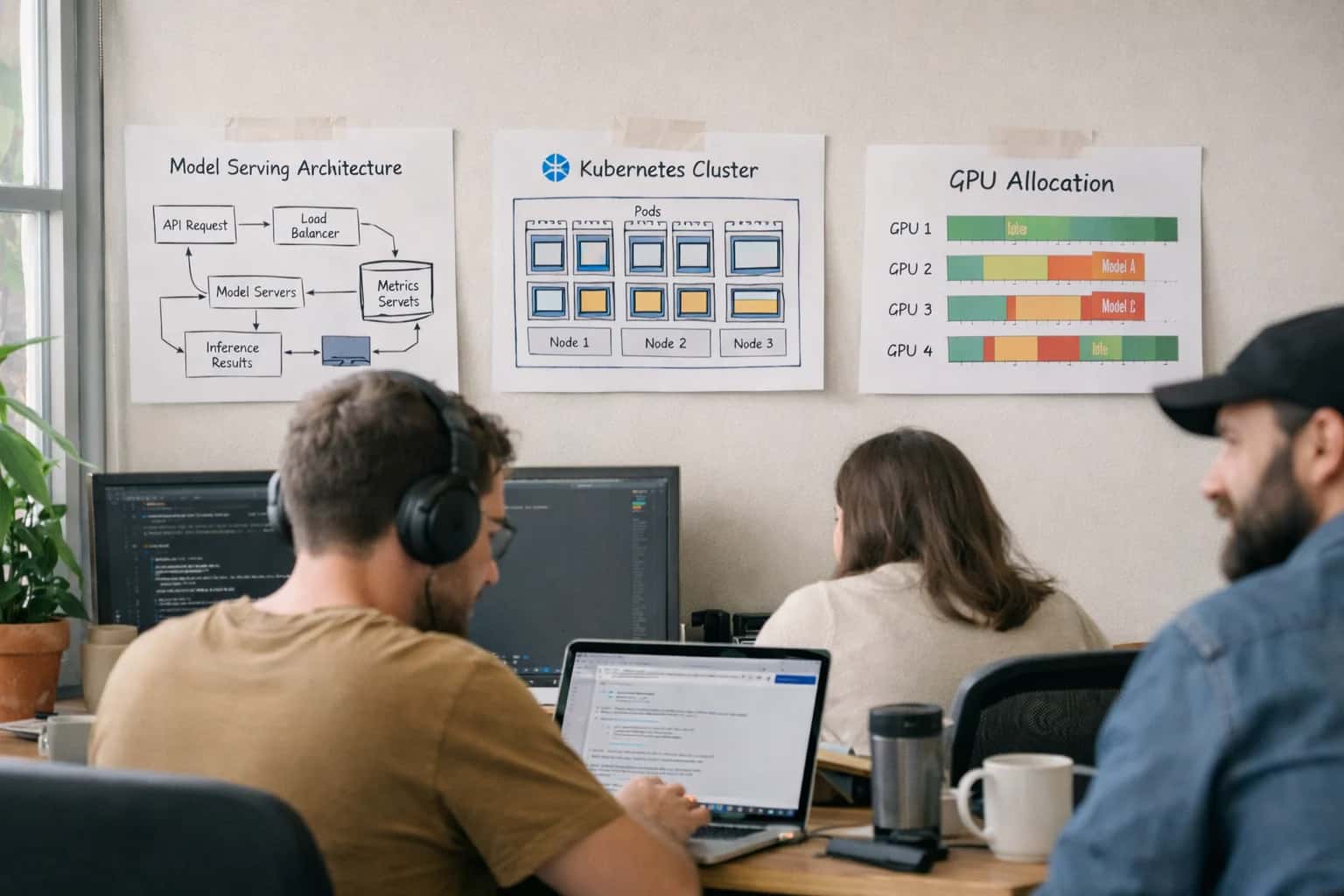
Model Hosting and Serving Options
Comparisons related to bring-your-own-model capabilities, external model API connectors, and serverless inference. Target: MLOps engineers and technical architects.
vLLM vs Text Generation Inference (TGI): LLM Serving Showdown
A technical deep-dive comparing the two dominant open-source LLM serving engines. We benchmark vLLM's PagedAttention against TGI's FlashAttention for throughput, latency, and memory efficiency under heavy load, helping MLOps engineers choose the right stack for production-grade generative AI.
SageMaker Serverless Inference vs Bedrock Custom Model Import
A strategic comparison for AWS shops deciding between the managed infrastructure of SageMaker Serverless and the API-driven simplicity of importing custom models into Bedrock. We analyze cold-start latency, cost scaling, and governance trade-offs for deploying fine-tuned models.
Triton Inference Server vs TorchServe: Multi-Framework Serving
A head-to-head evaluation of NVIDIA's Triton Inference Server against PyTorch's TorchServe for organizations running diverse model architectures. We compare multi-framework support, dynamic batching, and GPU utilization to determine the best high-performance, framework-agnostic serving solution.
KServe vs Seldon Core: Serverless Inference on Kubernetes
A comparison of the two leading Kubernetes-native model serving frameworks. We evaluate KServe's serverless, scale-to-zero capabilities against Seldon Core's complex inference graph orchestration, focusing on operational overhead, autoscaling, and multi-model deployment patterns.
Ray Serve vs FastAPI: Custom Model Microservices
A practical guide for ML engineers choosing between building custom serving logic with FastAPI and using the distributed, scalable Ray Serve framework. We compare development velocity, built-in model composition, and production readiness for complex AI microservice architectures.
Hugging Face Inference Endpoints vs Replicate Cloud API
A comparison of two popular platforms for deploying open-source models without managing infrastructure. We analyze Hugging Face's native integration with its ecosystem against Replicate's community-driven model library and Cog pushing, focusing on cold starts, customization, and pricing.
BentoML vs MLflow Model Serving: API Standardization
A comparison of BentoML's bento packaging standard against MLflow's built-in serving capabilities for creating standardized, production-ready model APIs. We evaluate deployment flexibility, multi-model service composition, and integration with existing MLOps pipelines.
Fireworks AI vs Together AI: Fine-Tuned Model Hosting
A performance and cost analysis of two specialized platforms for hosting and serving fine-tuned open-source LLMs. We benchmark inference speed, LoRA adapter support, and pricing models to determine the best platform for deploying customized generative models at scale.
Continuous Batching vs Dynamic Batching: LLM Throughput
A technical comparison of two critical techniques for maximizing GPU utilization in LLM serving. We explain how continuous batching eliminates the straggler problem inherent in dynamic batching, quantifying the throughput and latency improvements for real-world, high-concurrency workloads.
Real-Time Inference Endpoints vs Batch Transform Jobs
A cost-optimization guide comparing synchronous, low-latency endpoints against asynchronous, high-throughput batch jobs. We provide a decision matrix based on latency requirements, data freshness, and cost sensitivity to help architects choose the right inference pattern for their use case.
Serverless GPU Inference vs Dedicated GPU Instance Hosting
A total cost of ownership (TCO) analysis comparing scale-to-zero serverless GPU offerings like RunPod and Modal against always-on dedicated instances from CoreWeave or Lambda Labs. We evaluate cold-start penalties, per-task cost, and operational complexity for sporadic vs. steady-state inference traffic.
Model Quantization (AWQ) vs KV Cache Quantization: Memory Optimization
A technical deep-dive into two complementary memory-saving techniques for LLM serving. We compare Activation-aware Weight Quantization (AWQ) for reducing model footprint against KV cache quantization for enabling larger batch sizes, analyzing their individual and combined impact on throughput.
gRPC vs REST API: High-Throughput Model Serving
A performance benchmark comparing gRPC and REST as transport protocols for inference APIs. We measure latency, payload size, and throughput under load to determine when the binary protocol and persistent connections of gRPC provide a decisive advantage over the ubiquity of REST.
Semantic Cache (GPTCache) vs Exact Cache (Redis): LLM Response Reuse
A comparison of caching strategies to reduce LLM inference cost and latency. We evaluate semantic caching's ability to match similar queries against the speed and precision of exact key-value lookups, analyzing cache hit rates, cost savings, and the risk of returning stale or incorrect responses.
Canary Deployment vs Blue/Green Deployment: Model Updates
A risk-mitigation comparison for rolling out new model versions. We analyze canary deployments, which gradually shift traffic, against blue/green deployments, which perform an instant cutover, focusing on rollback speed, blast radius, and the monitoring requirements for safe, automated model updates.
AWS Inferentia vs NVIDIA T4: Cost-Effective Model Hosting
A price-performance analysis comparing AWS's custom Inferentia silicon against the ubiquitous NVIDIA T4 GPU for inference. We benchmark throughput and latency for popular model architectures to determine which accelerator provides the lowest cost per inference for budget-conscious deployments.
LiteLLM Proxy vs LangSmith Hub: Model Provider Abstraction
A comparison of two approaches to abstracting away model provider complexity. We evaluate LiteLLM's lightweight, OpenAI-compatible proxy for cost tracking and failover against LangSmith Hub's broader prompt management and observability platform, focusing on simplicity versus feature depth.
Cloudflare Workers AI vs Vercel AI SDK: Edge Model Hosting
A comparison of two leading edge AI platforms for deploying models close to users. We analyze Cloudflare's globally distributed inference network against Vercel's AI SDK for building generative UI, focusing on latency, supported models, and the developer experience for front-end and full-stack engineers.
Partnered with leading AI, data, and software stack.





How We Work
Custom AI workflows for your Business
One-fit-all AI don't work for modern businesses. At Inferensys, we aim to understand your business & custom requirements; which we use to define most efficient agentic workflows, the data, and the tools for your business.
01
Review the use case
We understand the task, the users, and where AI can actually help.
Read more02
Pick the right approach
We define what needs search, automation, or product integration.
Read more03
Build the first useful version
We implement the part that proves the value first.
Read more04
Improve from there
We add the checks and visibility needed to keep it useful.
Read moreThe first call is a practical review of your use case and the right next step.
Talk to Us