Cosmo Tech excels at complex system simulation because its core engine is built on a mathematical modeling approach that maps millions of individual entities and their behavioral rules. For example, in a multi-echelon supply chain, Cosmo Tech's platform can simulate cascading disruptions—like a Tier-2 supplier failure in Taiwan—by propagating the impact through every node, inventory buffer, and transportation lane, providing a probabilistic range of outcomes rather than a single forecast.

Difference
Cosmo Tech vs Palantir Foundry: AI-Driven Scenario Simulation
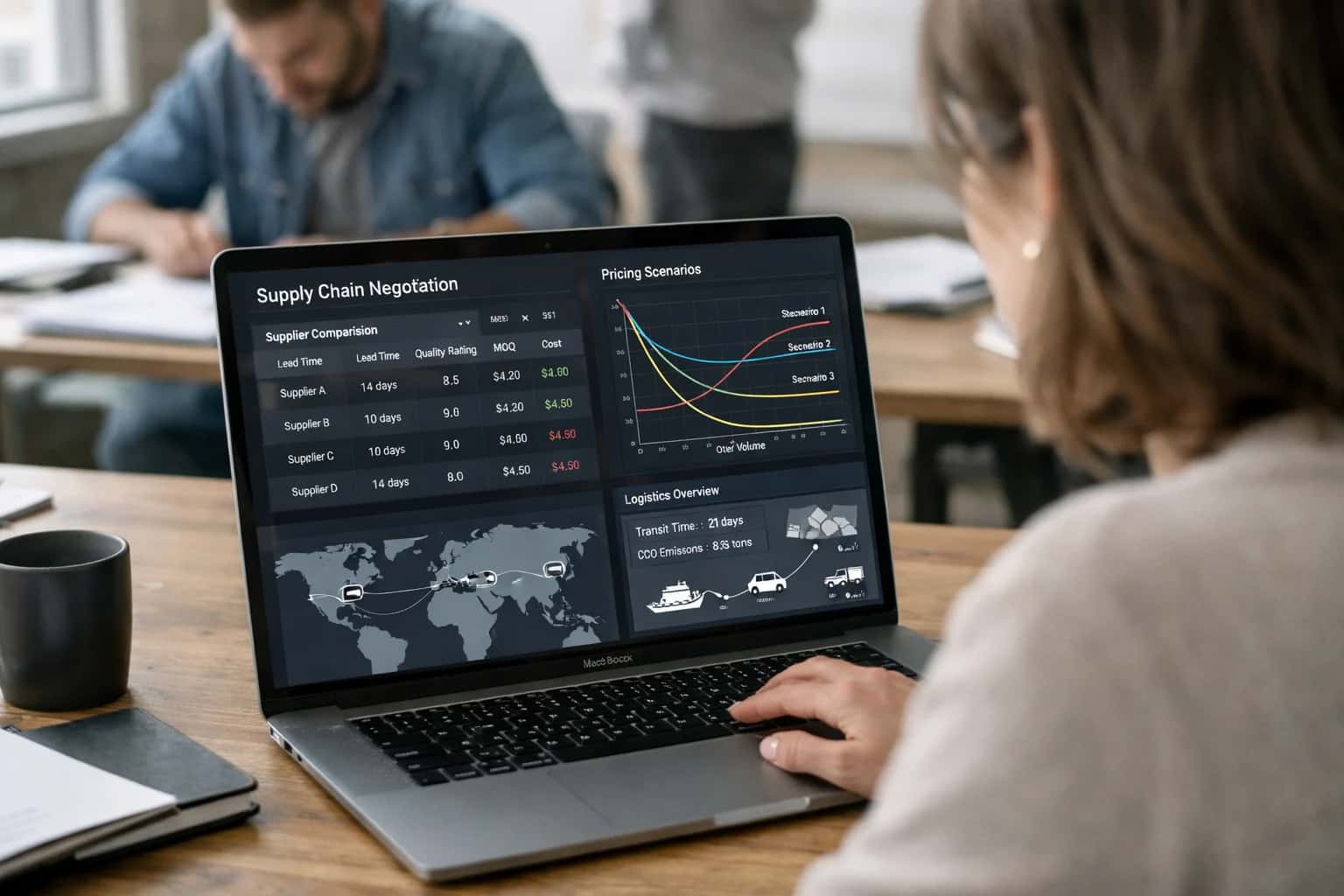
A technical comparison for VPs of Logistics and Supply Chain Innovation evaluating Cosmo Tech's enterprise digital twin platform against Palantir Foundry's ontology-powered operating system for complex scenario planning and disruption modeling.
THE ANALYSIS
Introduction
A data-driven comparison of Cosmo Tech's simulation-first digital twin platform against Palantir Foundry's ontology-powered operating system for AI-driven scenario planning and supply chain disruption modeling.
Palantir Foundry takes a different approach by prioritizing data integration and operational decision-making through its ontology-first architecture. Instead of simulating every entity from the ground up, Foundry connects to live ERP, TMS, and IoT data streams to create a semantic model of the supply chain. This results in a faster time-to-value for operational visibility and allows users to run 'what-if' analyses directly on a live data backbone, but the fidelity of the simulation is constrained by the granularity of the ingested data rather than a first-principles model.
The key trade-off: If your priority is high-fidelity simulation of cascading failures and emergent behavior in a complex system, choose Cosmo Tech's entity-centric modeling. If you prioritize rapid operationalization, cross-functional data integration, and a single source of truth for decision-making, choose Palantir Foundry's ontology-driven platform. Cosmo Tech simulates the world as it behaves; Palantir models the world as it is.
HEAD-TO-HEAD COMPARISON
Feature Comparison: Cosmo Tech vs Palantir Foundry
Direct comparison of key metrics and features for AI-driven scenario simulation in supply chain digital twins.
| Metric | Cosmo Tech | Palantir Foundry |
|---|---|---|
Core Simulation Paradigm | Causal AI & Complex Systems Theory | Ontology-Powered Operational Twin |
Model Explainability | White-box causal graphs | Black-box ML with lineage tracking |
Cascading Disruption Modeling | ||
Real-Time Data Ingestion | Batch & API | Streaming-first (Kafka, Flink) |
Typical Deployment Time | 6-12 months | 3-6 months |
Primary User Persona | Risk Strategist & Simulation Engineer | Data Engineer & Operations Analyst |
Integration Depth (ERP/TMS) | Pre-built connectors for SAP, Blue Yonder | Open APIs, heavy custom pipeline build |
Scalability (Max Entities) | ~500,000 agents | Billions of objects |
Pros & Cons at a Glance
TL;DR Summary
Key strengths and trade-offs for Cosmo Tech and Palantir Foundry in AI-driven scenario simulation.
01
Cosmo Tech: Causal AI & Simulation Fidelity
Specific advantage: Uses a proprietary causal AI engine to model complex system interdependencies, not just correlations. This matters for predicting cascading supply chain disruptions where a single event (e.g., a port closure) triggers a non-linear ripple effect across inventory, logistics, and production. The platform provides high-fidelity 'what-if' analysis that explains why a scenario unfolded, offering greater model explainability for strategic planning.
02
Cosmo Tech: Domain-Specific Twin Templates
Specific advantage: Offers pre-built, configurable digital twin templates for specific industries like manufacturing, energy, and logistics. This matters for faster time-to-value in supply chain use cases, as teams don't start from a blank canvas. The platform is designed for business leaders to run simulations directly, reducing dependency on data science teams for complex scenario planning.
03
Palantir Foundry: Ontology-Powered Data Integration
Specific advantage: Its core ontology maps and connects all enterprise data sources (ERP, IoT, spreadsheets) into a unified, object-based semantic layer. This matters for operationalizing decisions across silos, as the digital twin is directly connected to live operational data. Foundry excels at integrating messy, real-world data at massive scale, providing a single source of truth for simulation inputs.
04
Palantir Foundry: Operational Decision-Making OS
Specific advantage: Functions as a full operating system, not just a simulation tool. It links simulation outputs directly to operational workflows, alerts, and actions. This matters for closing the loop from insight to action, enabling autonomous or human-in-the-loop responses to disruptions. Its strength is in managing the entire decision lifecycle, from data integration and modeling to real-time monitoring and execution.
Enabling Efficiency, Speed & Accuracy
Intelligent Analysis, Decision & Execution
We build AI systems for teams that need search across company data, workflow automation across tools, or AI features inside products and internal software.
Talk to Us
Search across company data
Give teams answers from docs, tickets, runbooks, and product data with sources and permissions.
Useful when people spend too long searching or get different answers from different systems.
Enterprise searchRAGPermissions
Read more
Automate internal workflows
Use AI to route work, draft outputs, trigger actions, and keep approvals and logs in place.
Useful when repetitive work moves across multiple tools and teams.
AI agentsWorkflow automationGovernance
Read more
Add AI to products and internal tools
Build assistants, guided actions, or decision support into the software your team or customers already use.
Useful when AI needs to be part of the product, not a separate tool.
AI integrationDecision supportModel routing
Read moreCHOOSE YOUR PRIORITY
When to Choose Cosmo Tech vs Palantir Foundry
Cosmo Tech for Simulation Fidelity
Strengths: Cosmo Tech is purpose-built for high-fidelity, multi-agent simulation of complex industrial systems. Its core engine models cascading failures and emergent behaviors, making it the superior choice for understanding how a disruption propagates across a multi-echelon supply chain. It excels at 'what-if' analysis where the physics and constraints of the real world (lead times, capacities, bottlenecks) are non-negotiable.
Verdict: Choose Cosmo Tech when the primary goal is to understand the dynamic, non-linear behavior of a complex system under stress, such as modeling the impact of a port closure on global inventory levels.
Palantir Foundry for Simulation Fidelity
Strengths: Foundry's simulation capability is an extension of its ontology. It simulates decisions against a semantic model of the business. Its strength is not in modeling physical constraints but in simulating the impact of decisions across interconnected business units (finance, inventory, customer sentiment). It's best for 'what-if' analysis on strategic choices, like a pricing change or a supplier shift.
Verdict: Choose Foundry when the simulation must reflect the full business context, integrating operational data with financial and commercial models to simulate a decision's enterprise-wide ripple effect.
THE ANALYSIS
Verdict
A balanced, data-driven verdict on choosing between Cosmo Tech's simulation-first digital twin and Palantir Foundry's ontology-driven operational system for supply chain disruption modeling.
Cosmo Tech excels at high-fidelity, causal scenario simulation because its core engine models the propagation of cascading failures across complex systems, not just correlations. For example, a global automotive manufacturer used Cosmo Tech to simulate a tier-2 supplier disruption, accurately predicting a 15% production shortfall 14 days out by modeling inventory buffers and alternative routing constraints that a standard machine learning model missed. This makes it the superior choice when the primary need is understanding why a disruption happens and testing complex 'what-if' mitigation strategies in a risk-free environment.
Palantir Foundry takes a fundamentally different approach by prioritizing operational decision-making speed through its ontology-powered architecture. Instead of deep simulation, it connects live data from ERPs, IoT sensors, and external risk feeds to provide a unified, real-time operational picture. A major logistics provider used Foundry to reduce its disruption response time from 48 hours to 4 hours by giving decision-makers a single pane of glass to reroute shipments based on live weather and port congestion data. This results in a trade-off: Foundry sacrifices deep causal modeling for unmatched speed in orchestrating a response to a known, active event.
The key trade-off: If your priority is strategic planning, stress-testing network design, and understanding complex, multi-echelon failure propagation before it happens, choose Cosmo Tech. If you prioritize real-time operational visibility, cross-functional orchestration during an active disruption, and creating a central 'system of record' for decision-making, choose Palantir Foundry. For a truly resilient enterprise, the most advanced supply chains are integrating both: using Cosmo Tech for long-range scenario planning and Foundry for day-to-day operational command and control.

About the author
Prasad Kumkar
CEO & MD, Inference Systems
Prasad Kumkar is the CEO & MD of Inference Systems and writes about AI systems architecture, LLM infrastructure, model serving, evaluation, and production deployment. Over 5+ years, he has worked across computer vision models, L5 autonomous vehicle systems, and LLM research, with a focus on taking complex AI ideas into real-world engineering systems.
His work and writing cover AI systems, large language models, AI agents, multimodal systems, autonomous systems, inference optimization, RAG, evaluation, and production AI engineering.
LinkedIn
Limited slotsGet a Free AI Consultation
Partnered with leading AI, data, and software stack.





How We Work
Custom AI workflows for your Business
One-fit-all AI don't work for modern businesses. At Inferensys, we aim to understand your business & custom requirements; which we use to define most efficient agentic workflows, the data, and the tools for your business.
01
Review the use case
We understand the task, the users, and where AI can actually help.
Read more02
Pick the right approach
We define what needs search, automation, or product integration.
Read more03
Build the first useful version
We implement the part that proves the value first.
Read more04
Improve from there
We add the checks and visibility needed to keep it useful.
Read moreThe first call is a practical review of your use case and the right next step.
Talk to Us