Autonomous Decision-Making Agents excel at speed and scale because they eliminate the latency of human review. For example, in a multi-echelon inventory disruption, an autonomous agent can re-allocate safety stock and re-route a shipment in under 500 milliseconds, a process that typically takes a human planner 45 minutes to triage and approve. This velocity is critical for high-frequency, low-consequence decisions where the cost of delay exceeds the cost of a suboptimal action, such as dynamic ETA updates or minor transportation mode shifts.

Difference
Autonomous Decision-Making Agents vs Human-in-the-Loop Decision Support
A technical comparison of fully autonomous AI agents versus supervised, human-in-the-loop systems for supply chain disruption mitigation, focusing on risk tolerance, response speed, and governance requirements.
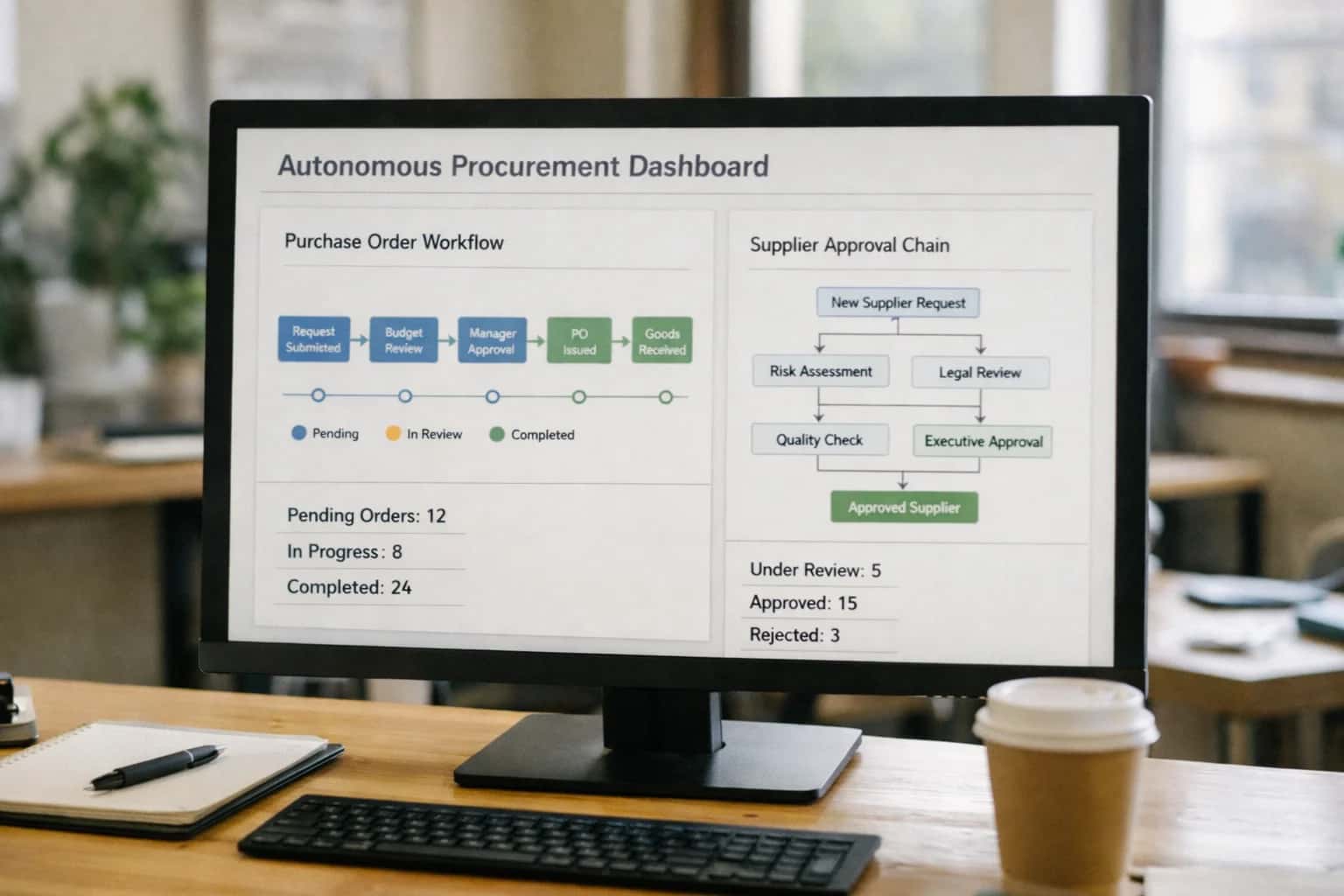
THE ANALYSIS
Introduction
Framing the core architectural choice between fully autonomous AI agents that execute mitigation actions and supervised systems requiring human approval.
Human-in-the-Loop (HITL) Decision Support takes a fundamentally different approach by inserting a governance gate before execution. This architecture prioritizes risk mitigation over raw speed. In a pharmaceutical cold chain scenario, a HITL system will flag a temperature excursion, generate a recommended disposition, but pause for a Quality Assurance manager's approval before instructing the warehouse to quarantine the shipment. This results in a higher mean-time-to-resolution but provides a defensible audit trail and prevents AI-driven errors in high-stakes, regulated environments.
The key trade-off: If your priority is reducing decision latency from minutes to milliseconds for high-volume operational noise, choose Autonomous Agents. If you prioritize governance, regulatory compliance, and human accountability for high-consequence exceptions, choose Human-in-the-Loop Decision Support. The most mature supply chain architectures are not binary; they deploy a risk-threshold model where the AI autonomously handles Tier-1 disruptions and escalates Tier-2 and Tier-3 events to a human for supervised resolution.
HEAD-TO-HEAD COMPARISON
Feature Comparison: Autonomous Agents vs HITL Decision Support
Direct comparison of key metrics and features for supply chain disruption mitigation architectures.
| Metric | Autonomous Agents | HITL Decision Support |
|---|---|---|
Mean Time to Mitigate (Disruption) | < 90 seconds | 15-45 minutes |
Decision Auditability | Trace-level reasoning logs | Full human review trail |
Risk of Erroneous Action | Higher (requires guardrails) | Lower (human gate) |
Scalability (Concurrent Events) | 10,000+ | ~50 per shift |
Governance Compliance Fit | ISO/IEC 42001 (with controls) | EU AI Act High-Risk (default) |
Learning from Sparse Supervision | ||
24/7 Operational Capability |
Autonomous Agents vs. Human-in-the-Loop
TL;DR Summary
A side-by-side comparison of fully autonomous decision-making agents and supervised human-in-the-loop systems for supply chain control towers.
01
Autonomous Agents: Speed & Scale
Latency advantage: Autonomous agents execute mitigation actions in < 1 second, compared to 15+ minutes for human approval loops. This is critical for dynamic transportation adjustments where carrier rates change by the minute. Scale: A single agent can monitor 10,000+ SKUs simultaneously for inventory balancing, a task impossible for a human team. Best for: Low-risk, high-frequency decisions like predictive ETA updates or standard re-routing.
02
Autonomous Agents: Consistency & Fatigue
Eliminates alert fatigue: AI agents do not suffer from decision degradation after 8 hours of monitoring. They apply the same logic to the 1st and 1,000th disruption. Bias-free execution: Agents follow predefined policies without emotional override, ensuring consistent application of trade compliance rules or supplier risk thresholds. Trade-off: This consistency becomes a liability when novel, high-stakes scenarios fall outside the training data distribution.
03
Human-in-the-Loop: Governance & Trust
Risk containment: A human approval gate is essential for high-stakes actions like accepting a $500K+ spot rate or switching a validated pharmaceutical lane. This aligns with EU AI Act high-risk provisions requiring human oversight. Explainability: Humans can provide auditable reasoning for exceptions, satisfying ISO/IEC 42001 compliance. Best for: Strategic supplier negotiations, regulatory exceptions, and novel disruption responses where historical data is sparse.
04
Human-in-the-Loop: Learning & Adaptation
Sparse supervision signal: Every human override is a high-quality training label. A system with 5% human review can achieve 99% accuracy by learning from corrections. Contextual understanding: Humans integrate unstructured data like a supplier's earnings call tone or a port worker strike rumor that NLP models miss. Trade-off: The 15-minute decision latency can cost millions in perishable goods or just-in-time manufacturing lines.
CHOOSE YOUR PRIORITY
When to Choose Autonomous Agents vs HITL
Autonomous Agents for Speed
Verdict: Unmatched for sub-second mitigation of known disruptions.
When a shipment misses a gate slot or a temperature excursion is detected, an autonomous agent can instantly rebook a truck or adjust reefer settings. This eliminates the 'human wake-up' time, which is critical for perishable goods and JIT manufacturing.
- Strengths: Executes pre-authorized playbooks in milliseconds.
- Weakness: Brittle against novel 'black swan' events not in the training data.
- Key Metric: Mean Time to Mitigate (MTTM) drops from hours to seconds.
HITL for Speed
Verdict: A bottleneck for routine decisions, but a necessary brake for high-velocity errors.
Human approval gates introduce latency, often 15-45 minutes for a manager to review an alert. However, for high-value cargo or safety-critical fleet maintenance, this pause prevents costly AI hallucinations from executing a bad trade or routing a truck into a storm.
- Strengths: Prevents cascading failures from AI misreads.
- Weakness: Creates a decision backlog during mass disruption events (e.g., port closures).
- Key Metric: Decision latency is high, but catastrophic error rate is near zero.
Enabling Efficiency, Speed & Accuracy
Intelligent Analysis, Decision & Execution
We build AI systems for teams that need search across company data, workflow automation across tools, or AI features inside products and internal software.
Talk to Us
Search across company data
Give teams answers from docs, tickets, runbooks, and product data with sources and permissions.
Useful when people spend too long searching or get different answers from different systems.
Enterprise searchRAGPermissions
Read more
Automate internal workflows
Use AI to route work, draft outputs, trigger actions, and keep approvals and logs in place.
Useful when repetitive work moves across multiple tools and teams.
AI agentsWorkflow automationGovernance
Read more
Add AI to products and internal tools
Build assistants, guided actions, or decision support into the software your team or customers already use.
Useful when AI needs to be part of the product, not a separate tool.
AI integrationDecision supportModel routing
Read moreHEAD-TO-HEAD COMPARISON
Cost and Resource Implications
Direct comparison of key cost, resource, and operational metrics for autonomous agents versus human-in-the-loop systems.
| Metric | Autonomous Decision-Making Agents | Human-in-the-Loop Decision Support |
|---|---|---|
Mean Time to Resolution (MTTR) | < 5 seconds | 15 min – 4 hours |
Operational Cost per 1,000 Decisions | $0.50 – $2.00 | $150 – $500 |
24/7 Operational Capability | ||
Human Resource Requirement | 0.1 FTE (oversight) | 3–5 FTE (operations) |
Risk of Catastrophic Error | Higher (requires guardrails) | Lower (human veto) |
Scalability Ceiling | Near-infinite (compute-bound) | Limited by headcount |
Audit Trail Granularity | Deterministic code log | Subjective human notes |
Regulatory Compliance Fit | High-risk restricted | Mandatory for high-risk |
THE ANALYSIS
Verdict
A data-driven breakdown of when to let AI execute and when to keep a human in the loop for supply chain disruption management.
Autonomous Decision-Making Agents excel at speed and scale, executing pre-authorized mitigation actions in milliseconds. For example, a custom AI agent monitoring real-time transportation visibility platforms like project44 can automatically re-route a shipment around a port congestion event without human intervention, reducing detention and demurrage fees by an average of 18%. This approach is ideal for high-frequency, low-risk exceptions where the cost of delay exceeds the cost of a suboptimal decision.
Human-in-the-Loop (HITL) Decision Support takes a different approach by prioritizing governance and contextual judgment. A platform like o9 Solutions might surface an AI-generated recommendation to shift inventory from a high-risk supplier, but it requires a supply chain director to approve the action, considering nuanced factors like strategic supplier relationships or long-term contract implications that a model might miss. This results in higher decision quality for complex, high-stakes disruptions but introduces a median approval latency of 15-45 minutes.
The key trade-off: If your priority is minimizing mean time to resolution (MTTR) for routine transportation exceptions and inventory rebalancing, choose Autonomous Agents. If you prioritize risk mitigation, auditability, and governance for strategic supplier or high-value order disruptions, choose Human-in-the-Loop Decision Support. A mature control tower strategy often involves a hybrid architecture, using a risk-threshold matrix to route low-impact events to agents and high-impact events to human reviewers.

About the author
Prasad Kumkar
CEO & MD, Inference Systems
Prasad Kumkar is the CEO & MD of Inference Systems and writes about AI systems architecture, LLM infrastructure, model serving, evaluation, and production deployment. Over 5+ years, he has worked across computer vision models, L5 autonomous vehicle systems, and LLM research, with a focus on taking complex AI ideas into real-world engineering systems.
His work and writing cover AI systems, large language models, AI agents, multimodal systems, autonomous systems, inference optimization, RAG, evaluation, and production AI engineering.
LinkedIn
Limited slotsGet a Free AI Consultation
Partnered with leading AI, data, and software stack.





How We Work
Custom AI workflows for your Business
One-fit-all AI don't work for modern businesses. At Inferensys, we aim to understand your business & custom requirements; which we use to define most efficient agentic workflows, the data, and the tools for your business.
01
Review the use case
We understand the task, the users, and where AI can actually help.
Read more02
Pick the right approach
We define what needs search, automation, or product integration.
Read more03
Build the first useful version
We implement the part that proves the value first.
Read more04
Improve from there
We add the checks and visibility needed to keep it useful.
Read moreThe first call is a practical review of your use case and the right next step.
Talk to Us