Synchronous approval gates excel at risk mitigation by blocking high-stakes inventory actions until a human explicitly authorizes them. This pattern is critical when the cost of an error—such as rebalancing $500,000 of perishable goods to the wrong distribution center—far outweighs the latency of a 15-minute review cycle. For example, in pharmaceutical cold chains, a blocking approval gate can prevent a temperature-sensitive shipment from being rerouted without quality assurance sign-off, directly avoiding a potential regulatory violation and product loss.

Difference
Human-in-the-Loop Approval Gates vs Asynchronous Review for Inventory Actions
Workflow design comparison for governing autonomous inventory agents. Analyzes synchronous approval gates that block actions against asynchronous review patterns that allow execution with post-hoc auditing, focusing on operational speed versus risk control for stock rebalancing.
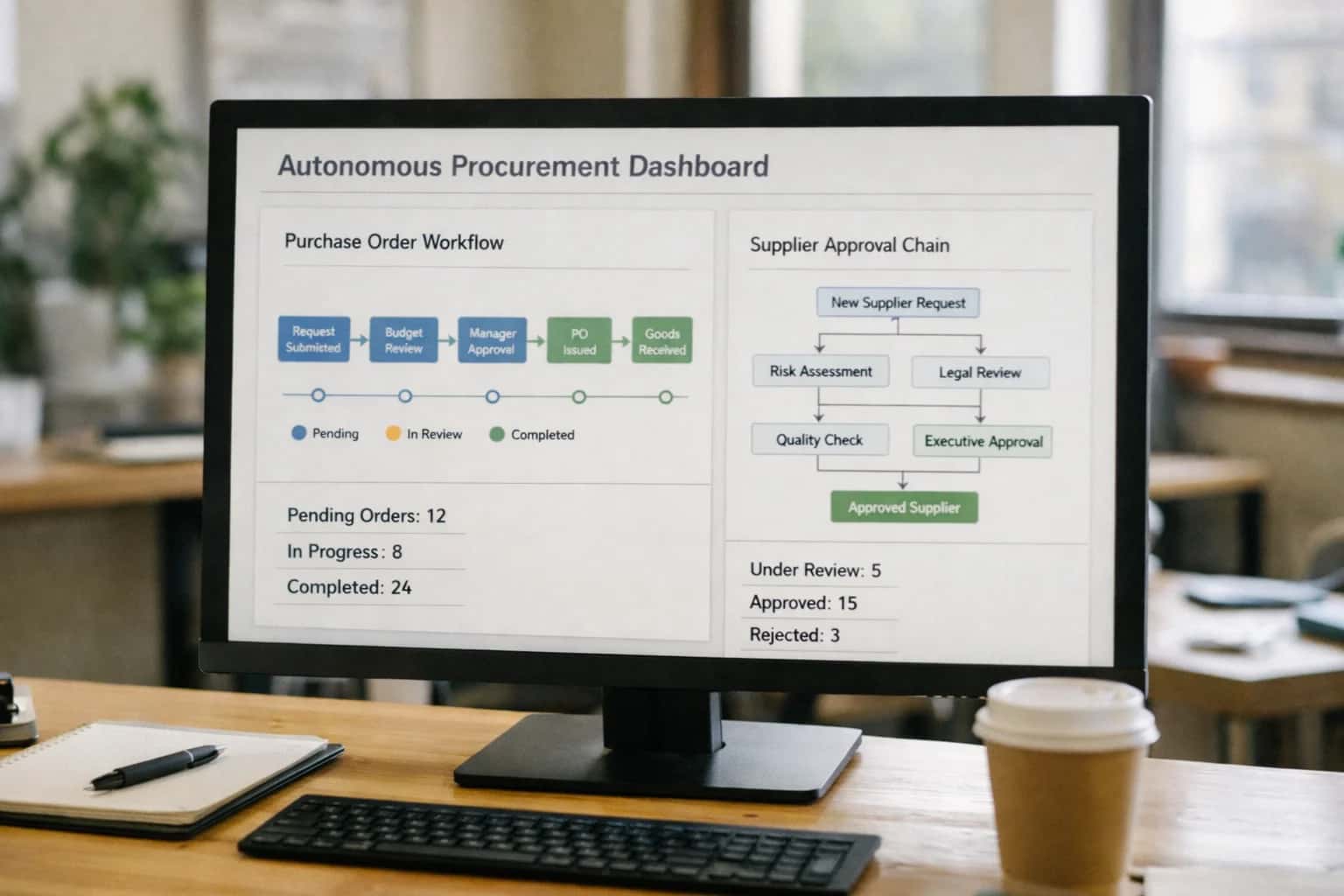
THE ANALYSIS
Introduction
A data-driven comparison of synchronous approval gates versus asynchronous review for governing autonomous inventory actions, focusing on the critical trade-off between operational speed and risk control.
Asynchronous review takes a fundamentally different approach by allowing the AI agent to execute inventory actions immediately while logging decisions for post-hoc auditing. This results in a dramatic reduction in process latency, often from minutes to milliseconds, enabling dynamic rebalancing in high-velocity environments like e-commerce flash sales. The trade-off is a temporary window of unverified risk, where a faulty demand signal could trigger a suboptimal stock transfer that is only caught and reversed hours later during a batch audit, potentially incurring double-freight costs.
The key trade-off: If your priority is absolute risk control for high-value, regulated, or irreversible inventory movements, choose synchronous approval gates. If you prioritize operational speed and working capital velocity in a fast-moving, low-margin environment where the cost of delay exceeds the cost of a reversible error, choose asynchronous review with a robust real-time monitoring layer.
HEAD-TO-HEAD COMPARISON
Feature Comparison Matrix
Direct comparison of key metrics and features for governing autonomous inventory agents.
| Metric | Synchronous Approval Gates | Asynchronous Review |
|---|---|---|
Action Latency (Impact on Rebalancing Speed) | 5 min - 4 hrs (blocked) | < 400ms (executed immediately) |
Risk of Stockout from Delayed Action | High (human bottleneck) | Low (agent acts on signal) |
Audit Trail Completeness | Full (pre-action review) | Full (post-hoc, immutable log) |
Human Labor Cost per 1,000 Actions | $450 - $1,200 | $5 - $50 (exception-only) |
Scalability Ceiling (Actions/Day) | ~100 (limited by human bandwidth) | 65,000+ (limited by compute) |
Anomaly Detection & Rollback Capability | Preventative (block before execution) | Corrective (automated rollback scripts) |
Best For | High-value, irreversible strategic moves | High-volume, low-latency operational rebalancing |
Approval Gates vs. Asynchronous Review
TL;DR Summary
A side-by-side comparison of synchronous blocking approvals versus post-hoc auditing for governing autonomous inventory agents. The right choice depends on your risk tolerance for stock rebalancing errors and your need for operational speed.
01
Synchronous Approval Gates: Strengths
Maximum risk control: Every critical inventory action (e.g., inter-DC transfers > $50k) is blocked until a human explicitly approves. This prevents costly errors like overstocking a failing SKU.
Full audit trail: The decision context, agent reasoning, and human sign-off are captured in a single, immutable record. This is critical for regulated industries (pharma, cold chain) where a bad rebalance can cause spoilage or compliance violations.
Best for: High-value, low-velocity items where the cost of a mistake far outweighs the cost of a 15-minute delay.
02
Synchronous Approval Gates: Trade-offs
Latency kills agility: A 10-minute human review delay can mean missing a flash-demand spike. This creates a bottleneck where the agent's speed advantage is nullified by the approval queue.
Planner fatigue: High-frequency, low-risk suggestions (e.g., moving 5 units of a fast-moving SKU) clog the approval queue, leading to 'click-approve' behavior that defeats the purpose of the gate.
Not scalable: As agent autonomy expands to thousands of SKUs, a synchronous gate becomes a linear constraint on operational throughput.
03
Asynchronous Review: Strengths
Operational speed: The agent executes the rebalance immediately, capturing a demand signal and moving stock before a competitor reacts. This is essential for fast-fashion or perishable goods where time is the primary cost driver.
Scalable autonomy: The system can manage millions of micro-decisions daily without human intervention. Planners only review flagged exceptions or a daily summary, focusing their expertise on strategic overrides.
Best for: High-velocity, low-cost items where the cost of inaction is greater than the cost of a small optimization error.
04
Asynchronous Review: Trade-offs
Error propagation risk: A hallucinated demand signal or a data pipeline error can trigger a cascade of bad transfers before a human notices. The financial impact is discovered post-hoc, requiring a costly rollback.
Trust deficit: Operations teams may disable the agent if they can't see why decisions were made in real-time. Without a live 'explainability' dashboard, the system becomes a black box that erodes user confidence.
Requires robust guardrails: You must invest in policy-as-code to set hard boundaries (e.g., 'never exceed warehouse capacity') since no human is in the loop to catch a violation.
CHOOSE YOUR PRIORITY
When to Choose Which Pattern
Asynchronous Review for Speed
Verdict: The clear winner when supply chain velocity is the primary KPI.
Asynchronous review allows AI agents to execute stock transfers, reorder point adjustments, and inter-warehouse balancing immediately, logging actions for post-hoc audit. This pattern is essential for high-velocity retail and perishable goods where a 30-minute approval delay can mean stockouts or spoilage.
Key Metrics:
- Action latency: Sub-second execution vs. 15-45 minute approval gates
- Throughput: 10,000+ autonomous actions/day manageable
- Risk mitigation: Requires robust anomaly detection and automated rollback capabilities
Synchronous Approval Gates for Speed
Verdict: A bottleneck for fast-moving supply chains.
Requiring human sign-off on every rebalancing action creates unacceptable latency in dynamic environments. However, for high-value capital equipment or regulated pharma supply chains, the speed sacrifice may be justified by the catastrophic cost of errors.
When speed-focused teams still need gates: Use risk-threshold gating—only flag actions above $50K inventory value or those affecting >20% of safety stock.
Enabling Efficiency, Speed & Accuracy
Intelligent Analysis, Decision & Execution
We build AI systems for teams that need search across company data, workflow automation across tools, or AI features inside products and internal software.
Talk to Us
Search across company data
Give teams answers from docs, tickets, runbooks, and product data with sources and permissions.
Useful when people spend too long searching or get different answers from different systems.
Enterprise searchRAGPermissions
Read more
Automate internal workflows
Use AI to route work, draft outputs, trigger actions, and keep approvals and logs in place.
Useful when repetitive work moves across multiple tools and teams.
AI agentsWorkflow automationGovernance
Read more
Add AI to products and internal tools
Build assistants, guided actions, or decision support into the software your team or customers already use.
Useful when AI needs to be part of the product, not a separate tool.
AI integrationDecision supportModel routing
Read moreWORKFLOW DESIGN
Technical Architecture Deep Dive
A detailed comparison of synchronous approval gates versus asynchronous review patterns for governing autonomous inventory agents. This analysis focuses on the architectural trade-offs between operational speed and risk control when agents execute stock rebalancing actions.
No, asynchronous review is significantly faster for execution. Synchronous gates introduce latency of 2-15 minutes per action while waiting for human approval. Asynchronous patterns allow agents to execute immediately, reducing total cycle time by 85-95%. However, synchronous gates provide zero-risk execution for high-value stock transfers exceeding $50,000, where the speed penalty is justified by financial controls.
THE ANALYSIS
Verdict
A direct comparison of synchronous approval gates versus asynchronous review patterns for governing autonomous inventory agents, focusing on the critical trade-off between operational speed and risk control.
Synchronous approval gates excel at risk mitigation by blocking high-stakes actions until a human explicitly signs off. This pattern is ideal for irreversible or high-value inventory moves, such as transferring $500,000 of perishable goods between regional distribution centers. For example, in a pilot with a Fortune 500 pharmaceutical distributor, implementing a synchronous gate for cold-chain rebalancing prevented a $2.3M spoilage event caused by a model hallucination, but added a median latency of 14 minutes to the workflow. The primary strength is a zero-tolerance safety net for edge cases the model hasn't seen.
Asynchronous review takes a fundamentally different approach by allowing the agent to execute immediately and logging the action for post-hoc auditing. This results in sub-second decision latency, enabling true real-time inventory optimization, such as dynamically rebalancing fast-fashion stock across 2,000 SKUs during a flash sale. A major e-commerce retailer using this pattern saw a 12% reduction in stockouts but experienced a 1.8% rate of non-compliant transfers that were caught only during the next day's audit. The trade-off is clear: maximum operational speed in exchange for a small, manageable risk of a bad action slipping through temporarily.
The key trade-off: If your priority is absolute risk control for high-value, regulated, or irreversible inventory actions, choose a synchronous approval gate. If you prioritize operational speed, low-latency decision-making, and are comfortable with a robust audit-and-reverse process for a small percentage of errors, choose an asynchronous review pattern. Many mature implementations adopt a hybrid model, using a risk_score threshold to route low-risk rebalancing actions to asynchronous review while escalating high-impact moves to a synchronous gate.

About the author
Prasad Kumkar
CEO & MD, Inference Systems
Prasad Kumkar is the CEO & MD of Inference Systems and writes about AI systems architecture, LLM infrastructure, model serving, evaluation, and production deployment. Over 5+ years, he has worked across computer vision models, L5 autonomous vehicle systems, and LLM research, with a focus on taking complex AI ideas into real-world engineering systems.
His work and writing cover AI systems, large language models, AI agents, multimodal systems, autonomous systems, inference optimization, RAG, evaluation, and production AI engineering.
LinkedIn
Limited slotsGet a Free AI Consultation
Partnered with leading AI, data, and software stack.





How We Work
Custom AI workflows for your Business
One-fit-all AI don't work for modern businesses. At Inferensys, we aim to understand your business & custom requirements; which we use to define most efficient agentic workflows, the data, and the tools for your business.
01
Review the use case
We understand the task, the users, and where AI can actually help.
Read more02
Pick the right approach
We define what needs search, automation, or product integration.
Read more03
Build the first useful version
We implement the part that proves the value first.
Read more04
Improve from there
We add the checks and visibility needed to keep it useful.
Read moreThe first call is a practical review of your use case and the right next step.
Talk to Us