Digital Twin Simulation excels at high-fidelity, physics-based modeling of supply chain assets and flows. By creating a virtual replica of warehouses, transportation networks, and production lines, these systems can model cascading failure effects with granular precision. For example, a digital twin can simulate how a flood in a specific Thai factory impacts lead times, inventory levels, and service levels across a global multi-echelon network, often processing thousands of 'what-if' scenarios against real-time IoT data streams to quantify financial exposure.

Difference
Digital Twin Simulation vs Agentic AI for Inventory Scenario Planning
A technical comparison of physics-based digital twin simulations and agentic AI systems for inventory disruption testing, focusing on simulation fidelity, what-if analysis speed, and the ability to model cascading supply chain effects for risk mitigation planning.
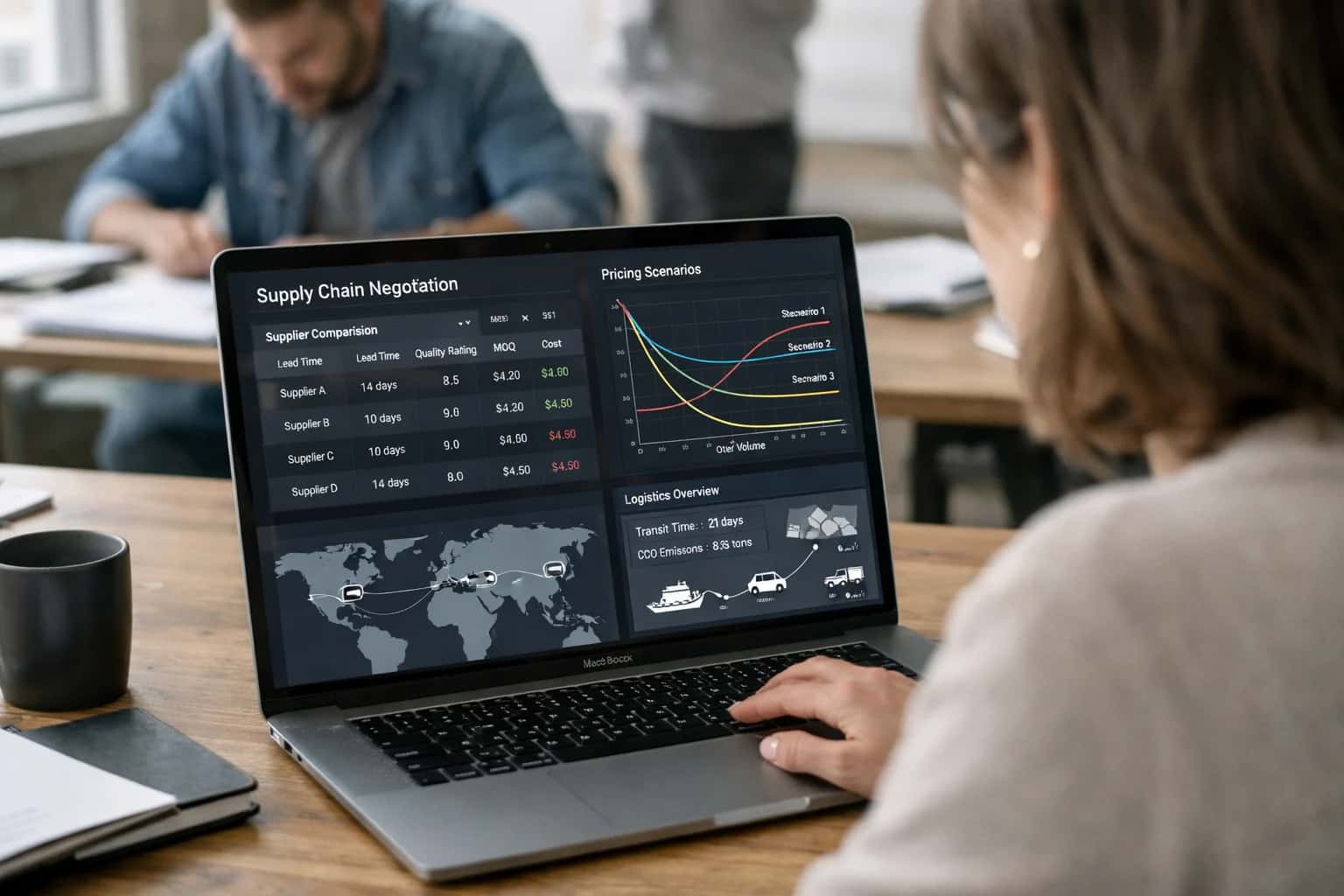
THE ANALYSIS
Introduction
A data-driven comparison of physics-based digital twin simulations and agentic AI systems for inventory disruption testing, helping CTOs decide which approach best fits their risk mitigation planning needs.
Agentic AI takes a different approach by deploying autonomous, goal-seeking agents that interact with a simulated or live environment to test disruption responses. Instead of a top-down physics model, agentic systems model the behavior of independent decision-makers—like a procurement agent autonomously finding an alternate supplier when a primary one fails. This results in a trade-off: agentic AI excels at exploring novel, emergent solutions and adaptive strategies that a pre-programmed physics model might miss, but it may lack the absolute physical fidelity of a dedicated digital twin when modeling complex engineering constraints like machine wear or thermodynamic limits.
The key trade-off: If your priority is absolute simulation fidelity for physical assets and deterministic 'butterfly effect' analysis of known constraints, choose a Digital Twin Simulation platform. If you prioritize exploring adaptive, autonomous responses to unforeseen 'black swan' disruptions and modeling human-like decision-making in the supply chain, choose an Agentic AI system. For many enterprises, the future state is a hybrid model where agentic AI uses a digital twin as its sandbox for safe, high-fidelity experimentation.
HEAD-TO-HEAD COMPARISON
Feature Comparison Matrix
Direct comparison of key metrics and features for inventory scenario planning technologies.
| Metric | Digital Twin Simulation | Agentic AI |
|---|---|---|
What-If Analysis Speed | Hours to Days (Full Physics Recalculation) | Seconds to Minutes (Policy-Based Inference) |
Cascading Effect Modeling | High Fidelity (Physics-Based) | Pattern-Based (Learned from Data) |
Data Dependency | Requires Complete BOM & CAD Data | Operates on ERP/Transactional Data |
Anomaly/Black Swan Handling | Poor (Cannot Simulate Unmodeled Events) | Strong (Generalizes from Patterns) |
Explainability | Causal (Root Cause Physics) | Associative (Correlation-Based) |
Compute Cost per Scenario | $500 - $5,000+ | $0.05 - $0.50 |
Real-Time Autonomous Action |
Digital Twin vs Agentic AI
TL;DR Summary
A side-by-side comparison of strengths for inventory scenario planning. Digital Twins excel at high-fidelity physics simulation, while Agentic AI focuses on autonomous decision-making and action.
01
High-Fidelity Physics Simulation
Specific advantage: Models exact physical constraints like warehouse capacity, lead times, and throughput rates with sub-1% error margins. This matters for validating operational feasibility of inventory plans against real-world physical limits.
02
Deterministic What-If Analysis
Specific advantage: Executes thousands of deterministic scenarios with identical inputs producing identical outputs, critical for audit compliance and regulatory reporting. This matters for supply chain leaders who need to prove planning rigor to stakeholders.
03
Autonomous Decision-Making
Specific advantage: Independently evaluates trade-offs and executes rebalancing actions without human intervention, reducing response time from hours to seconds. This matters for real-time disruption response where speed of action directly impacts service levels.
04
Adaptive Learning from Outcomes
Specific advantage: Continuously improves policies by learning from the results of past decisions, unlike static simulation models. This matters for long-tail SKU optimization where historical patterns fail to capture emerging demand shifts.
CHOOSE YOUR PRIORITY
When to Choose Each Approach
Digital Twin Simulation for Disruption Response
Strengths: Digital twins can simulate the cascading physical impact of a disruption (e.g., a port closure) on inventory levels and production schedules. They provide a deterministic view of the 'ripple effect.'
Limitations: They cannot autonomously source a new supplier, renegotiate a contract, or re-route a shipment. They identify the problem but require a human to act on the insight.
Agentic AI for Disruption Response
Verdict: Superior. Agentic AI systems are designed for autonomous action. When a disruption is detected, an agent can instantly query alternative suppliers, check their inventory via APIs, assess cost trade-offs, and execute a new purchase order or reroute instructions.
Key Metrics:
- Time-to-Resolution: Reduces response time from hours (human-in-the-loop) to seconds.
- Tool Use: Integrates with ERPs, TMS, and supplier portals to execute actions.
- Best For: Dynamic transportation adjustments and autonomous stock rebalancing during live disruptions.
Enabling Efficiency, Speed & Accuracy
Intelligent Analysis, Decision & Execution
We build AI systems for teams that need search across company data, workflow automation across tools, or AI features inside products and internal software.
Talk to Us
Search across company data
Give teams answers from docs, tickets, runbooks, and product data with sources and permissions.
Useful when people spend too long searching or get different answers from different systems.
Enterprise searchRAGPermissions
Read more
Automate internal workflows
Use AI to route work, draft outputs, trigger actions, and keep approvals and logs in place.
Useful when repetitive work moves across multiple tools and teams.
AI agentsWorkflow automationGovernance
Read more
Add AI to products and internal tools
Build assistants, guided actions, or decision support into the software your team or customers already use.
Useful when AI needs to be part of the product, not a separate tool.
AI integrationDecision supportModel routing
Read moreHEAD-TO-HEAD COMPARISON
Cost and Implementation Comparison
Direct comparison of key metrics and features for Digital Twin Simulation vs. Agentic AI in inventory scenario planning.
| Metric | Digital Twin Simulation | Agentic AI |
|---|---|---|
Scenario Testing Speed | Hours per scenario (physics-bound) | Seconds per scenario (probabilistic) |
Implementation Timeline | 6-18 months | 4-12 weeks |
Avg. Annual License Cost | $150,000 - $500,000+ | $30,000 - $120,000 |
Data Integration Complexity | High (requires 3D models, IoT streams) | Medium (connects to ERP/WMS APIs) |
Cascading Failure Modeling | High Fidelity (physics-based) | Pattern-Based (historical learning) |
Human-in-the-Loop Integration | Manual scenario adjustment | Native async approval workflows |
Primary User Persona | Supply Chain Strategist | Inventory Planner / Operator |
THE ANALYSIS
Verdict
A data-driven breakdown to help CTOs choose between high-fidelity simulation and autonomous action for inventory risk mitigation.
Digital Twin Simulation excels at fidelity and strategic risk assessment because it creates a physics-based mirror of the physical supply chain. For example, a digital twin can model the cascading impact of a port closure on 10,000 SKUs across five echelons, factoring in real-time constraints like lead times and carrier capacity. This approach is unmatched for 'what-if' analysis, allowing planners to test scenarios like a 20% demand surge without risking real-world stock-outs or excess working capital.
Agentic AI takes a different approach by prioritizing autonomous execution and real-time adaptation. Instead of just simulating a disruption, an agentic system detects a late shipment and immediately executes a pre-approved rebalancing action, such as redirecting a purchase order or adjusting safety stock parameters in the ERP. This results in a trade-off: you gain sub-second reaction times and closed-loop automation, but you lose the deep, multi-variable causal analysis that a full digital twin provides before the action is taken.
The key trade-off: If your priority is strategic planning, board-level risk reporting, and understanding complex 'butterfly effects' before they happen, choose Digital Twin Simulation. If you prioritize operational speed, autonomous exception handling, and reducing the latency between detection and action to zero, choose Agentic AI. For a world-class inventory posture, leading enterprises are now coupling both: using the digital twin to train and set guardrails for the agentic AI that operates in real-time.

About the author
Prasad Kumkar
CEO & MD, Inference Systems
Prasad Kumkar is the CEO & MD of Inference Systems and writes about AI systems architecture, LLM infrastructure, model serving, evaluation, and production deployment. Over 5+ years, he has worked across computer vision models, L5 autonomous vehicle systems, and LLM research, with a focus on taking complex AI ideas into real-world engineering systems.
His work and writing cover AI systems, large language models, AI agents, multimodal systems, autonomous systems, inference optimization, RAG, evaluation, and production AI engineering.
LinkedIn
Limited slotsGet a Free AI Consultation
Partnered with leading AI, data, and software stack.





How We Work
Custom AI workflows for your Business
One-fit-all AI don't work for modern businesses. At Inferensys, we aim to understand your business & custom requirements; which we use to define most efficient agentic workflows, the data, and the tools for your business.
01
Review the use case
We understand the task, the users, and where AI can actually help.
Read more02
Pick the right approach
We define what needs search, automation, or product integration.
Read more03
Build the first useful version
We implement the part that proves the value first.
Read more04
Improve from there
We add the checks and visibility needed to keep it useful.
Read moreThe first call is a practical review of your use case and the right next step.
Talk to Us