Portkey excels as a control plane for the request lifecycle because it operates as a full AI gateway. Instead of just logging what happens, Portkey intercepts, transforms, and routes requests before they reach a model. For example, a single API call can be dynamically load-balanced across GPT-4o and Claude 3.5 Sonnet based on real-time cost and latency metrics, with automatic fallback if a provider returns a 5xx error. This makes it a critical piece of infrastructure for teams needing to enforce cost policies, manage virtual API keys, and abstract away vendor-specific schemas at the network edge.

Difference
Portkey vs Langfuse: Gateway vs Observability
A technical decision guide comparing Portkey's AI gateway control plane for policy enforcement and routing against Langfuse's observability platform for deep tracing and evaluation of LLM interactions.
THE ANALYSIS
Introduction
Framing the fundamental architectural choice between controlling the request path and observing the application's behavior.
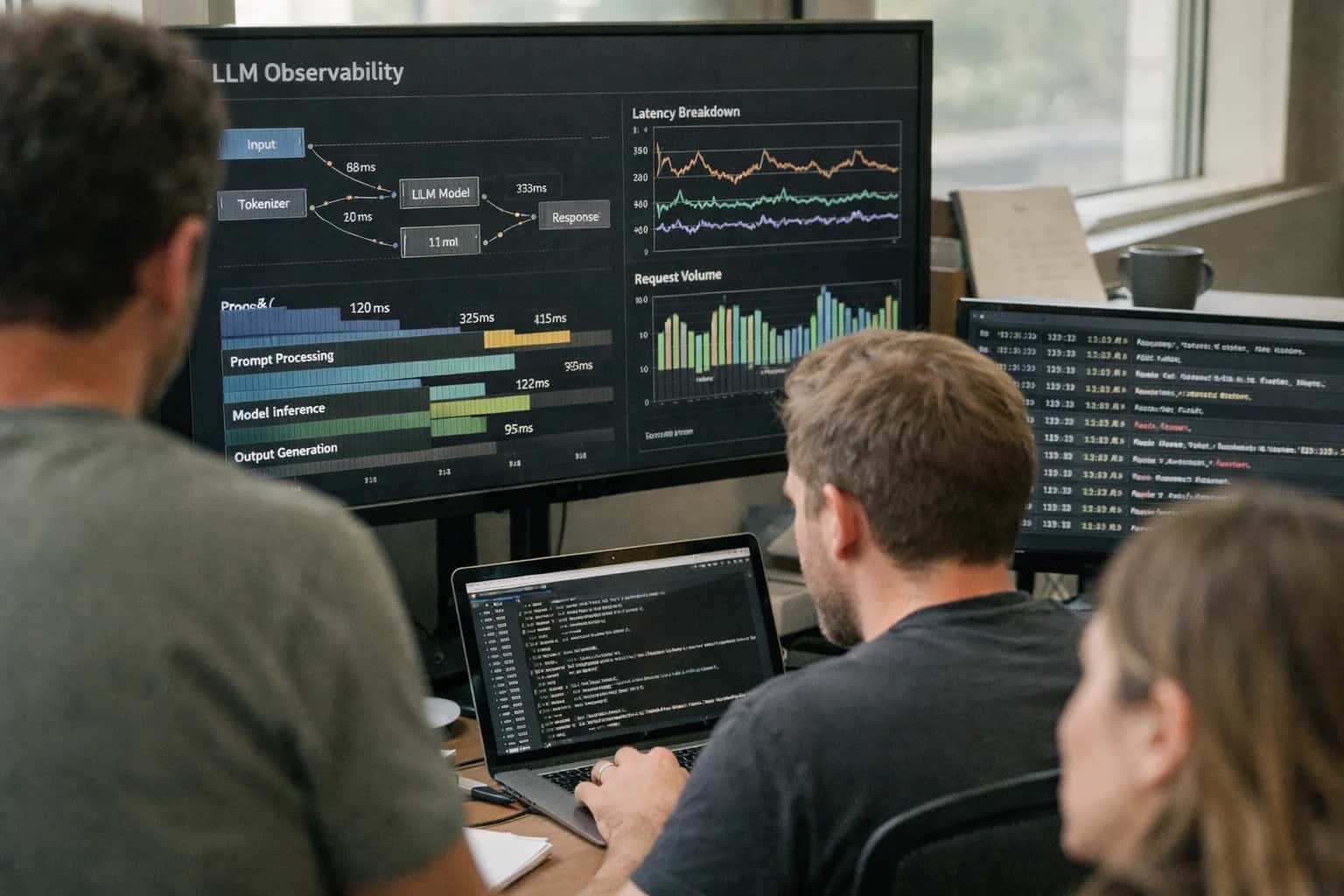
Langfuse takes a different approach by functioning as a deep observability and evaluation platform. It does not sit in the critical path of a request; instead, it ingests traces asynchronously to build a rich debugging interface. This results in superior root-cause analysis for complex agentic workflows, where you need to replay exact execution paths, score the quality of tool calls, and calculate per-session costs. The trade-off is that Langfuse cannot prevent a bad request from happening—it can only help you understand why it failed after the fact.
The key trade-off: If your priority is real-time policy enforcement, dynamic model routing, and creating a resilient abstraction layer over multiple LLM providers, choose Portkey. If you prioritize deep introspection, evaluating prompt and tool-call quality, and building a data-driven development loop for your AI application, choose Langfuse. Many sophisticated teams ultimately deploy both, using Portkey as the data-plane gateway and Langfuse as the observability backend.
HEAD-TO-HEAD COMPARISON
Feature Comparison
Direct comparison of core capabilities for Portkey's control plane vs. Langfuse's observability platform.
| Metric | Portkey | Langfuse |
|---|---|---|
Primary Function | Request Control & Policy | Tracing & Evaluation |
Request Transformation | ||
Load Balancing / Fallback | ||
LLM Cost Guardrails | ||
Deep Trace Debugging | ||
LLM-as-a-Judge Evaluations | ||
Virtual Key Management | ||
Self-Hosted Option |
Portkey Pros
TL;DR Summary
Key strengths and trade-offs at a glance.
01
Centralized Control Plane
Unified policy enforcement: Portkey acts as a reverse proxy, allowing you to manage authentication, rate limits, and load balancing for 200+ LLMs from a single dashboard. This matters for platform teams needing to govern access without distributing API keys to every developer.
02
Request Transformation & Guardrails
Pre/Post-processing middleware: Portkey can automatically redact PII, cache semantically similar requests, and enforce JSON schema compliance before the response hits your app. This matters for compliance-focused teams that need to sanitize data and control outputs at the network edge.
03
Virtual Key & Budget Management
Fine-grained cost controls: Issue virtual API keys with hard spending limits, rate caps, and allowed model lists. This matters for FinOps leads who need to prevent bill shock and attribute costs to specific teams or projects without manual accounting.
CHOOSE YOUR PRIORITY
When to Choose Portkey vs Langfuse
Portkey for Platform Engineers
Strengths: Acts as a centralized control plane for all LLM traffic. Provides virtual keys, rate limiting, load balancing, and fallback logic at the gateway layer. Ideal for enforcing cost policies and vendor abstraction without changing application code.
Verdict: Choose Portkey when your primary goal is to control and transform requests before they reach an LLM. It's the right tool for building a resilient, policy-aware API ingress point.
Langfuse for Platform Engineers
Strengths: Offers deep, open-source tracing and evaluation pipelines. It excels at capturing full execution traces, scoring outputs, and managing evaluation datasets. The self-hosted option provides strong data residency control.
Verdict: Choose Langfuse when your primary goal is to observe and score LLM interactions. It's the right tool for debugging complex chains, attributing costs, and building a continuous evaluation feedback loop.
Enabling Efficiency, Speed & Accuracy
Intelligent Analysis, Decision & Execution
We build AI systems for teams that need search across company data, workflow automation across tools, or AI features inside products and internal software.
Talk to Us
Search across company data
Give teams answers from docs, tickets, runbooks, and product data with sources and permissions.
Useful when people spend too long searching or get different answers from different systems.
Enterprise searchRAGPermissions
Read more
Automate internal workflows
Use AI to route work, draft outputs, trigger actions, and keep approvals and logs in place.
Useful when repetitive work moves across multiple tools and teams.
AI agentsWorkflow automationGovernance
Read more
Add AI to products and internal tools
Build assistants, guided actions, or decision support into the software your team or customers already use.
Useful when AI needs to be part of the product, not a separate tool.
AI integrationDecision supportModel routing
Read moreARCHITECTURE COMPARISON
Technical Deep Dive: Inline Proxy vs. Out-of-Band Tracing
A granular look at how Portkey's inline proxy architecture compares to Langfuse's out-of-band tracing model, focusing on latency, data fidelity, and failure modes in production AI systems.
Yes, an inline proxy adds ~5-15ms of latency, while out-of-band tracing adds near-zero. Portkey sits in the critical request path, inspecting every payload for policy enforcement, which introduces a small but measurable delay. Langfuse uses asynchronous POST calls from your application code, so tracing data is sent after the LLM response is streamed to the user. However, Portkey's latency is offset by its semantic caching, which can skip the LLM call entirely and return responses in under 10ms. The trade-off is deterministic control vs. minimal interference.
THE ANALYSIS
Verdict
A final decision framework for choosing between an AI-native control plane and a specialized observability platform.
Portkey excels as an AI-native control plane because it operates as a reverse proxy, actively managing and transforming requests in-flight. For example, its gateway can dynamically load balance across multiple LLM providers based on real-time latency and error rates, enforcing cost policies and automatic fallbacks without requiring application code changes. This makes it the superior choice for teams that need to abstract away vendor complexity and enforce governance at the network layer.
Langfuse takes a fundamentally different approach by focusing on deep, post-hoc observability and evaluation. Rather than controlling the request path, it ingests traces via its SDK to provide a rich debugging interface, scoring datasets for LLM outputs, and granular cost attribution down to the user session. This results in a best-in-class platform for iterating on prompt quality and understanding why a model behaved a certain way, but it does not natively control or block that behavior in production.
The key trade-off: If your priority is active traffic management—such as enforcing PII redaction, managing API keys, or routing to the cheapest available model in real-time—choose Portkey. If you prioritize deep introspection, evaluation-driven development, and building a robust dataset to measure LLM performance over time, choose Langfuse. For a comprehensive production stack, many teams deploy Portkey as the gateway and integrate it with Langfuse for observability, using each tool for its core strength.

About the author
Prasad Kumkar
CEO & MD, Inference Systems
Prasad Kumkar is the CEO & MD of Inference Systems and writes about AI systems architecture, LLM infrastructure, model serving, evaluation, and production deployment. Over 5+ years, he has worked across computer vision models, L5 autonomous vehicle systems, and LLM research, with a focus on taking complex AI ideas into real-world engineering systems.
His work and writing cover AI systems, large language models, AI agents, multimodal systems, autonomous systems, inference optimization, RAG, evaluation, and production AI engineering.
LinkedIn
Limited slotsGet a Free AI Consultation
Partnered with leading AI, data, and software stack.





How We Work
Custom AI workflows for your Business
One-fit-all AI don't work for modern businesses. At Inferensys, we aim to understand your business & custom requirements; which we use to define most efficient agentic workflows, the data, and the tools for your business.
01
Review the use case
We understand the task, the users, and where AI can actually help.
Read more02
Pick the right approach
We define what needs search, automation, or product integration.
Read more03
Build the first useful version
We implement the part that proves the value first.
Read more04
Improve from there
We add the checks and visibility needed to keep it useful.
Read moreThe first call is a practical review of your use case and the right next step.
Talk to Us