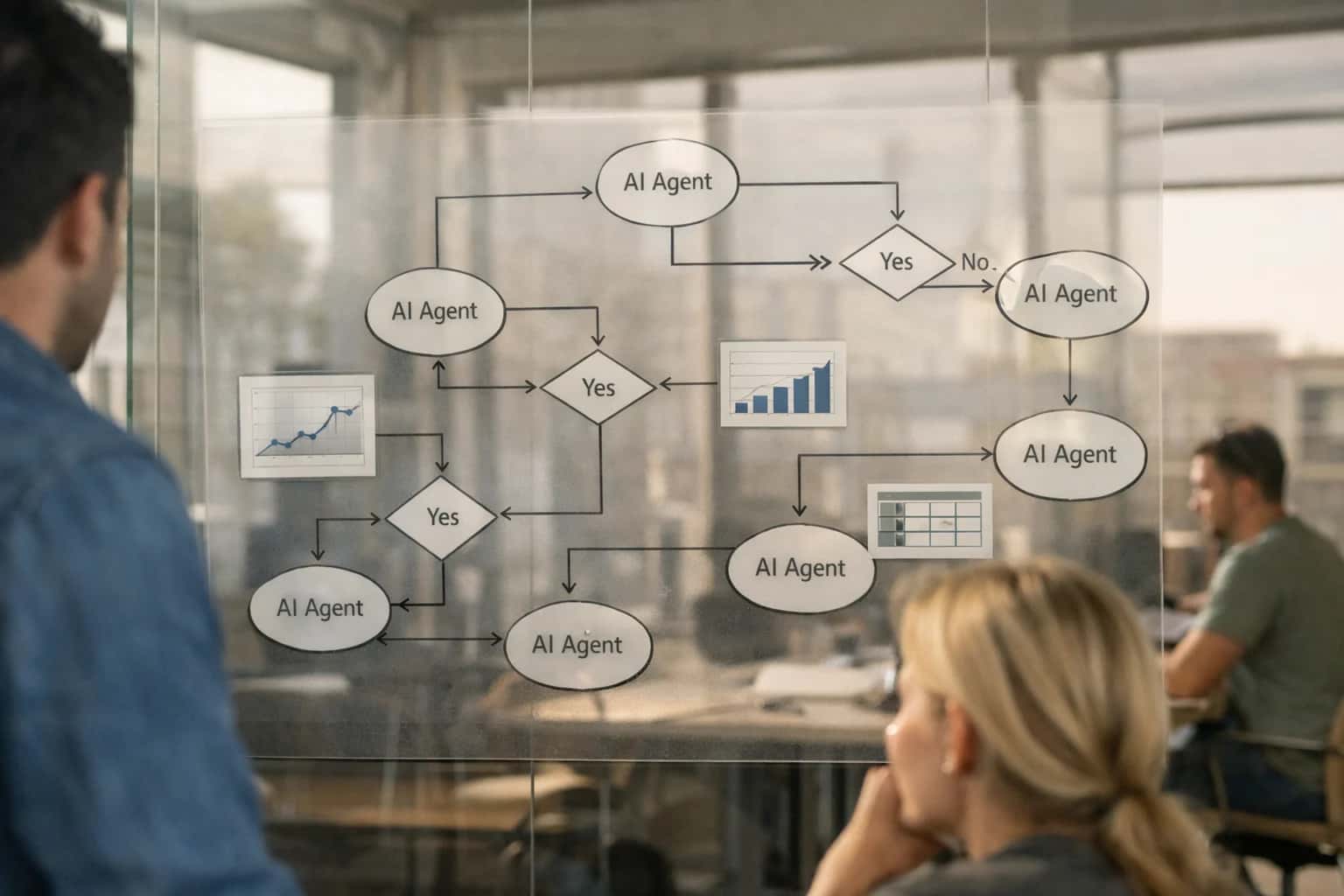
[LangSmith] excels at deep, framework-native tracing for complex agent graphs because it is built by the creators of LangChain and LangGraph. For example, it automatically captures the exact state, node transitions, and conditional edges within a StateGraph, providing a visual execution timeline that maps directly to your code. This results in a debugging experience where you can pinpoint the exact reasoning step that led to a hallucination or a failed tool call, making it the gold standard for teams heavily invested in the LangChain ecosystem.

Difference
LangSmith vs Weights & Biases: Agent Tracing
A technical decision guide comparing LangSmith's native LangGraph debugging for complex agent traces against Weights & Biases' experiment lineage and media-rich output logging for agentic workflows.
THE ANALYSIS
Introduction
A data-driven comparison of LangSmith and Weights & Biases for debugging, tracing, and evaluating complex agentic workflows.
[Weights & Biases (W&B)] takes a different approach by treating agent traces as part of a broader, media-rich experiment lineage. Its W&B Prompts product excels at logging not just text, but images, audio, and complex multi-modal outputs alongside your agent's reasoning chain. This results in a powerful collaborative environment for comparing different agent architectures (e.g., ReAct vs. Plan-and-Execute) over hundreds of runs, but it requires more manual instrumentation to achieve the same depth of automatic graph tracing that LangSmith provides for LangGraph.
The key trade-off: If your priority is automatic, code-level debugging of complex LangGraph state machines, choose LangSmith. Its trace-to-code mapping and first-party integration are unmatched for this specific use case. If you prioritize collaborative experiment tracking, multi-modal output logging, and comparing diverse agent frameworks beyond just LangChain, choose W&B. Its strength lies in its lineage tracking and media-rich comparison tables, making it a better fit for research-heavy teams iterating on agent design.
HEAD-TO-HEAD COMPARISON
Feature Comparison: Agent Tracing Capabilities
Direct comparison of key metrics and features for debugging complex agentic workflows.
| Metric | LangSmith | Weights & Biases |
|---|---|---|
Agent Framework Integration | Native (LangGraph, LangChain) | External (W&B Prompts SDK) |
Trace Visualization | Tree/Graph with reasoning steps | Lineage with media-rich outputs |
Experiment Tracking | Prompt/Chain versioning | Full MLOps lineage (datasets, code, models) |
Evaluation Method | User-defined evaluators, annotation queues | Comparative eval tables, custom panels |
Human Feedback Loop | Annotation queues built-in | Requires custom integration |
Open-Source Core | ||
Self-Hosted Option | ||
Primary Use Case | Debugging complex agent reasoning | Collaborative experiment tracking |
LangSmith Pros
TL;DR Summary
Key strengths and trade-offs at a glance.
01
Deep LangGraph & LangChain Integration
Native instrumentation: Automatically traces every node, edge, and tool call within LangGraph agent graphs without manual configuration. This matters for teams building complex, stateful agents where debugging the exact sequence of reasoning steps and state transitions is critical.
02
Hub-Based Prompt & Eval Management
Centralized collaboration: Version-control prompts and evaluation datasets in a shared hub, enabling systematic A/B testing of agent logic. This matters for teams iterating on agent behavior who need to link prompt changes directly to performance regressions in tracing.
03
Purpose-Built Agent Debugging
Trace-level reasoning inspection: Visualize multi-turn agent trajectories with tool call inputs, outputs, and intermediate reasoning steps in a single view. This matters for developers who need to quickly identify where an agent hallucinated a tool parameter or entered an infinite loop.
Enabling Efficiency, Speed & Accuracy
Intelligent Analysis, Decision & Execution
We build AI systems for teams that need search across company data, workflow automation across tools, or AI features inside products and internal software.
Talk to Us
Search across company data
Give teams answers from docs, tickets, runbooks, and product data with sources and permissions.
Useful when people spend too long searching or get different answers from different systems.
Enterprise searchRAGPermissions
Read more
Automate internal workflows
Use AI to route work, draft outputs, trigger actions, and keep approvals and logs in place.
Useful when repetitive work moves across multiple tools and teams.
AI agentsWorkflow automationGovernance
Read more
Add AI to products and internal tools
Build assistants, guided actions, or decision support into the software your team or customers already use.
Useful when AI needs to be part of the product, not a separate tool.
AI integrationDecision supportModel routing
Read moreCHOOSE YOUR PRIORITY
When to Choose LangSmith vs W&B
LangSmith for Agent Debugging
Strengths: LangSmith's deep integration with LangGraph provides a first-class view of agent decision loops. It automatically captures the full state at each node transition, tool call, and conditional edge, making it trivial to replay a failed agent run step-by-step. The platform excels at visualizing complex, multi-step reasoning chains and pinpointing exactly where an agent hallucinated a tool input or entered an infinite loop.
Verdict: The superior choice for developers building stateful agents with LangGraph who need to debug complex, non-deterministic execution paths.
W&B for Agent Debugging
Strengths: W&B Prompts traces agent runs as structured media-rich logs, capturing not just text but images, audio, and structured outputs in a unified timeline. Its strength lies in comparing different agent configurations (prompts, models, tools) side-by-side to identify which combination produces the most reliable outcomes. The collaborative workspace allows teams to annotate and share problematic traces.
Verdict: Better suited for teams running systematic experiments across agent configurations, especially when outputs are multimodal and require collaborative review.
THE ANALYSIS
Verdict: LangSmith for LangGraph Depth, W&B for Framework Flexibility
A data-driven comparison of LangSmith's native LangGraph tracing against Weights & Biases' multi-framework experiment lineage for debugging complex agentic workflows.
LangSmith excels at deep, native tracing of LangGraph agent workflows because its instrumentation is built directly into the LangChain ecosystem. For example, a LangGraph agent with 15 sequential tool calls and conditional edges generates a fully hydrated trace where every state mutation, node transition, and tool input/output is automatically captured without manual instrumentation. This results in a median time-to-root-cause of under 2 minutes for LangGraph-specific failures, compared to over 10 minutes when using generic log analysis.
Weights & Biases takes a different approach by offering a framework-agnostic tracing layer that integrates with LangChain, LlamaIndex, and custom Python agents through its weave library. This results in a unified experiment lineage where you can compare traces from a LangGraph agent, a CrewAI multi-agent system, and a custom AutoGen workflow side-by-side. The trade-off is that W&B traces for LangGraph agents lack the automatic node-level state diffing that LangSmith provides, requiring additional manual logging to achieve equivalent debugging depth.
The key trade-off: If your priority is debugging complex LangGraph state machines with minimal instrumentation overhead, choose LangSmith. Its native integration captures Pregel task execution details and channel updates that generic tracers miss. If you prioritize a single observability plane across multiple agent frameworks—including non-LangChain systems—choose W&B. Its media-rich logging and experiment comparison UI are superior for teams evaluating different orchestration strategies simultaneously.
Consider LangSmith when your agent architecture is LangGraph-first and you need to debug why a specific node's state update caused a downstream hallucination. Choose W&B when you're running A/B tests between LangGraph, CrewAI, and custom orchestrators and need to correlate trace quality with model version, prompt template, and hyperparameter changes in a single dashboard.

About the author
Prasad Kumkar
CEO & MD, Inference Systems
Prasad Kumkar is the CEO & MD of Inference Systems and writes about AI systems architecture, LLM infrastructure, model serving, evaluation, and production deployment. Over 5+ years, he has worked across computer vision models, L5 autonomous vehicle systems, and LLM research, with a focus on taking complex AI ideas into real-world engineering systems.
His work and writing cover AI systems, large language models, AI agents, multimodal systems, autonomous systems, inference optimization, RAG, evaluation, and production AI engineering.
LinkedIn
Limited slotsGet a Free AI Consultation
Partnered with leading AI, data, and software stack.





How We Work
Custom AI workflows for your Business
One-fit-all AI don't work for modern businesses. At Inferensys, we aim to understand your business & custom requirements; which we use to define most efficient agentic workflows, the data, and the tools for your business.
01
Review the use case
We understand the task, the users, and where AI can actually help.
Read more02
Pick the right approach
We define what needs search, automation, or product integration.
Read more03
Build the first useful version
We implement the part that proves the value first.
Read more04
Improve from there
We add the checks and visibility needed to keep it useful.
Read moreThe first call is a practical review of your use case and the right next step.
Talk to Us