
Differences
Context Engineering Platforms
Context Engineering Platforms
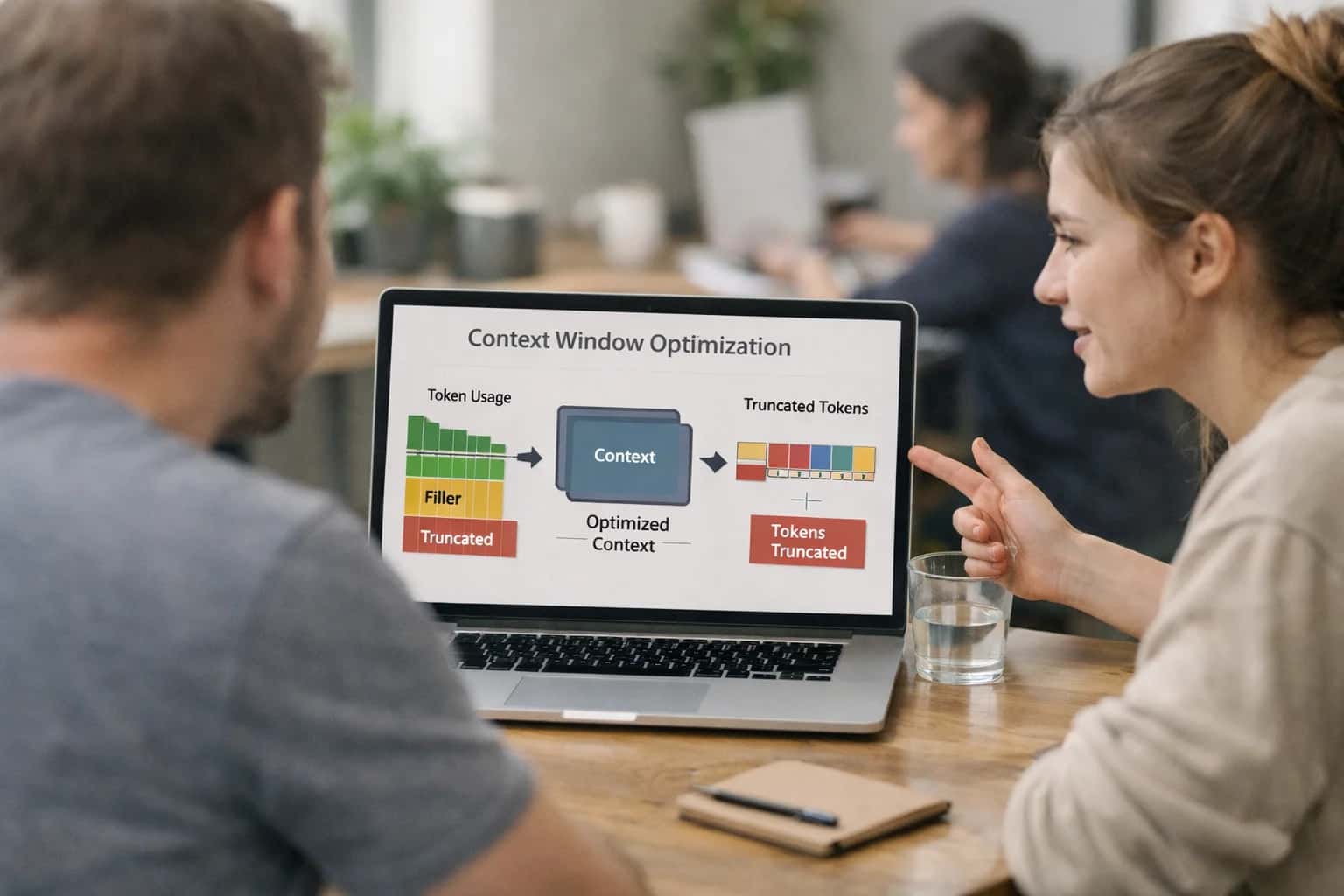
Comparisons related to assembling, ranking, and compressing retrieval context for LLMs. Target: ML Platform Leads optimizing context windows, citation accuracy, and token efficiency.
LlamaIndex vs LangChain: Context Assembly
Compare the two dominant frameworks for building RAG pipelines and agents. LlamaIndex excels at data ingestion, indexing, and retrieval optimization, while LangChain provides a more flexible, chain-based architecture for complex agentic workflows. Decision hinges on whether your priority is retrieval quality or multi-step tool orchestration.
Cohere Rerank vs BGE-Reranker: Retrieval Scoring
Evaluate the leading cross-encoder models for improving retrieval precision. Cohere Rerank offers a managed, high-performance API with strong multilingual support, while BGE-Reranker provides an open-source, self-hosted alternative with competitive accuracy on benchmarks like BEIR. The trade-off is operational simplicity versus data privacy and cost control.
GPTCache vs Redis: Semantic Caching
Compare purpose-built semantic caches against general-purpose stores for reducing LLM latency and cost. GPTCache offers configurable similarity thresholds and eviction policies tuned for LLM responses, while Redis provides a battle-tested, low-latency infrastructure that requires custom logic for semantic matching.
Unstructured.io vs LlamaParse: Document Ingestion
Compare tools for transforming complex PDFs, HTML, and scans into LLM-ready text. Unstructured.io provides a broad library of connectors and partitioning strategies, while LlamaParse is optimized for complex document layouts and tables with native Markdown output, making it a strong choice for financial and legal documents.
RAGAS vs TruLens: RAG Evaluation
Compare open-source frameworks for measuring RAG pipeline quality. RAGAS focuses on component-level metrics like faithfulness, answer relevancy, and context precision using synthetic test sets. TruLens provides a broader feedback function system with app tracking, making it suitable for holistic evaluation and debugging of LLM apps.
Pinecone vs Weaviate: Vector Store for RAG
Compare the leading purpose-built vector databases. Pinecone offers a fully managed, serverless experience with low operational overhead and strong hybrid search. Weaviate provides an open-source, flexible architecture with built-in generative modules and a GraphQL API, appealing to teams needing deployment control.
Qdrant vs Milvus: Billion-Scale Retrieval
Compare vector databases engineered for high-performance, large-scale similarity search. Qdrant is written in Rust, offering high throughput with a minimal resource footprint and advanced quantization. Milvus provides a cloud-native, distributed architecture designed for trillion-scale datasets with tunable consistency levels.
Neo4j vs Amazon Neptune: Graph RAG Storage
Compare graph database backends for knowledge graph-powered RAG. Neo4j provides a mature, native graph engine with a rich Cypher query language and extensive library support. Amazon Neptune is a fully managed AWS service offering high availability and multi-model support, simplifying operations for teams already in the AWS ecosystem.
LangChain vs Haystack: RAG Pipeline Design
Compare two mature frameworks for constructing custom RAG pipelines. LangChain offers a highly composable, chain-of-thought architecture with a vast ecosystem of integrations. Haystack provides a more opinionated, production-focused pipeline architecture with strong document processing roots, often leading to cleaner, more maintainable code for standard retrieval tasks.
Azure AI Search vs Pinecone: Enterprise Retrieval
Compare a comprehensive cloud search platform against a specialized vector database. Azure AI Search integrates vector, keyword, and semantic ranking with built-in AI enrichment and Microsoft ecosystem security. Pinecone provides a best-in-class, serverless vector database focused purely on high-performance similarity search with lower operational complexity.
Lakera Guard vs Prompt Security: Injection Prevention
Compare LLM firewalls designed to detect and block prompt injection and data exfiltration. Lakera Guard uses a purpose-built ML model for real-time detection with low latency. Prompt Security provides a broader enterprise security platform that inspects prompts and responses for a wider range of threats, including PII leakage and toxic content.
Arize Phoenix vs LangSmith: Trace Observability
Compare platforms for debugging and monitoring LLM applications. Arize Phoenix is an open-source library focused on tracing, evaluation, and embedding drift analysis. LangSmith is a commercial platform tightly integrated with the LangChain ecosystem, offering deep debugging, dataset curation, and human annotation workflows for the full development lifecycle.
Hugging Face TGI vs vLLM: Token Generation Speed
Compare high-performance inference servers for open-source LLMs. vLLM uses PagedAttention for near-zero waste in KV cache memory, delivering state-of-the-art throughput. Hugging Face TGI offers a production-ready server with built-in quantization, watermarking, and a broader model support matrix, prioritizing ease of use and feature completeness.
Together AI vs Fireworks AI: Inference Optimization
Compare platforms offering optimized, serverless inference for open-source models. Together AI focuses on research-driven speed improvements and fine-tuning capabilities. Fireworks AI provides a compound AI platform with a focus on fast, cost-effective inference and a unique model composition API for building multi-model pipelines.
Nvidia NeMo Guardrails vs Guardrails AI: Policy Enforcement
Compare frameworks for defining and enforcing safety policies on LLM outputs. NeMo Guardrails uses a Colang modeling language for defining complex, dialog-aware rails. Guardrails AI provides a Python-native approach using Reliable AI markup (.rail) to define structural, type, and quality constraints on LLM outputs, integrating easily into existing codebases.
Microsoft GraphRAG vs LightRAG: Graph Indexing Strategy
Compare approaches to building knowledge graphs from text for RAG. Microsoft GraphRAG uses LLM-derived entity and community summaries for global sensemaking over large corpora. LightRAG offers a lighter-weight, incremental graph construction and retrieval method that is faster and cheaper, making it suitable for dynamic datasets where full re-indexing is prohibitive.
Partnered with leading AI, data, and software stack.





How We Work
Custom AI workflows for your Business
One-fit-all AI don't work for modern businesses. At Inferensys, we aim to understand your business & custom requirements; which we use to define most efficient agentic workflows, the data, and the tools for your business.
01
Review the use case
We understand the task, the users, and where AI can actually help.
Read more02
Pick the right approach
We define what needs search, automation, or product integration.
Read more03
Build the first useful version
We implement the part that proves the value first.
Read more04
Improve from there
We add the checks and visibility needed to keep it useful.
Read moreThe first call is a practical review of your use case and the right next step.
Talk to Us