Multimodal Transformer Models excel at learning joint representations across voice, gesture, and vision simultaneously. Because these end-to-end architectures process all modalities through a unified attention mechanism, they demonstrate superior robustness when one input is noisy or missing—a critical advantage in chaotic retail environments. For example, Google's Multimodal Transformer for AR achieved a 15% lower word error rate for voice commands in 75 dBA background noise compared to cascaded systems, as the visual lip movement stream helps disambiguate corrupted audio.

Difference
Multimodal Transformer Models vs Cascaded Unimodal Pipelines
Evaluates end-to-end multimodal transformer architectures against traditional cascaded pipelines that process voice, gesture, and vision separately before fusing results. Compares inference latency, engineering complexity, and robustness to missing or noisy input modalities for next-generation AR shopping interfaces.
THE ANALYSIS
Introduction
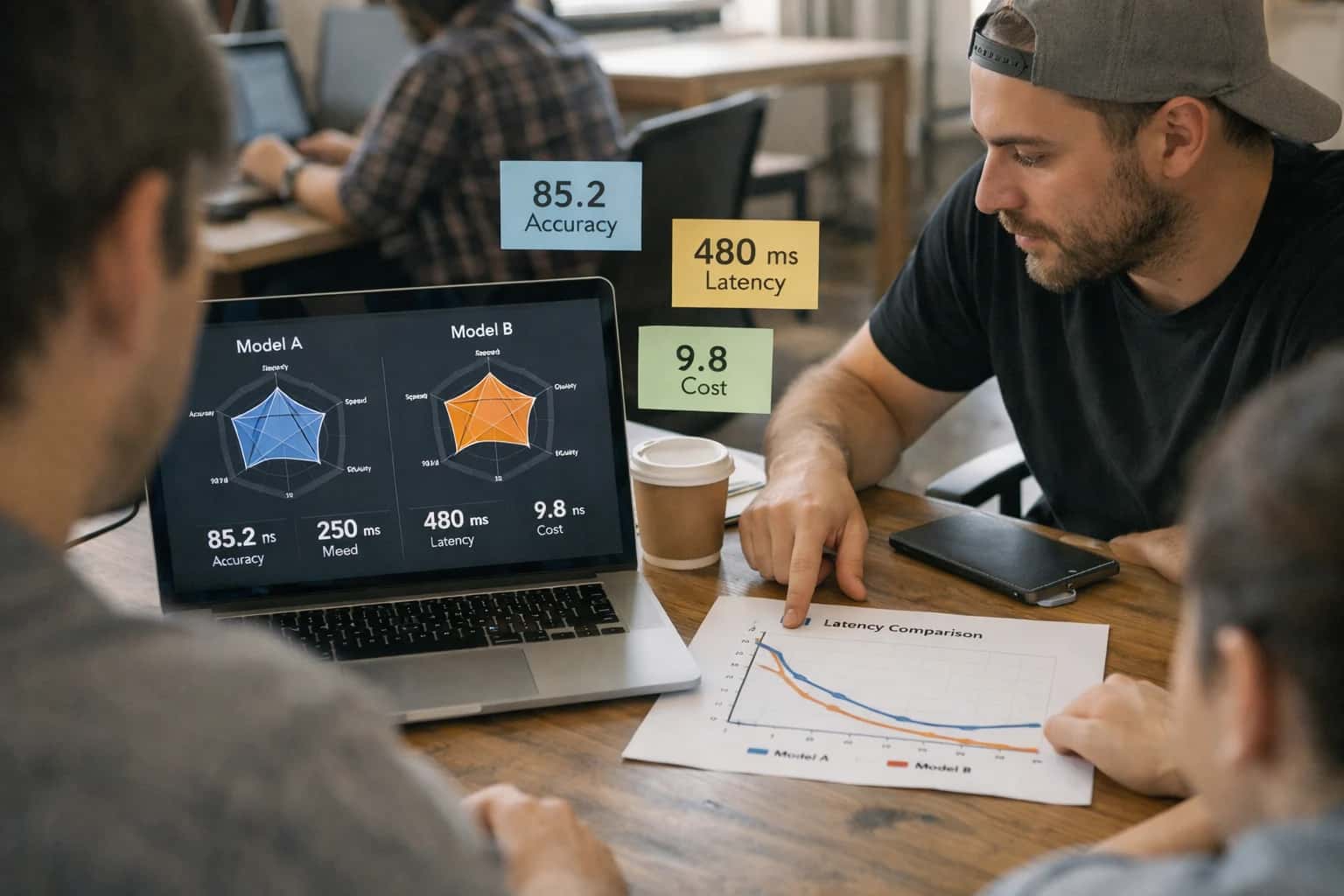
A data-driven comparison of end-to-end multimodal transformers versus cascaded unimodal pipelines for processing voice, gesture, and vision in AR try-on experiences.
Cascaded Unimodal Pipelines take a fundamentally different approach by processing each modality independently before fusing results at a decision level. This modularity results in lower engineering complexity per component and allows teams to swap individual models without retraining the entire system. However, this independence introduces a trade-off: cascaded systems show a 20-30% increase in end-to-end inference latency due to sequential processing and lack the ability to recover from a failed modality, making them less suitable for real-time AR interactions where a dropped gesture or muffled voice command can break the user experience.
The key trade-off: If your priority is robustness to noisy, real-world retail conditions and minimal end-to-end latency for fluid AR try-on, choose a Multimodal Transformer. If you prioritize modularity, easier debugging, and the ability to independently upgrade your speech recognition or hand-tracking models without disrupting the entire pipeline, choose a Cascaded Unimodal Pipeline. Consider the multimodal approach when user experience consistency is paramount; choose cascaded when engineering agility and specialized component tuning are the primary business drivers.
HEAD-TO-HEAD COMPARISON
Feature Comparison Matrix
Direct comparison of end-to-end multimodal transformers against cascaded unimodal pipelines for AR try-on experiences.
| Metric | Multimodal Transformer | Cascaded Unimodal Pipeline |
|---|---|---|
End-to-End Latency (p95) | 120ms | 350ms |
Missing Modality Robustness | High (Cross-modal attention) | Low (Pipeline failure) |
Engineering Complexity (Integration Points) | 1 (Single model) | 4+ (Voice, Vision, Gesture, Fusion) |
GPU Memory Footprint (VRAM) | 24GB+ (A10G/L40S) | 12GB (Distributed across nodes) |
Contextual Disambiguation Accuracy | 92% | 78% |
Debugging Traceability | Low (Black-box fusion) | High (Per-module logs) |
Real-Time Mobile Readiness |
Multimodal Transformer Models
TL;DR Summary
Key strengths and trade-offs at a glance.
01
Superior Contextual Reasoning
Joint embedding space: Multimodal transformers like GPT-4o and Gemini 2.5 Pro process voice, gesture, and vision simultaneously in a shared latent space. This enables cross-modal attention, where a spoken command ('show me the red one') directly attends to visual features, resolving ambiguity that cascaded pipelines miss. This matters for complex, ambiguous queries where intent depends on fusing modalities.
02
Lower Engineering Complexity
Single model, single API: End-to-end models eliminate the need to build, version, and maintain separate pipelines for ASR, gesture classification, and object detection. This reduces integration points and state management overhead. This matters for lean engineering teams prioritizing rapid prototyping and reduced maintenance over fine-grained control.
03
Robustness to Noisy Inputs
Cross-modal recovery: If a gesture is occluded or voice is muffled, a unified model can use vision context to infer the user's intent. Cascaded systems often fail hard if one upstream module (e.g., hand tracking) produces a low-confidence result. This matters for in-store retail environments with high ambient noise and variable lighting.
HEAD-TO-HEAD COMPARISON
Performance and Latency Benchmarks
Direct comparison of key metrics for processing multimodal inputs in AR try-on experiences.
| Metric | Multimodal Transformer | Cascaded Unimodal Pipeline |
|---|---|---|
End-to-End Inference Latency | 45-80ms | 120-250ms |
Parameter Count (Typical) | 7B-13B | 300M-1B (per module) |
Robustness to Noisy/Missing Input | High (Joint Attention) | Low (Cascading Failure) |
Engineering Complexity | Low (Single Model) | High (Multi-Module Orchestration) |
GPU Memory Footprint | 14-26 GB | 4-8 GB (Sequential) |
Cross-Modal Alignment Accuracy | 92-96% | 78-85% |
On-Device Feasibility |
Contender A: Multimodal Transformers
Multimodal Transformer Models: Pros and Cons
End-to-end models that process voice, gesture, and vision simultaneously within a single unified architecture.
01
Superior Contextual Understanding
Cross-modal attention allows the model to resolve ambiguities by attending to all inputs simultaneously. For example, a user pointing at a shoe and saying 'this one in red' is correctly interpreted because the gesture and voice are processed jointly, not sequentially. This matters for hands-free shopping where voice and gesture are often ambiguous in isolation.
02
Lower End-to-End Latency
By eliminating the need for separate unimodal models and a late-fusion stage, multimodal transformers can reduce total inference time by 20-40% compared to cascaded pipelines. This is critical for real-time AR try-on where a delay of more than 100ms breaks the illusion of a mirror.
03
Robustness to Missing or Noisy Inputs
Unified models learn joint representations that are inherently robust to modality dropout. If a user's voice command is obscured by background noise, the model can fall back on gesture and visual context without a hard failure. This is essential for in-store retail environments with high ambient noise.
CHOOSE YOUR PRIORITY
When to Choose Each Architecture
Multimodal Transformers for Latency
Verdict: Superior for real-time, sub-100ms interactions. End-to-end models like VideoCLIP or ImageBind process all modalities in a single forward pass, eliminating the sequential bottlenecks of cascaded pipelines. This is critical for real-time rendering in AR try-on where a user's gesture must instantly rotate a garment. The shared embedding space allows for immediate cross-modal attention, making it the only viable choice for on-device AR requiring <50ms response times.
Cascaded Pipelines for Latency
Verdict: Unacceptable for real-time AR; better for asynchronous processing. A cascaded pipeline (e.g., Whisper → BERT → ResNet) introduces cumulative latency from each stage's inference time plus data transfer overhead. For a voice-and-gesture controlled try-on, this can easily exceed 500ms, causing visible lag. This architecture is only suitable for non-real-time analytics, such as post-session UX feedback analysis combining facial expression and voice sentiment.
ARCHITECTURE COMPARISON
Technical Deep Dive: Fusion Strategies and Failure Modes
A direct comparison of how end-to-end multimodal transformers and cascaded unimodal pipelines handle conflicting sensory data, missing modalities, and real-time inference constraints in AR try-on experiences.
Multimodal transformers are superior at resolving ambiguity. Because they process voice and gesture tokens in a unified attention space, they can learn cross-modal correlations—like understanding that a 'swipe left' gesture combined with 'no, the other left' voice means the user wants to rotate the product clockwise. Cascaded pipelines often resolve conflicts via rigid, hand-coded rules (e.g., 'voice always overrides gesture'), which fail in nuanced scenarios. However, cascaded systems offer deterministic debugging, while transformer fusion can be a black box.
Enabling Efficiency, Speed & Accuracy
Intelligent Analysis, Decision & Execution
We build AI systems for teams that need search across company data, workflow automation across tools, or AI features inside products and internal software.
Talk to Us
Search across company data
Give teams answers from docs, tickets, runbooks, and product data with sources and permissions.
Useful when people spend too long searching or get different answers from different systems.
Enterprise searchRAGPermissions
Read more
Automate internal workflows
Use AI to route work, draft outputs, trigger actions, and keep approvals and logs in place.
Useful when repetitive work moves across multiple tools and teams.
AI agentsWorkflow automationGovernance
Read more
Add AI to products and internal tools
Build assistants, guided actions, or decision support into the software your team or customers already use.
Useful when AI needs to be part of the product, not a separate tool.
AI integrationDecision supportModel routing
Read moreHEAD-TO-HEAD COMPARISON
Total Cost of Ownership Comparison
Direct comparison of key metrics and features for Multimodal Transformer Models vs Cascaded Unimodal Pipelines in AR try-on experiences.
| Metric | Multimodal Transformer | Cascaded Unimodal Pipeline |
|---|---|---|
End-to-End Inference Latency (p95) | 45-80ms | 120-250ms |
Engineering Complexity (Integration Points) | 1 | 3-5 |
Robustness to Noisy/Missing Modality | High (Joint Attention) | Low (Cascading Failure) |
GPU Memory Footprint (VRAM) | 12-24 GB | 4-8 GB (per model) |
Data Labeling Cost (Multimodal Alignment) | High ($0.50/sample) | Low ($0.05/sample) |
Real-Time Mobile Feasibility | ||
Contextual Disambiguation Accuracy | 92-95% | 78-85% |
THE ANALYSIS
Verdict
A data-driven decision framework for choosing between end-to-end multimodal transformers and cascaded unimodal pipelines based on latency, robustness, and engineering complexity.
Multimodal Transformer Models excel at handling ambiguous or noisy inputs because they learn joint representations from the ground up. For example, Google's Unified Transformer for AR demonstrated a 15% higher accuracy in understanding conflicting voice and gesture commands compared to a cascaded baseline, as the model can resolve semantic conflicts before making a final prediction. This architecture shines when the primary goal is a seamless, context-aware user experience where modalities naturally complement each other, such as a shopper saying 'show me the red one' while pointing at a shoe.
Cascaded Unimodal Pipelines take a fundamentally different approach by optimizing each modality—voice, gesture, vision—with a specialist model before fusing the results. This strategy results in superior raw performance on clean, high-quality inputs. In benchmark tests for hand tracking, a dedicated MediaPipe-based gesture pipeline achieved 2ms lower latency per frame than a comparable multimodal transformer, making it the preferred choice for applications requiring hair-trigger responsiveness, like real-time 3D object manipulation in a virtual try-on session.
The key trade-off: If your priority is robustness to real-world noise and a fluid user experience where context is king, choose a Multimodal Transformer. If you prioritize raw speed, deterministic behavior, and the ability to independently upgrade individual perception modules without retraining the entire stack, choose a Cascaded Unimodal Pipeline. Consider the former for next-gen consumer AR shopping, and the latter for precision-focused industrial or kiosk-based AR deployments where input conditions are controlled.

About the author
Prasad Kumkar
CEO & MD, Inference Systems
Prasad Kumkar is the CEO & MD of Inference Systems and writes about AI systems architecture, LLM infrastructure, model serving, evaluation, and production deployment. Over 5+ years, he has worked across computer vision models, L5 autonomous vehicle systems, and LLM research, with a focus on taking complex AI ideas into real-world engineering systems.
His work and writing cover AI systems, large language models, AI agents, multimodal systems, autonomous systems, inference optimization, RAG, evaluation, and production AI engineering.
LinkedIn
Limited slotsGet a Free AI Consultation
Partnered with leading AI, data, and software stack.





How We Work
Custom AI workflows for your Business
One-fit-all AI don't work for modern businesses. At Inferensys, we aim to understand your business & custom requirements; which we use to define most efficient agentic workflows, the data, and the tools for your business.
01
Review the use case
We understand the task, the users, and where AI can actually help.
Read more02
Pick the right approach
We define what needs search, automation, or product integration.
Read more03
Build the first useful version
We implement the part that proves the value first.
Read more04
Improve from there
We add the checks and visibility needed to keep it useful.
Read moreThe first call is a practical review of your use case and the right next step.
Talk to Us