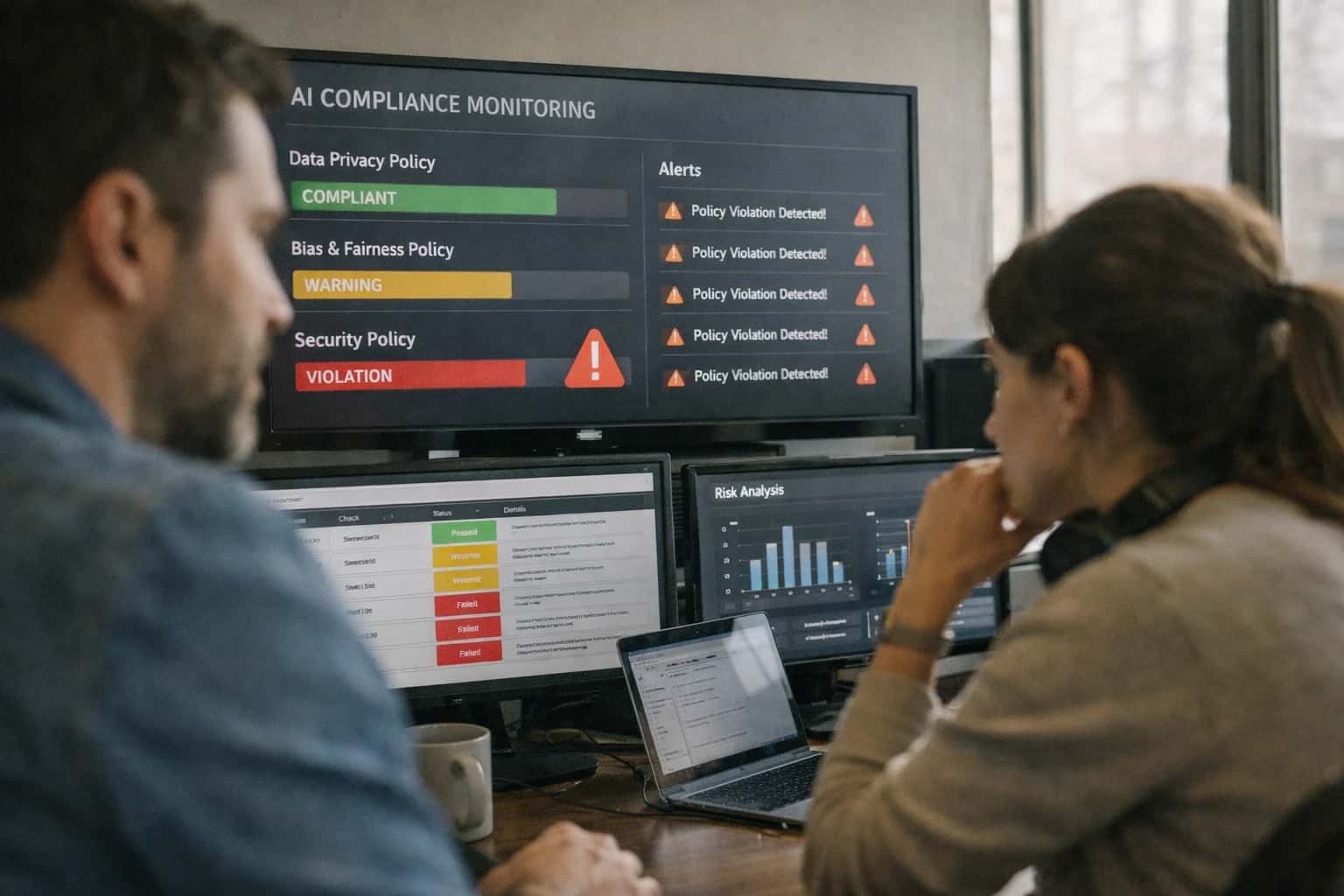
Continuous Supplier Monitoring excels at providing real-time visibility into a supplier's financial, operational, and reputational health by ingesting thousands of external data signals daily. For example, platforms leveraging this approach can detect a Tier-2 supplier's bankruptcy filing or a negative ESG news event within hours, reducing mean-time-to-detect (MTTD) for critical risks from months to minutes. This method is designed for a world where a single geopolitical event or cyber-attack can cascade through a supply chain in days, not quarters.

Difference
Continuous Supplier Monitoring vs Point-in-Time Audits
A technical comparison of always-on AI monitoring for financial, ESG, and compliance risks against the snapshot view of periodic audits. We break down trade-offs in risk detection speed, coverage depth, and operational cost for supply chain leaders.
THE ANALYSIS
Introduction
A data-driven comparison of always-on AI monitoring against periodic manual audits for supplier risk management.
Point-in-Time Audits take a fundamentally different approach by providing a deep, forensic snapshot of a supplier's controls, financials, and compliance posture at a specific moment. This results in a high-confidence, verified baseline that is often required for regulatory filings like ISO 9001 or SOC 2 reports. The trade-off is a static view that begins to decay immediately, leaving a 'risk gap' between audit cycles where material changes—such as a silent change in beneficial ownership or a rapid liquidity crunch—can go undetected for up to 12 months.
The key trade-off: If your priority is detecting fast-moving, external risk signals like adverse media, cyber breaches, or sudden financial distress across a large, multi-tier supply base, choose Continuous AI Monitoring. If you prioritize deep, on-site verification of internal controls, physical security, and manufacturing processes for a critical, single-source supplier, choose a Point-in-Time Audit. A mature risk strategy often layers the former for breadth and speed, reserving the latter for depth and assurance.
HEAD-TO-HEAD COMPARISON
Feature Comparison Matrix
Direct comparison of risk coverage, data latency, and operational impact between continuous AI monitoring and periodic manual audits.
| Metric | Continuous Supplier Monitoring | Point-in-Time Audits |
|---|---|---|
Data Refresh Frequency | Real-time / Streaming | Annual or Bi-annual |
Risk Signal Latency | < 1 hour | 3-12 months |
Data Source Coverage | Structured + Unstructured (News, Sanctions, Cyber, Social) | Structured (Financials, Surveys) |
ESG/Compliance Update Detection | Immediate (NLP on regulatory changes) | Delayed (Next scheduled audit) |
Financial Distress Prediction | Predictive (Alt data, payment patterns) | Lagging (Filed statements) |
Operational Overhead | Low (Automated alerts) | High (Manual evidence collection) |
Multi-Tier Visibility |
Continuous Monitoring vs. Point-in-Time Audits
TL;DR Summary
A side-by-side comparison of the strengths and trade-offs between always-on AI supplier monitoring and traditional periodic audits.
01
Continuous Monitoring: Real-Time Risk Detection
Speed of signal detection: AI platforms like Exiger and Resilinc scan millions of public and private data sources daily, detecting financial distress, cyber breaches, and adverse media within hours. This matters for just-in-time supply chains where a 24-hour delay in detecting a Tier-2 factory fire can halt production lines.
02
Continuous Monitoring: Comprehensive Coverage
Breadth of data: AI agents monitor 100% of your supply base simultaneously, including sub-tiers, by scraping news, sanctions lists, and even social media. This matters for ESG compliance, where a single unreported labor violation at a Tier-3 supplier can cause reputational damage that a manual audit would likely miss.
03
Continuous Monitoring: Predictive Insights
Proactive posture: Machine learning models correlate weak signals—like a supplier's late tax filings or declining employee sentiment on Glassdoor—to predict a 70% probability of bankruptcy within 6 months. This matters for strategic sourcing, allowing you to qualify alternatives before a disruption occurs.
04
Point-in-Time Audits: Deep Forensic Validation
Depth of verification: A physical or remote audit by a firm like Intertek or SGS verifies the physical reality of a factory floor, including safety equipment, actual working conditions, and inventory counts. This matters for highly regulated industries like aerospace or pharma, where a digital signal cannot replace a physical certificate of analysis.
05
Point-in-Time Audits: Relationship Building
Human context: On-site visits allow procurement teams to assess management quality, culture, and operational maturity through direct observation—nuances an AI cannot capture. This matters for strategic partnerships where trust and cultural alignment are critical to long-term innovation collaboration.
06
Point-in-Time Audits: Regulatory Certainty
Compliance proof: A dated, signed audit report from a certified body provides a definitive legal artifact for regulatory filings like FDA or ISO 9001 recertification. This matters for legal defensibility, as an AI-generated risk score currently lacks the same standing in a court or regulatory hearing.
HEAD-TO-HEAD COMPARISON
Cost and Resource Comparison
Direct comparison of key metrics and features for Continuous Supplier Monitoring vs Point-in-Time Audits.
| Metric | Continuous AI Monitoring | Point-in-Time Audits |
|---|---|---|
Risk Detection Latency | < 1 hour (Real-time alerts) | 3-6 months (Audit cycle) |
Annual Cost per 1,000 Suppliers | $15,000 - $50,000 | $150,000 - $500,000+ |
Data Sources Analyzed | 10,000+ (News, sanctions, cyber, financial) | 50-100 (Self-reported docs, checklists) |
Coverage Scope | 100% of suppliers, continuously | 5-15% sample, annually |
ESG Signal Freshness | Real-time (Public data & NLP) | 12-18 months old (Survey-based) |
False Positive Rate | 2-5% (Requires triage tuning) | < 1% (Verified manually) |
Integration with ERP/CLM |
Enabling Efficiency, Speed & Accuracy
Intelligent Analysis, Decision & Execution
We build AI systems for teams that need search across company data, workflow automation across tools, or AI features inside products and internal software.
Talk to Us
Search across company data
Give teams answers from docs, tickets, runbooks, and product data with sources and permissions.
Useful when people spend too long searching or get different answers from different systems.
Enterprise searchRAGPermissions
Read more
Automate internal workflows
Use AI to route work, draft outputs, trigger actions, and keep approvals and logs in place.
Useful when repetitive work moves across multiple tools and teams.
AI agentsWorkflow automationGovernance
Read more
Add AI to products and internal tools
Build assistants, guided actions, or decision support into the software your team or customers already use.
Useful when AI needs to be part of the product, not a separate tool.
AI integrationDecision supportModel routing
Read moreCHOOSE YOUR PRIORITY
When to Choose Continuous Monitoring vs Audits
Continuous Monitoring for Risk Managers
Strengths: Real-time signal detection is the core value proposition. AI-driven platforms like Everstream Analytics and Resilinc ingest news, weather, financial filings, and social media to provide instant alerts on supplier disruptions. This allows risk managers to shift from a reactive posture to a proactive one, triggering mitigation plans the moment a Tier-2 supplier's factory is threatened by a natural disaster.
Key Metric: Mean Time to Detect (MTTD) drops from weeks to minutes.
Point-in-Time Audits for Risk Managers
Strengths: Audits provide deep, verified ground truth that monitoring cannot. An on-site or virtual audit using a framework like ISO 28000 validates the actual maturity of a supplier's security and continuity plans. This is critical for high-risk, single-source suppliers where a failure is catastrophic.
Verdict: Use continuous monitoring for broad-based, early-warning detection across your entire supply base. Reserve deep audits for validating the controls of your most critical, high-impact suppliers.
THE ANALYSIS
Verdict
A data-driven comparison of risk coverage and operational cost between always-on AI monitoring and periodic manual audits.
Continuous Supplier Monitoring excels at capturing time-sensitive risk signals that expire between audit cycles. Because these platforms ingest real-time data from financial markets, news wires, shipping APIs, and sanctions lists, they can detect a supplier's credit downgrade or a factory-floor disruption within hours. For example, AI-driven monitoring tools have demonstrated the ability to reduce 'time-to-alert' for critical supplier bankruptcy filings from an average of 90 days (with annual audits) to under 24 hours, effectively closing the 'risk gap' that leaves supply chains vulnerable.
Point-in-Time Audits take a fundamentally different approach by prioritizing depth of verification over speed of detection. This strategy results in a verified, legally defensible snapshot of a supplier's financial health, safety protocols, and physical infrastructure that AI scraping cannot replicate. A forensic on-site audit can uncover fraudulent quality certifications or unsafe working conditions that leave no digital footprint, providing a level of assurance that is critical for high-stakes regulatory compliance, such as FDA supplier qualification or aerospace AS9100 certification.
The key trade-off: If your priority is velocity of risk detection and coverage across thousands of suppliers, choose Continuous AI Monitoring. If you prioritize depth of verification and irrefutable evidence for a concentrated group of critical partners, choose Point-in-Time Audits. For most enterprise supply chains, the optimal architecture is a hybrid model: use AI to continuously filter the noise and flag high-risk suppliers, then dispatch targeted, risk-based audits to verify the most critical signals.

About the author
Prasad Kumkar
CEO & MD, Inference Systems
Prasad Kumkar is the CEO & MD of Inference Systems and writes about AI systems architecture, LLM infrastructure, model serving, evaluation, and production deployment. Over 5+ years, he has worked across computer vision models, L5 autonomous vehicle systems, and LLM research, with a focus on taking complex AI ideas into real-world engineering systems.
His work and writing cover AI systems, large language models, AI agents, multimodal systems, autonomous systems, inference optimization, RAG, evaluation, and production AI engineering.
LinkedIn
Limited slotsGet a Free AI Consultation
Partnered with leading AI, data, and software stack.





How We Work
Custom AI workflows for your Business
One-fit-all AI don't work for modern businesses. At Inferensys, we aim to understand your business & custom requirements; which we use to define most efficient agentic workflows, the data, and the tools for your business.
01
Review the use case
We understand the task, the users, and where AI can actually help.
Read more02
Pick the right approach
We define what needs search, automation, or product integration.
Read more03
Build the first useful version
We implement the part that proves the value first.
Read more04
Improve from there
We add the checks and visibility needed to keep it useful.
Read moreThe first call is a practical review of your use case and the right next step.
Talk to Us