Agiloft AI excels at extreme configurability, offering a no-code platform where the data model, workflows, and UI can be molded to fit highly specific procurement and legal processes without writing a single line of code. This is critical for enterprises with unique contract types or complex approval matrices that out-of-the-box SaaS cannot handle. For example, Agiloft's conditional rule engine allows a manufacturer to automatically trigger a quality audit clause review only when a supplier's on-time-in-full (OTIF) rate drops below 95%, a level of granularity that reduces manual oversight by an estimated 40% according to user reports.

Difference
Agiloft AI vs ContractPodAi: Configurable No-Code vs. Unified AI CLM
A head-to-head comparison of Agiloft AI and ContractPodAi for AI-native contract lifecycle management. We analyze configurability versus unified design, AI redlining accuracy, obligation extraction, and total cost of ownership to help legal ops and procurement leads choose the right platform.
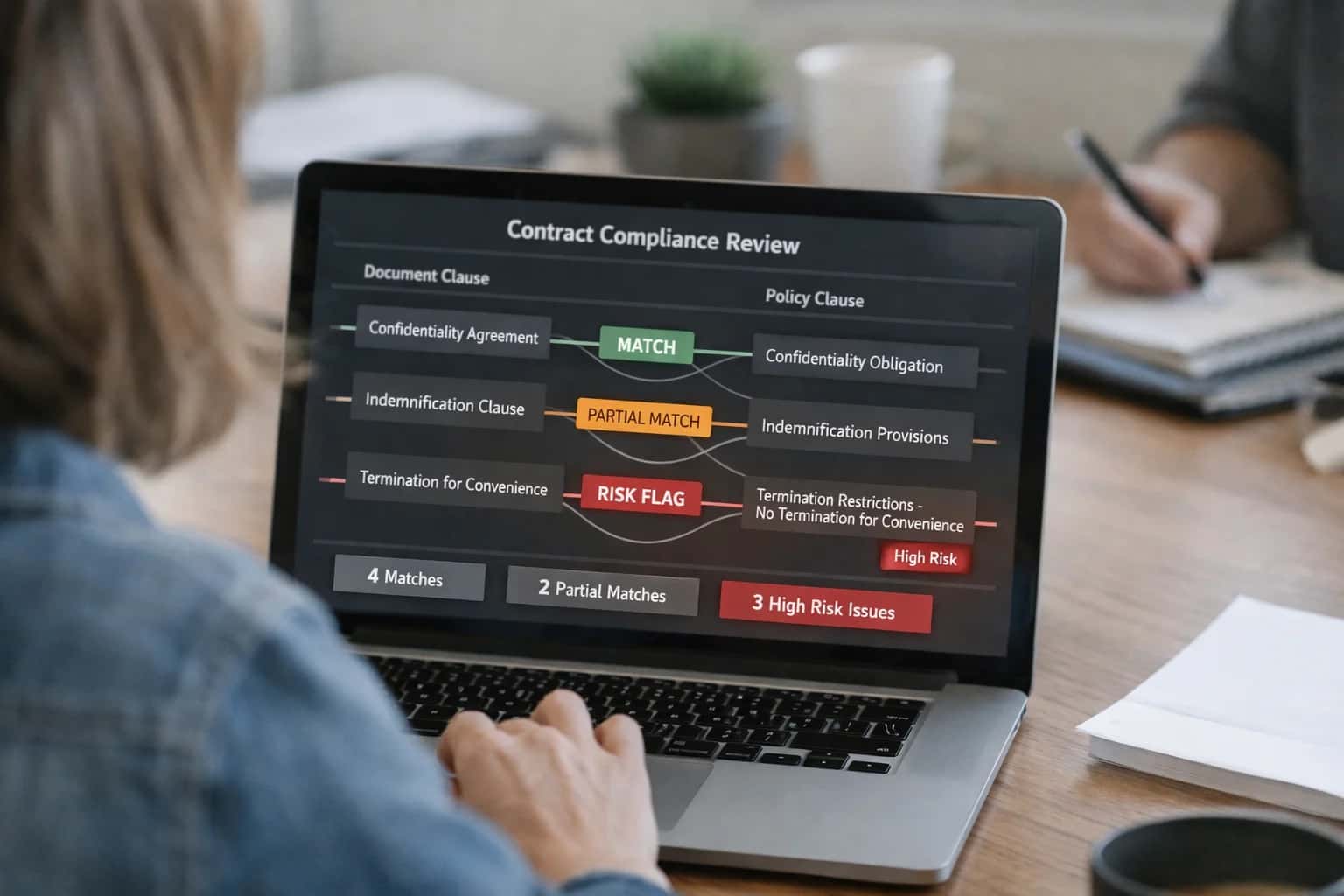
THE ANALYSIS
Agiloft AI vs ContractPodAi: The Battle for AI-Native CLM
A data-driven comparison of Agiloft's no-code configurability against ContractPodAi's unified, AI-embedded platform for legal operations and procurement leaders.
ContractPodAi takes a different approach by delivering an all-in-one, unified platform with an embedded AI legal assistant, 'Leah,' that is deeply integrated across the entire contract lifecycle. Rather than requiring extensive configuration to activate AI, ContractPodAi provides pre-built AI skills for obligation extraction, risk scoring, and clause recommendation directly out of the box. This results in a faster time-to-value for standard CLM use cases but can introduce rigidity when a business needs to map the tool to a non-standard legacy process, creating a trade-off between immediate AI power and long-term process adaptability.
The key trade-off: If your priority is a bespoke, highly automated workflow that mirrors your exact current operating model—especially for complex procurement orchestration and supplier performance triggers—choose Agiloft AI. Its no-code architecture treats AI as a configurable service you weave into custom logic. If you prioritize rapid deployment of a unified, AI-native legal front-door with pre-trained models for contract risk and obligation management, choose ContractPodAi. Its strength lies in accelerating standard legal review and post-signature governance without requiring a deep configuration project. Consider Agiloft when process differentiation is your competitive advantage; choose ContractPodAi when AI-driven legal velocity is the primary goal.
HEAD-TO-HEAD COMPARISON
Head-to-Head Feature Matrix
Direct comparison of key metrics and features for Agiloft AI vs ContractPodAi.
| Metric | Agiloft AI | ContractPodAi |
|---|---|---|
Core Architecture | No-Code, Highly Configurable Data Model | Unified, End-to-End CLM with Embedded AI (Leah) |
AI Redlining & Clause Library | ||
Post-Signature Obligation Extraction | ||
Third-Party Paper Ingestion (OCR) | ||
Pre-Trained AI Models (No Setup) | ||
Salesforce Integration Depth | Standard API | Native & Deep |
Ideal Deployment | Complex, Non-Standard Workflows | Rapid Time-to-Value, Standard CLM |
Agiloft AI vs ContractPodAi
TL;DR: Key Differentiators at a Glance
A quick-scan comparison of core strengths and trade-offs to help legal ops and procurement leads decide between a no-code configurable platform and an all-in-one unified CLM.
01
Agiloft: Unmatched No-Code Customization
Specific advantage: Agiloft's data model and workflow engine are built on a no-code platform, allowing organizations to configure virtually any contract type, approval chain, or conditional logic without developer support. This matters for complex, non-standard procurement processes where rigid SaaS workflows fail. Enterprises with unique clause libraries or multi-step, conditional approval matrices can adapt the system precisely to their existing operations rather than changing their processes to fit the software.
02
Agiloft: Granular Table-Driven Architecture
Specific advantage: Unlike document-centric CLMs, Agiloft uses a relational table-based backend that links contracts to related entities (suppliers, subsidiaries, assets, obligations) with high integrity. This matters for procurement and sourcing teams managing complex supplier hierarchies where a single vendor might have dozens of sub-agreements, amendments, and performance records. The architecture enables cross-contract reporting and obligation tracking that is difficult to achieve in flat, folder-based repositories.
03
Agiloft: Trade-off to Consider
Key trade-off: The extreme configurability comes with a steeper initial implementation curve. While no-code, the platform requires a deliberate design phase to map out data relationships and workflows. This matters for teams needing instant out-of-the-box value; Agiloft rewards upfront planning but can feel overwhelming for organizations seeking a simple, immediate contract repository with basic AI redlining. The embedded AI features, while powerful, are not as deeply unified as a platform built natively around an AI assistant.
04
ContractPodAi: Unified AI-First Legal Assistant
Specific advantage: ContractPodAi is built around 'Leah,' an embedded AI legal assistant that provides end-to-end support from intake to post-signature analytics. This matters for legal teams seeking a single, guided experience where AI proactively suggests clauses, flags risks, and extracts obligations without switching between modules. The platform's 'One Legal Platform' philosophy means the AI is deeply integrated into every stage of the contract lifecycle, offering a more cohesive user journey than bolted-on AI features.
05
ContractPodAi: Rapid Deployment for Standard CLM
Specific advantage: ContractPodAi offers a more prescriptive, best-practice CLM workflow that accelerates time-to-value for organizations with standard contract processes. This matters for mid-market to enterprise legal departments that want to digitize contract management quickly without extensive process re-engineering. The platform's pre-built templates, clause libraries, and AI-driven review workflows allow teams to start redlining and managing contracts within weeks, not months.
06
ContractPodAi: Trade-off to Consider
Key trade-off: The unified, opinionated architecture offers less flexibility for highly bespoke procurement or sourcing workflows. This matters for organizations with deeply unique, non-standard contract types (e.g., complex manufacturing supply agreements with multi-tier pricing and performance incentives) that require custom data models. While configurable, ContractPodAi's platform is less suited to radical process customization compared to a no-code table-driven system, potentially forcing teams to adapt their processes to the tool.
HEAD-TO-HEAD COMPARISON
AI Accuracy and Capability Benchmarks
Direct comparison of AI feature maturity and core capability benchmarks for Agiloft AI and ContractPodAi.
| Metric | Agiloft AI | ContractPodAi |
|---|---|---|
AI Redlining Accuracy (Out-of-Box) | Requires configuration | High (Pre-trained on legal corpora) |
Obligation Extraction (Unstructured) | Configurable extraction rules | AI-native extraction engine |
No-Code AI Model Training | ||
Embedded Legal AI Assistant | ||
Third-Party AI Integration | Open API (BYO Model) | Proprietary Leah AI |
Metadata Enrichment Speed | Dependent on workflow config | Automated on ingestion |
Risk Scoring Customization | Highly customizable logic | Standard AI risk models |
Enabling Efficiency, Speed & Accuracy
Intelligent Analysis, Decision & Execution
We build AI systems for teams that need search across company data, workflow automation across tools, or AI features inside products and internal software.
Talk to Us
Search across company data
Give teams answers from docs, tickets, runbooks, and product data with sources and permissions.
Useful when people spend too long searching or get different answers from different systems.
Enterprise searchRAGPermissions
Read more
Automate internal workflows
Use AI to route work, draft outputs, trigger actions, and keep approvals and logs in place.
Useful when repetitive work moves across multiple tools and teams.
AI agentsWorkflow automationGovernance
Read more
Add AI to products and internal tools
Build assistants, guided actions, or decision support into the software your team or customers already use.
Useful when AI needs to be part of the product, not a separate tool.
AI integrationDecision supportModel routing
Read moreCHOOSE YOUR PRIORITY
When to Choose Agiloft AI vs ContractPodAi
Agiloft AI for Legal Ops
Strengths: Unmatched no-code configurability. Legal Ops teams can build custom workflows, approval chains, and clause libraries without developer dependency. The platform's relational data model allows you to link contracts to matters, IP, and obligations in a way that mirrors your specific legal taxonomy.
Verdict: Choose Agiloft if your legal team has unique, complex processes that a rigid CLM would break. The AI is a powerful assistant, but the core value is the platform's ability to mold to your existing operations, not the other way around.
ContractPodAi for Legal Ops
Strengths: End-to-end, unified CLM with an embedded AI legal assistant (Leah). ContractPodAi provides a more opinionated, best-practice workflow out of the box. Its AI is deeply integrated for automated redlining, clause extraction, and risk scoring directly within the contract record.
Verdict: Choose ContractPodAi if you want a single, comprehensive platform where AI is a native, guiding force throughout the entire contract lifecycle, from request to renewal, with less upfront configuration.
THE ANALYSIS
Final Verdict: Configurability or Unified AI?
A data-driven breakdown of the core architectural trade-off between Agiloft's no-code configurability and ContractPodAi's unified, AI-native legal assistant.
Agiloft AI excels at adapting to highly specific, non-standard contract workflows because its no-code platform treats the data model as a blank canvas. For example, a global manufacturer used Agiloft to automate a complex channel partner onboarding process involving unique tiered pricing tables and regional compliance checks, a use case that would break most rigid SaaS CLMs. This results in a system that mirrors the business, not the other way around, but it requires a significant upfront investment in process design and platform configuration.
ContractPodAi takes a different approach by offering a unified, end-to-end platform with an embedded AI legal assistant, 'Leah,' that is deeply integrated into a standardized CLM workflow. This strategy prioritizes immediate time-to-value and a cohesive user experience. For instance, its AI can automatically extract obligations from a signed MSA and populate a compliance tracker without needing a consultant to build the link. The trade-off is less flexibility for unique edge cases; you must adapt your process to the platform's best-practice structure.
The key trade-off: If your priority is molding the technology to fit a complex, differentiating business process where competitive advantage lies in the workflow itself, choose Agiloft AI. If you prioritize a rapid, out-of-the-box deployment with a tightly integrated AI assistant that accelerates standard contract velocity across a common CLM framework, choose ContractPodAi. Consider Agiloft for 'system of differentiation' needs and ContractPodAi for a 'system of record' that gets smarter over time.

About the author
Prasad Kumkar
CEO & MD, Inference Systems
Prasad Kumkar is the CEO & MD of Inference Systems and writes about AI systems architecture, LLM infrastructure, model serving, evaluation, and production deployment. Over 5+ years, he has worked across computer vision models, L5 autonomous vehicle systems, and LLM research, with a focus on taking complex AI ideas into real-world engineering systems.
His work and writing cover AI systems, large language models, AI agents, multimodal systems, autonomous systems, inference optimization, RAG, evaluation, and production AI engineering.
LinkedIn
Limited slotsGet a Free AI Consultation
Partnered with leading AI, data, and software stack.





How We Work
Custom AI workflows for your Business
One-fit-all AI don't work for modern businesses. At Inferensys, we aim to understand your business & custom requirements; which we use to define most efficient agentic workflows, the data, and the tools for your business.
01
Review the use case
We understand the task, the users, and where AI can actually help.
Read more02
Pick the right approach
We define what needs search, automation, or product integration.
Read more03
Build the first useful version
We implement the part that proves the value first.
Read more04
Improve from there
We add the checks and visibility needed to keep it useful.
Read moreThe first call is a practical review of your use case and the right next step.
Talk to Us