Autonomous Negotiation Bots excel at extracting maximum value from supplier relationships by algorithmically optimizing pricing, payment terms, and contract details in real-time. For example, platforms like Pactum AI have demonstrated the ability to unlock 2-5% additional savings on tail spend categories by autonomously negotiating with thousands of suppliers simultaneously, a scale unattainable by human teams. The core strength lies in their ability to execute high-velocity, low-complexity negotiations without human fatigue, directly impacting the bottom line.

Difference
Autonomous Negotiation Bots vs Supplier Risk AI
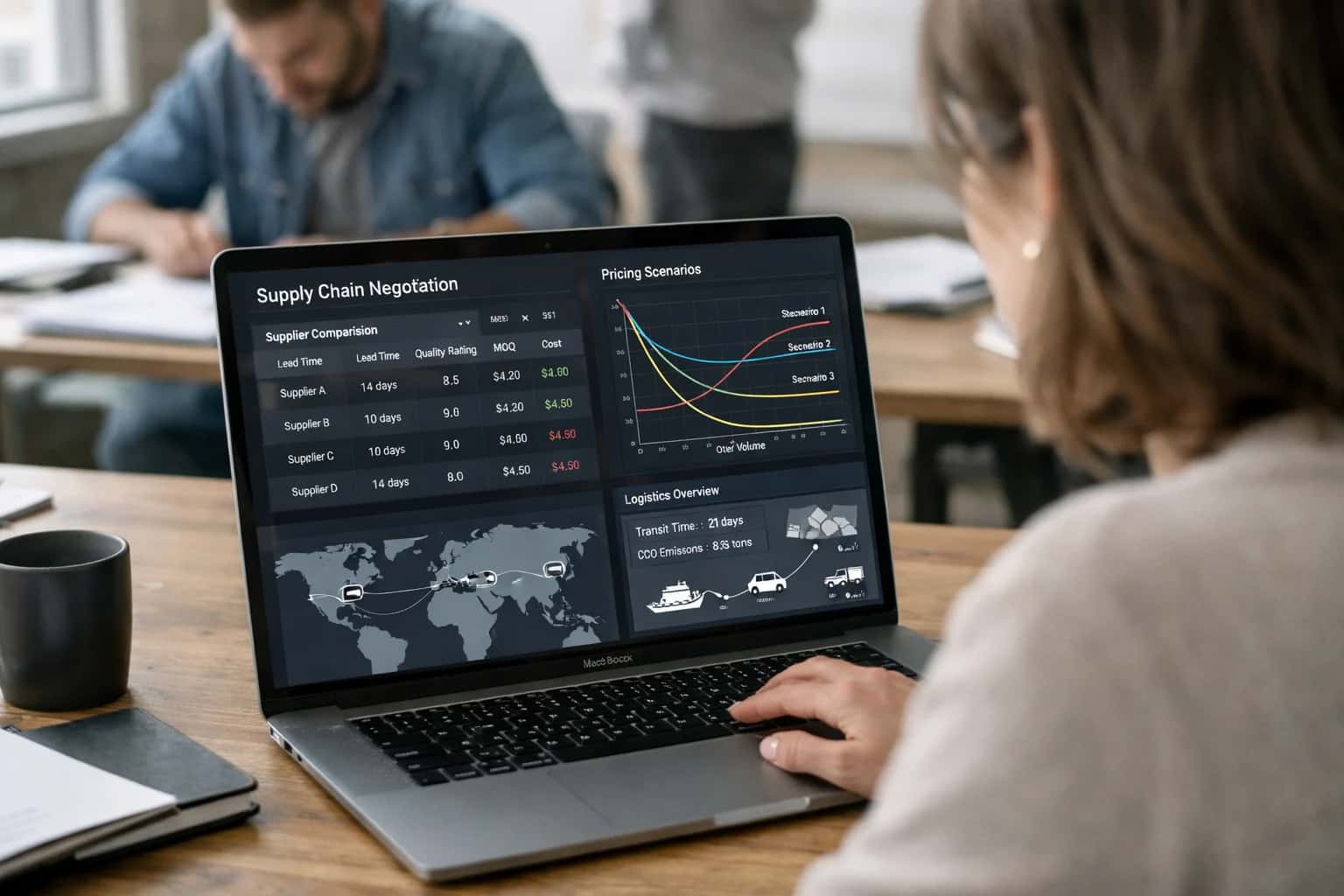
A technical comparison for CPOs and supply chain leaders evaluating AI that maximizes cost savings against AI that protects supply chain continuity. Covers risk-parameter embedding, multi-tier visibility, and the trade-off between margin gains and resilience.
THE ANALYSIS
Introduction
A data-driven comparison of autonomous negotiation bots focused on cost savings versus supplier risk AI platforms designed to prevent supply chain disruptions.
Supplier Risk AI takes a fundamentally different approach by prioritizing supply chain resilience over unit cost reduction. These platforms, such as those monitoring multi-tier dependencies and geopolitical signals, continuously score suppliers on financial health, cyber posture, and ESG compliance. This results in a trade-off: a negotiation bot might secure a 3% cost reduction from a supplier that a risk AI simultaneously flags as having a high probability of bankruptcy, creating a potential future disruption that far outweighs the immediate savings.
The key trade-off: If your primary mandate is to hit quarterly cost-savings targets and optimize tail spend, an autonomous negotiation bot delivers immediate, measurable ROI. If your organization prioritizes supply assurance, regulatory compliance, and long-term supplier health, a Supplier Risk AI platform is the essential first layer of defense. The most mature procurement functions are now embedding risk thresholds directly into their autonomous negotiation parameters, instructing bots to exclude high-risk suppliers from sourcing events entirely, regardless of the price offered.
HEAD-TO-HEAD COMPARISON
Feature Comparison Matrix
Direct comparison of core capabilities: driving cost savings vs. preventing supply chain disruption.
| Metric | Autonomous Negotiation Bots | Supplier Risk AI |
|---|---|---|
Primary Objective | Cost Savings & Cycle Time | Continuity & Compliance |
Avg. Savings Impact | 2-8% on tail spend | N/A (Risk Avoidance) |
Time to Action | Real-time (< 5 min) | Periodic (Daily/Weekly) |
Data Source Focus | Market pricing, historical bids | News, financials, cyber, ESG |
Core AI Architecture | Game Theory / Reinforcement Learning | NLP / Graph Analytics |
Key Integration Point | ERP / e-Sourcing (Pre-PO) | Supply Chain Control Tower |
Human Handoff Trigger | Deal threshold exceeded | Risk score threshold breached |
Autonomous Negotiation Bots vs Supplier Risk AI
TL;DR Summary
A direct comparison of AI agents optimized for cost savings against platforms designed to protect supply chain continuity. The core tension: maximizing margin through aggressive negotiation versus preventing catastrophic losses from unstable suppliers.
01
Choose Autonomous Negotiation Bots for Tail Spend Velocity
Primary advantage: Achieves 8-15% savings on unmanaged tail spend by autonomously negotiating spot buys in real-time, a task human buyers rarely touch. This matters for organizations where 80% of suppliers account for only 20% of spend, and manual negotiation is economically unviable. Platforms like Pactum AI demonstrate 3-5% margin improvement on previously unmanaged categories by deploying bots that negotiate 24/7 without human intervention.
02
Choose Supplier Risk AI for Strategic Supplier Resilience
Primary advantage: Prevents multi-million dollar supply chain disruptions by monitoring financial, cyber, and geopolitical risk signals across 10,000+ suppliers simultaneously. This matters for manufacturers where a single-tier 2 supplier failure can halt production lines costing $1M+ per hour. Platforms like Resilinc or Interos map multi-tier dependencies and predict disruptions 7-14 days before they impact operations, allowing proactive mitigation rather than reactive firefighting.
03
Embed Risk Thresholds to Combine Both Approaches
The integration sweet spot: Configure autonomous negotiation bots to exclude suppliers flagged as high-risk by your risk AI platform. This matters for procurement teams that want to automate 70% of negotiations without accidentally sourcing from a supplier with a 40% probability of bankruptcy. Leading enterprises set risk-score gates (e.g., 'do not negotiate with suppliers below a 75/100 financial health score') directly in their bot parameters, creating a 'safe zone' for autonomous action.
04
Avoid Autonomous Negotiation for Single-Source Strategic Partners
Critical limitation: Bots optimized for price reduction can damage relationships with innovation partners where collaboration value exceeds savings. This matters for categories like custom-engineered components where supplier expertise drives product differentiation. In these scenarios, Supplier Risk AI's monitoring capabilities should inform human-led strategic conversations, not algorithmic price squeezing. The cost of switching a failed strategic supplier often exceeds 10x the negotiated savings.
CHOOSE YOUR PRIORITY
When to Choose What
Autonomous Negotiation Bots for Cost Savings
Strengths: These bots are purpose-built to compress margins and secure the lowest possible unit price. Platforms like Pactum AI and Nibble Technology use game theory and adaptive AI to run thousands of parallel negotiations, achieving 2-5% savings on tail spend that human buyers would never touch. They excel in high-volume, low-complexity categories like MRO, packaging, and indirect services.
Verdict: Choose autonomous bots when your primary KPI is hard-dollar savings and you have a large, unmanaged tail spend. The ROI is immediate and measurable.
Supplier Risk AI for Cost Savings
Strengths: Supplier Risk AI contributes to cost savings indirectly by preventing catastrophic losses. Platforms like Resilinc and Interos map multi-tier dependencies to predict disruptions that cause spot-buy premiums and production shutdowns. They save money by avoiding the 20-30% cost spikes associated with reactive sourcing during a crisis.
Verdict: Choose Risk AI when your cost savings strategy must account for supply assurance. The savings are 'avoided costs' rather than direct price reductions, but they protect the P&L from volatility.
Enabling Efficiency, Speed & Accuracy
Intelligent Analysis, Decision & Execution
We build AI systems for teams that need search across company data, workflow automation across tools, or AI features inside products and internal software.
Talk to Us
Search across company data
Give teams answers from docs, tickets, runbooks, and product data with sources and permissions.
Useful when people spend too long searching or get different answers from different systems.
Enterprise searchRAGPermissions
Read more
Automate internal workflows
Use AI to route work, draft outputs, trigger actions, and keep approvals and logs in place.
Useful when repetitive work moves across multiple tools and teams.
AI agentsWorkflow automationGovernance
Read more
Add AI to products and internal tools
Build assistants, guided actions, or decision support into the software your team or customers already use.
Useful when AI needs to be part of the product, not a separate tool.
AI integrationDecision supportModel routing
Read moreHEAD-TO-HEAD COMPARISON
Cost and ROI Structure Comparison
Direct comparison of key metrics and features for Autonomous Negotiation Bots vs Supplier Risk AI.
| Metric | Autonomous Negotiation Bots | Supplier Risk AI |
|---|---|---|
Primary ROI Driver | Hard cost savings (3-15% on tail spend) | Cost avoidance & supply assurance |
Avg. Time-to-Value | 30-90 days | 6-12 months |
Risk of Value Leakage | High (if risk thresholds ignored) | Low (built-in risk mitigation) |
Typical Implementation Cost | $50K - $150K | $100K - $300K+ |
Data Integration Depth | ERP, P2P, Market Pricing Feeds | Multi-tier Supply Chain, News, Cyber, Financial |
Action Type | Transactional (executes deals) | Advisory (alerts & scores) |
Compliance & Audit Trail | Automated deal logs | Risk assessment reports |
THE ANALYSIS
Verdict
A data-driven breakdown of where autonomous negotiation bots and supplier risk AI excel, and how to choose based on your primary procurement objective.
Autonomous Negotiation Bots excel at maximizing immediate cost savings and cycle-time reduction because they optimize for transactional efficiency. For example, Pactum AI's bots have demonstrated the ability to negotiate with thousands of tail-end suppliers simultaneously, achieving an average of 3-5% savings above human-led negotiations on spot buys. This approach treats every dollar of addressable spend as an optimization target, compressing sourcing cycles from weeks to minutes.
Supplier Risk AI takes a fundamentally different approach by prioritizing supply chain resilience and continuity over pure cost reduction. Platforms like Interos or Resilinc continuously monitor multi-tier supplier networks for financial distress, cyber vulnerabilities, and geopolitical disruptions. This results in a trade-off: a risk-flagged supplier might be 8% more expensive but carries a 40% lower probability of causing a production line shutdown, a metric that often outweighs the unit cost savings in total value at risk (TVaR) calculations.
The key trade-off: If your priority is aggressive margin improvement and you operate in categories with low supply disruption risk (e.g., indirects, MRO), choose autonomous negotiation bots. If you prioritize supply assurance and operate in high-risk categories (e.g., direct materials, single-source components), embed supplier risk AI as the gatekeeper before any autonomous negotiation is triggered. The most mature procurement organizations are not choosing one over the other; they are parameterizing their negotiation bots to automatically exclude suppliers with a risk score below a defined threshold, creating a closed-loop system where risk intelligence governs autonomous action.

About the author
Prasad Kumkar
CEO & MD, Inference Systems
Prasad Kumkar is the CEO & MD of Inference Systems and writes about AI systems architecture, LLM infrastructure, model serving, evaluation, and production deployment. Over 5+ years, he has worked across computer vision models, L5 autonomous vehicle systems, and LLM research, with a focus on taking complex AI ideas into real-world engineering systems.
His work and writing cover AI systems, large language models, AI agents, multimodal systems, autonomous systems, inference optimization, RAG, evaluation, and production AI engineering.
LinkedIn
Limited slotsGet a Free AI Consultation
Partnered with leading AI, data, and software stack.





How We Work
Custom AI workflows for your Business
One-fit-all AI don't work for modern businesses. At Inferensys, we aim to understand your business & custom requirements; which we use to define most efficient agentic workflows, the data, and the tools for your business.
01
Review the use case
We understand the task, the users, and where AI can actually help.
Read more02
Pick the right approach
We define what needs search, automation, or product integration.
Read more03
Build the first useful version
We implement the part that proves the value first.
Read more04
Improve from there
We add the checks and visibility needed to keep it useful.
Read moreThe first call is a practical review of your use case and the right next step.
Talk to Us