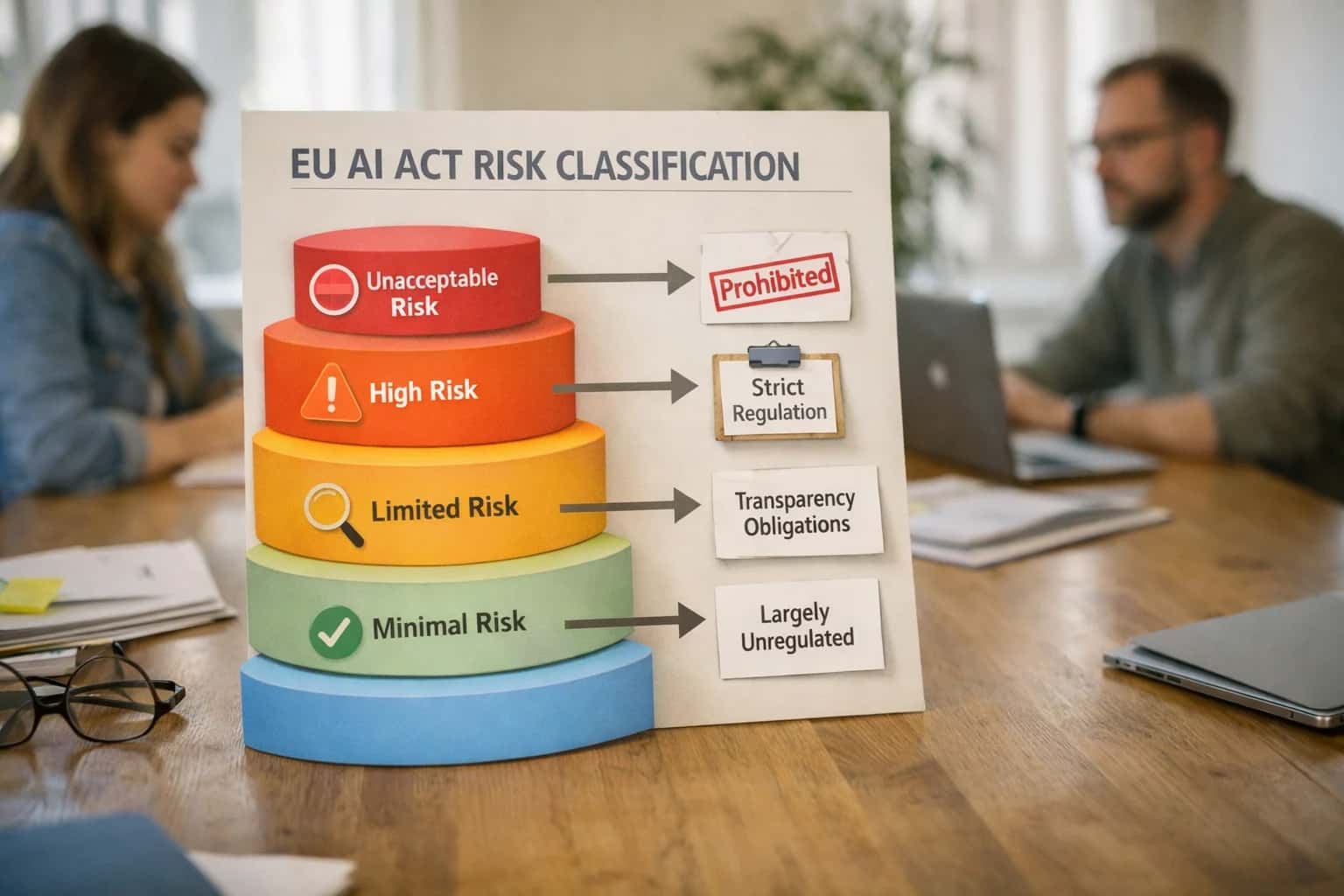
Human-in-the-Loop (HITL) contractual requirements excel at preserving due process and enabling meaningful appeals because they mandate a 'meaningful human review' gate before a final legal or beneficial decision is made. For example, the EU AI Act's Article 14 for high-risk systems requires human oversight capable of fully understanding the system's outputs and overriding them, effectively making a human operator a legally required component of the decision architecture.

Difference
Human-in-the-Loop Contractual Requirements vs Fully Automated Decision Clauses
A technical comparison for government procurement officers and legal teams evaluating contractual mandates for meaningful human review versus permitting fully automated AI decisions that affect citizens' rights and essential services.
THE ANALYSIS
Introduction
A foundational trade-off in public sector AI procurement is defining the boundary between automated efficiency and the constitutional or statutory right to human review.
Fully Automated Decision (FAD) clauses take a different approach by optimizing for speed, cost-efficiency, and scalability in high-volume, low-risk determinations. This strategy results in a trade-off where an agency can process millions of transactions, such as park permit approvals, with sub-second latency, but it creates a 'black-box' liability when applied to complex eligibility cases. The UK's 'Bridge' system for universal credit, which automates fraud detection, has faced legal challenges precisely because the lack of mandated human review in the initial decision loop raised questions of procedural fairness.
The key trade-off: If your priority is constitutional compliance and providing a defensible appeals path for high-stakes decisions like social security benefits or pretrial release, choose a HITL contractual mandate. If you prioritize operational throughput and cost reduction for non-adversarial, low-risk services like public library notifications or pothole reporting, a FAD clause with a clear, post-hoc appeals process is more appropriate.
HEAD-TO-HEAD COMPARISON
Contractual Clause Feature Matrix
Direct comparison of key metrics and features for Human-in-the-Loop (HITL) vs. Fully Automated Decision clauses in public sector AI procurement.
| Metric | Human-in-the-Loop (HITL) Clause | Fully Automated Decision Clause |
|---|---|---|
Citizen Right to Appeal | ||
Avg. Human Review Latency Added | < 24 hours | 0 ms |
Suitable for High-Risk Use Cases (EU AI Act) | ||
Vendor Liability for Erroneous Output | Shared (Human + Model) | Vendor Solely Liable |
Requires Meaningful Human Override Capability | ||
Operational Cost per Decision | $5.00 - $50.00 | $0.001 - $0.50 |
Scalability Ceiling | Limited by Reviewer Bandwidth | Virtually Unlimited |
Compliance with US Executive Order 14110 | Mandated for Safety-Critical | Requires Extensive Waiver |
Human-in-the-Loop vs. Full Automation
TL;DR Summary
Key strengths and trade-offs for contractual mandates on human review versus fully automated decision clauses in public sector AI.
01
Legal & Constitutional Safeguard
Specific advantage: Mandates meaningful human review, satisfying due process requirements under the EU AI Act Art. 14 and US Executive Order 14110. This matters for high-stakes decisions affecting citizens' legal rights or access to essential services like social benefits.
02
Operational Bottleneck & Cost
Specific trade-off: Introduces a human 'speed limit' on processing, with review queues often adding 24-48 hours to decision timelines. This matters for high-volume, low-risk determinations where speed of service delivery is a primary citizen expectation.
03
Scalability & Efficiency
Specific advantage: Enables near-instantaneous processing of high-volume, routine decisions (e.g., permit renewals, standard eligibility checks). This matters for agencies facing resource constraints and seeking to eliminate backlogs without proportional staff increases.
04
Accountability & Appeal Risk
Specific trade-off: Creates an 'accountability gap' where it's difficult to assign responsibility for erroneous or biased outcomes, increasing the risk of successful legal appeals. This matters for decisions where a clear, auditable rationale is required for judicial review.
HEAD-TO-HEAD COMPARISON
Cost and Operational Overhead Comparison
Direct comparison of key metrics and features for Human-in-the-Loop vs. Fully Automated Decision Clauses.
| Metric | Human-in-the-Loop (HITL) | Fully Automated |
|---|---|---|
Avg. Decision Latency | ~15 min (human review cycle) | < 400ms (API response) |
Cost per 1,000 Decisions | $250 - $500 (loaded labor) | $0.50 - $2.00 (compute) |
24/7 Operational Capability | ||
Scalability Ceiling | Limited by staffing (e.g., 50 decisions/hr/FTE) | Virtually unlimited (65,000+ TPS) |
Explainability for Appeals | High (human rationale documented) | Low (requires XAI tooling) |
Regulatory Alignment (EU AI Act) | Mandatory for 'High-Risk' Art. 14 | Permitted for non-high-risk only |
Error Rate Consistency | Variable (human fatigue factor) | Static (model drift dependent) |
CHOOSE YOUR PRIORITY
When to Choose HITL vs Fully Automated Clauses
Human-in-the-Loop for High-Stakes Decisions
Verdict: Mandatory. When AI decisions directly affect citizens' legal rights, benefits eligibility, or access to essential services, HITL is not just a best practice—it's a constitutional and regulatory requirement under frameworks like the EU AI Act's high-risk classification.
Key Contractual Requirements:
- Meaningful Review: The clause must mandate that a qualified human reviewer has the authority, competence, and time to override the AI's recommendation. Avoid 'rubber-stamp' HITL where the human merely confirms the AI output.
- Override Audit Trail: Require logging of every override decision, including the reviewer's rationale, to satisfy FOIA requests and appeals processes.
- Competency Standards: Specify the training and qualifications of human reviewers, referencing standards like NIST AI RMF's 'Human Oversight' category.
Fully Automated for High-Stakes Decisions
Verdict: Prohibited in most public sector contexts. Fully automated decisions that produce legal effects concerning citizens are explicitly restricted under GDPR Article 22 and the EU AI Act. For US agencies, Executive Order 14110 directs agencies to implement safeguards against automated harms.
Exception: Permissible only if explicitly authorized by law with suitable safeguards, such as automated tax refund calculations where the algorithm applies a clear, auditable formula with a robust appeals process.
Enabling Efficiency, Speed & Accuracy
Intelligent Analysis, Decision & Execution
We build AI systems for teams that need search across company data, workflow automation across tools, or AI features inside products and internal software.
Talk to Us
Search across company data
Give teams answers from docs, tickets, runbooks, and product data with sources and permissions.
Useful when people spend too long searching or get different answers from different systems.
Enterprise searchRAGPermissions
Read more
Automate internal workflows
Use AI to route work, draft outputs, trigger actions, and keep approvals and logs in place.
Useful when repetitive work moves across multiple tools and teams.
AI agentsWorkflow automationGovernance
Read more
Add AI to products and internal tools
Build assistants, guided actions, or decision support into the software your team or customers already use.
Useful when AI needs to be part of the product, not a separate tool.
AI integrationDecision supportModel routing
Read moreARCHITECTURAL COMPARISON
Technical Deep Dive: Meaningful Review and Override Architectures
A technical comparison of contractual and architectural patterns for human oversight in automated decision systems, focusing on the trade-offs between synchronous approval gates and asynchronous review mechanisms in public sector AI deployments.
A synchronous approval gate blocks the decision pipeline until a human explicitly approves or rejects the AI's recommendation. The system state is paused, and the citizen waits. An asynchronous review pattern allows the AI to execute the decision immediately but flags it for post-hoc human audit within a defined SLA (e.g., 24 hours). Synchronous gates prioritize safety and control at the cost of latency, while asynchronous patterns optimize for speed and throughput but introduce a window of uncorrected error. For high-stakes benefits eligibility, synchronous gates are contractually mandated; for low-risk permit renewals, asynchronous review often suffices.
THE ANALYSIS
Verdict
A data-driven comparison of contractual mandates for human oversight versus fully automated decision-making in public sector AI.
Human-in-the-Loop (HITL) contractual requirements excel at preserving due process and enabling algorithmic recourse because they mandate a meaningful human review before a final decision is made. For example, the EU AI Act's Article 14 for high-risk systems requires human oversight capable of fully understanding the system's outputs, and a Stanford HAI study found that jurisdictions with mandated HITL appeals processes saw a 40% reduction in successful litigation against automated benefits denials. This approach directly supports constitutional compliance and builds public trust by ensuring a citizen can contest a machine's logic.
Fully Automated Decision Clauses take a different approach by prioritizing operational efficiency and speed, permitting systems to make legally binding decisions without human intervention. This strategy results in a significant reduction in processing times—often from weeks to milliseconds—and can lower administrative costs by up to 80% for high-volume, low-complexity tasks like license plate renewals. However, this efficiency introduces a trade-off: it creates a 'black box' effect that can hinder an agency's ability to explain a decision during an appeal, potentially violating 'meaningful human review' standards under the GDPR and increasing the risk of undetected algorithmic bias at scale.
The key trade-off: If your priority is constitutional compliance, due process, and managing high-stakes decisions like social services eligibility or pretrial release, choose Human-in-the-Loop contractual requirements. If you prioritize operational efficiency and cost reduction for low-risk, high-volume administrative tasks where the legal right to appeal is clearly defined and easily accessible, choose Fully Automated Decision Clauses. Consider a hybrid model that uses automated systems for initial recommendations but contractually mandates a human override for all adverse actions to balance speed with accountability.

About the author
Prasad Kumkar
CEO & MD, Inference Systems
Prasad Kumkar is the CEO & MD of Inference Systems and writes about AI systems architecture, LLM infrastructure, model serving, evaluation, and production deployment. Over 5+ years, he has worked across computer vision models, L5 autonomous vehicle systems, and LLM research, with a focus on taking complex AI ideas into real-world engineering systems.
His work and writing cover AI systems, large language models, AI agents, multimodal systems, autonomous systems, inference optimization, RAG, evaluation, and production AI engineering.
LinkedIn
Limited slotsGet a Free AI Consultation
Partnered with leading AI, data, and software stack.





How We Work
Custom AI workflows for your Business
One-fit-all AI don't work for modern businesses. At Inferensys, we aim to understand your business & custom requirements; which we use to define most efficient agentic workflows, the data, and the tools for your business.
01
Review the use case
We understand the task, the users, and where AI can actually help.
Read more02
Pick the right approach
We define what needs search, automation, or product integration.
Read more03
Build the first useful version
We implement the part that proves the value first.
Read more04
Improve from there
We add the checks and visibility needed to keep it useful.
Read moreThe first call is a practical review of your use case and the right next step.
Talk to Us