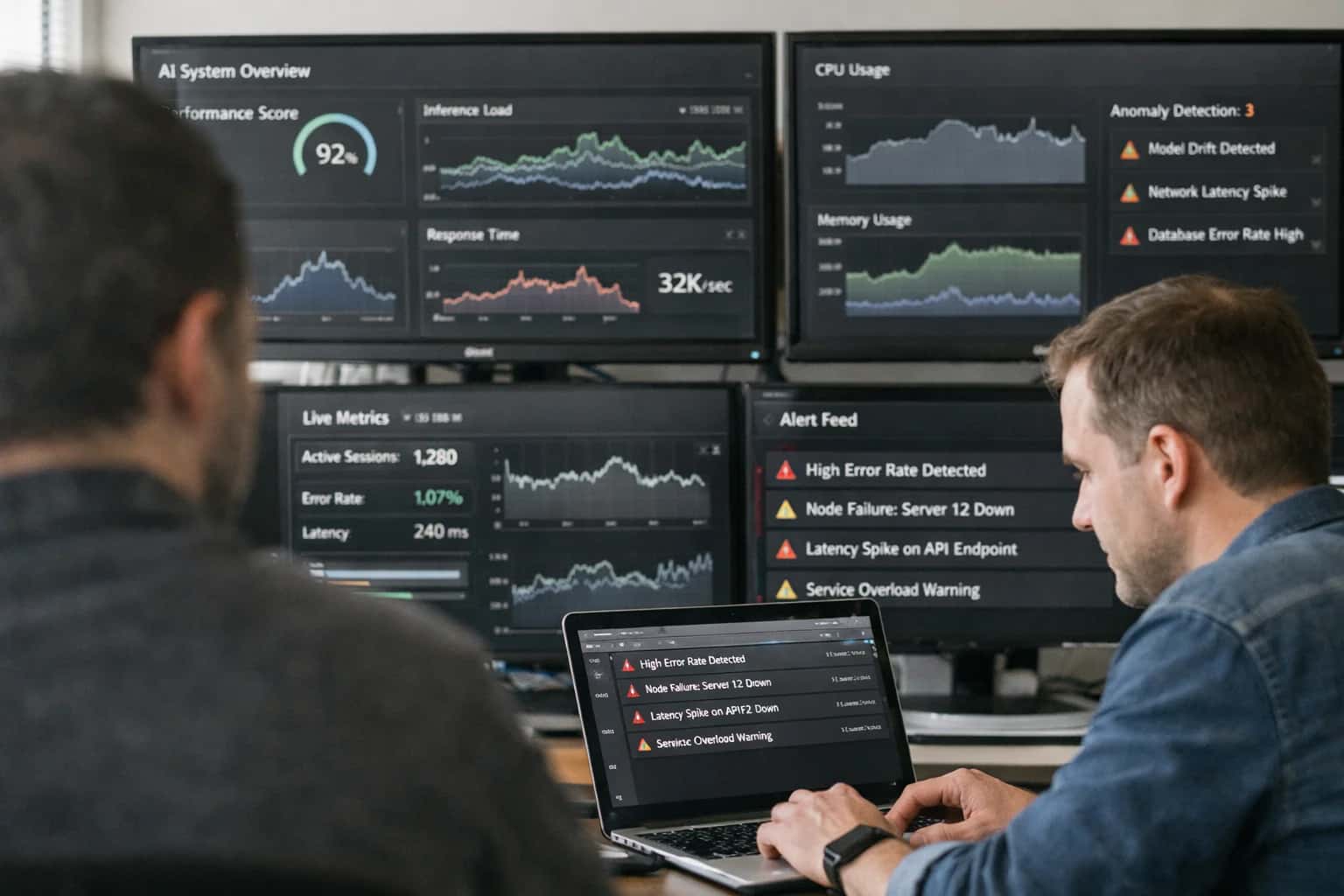
Continuous Algorithmic Monitoring excels at providing real-time operational assurance by tracking model drift, fairness metrics, and performance degradation in production. For example, a benefits eligibility model might silently develop a 15% disparate impact against a protected group due to a seasonal population shift, a failure that continuous monitoring would detect within hours, not months.

Difference
Continuous Algorithmic Monitoring vs Point-in-Time Certification
A technical comparison for government procurement officers evaluating ongoing, real-time AI monitoring against one-time deployment audits. Covers drift detection, lifecycle costs, and regulatory alignment with NIST AI RMF and EU AI Act mandates.
THE ANALYSIS
Introduction
A foundational trade-off between static validation and dynamic assurance for public sector AI systems.
Point-in-Time Certification takes a fundamentally different approach by providing a rigorous, static audit at a specific deployment milestone. This results in a clear, defensible compliance artifact suitable for procurement acceptance, but it creates a 'snapshot' that becomes increasingly stale as live data diverges from the training set.
The key trade-off: If your priority is maintaining ongoing constitutional compliance and detecting silent model failures in dynamic environments like social services, choose continuous monitoring. If you prioritize a formal, certifiable governance gate for initial procurement and vendor acceptance, choose point-in-time certification. A mature public sector strategy often layers a point-in-time certification as a deployment prerequisite with continuous monitoring as a lifecycle safety net.
HEAD-TO-HEAD COMPARISON
Feature Comparison
Direct comparison of key metrics and features for Continuous Algorithmic Monitoring vs Point-in-Time Certification.
| Metric | Continuous Algorithmic Monitoring | Point-in-Time Certification |
|---|---|---|
Detection of Post-Deployment Drift | ||
Real-Time Fairness Metric Tracking | ||
Regulatory Audit Readiness (EU AI Act) | Continuous log of compliance state | Static report valid only at time of issue |
Time to Detect Critical Performance Drop | < 1 hour (automated alerts) | 3-12 months (next audit cycle) |
Integration with MLOps/LLMOps Pipelines | Native API/SDK hooks for real-time telemetry | Manual evidence collection for review |
Suitability for High-Risk Autonomous Agents | Essential for governing agentic decisions | Insuffient for dynamic tool-use risks |
Initial Setup Complexity | High (requires infrastructure integration) | Low (documentation-centric assessment) |
Long-Term Cost Profile | Recurring (compute + platform licensing) | Periodic (consulting/auditor fees per cycle) |
Continuous Monitoring vs Point-in-Time Certification
TL;DR Summary
Key strengths and trade-offs at a glance for public sector AI governance.
01
Pro: Continuous Monitoring
Real-time drift detection: Catches model decay, fairness degradation, and data quality issues as they happen, not months later. This matters for high-stakes citizen services where a single biased decision can trigger legal liability. Tools like Arize and WhyLabs can alert teams within minutes of a performance drop, enabling immediate rollback.
02
Pro: Continuous Monitoring
Lifecycle risk management: Aligns with NIST AI RMF's 'Monitor' function by tracking the AI system across its entire operational lifespan. This matters for agencies needing to demonstrate ongoing due diligence to oversight bodies, not just a clean bill of health at launch. Provides an audit trail for every model version and prediction.
03
Pro: Point-in-Time Certification
Clear procurement gate: Provides a definitive, pass/fail compliance artifact that procurement officers can attach to a contract award. This matters for RFPs requiring a specific ISO/IEC 42001 certification or an Algorithmic Impact Assessment sign-off before a vendor can go live. It simplifies the initial 'buy vs. build' decision.
04
Pro: Point-in-Time Certification
Lower operational overhead: Does not require the continuous investment in MLOps infrastructure, monitoring engineers, or 24/7 on-call rotations. This matters for smaller agencies or those deploying low-risk, stable models where the cost of continuous monitoring outweighs the risk of silent failure. A one-time audit is often cheaper and simpler to staff.
05
Con: Continuous Monitoring
High infrastructure cost: Requires a dedicated observability stack, integration engineering, and ongoing human review of alerts. For a single model, the tooling cost can exceed the model's development cost. This matters for agencies with flat IT budgets that cannot absorb new SaaS subscriptions for every deployed algorithm.
06
Con: Point-in-Time Certification
Snapshot fallacy: A model certified as 'fair and accurate' in January can be dangerously biased by March due to population drift or adversarial inputs. This matters for dynamic systems like benefits eligibility, where economic shifts rapidly invalidate the original test data. It creates a false sense of security and a legal liability gap between audits.
HEAD-TO-HEAD COMPARISON
Cost Analysis
Direct comparison of key metrics and features for Continuous Algorithmic Monitoring vs Point-in-Time Certification.
| Metric | Continuous Algorithmic Monitoring | Point-in-Time Certification |
|---|---|---|
Total Cost of Ownership (3-Year) | $450,000 - $750,000 | $80,000 - $150,000 |
Upfront Implementation Cost | $50,000 - $100,000 | $60,000 - $120,000 |
Annual Recurring Cost | $120,000 - $200,000 | $5,000 - $10,000 |
Cost per Model Monitored/Year | $15,000 - $25,000 | $20,000 - $40,000 (per audit) |
Remediation Cost Avoidance | High (proactive drift correction) | Low (reactive, post-failure) |
Compliance Violation Risk | Low (continuous evidence) | High (snapshot-in-time) |
Infrastructure Overhead | Significant (real-time pipelines) | Minimal (document review) |
Vendor Lock-in Risk | High (proprietary platforms) | Low (standard audit firms) |
Contender A Pros
Pros and Cons of Continuous Algorithmic Monitoring
Key strengths and trade-offs at a glance.
01
Real-Time Drift Detection Prevents Silent Failures
Specific advantage: Continuous monitoring detects model drift, data skew, and concept drift within minutes of deployment, not months later during a scheduled audit. This matters for high-stakes public services like benefits eligibility, where a silent model degradation can unlawfully deny thousands of citizens' claims before a point-in-time certification catches it.
02
Enables Dynamic Fairness and Bias Guardrails
Specific advantage: Unlike a one-time fairness audit, continuous monitoring evaluates every prediction for disparate impact across protected groups in real time. This matters for criminal justice and social services applications, where demographic patterns shift seasonally and a static certification from January may be invalid by March.
03
Supports Regulatory Compliance with the EU AI Act
Specific advantage: The EU AI Act's high-risk provisions mandate ongoing post-market monitoring (Article 61) and serious incident reporting. Continuous monitoring generates the audit-ready logs and automated alerts required for compliance. This matters for any government agency procuring AI systems that must demonstrate 'continuous conformity' rather than a single certification snapshot.
CHOOSE YOUR PRIORITY
When to Use Continuous Monitoring vs Point-in-Time Certification
Continuous Monitoring for Procurement
Strengths: Mandates vendor accountability for the entire AI lifecycle, not just at deployment. This is critical for high-risk use cases like benefits eligibility or recidivism prediction where model drift can directly violate citizen rights. It shifts the contract from a one-time 'acceptance test' to an ongoing 'service level agreement' for fairness and accuracy.
Key Clause: Requires vendor to provide real-time drift dashboards and automated alerts for bias metrics, integrated into the agency's Algorithmic Impact Assessment Tools framework.
Point-in-Time Certification for Procurement
Strengths: Provides a clear, auditable 'gate' before a system goes live. This is easier to write into an RFP as a definitive deliverable and aligns with traditional software acceptance milestones. It's sufficient for low-risk, internally facing tools where the data distribution is static.
Key Clause: Requires a certified audit report from a qualified third-party firm against a specific standard (e.g., NIST AI RMF) before final payment, but may lack teeth for post-deployment issues.
Enabling Efficiency, Speed & Accuracy
Intelligent Analysis, Decision & Execution
We build AI systems for teams that need search across company data, workflow automation across tools, or AI features inside products and internal software.
Talk to Us
Search across company data
Give teams answers from docs, tickets, runbooks, and product data with sources and permissions.
Useful when people spend too long searching or get different answers from different systems.
Enterprise searchRAGPermissions
Read more
Automate internal workflows
Use AI to route work, draft outputs, trigger actions, and keep approvals and logs in place.
Useful when repetitive work moves across multiple tools and teams.
AI agentsWorkflow automationGovernance
Read more
Add AI to products and internal tools
Build assistants, guided actions, or decision support into the software your team or customers already use.
Useful when AI needs to be part of the product, not a separate tool.
AI integrationDecision supportModel routing
Read moreTHE ANALYSIS
Verdict
A final, data-driven comparison to help procurement officers decide between continuous monitoring and point-in-time certification for high-stakes public sector AI.
Continuous Algorithmic Monitoring excels at maintaining long-term safety and public trust because it provides a real-time defense against model drift, data poisoning, and emergent bias. For example, a continuous monitoring platform can detect a 5% accuracy drop in a benefits eligibility model within hours of a demographic shift, triggering an automatic rollback or human review. This approach aligns with the NIST AI RMF's 'Monitor' function and is critical for high-risk systems under the EU AI Act, where ongoing performance logging is a legal requirement, not just a best practice.
Point-in-Time Certification takes a different approach by providing a definitive, auditable snapshot of an AI system's safety and fairness at a specific version. This results in a clear, contractually defensible artifact that simplifies procurement acceptance and vendor sign-off. For instance, a certified model card generated at deployment can serve as a powerful piece of evidence for an initial Algorithmic Impact Assessment. However, this static assurance decays immediately as the real world changes, leaving agencies exposed to 'silent failures' that won't be caught until the next scheduled audit cycle, which could be a year or more away.
The key trade-off: If your priority is managing dynamic, long-term risk and ensuring continuous compliance with frameworks like the EU AI Act, choose continuous monitoring. If you prioritize a clear, defensible procurement milestone and a one-time, auditable proof of safety for a stable, low-risk system, choose point-in-time certification. For most high-stakes public sector applications, a hybrid model—using certification as a deployment gate and continuous monitoring as an operational safety net—is the emerging standard for responsible AI governance.
Continuous Monitoring vs. Point-in-Time Certification
Expertise Showcase
A side-by-side comparison of strengths for each approach to AI governance in the public sector.
01
Real-Time Drift & Anomaly Detection
Specific advantage: Continuous monitoring platforms can detect model drift, data skew, and performance degradation within hours or minutes of occurrence. This matters for high-frequency citizen services like benefits eligibility or traffic management, where a silent model failure over a weekend could impact thousands of decisions. Point-in-time certification only validates the model's state at a single historical moment, offering no protection against post-deployment decay.
02
Regulatory Compliance for High-Risk Systems
Specific advantage: The EU AI Act's high-risk classification and NIST AI RMF 1.0 explicitly require ongoing monitoring and corrective action. Continuous monitoring provides the audit-ready telemetry needed to demonstrate compliance during an investigation. This matters for agencies under sovereign AI mandates, where proving continuous control is a legal necessity, not just a best practice.
03
Clear, Defensible Procurement Milestone
Specific advantage: A point-in-time certification provides a definitive, binary acceptance criterion for a vendor deliverable. The model either passes the fairness and accuracy audit or it doesn't. This matters for procurement officers who need a clean, legally defensible sign-off to close a contract and authorize payment, avoiding the ambiguity of "ongoing" obligations.
04
Lower Initial Technical Overhead
Specific advantage: Certification requires no persistent infrastructure, logging pipelines, or real-time alerting systems. A one-time audit can be conducted with static datasets and offline tools. This matters for smaller agencies or pilot programs deploying a low-risk, internal tool where the cost and complexity of a full monitoring stack would outweigh the marginal safety benefit.

About the author
Prasad Kumkar
CEO & MD, Inference Systems
Prasad Kumkar is the CEO & MD of Inference Systems and writes about AI systems architecture, LLM infrastructure, model serving, evaluation, and production deployment. Over 5+ years, he has worked across computer vision models, L5 autonomous vehicle systems, and LLM research, with a focus on taking complex AI ideas into real-world engineering systems.
His work and writing cover AI systems, large language models, AI agents, multimodal systems, autonomous systems, inference optimization, RAG, evaluation, and production AI engineering.
LinkedIn
Limited slotsGet a Free AI Consultation
Partnered with leading AI, data, and software stack.





How We Work
Custom AI workflows for your Business
One-fit-all AI don't work for modern businesses. At Inferensys, we aim to understand your business & custom requirements; which we use to define most efficient agentic workflows, the data, and the tools for your business.
01
Review the use case
We understand the task, the users, and where AI can actually help.
Read more02
Pick the right approach
We define what needs search, automation, or product integration.
Read more03
Build the first useful version
We implement the part that proves the value first.
Read more04
Improve from there
We add the checks and visibility needed to keep it useful.
Read moreThe first call is a practical review of your use case and the right next step.
Talk to Us