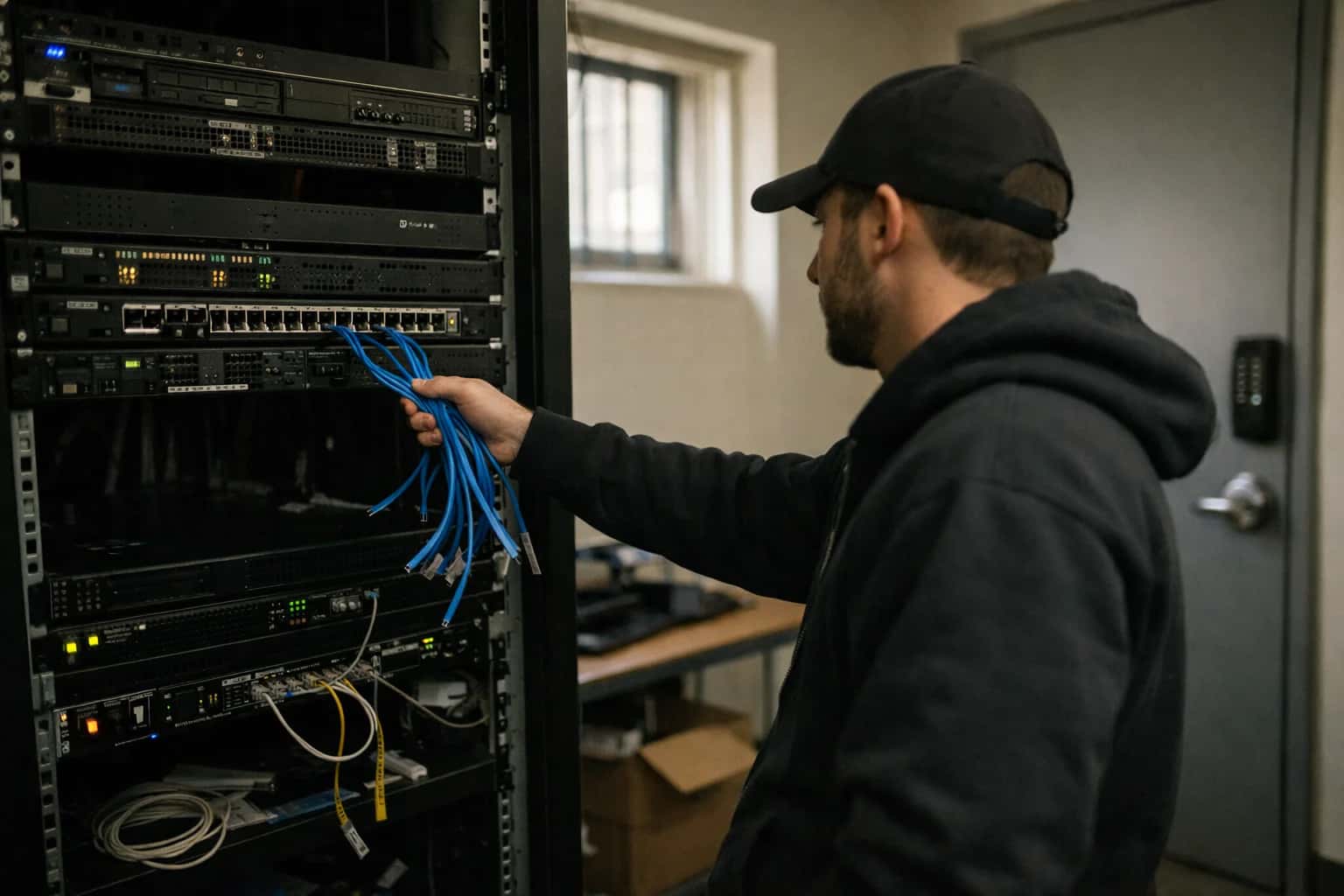
Air-gapped LLM inference excels at eliminating network-borne exfiltration risk because it operates on infrastructure with no physical or logical connection to unsecured networks. For example, the U.S. Department of Defense's 'Project Maven' and similar classified programs mandate true air-gapped environments, where model updates require a 'sneakernet'—physically transporting storage media—to ensure an attack surface of effectively zero for remote data theft.

Difference
Air-Gapped LLM Inference vs VPC-Hosted LLM Inference for Classified Data
A technical comparison of fully disconnected and logically isolated architectures for running AI on classified government data, focusing on security posture, operational overhead, and model lifecycle management.
THE ANALYSIS
Introduction
A foundational comparison of physical network isolation versus logical cloud isolation for running AI on classified government data.
VPC-hosted LLM inference takes a different approach by creating a logically isolated, software-defined boundary within a shared cloud infrastructure. This results in significantly lower operational overhead for model updates and scalability, as engineers can push new model weights and patches via private gateways without physical site access. The trade-off is a residual risk of misconfiguration, such as an improperly secured S3 bucket or IAM role, which can inadvertently expose classified data to the public internet.
The key trade-off: If your priority is an absolute, mathematically provable air gap for the highest classification levels (e.g., TOP SECRET/SCI), choose an air-gapped architecture. If you prioritize operational agility, continuous model improvement, and lower infrastructure costs for sensitive but not compartmented data, choose a VPC-hosted model with enhanced CSPM and IAM controls.
HEAD-TO-HEAD COMPARISON
Architectural Security Feature Matrix
Direct comparison of key architectural security and operational metrics for deploying LLMs on classified data.
| Metric | Air-Gapped LLM Inference | VPC-Hosted LLM Inference |
|---|---|---|
Data Exfiltration Risk | Near-Zero (Physical Isolation) | Low (Logical Isolation) |
Model Update Mechanism | Manual Sneakernet / Offline Transfer | Automated CI/CD Pipeline |
Operational Burden | High (Physical Access, Hardware) | Low (Managed Cloud Service) |
Network Connectivity | ||
Compliance Fit | ITAR, Top Secret / SCI | FedRAMP High, NIST 800-53 |
Inference Latency (p50) | < 50ms (Local GPU) | < 200ms (Network Dependent) |
Hardware Scalability | Fixed (CapEx Constrained) | Elastic (OpEx Driven) |
Air-Gapped vs. VPC-Hosted
TL;DR Summary
A direct comparison of fully disconnected network architectures against logically isolated virtual private clouds for running AI workloads on classified or sensitive government information.
01
Air-Gapped: Maximum Security, Maximum Friction
Absolute data isolation: No physical or logical connection to external networks, eliminating remote exfiltration risk. This is the gold standard for Top Secret/SCI data and critical national security functions. However, this comes at the cost of high operational burden: model updates require manual 'sneakernet' transfers, patching is slow, and scalability is limited by on-prem hardware. Choose this when a data breach is an existential threat.
02
Air-Gapped: The Update Desert
Stale intelligence risk: Without internet access, models cannot receive real-time threat intelligence feeds or continuous updates. A model deployed in an air-gapped environment is a frozen snapshot of its training data, potentially missing new attack vectors or geopolitical shifts. The mean time to update (MTTU) is measured in weeks or months, not hours. This creates a significant operational disadvantage for dynamic mission sets.
03
VPC-Hosted: Agile, But a Shared Responsibility
Near-cloud agility with a secure perimeter: A logically isolated VPC offers the elasticity of cloud compute, enabling rapid scaling and continuous model updates via controlled egress points. This is ideal for Secret/NOFORN data where FedRAMP High or equivalent controls are acceptable. The trade-off is a residual exfiltration risk from misconfigured security groups, IAM roles, or insider threats, demanding rigorous cloud security posture management (CSPM).
04
VPC-Hosted: The Configuration Minefield
Complexity is the enemy of security: A VPC's security depends on perfect configuration of network ACLs, flow logs, and endpoint policies. A single misconfigured S3 bucket or an overly permissive NAT gateway can create a data exfiltration pathway. The operational burden shifts from physical logistics to continuous compliance monitoring and DevSecOps maturity. This model is only as secure as the team managing it.
HEAD-TO-HEAD COMPARISON
Total Cost of Ownership Analysis
Direct comparison of key financial and operational metrics for running LLM inference on classified data.
| Metric | Air-Gapped LLM Inference | VPC-Hosted LLM Inference |
|---|---|---|
Data Exfiltration Risk | Near-Zero (Physical Isolation) | Low (Logical Isolation) |
3-Year Infrastructure Cost (Est.) | $2.5M - $4M+ (Dedicated Hardware) | $800K - $1.5M (Shared/Reserved) |
Model Update Mechanism | Manual Sneakernet / Data Diode | Automated CI/CD Pipeline |
Compliance with Sovereign Mandates | ||
Operational Burden (FTE Required) | 3-5 FTE (Specialized) | 1-2 FTE (Standard CloudOps) |
Time to Deploy New Model | 2-4 Weeks | < 1 Hour |
Scalability Ceiling | Fixed (Physical GPU Limit) | Elastic (Cloud Bursting) |
OPERATIONAL ARCHITECTURE
Technical Deep Dive: Model Updates and Data Flow
The fundamental divergence between air-gapped and VPC-hosted inference lies in how models are updated and how data traverses security boundaries. This section examines the operational burden, latency implications, and residual exfiltration risks associated with each architecture.
Model updates require a manual, offline 'sneakernet' process. New model weights, typically delivered on encrypted physical media (FIPS 140-2 certified drives), must be physically transported into the secure facility. A designated System Administrator performs integrity verification (SHA-256 checksums) on a staging machine before transferring the blob to the inference cluster. This process introduces a 72-hour to 2-week latency for critical security patches. In contrast, VPC-hosted models can be updated via controlled CI/CD pipelines in minutes, but this connectivity introduces a vector for supply-chain attacks.
Enabling Efficiency, Speed & Accuracy
Intelligent Analysis, Decision & Execution
We build AI systems for teams that need search across company data, workflow automation across tools, or AI features inside products and internal software.
Talk to Us
Search across company data
Give teams answers from docs, tickets, runbooks, and product data with sources and permissions.
Useful when people spend too long searching or get different answers from different systems.
Enterprise searchRAGPermissions
Read more
Automate internal workflows
Use AI to route work, draft outputs, trigger actions, and keep approvals and logs in place.
Useful when repetitive work moves across multiple tools and teams.
AI agentsWorkflow automationGovernance
Read more
Add AI to products and internal tools
Build assistants, guided actions, or decision support into the software your team or customers already use.
Useful when AI needs to be part of the product, not a separate tool.
AI integrationDecision supportModel routing
Read moreCHOOSE YOUR PRIORITY
Decision Guide by Persona
Air-Gapped for Security Architects
Verdict: The gold standard for classified data, but operationally heavy.
Strengths:
- Physical Network Isolation: Eliminates remote exfiltration vectors entirely. Data never touches a routable network.
- Sneakernet Updates: Model weights and patches are transferred via controlled physical media, providing a definitive audit trail.
- Residual Risk: Near-zero for network-based attacks, shifting the threat model entirely to insider threats and physical access.
Weaknesses:
- Model Drift: Models become stale quickly without automated updates, creating a 'brittleness' risk for citizen-facing applications.
- Operational Burden: Requires on-site personnel for maintenance, patching, and data ingress/egress, significantly increasing TCO.
VPC-Hosted for Security Architects
Verdict: The pragmatic choice for 'sensitive but unclassified' workloads requiring agility.
Strengths:
- Logical Isolation: AWS GovCloud or Azure Government provides strong cryptographic isolation with FedRAMP High authorization.
- Continuous Delivery: Supports CI/CD pipelines for model updates, fine-tuning, and security patches without physical intervention.
- Native Services: Integrates with cloud-native key management (KMS), logging, and threat detection, reducing manual security overhead.
Weaknesses:
- Shared Responsibility: Misconfigurations in security groups or IAM policies are the primary cause of data exposure.
- Residual Risk: Advanced persistent threats (APTs) targeting the hypervisor or side-channel attacks remain a theoretical concern.
THE ANALYSIS
Verdict
A data-driven breakdown of the operational, security, and cost trade-offs between air-gapped and VPC-hosted inference for classified workloads.
Air-gapped inference provides the highest assurance of data isolation by creating a physical 'impossible-to-breach' boundary. This architecture eliminates the risk of network-based exfiltration, making it the only viable option for Top Secret or SCI-level data. However, this security comes at a steep operational cost: model updates require a manual 'sneakernet' process, often involving physically transferring drives from a connected staging environment, which can delay critical model patches by days or weeks. The total cost of ownership is also significantly higher, often requiring dedicated, non-virtualized hardware stacks.
VPC-hosted inference offers a more agile and cost-effective alternative by using logically isolated, encrypted network segments within a shared cloud infrastructure. This approach allows for automated CI/CD pipelines for model updates, enabling teams to deploy fine-tuned models or security patches in near real-time. The primary trade-off is a residual risk of misconfiguration; a single erroneous firewall rule or a compromised IAM role can theoretically expose the environment, making it suitable for Secret-level data but often insufficient for the most sensitive compartmentalized information without additional overlay controls.
The key trade-off: If your priority is an absolute, mathematically provable boundary for classified data and you can absorb high operational friction and cost, choose an air-gapped architecture. If you prioritize agility, scalability, and lower total cost of ownership for sensitive but not strictly compartmentalized data, a VPC-hosted model with a zero-trust overlay is the pragmatic choice. For many government agencies, a hybrid model—air-gapped for the most sensitive inference and VPC for less critical workloads—provides the optimal balance of security and operational efficiency.

About the author
Prasad Kumkar
CEO & MD, Inference Systems
Prasad Kumkar is the CEO & MD of Inference Systems and writes about AI systems architecture, LLM infrastructure, model serving, evaluation, and production deployment. Over 5+ years, he has worked across computer vision models, L5 autonomous vehicle systems, and LLM research, with a focus on taking complex AI ideas into real-world engineering systems.
His work and writing cover AI systems, large language models, AI agents, multimodal systems, autonomous systems, inference optimization, RAG, evaluation, and production AI engineering.
LinkedIn
Limited slotsGet a Free AI Consultation
Partnered with leading AI, data, and software stack.





How We Work
Custom AI workflows for your Business
One-fit-all AI don't work for modern businesses. At Inferensys, we aim to understand your business & custom requirements; which we use to define most efficient agentic workflows, the data, and the tools for your business.
01
Review the use case
We understand the task, the users, and where AI can actually help.
Read more02
Pick the right approach
We define what needs search, automation, or product integration.
Read more03
Build the first useful version
We implement the part that proves the value first.
Read more04
Improve from there
We add the checks and visibility needed to keep it useful.
Read moreThe first call is a practical review of your use case and the right next step.
Talk to Us