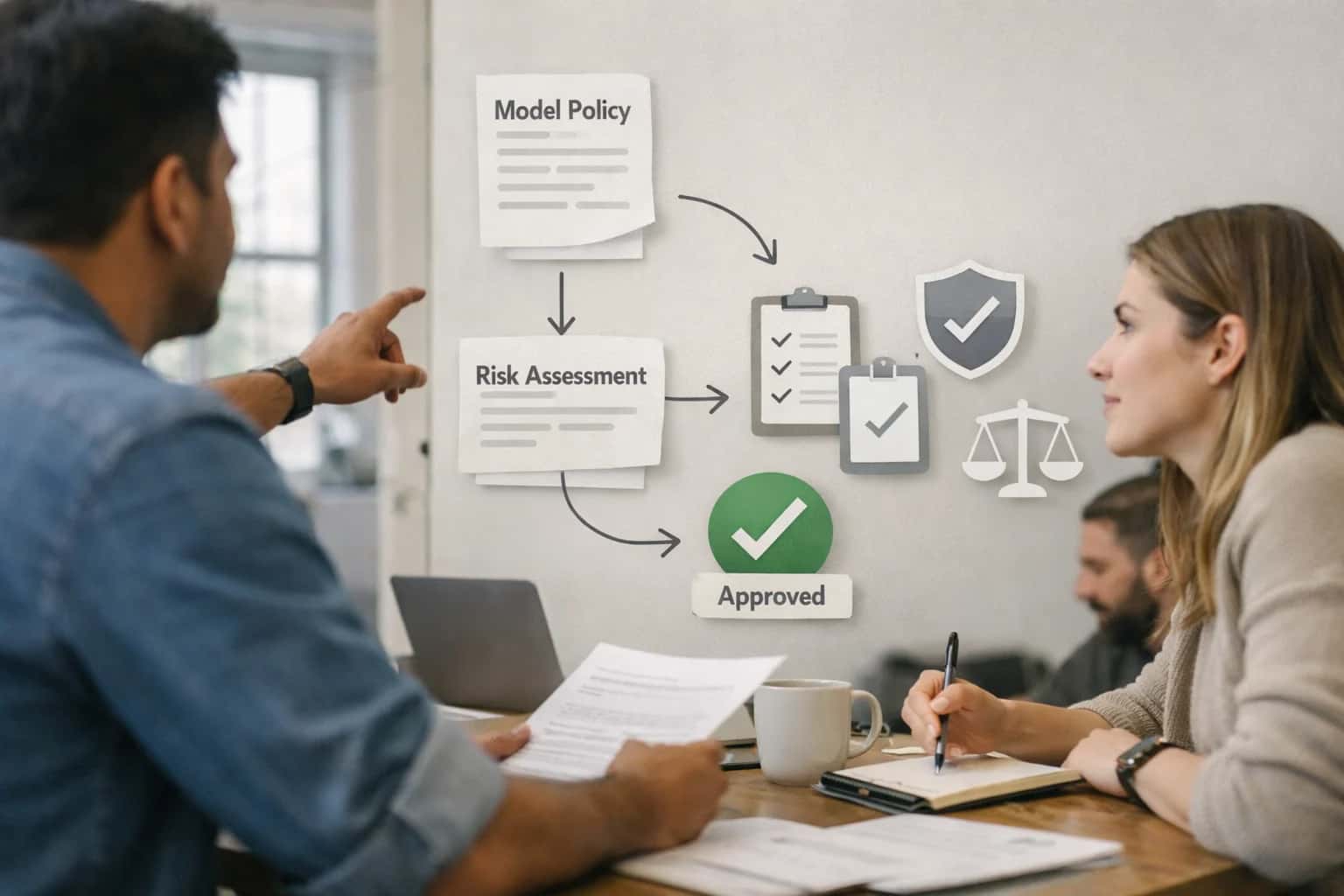
[Public Sector AI Procurement Frameworks] excel at establishing sovereign control before a contract is signed. These frameworks embed specific AI contract clauses, data residency requirements, and algorithmic transparency mandates directly into the Request for Proposal (RFP) process. For example, the World Economic Forum's AI Procurement in a Box toolkit has been piloted to help governments pre-define 'explainability' and 'bias testing' as pass/fail criteria, effectively shifting the compliance burden onto the vendor before any tax dollars are spent.

Difference
Public Sector AI Procurement Frameworks vs Vendor AI Governance Maturity Assessment
A tactical comparison for government procurement officers evaluating sovereign AI contract clauses and acquisition compliance against the depth of vendor governance maturity assessments during public sector AI acquisition.
THE ANALYSIS
Introduction
A comparison of proactive government procurement frameworks against reactive vendor governance assessments for public sector AI acquisition.
[Vendor AI Governance Maturity Assessment] takes a different approach by evaluating the vendor's internal processes and culture rather than just the product's features. This strategy assesses the maturity of a vendor's AI development lifecycle, including their model risk management, adversarial testing frequency, and adherence to standards like ISO/IEC 42001. This results in a deeper understanding of long-term viability but often occurs reactively during a security review, rather than proactively shaping the acquisition.
The key trade-off: If your priority is immediate, legally binding compliance with sovereign AI mandates and data localization, choose a structured Procurement Framework to gatekeep vendors at the door. If you prioritize the long-term safety culture and operational resilience of a vendor's AI supply chain, invest in a Vendor Governance Maturity Assessment to evaluate their internal engineering integrity.
HEAD-TO-HEAD COMPARISON
Feature Comparison
Direct comparison of key metrics and features for evaluating AI solutions during public sector procurement.
| Metric | Public Sector AI Procurement Frameworks | Vendor AI Governance Maturity Assessment |
|---|---|---|
Primary Focus | Contractual compliance & sovereign clauses | Vendor's internal governance maturity |
Evaluation Trigger | Pre-award / Acquisition phase | Pre-award / Vendor due diligence |
Sovereign Data Residency | ||
NIST AI RMF Alignment | ||
ISO/IEC 42001 Certification | ||
Algorithmic Bias Audit | Mandates external audit rights | Reviews internal audit process maturity |
FOIA/Transparency Readiness |
Procurement Frameworks vs. Vendor Maturity
TL;DR Summary
A side-by-side look at the strengths of each approach to help public sector teams decide where to focus their AI acquisition diligence.
01
Standardized, Repeatable Compliance
Specific advantage: Public Sector AI Procurement Frameworks embed sovereign AI contract clauses (e.g., data residency, IP indemnification) directly into RFPs. This creates a uniform, legally-binding baseline that every vendor must meet, simplifying the evaluation of 50+ bids. This matters for procurement officers who need to defend acquisition decisions to auditors and legislative bodies.
02
Sovereign Mandate Enforcement
Specific advantage: Frameworks are purpose-built to enforce jurisdictional requirements like the EU AI Act's high-risk provisions or NIST AI RMF 1.0 profiles. They translate policy into pass/fail technical requirements (e.g., 'model must be trainable on air-gapped infrastructure'). This matters for national digital strategy leads ensuring AI systems do not create unconstitutional or extraterritorial legal risks.
03
Deep Technical Due Diligence
Specific advantage: Vendor AI Governance Maturity Assessments go beyond a checklist to evaluate the actual operational rigor of a vendor's AI lifecycle—examining their model card accuracy, adversarial testing frequency, and data lineage tooling. A mature vendor might demonstrate a 99.5% success rate in reproducing model outputs for audit trails. This matters for agency CTOs who need to trust that a vendor's 'black box' won't fail in a high-stakes citizen service scenario.
04
Innovation and Best-Practice Adoption
Specific advantage: Maturity assessments reward vendors who invest in cutting-edge governance, such as automated bias detection suites or continuous runtime monitoring agents. This allows agencies to identify and partner with vendors whose internal practices exceed the minimum legal standard, future-proofing the solution. This matters for digital service teams seeking best-in-class partners, not just the lowest compliant bidder.
Enabling Efficiency, Speed & Accuracy
Intelligent Analysis, Decision & Execution
We build AI systems for teams that need search across company data, workflow automation across tools, or AI features inside products and internal software.
Talk to Us
Search across company data
Give teams answers from docs, tickets, runbooks, and product data with sources and permissions.
Useful when people spend too long searching or get different answers from different systems.
Enterprise searchRAGPermissions
Read more
Automate internal workflows
Use AI to route work, draft outputs, trigger actions, and keep approvals and logs in place.
Useful when repetitive work moves across multiple tools and teams.
AI agentsWorkflow automationGovernance
Read more
Add AI to products and internal tools
Build assistants, guided actions, or decision support into the software your team or customers already use.
Useful when AI needs to be part of the product, not a separate tool.
AI integrationDecision supportModel routing
Read moreCHOOSE YOUR PRIORITY
When to Choose Which Approach
Public Sector AI Procurement Frameworks for Acquisition Teams
Strengths: Provides legally binding contract clauses, sovereign compliance checklists, and mandatory transparency requirements. Frameworks like the EU's AI Act procurement guidelines or the US Executive Order 14110 acquisition rules give you pre-negotiated terms for data residency, algorithmic auditing, and vendor liability. This is essential when you need to ensure taxpayer-funded AI systems meet constitutional and statutory obligations before a single dollar is spent.
Vendor AI Governance Maturity Assessment for Acquisition Teams
Strengths: Offers a dynamic, risk-based view of a vendor's actual operational maturity—not just their contractual promises. Assessments based on NIST AI RMF or ISO/IEC 42001 evaluate whether a vendor has real model risk management, bias testing pipelines, and incident response plans in place. This is critical for distinguishing between vendors who 'check the box' on compliance and those who have genuinely operationalized responsible AI.
Verdict: Use Procurement Frameworks as your mandatory gate for all RFPs to set the floor. Layer on Vendor Maturity Assessments during technical evaluation to differentiate between compliant vendors and truly mature partners.
THE ANALYSIS
Verdict
A direct comparison of proactive procurement frameworks versus reactive vendor maturity assessments for public sector AI acquisition.
[Public Sector AI Procurement Frameworks] excel at establishing sovereign control before a contract is signed. By embedding specific AI governance requirements—such as mandatory NIST AI RMF alignment, data residency clauses, and algorithmic transparency mandates—directly into RFPs and contract terms, agencies create a legally enforceable baseline. This approach prevents 'black box' vendor lock-in and ensures that public trust and constitutional compliance are non-negotiable from day one. For example, a framework might require vendors to submit a model card and pass an algorithmic impact assessment as a condition of payment, shifting the compliance burden to the supplier.
[Vendor AI Governance Maturity Assessment] takes a different approach by evaluating the vendor's internal processes, culture, and technical infrastructure for responsible AI. Instead of dictating specific contract clauses, this method scores vendors on their existing governance maturity—such as their internal red-teaming practices, bias auditing cadence, and ISO/IEC 42001 certification status. This results in a more flexible partnership but carries the trade-off of relying on the vendor's self-attested controls, which may not perfectly align with specific sovereign mandates or the unique risk appetite of a public agency.
The key trade-off: If your priority is enforcing strict, legally-binding compliance with sovereign AI mandates and public law, choose a Public Sector AI Procurement Framework. If you prioritize evaluating the holistic, long-term trustworthiness and internal safety culture of a vendor for a collaborative development project, choose a Vendor AI Governance Maturity Assessment. For high-risk citizen-facing systems, the procurement framework's hard legal teeth are often non-negotiable, while maturity assessments are better suited for evaluating partners for internal, lower-risk productivity tools.

About the author
Prasad Kumkar
CEO & MD, Inference Systems
Prasad Kumkar is the CEO & MD of Inference Systems and writes about AI systems architecture, LLM infrastructure, model serving, evaluation, and production deployment. Over 5+ years, he has worked across computer vision models, L5 autonomous vehicle systems, and LLM research, with a focus on taking complex AI ideas into real-world engineering systems.
His work and writing cover AI systems, large language models, AI agents, multimodal systems, autonomous systems, inference optimization, RAG, evaluation, and production AI engineering.
LinkedIn
Limited slotsGet a Free AI Consultation
Partnered with leading AI, data, and software stack.





How We Work
Custom AI workflows for your Business
One-fit-all AI don't work for modern businesses. At Inferensys, we aim to understand your business & custom requirements; which we use to define most efficient agentic workflows, the data, and the tools for your business.
01
Review the use case
We understand the task, the users, and where AI can actually help.
Read more02
Pick the right approach
We define what needs search, automation, or product integration.
Read more03
Build the first useful version
We implement the part that proves the value first.
Read more04
Improve from there
We add the checks and visibility needed to keep it useful.
Read moreThe first call is a practical review of your use case and the right next step.
Talk to Us