Policy-as-Code Enforcement Logs excel at providing continuous, real-time evidence generation because they embed compliance checks directly into the AI operational pipeline. For example, an automated system can generate over 10,000 immutable log entries per hour, each cryptographically signed, ensuring a 99.9% reduction in the 'observation gap' between a model decision and its auditable record. This approach transforms compliance from a periodic snapshot into a streaming, verifiable data feed.

Difference
Policy-as-Code Enforcement Logs vs Manual Compliance Checklists
A technical comparison of automated policy-as-code enforcement logging against manual compliance checklist processes for AI governance, analyzing audit efficiency, human error rates, and the ability to generate continuous compliance evidence under frameworks like the EU AI Act and NIST AI RMF.
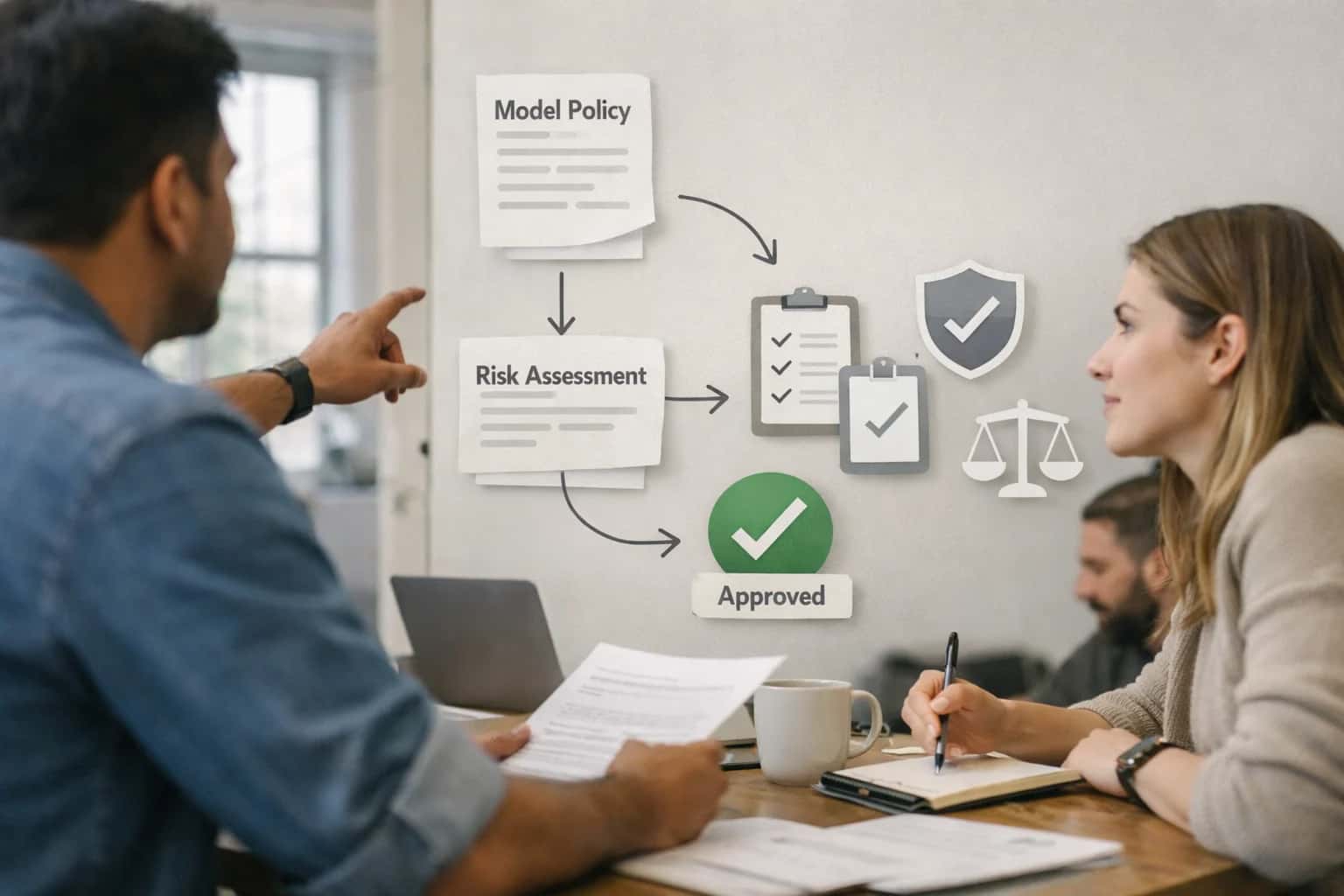
THE ANALYSIS
Introduction
A data-driven comparison of automated policy-as-code enforcement logging versus manual compliance checklists for AI governance audit efficiency.
Manual Compliance Checklists take a different approach by relying on human judgment and contextual interpretation during periodic reviews. This results in a higher error rate—typically 1-5% for manual data entry—but offers unparalleled flexibility in handling novel, ambiguous, or high-stakes scenarios where a rigid policy-as-code rule might fail to capture nuanced regulatory intent or ethical considerations. The process generates evidence only at the point of review, creating a defensible, human-attested artifact rather than a continuous machine log.
The key trade-off: If your priority is continuous compliance, forensic traceability, and eliminating human error from repetitive checks, choose automated Policy-as-Code Enforcement Logs. If you prioritize human contextual judgment for complex, non-deterministic AI behaviors and require a narrative defense for auditors, choose Manual Compliance Checklists.
HEAD-TO-HEAD COMPARISON
Head-to-Head Feature Matrix
Direct comparison of key metrics and features for AI governance audit logging.
| Metric | Policy-as-Code Enforcement Logs | Manual Compliance Checklists |
|---|---|---|
Audit Evidence Collection | Continuous & Automated | Point-in-Time & Manual |
Human Error Rate in Evidence | < 0.1% | 5-15% |
Time to Generate Audit Report | < 1 hour | 2-4 weeks |
Real-Time Policy Violation Alerting | ||
Integration with SIEM/SOAR | ||
Scalability (Decisions/Day) | Millions | Hundreds |
Regulatory Mapping (EU AI Act, NIST) | Automated Code-to-Regulation | Manual Interpretation |
Forensic Traceability Depth | Code, Context, & Decision | Checklist Item & Sign-off |
Policy-as-Code Enforcement Logs vs Manual Compliance Checklists
TL;DR Summary
A direct comparison of automated, evidence-grade audit trails against periodic, human-dependent review processes for AI governance.
01
Policy-as-Code Enforcement Logs
Automated, real-time evidence generation: Every policy decision, tool call, and guardrail trigger is logged immutably at the moment of execution. This provides continuous compliance evidence for frameworks like the EU AI Act and NIST AI RMF, eliminating the 'audit preparation scramble.'
- Error Rate: Near-zero for log generation; deterministic policy enforcement reduces human error in evidence collection.
- Best For: High-risk AI systems requiring real-time monitoring, autonomous agent oversight, and forensic traceability.
- Trade-off: Requires upfront engineering investment to codify policies and integrate with logging infrastructure.
02
Manual Compliance Checklists
Periodic, human-dependent review: Compliance is assessed through scheduled audits, spreadsheets, and manual evidence gathering. This approach is familiar to auditors but introduces significant latency between an AI action and its compliance review.
- Error Rate: High; subject to sampling bias, fatigue, and inconsistent interpretation across reviewers.
- Best For: Low-risk, infrequently changing AI systems where real-time oversight is not a regulatory requirement.
- Trade-off: Low initial cost but scales poorly, creating a growing 'compliance debt' as AI systems and agent counts increase.
03
Choose Policy-as-Code for Agentic & High-Risk AI
Mandatory for autonomous agents: When an AI agent independently chains tool calls, manual checklists cannot provide the step-level traceability required for forensic audits. Policy-as-code logs capture the exact reasoning path, tool inputs, and guardrail decisions, enabling replay and root-cause analysis.
- Key Metric: Provides per-decision traceability vs. sampled process audits.
- Regulatory Fit: Aligns with EU AI Act Article 12 record-keeping for high-risk systems.
04
Choose Manual Checklists for Static, Low-Risk Models
Sufficient for stable, non-agentic systems: If a model's behavior, data, and risk profile are static, a well-structured manual checklist executed quarterly may satisfy basic governance requirements without the overhead of an automated logging pipeline.
- Key Metric: Lower operational cost for systems with fewer than 10 significant changes per year.
- Regulatory Fit: May meet minimal compliance for non-high-risk systems under current frameworks.
CHOOSE YOUR PRIORITY
When to Use What
Policy-as-Code Enforcement Logs for IT Auditors
Strengths: Provides continuous, machine-readable evidence of control effectiveness. Logs are generated automatically with every policy evaluation, creating a real-time audit trail that maps directly to control frameworks like NIST AI RMF and ISO/IEC 42001. Auditors can query structured logs for specific control assertions rather than sampling manual evidence.
Key Differentiator: Eliminates "audit fatigue" by shifting from periodic evidence collection to always-on compliance monitoring. Logs include cryptographic hashes and timestamps, supporting non-repudiation.
Manual Compliance Checklists for IT Auditors
Strengths: Familiar, low-tech, and accessible for organizations without mature DevSecOps pipelines. Checklists allow for narrative context and qualitative assessments that rigid code policies might miss.
Verdict: Manual checklists are only viable for low-risk, low-frequency audits. For high-risk AI systems under the EU AI Act, policy-as-code logs provide the forensic depth and tamper-evidence required for regulatory defense.
HEAD-TO-HEAD COMPARISON
Cost and Effort Analysis
Direct comparison of audit efficiency, error rates, and continuous compliance evidence generation between automated policy-as-code enforcement logging and manual compliance checklist processes.
| Metric | Policy-as-Code Enforcement Logs | Manual Compliance Checklists |
|---|---|---|
Audit Evidence Generation Time | < 1 second (real-time streaming) | 2-5 business days (per audit cycle) |
Human Error Rate in Evidence Collection | 0.1% (automated log capture) | 12-18% (manual transcription errors) |
Continuous Compliance Monitoring | ||
Per-Audit Labor Cost (Annual Estimate) | $5,000-15,000 (automated collection) | $45,000-120,000 (manual sampling) |
Regulatory Admissibility (ISO/IEC 42001) | Cryptographically signed, tamper-proof | Requires notarized attestation |
Coverage of Agentic Decision Steps | 100% (every tool call, reasoning step) | 5-10% (sampled manual review) |
Integration with SIEM/SOAR | ||
Time to Detect Policy Violation | < 1 minute (automated alerting) | Weeks to months (next audit cycle) |
Enabling Efficiency, Speed & Accuracy
Intelligent Analysis, Decision & Execution
We build AI systems for teams that need search across company data, workflow automation across tools, or AI features inside products and internal software.
Talk to Us
Search across company data
Give teams answers from docs, tickets, runbooks, and product data with sources and permissions.
Useful when people spend too long searching or get different answers from different systems.
Enterprise searchRAGPermissions
Read more
Automate internal workflows
Use AI to route work, draft outputs, trigger actions, and keep approvals and logs in place.
Useful when repetitive work moves across multiple tools and teams.
AI agentsWorkflow automationGovernance
Read more
Add AI to products and internal tools
Build assistants, guided actions, or decision support into the software your team or customers already use.
Useful when AI needs to be part of the product, not a separate tool.
AI integrationDecision supportModel routing
Read moreAUDIT ARCHITECTURE
Technical Deep Dive
A granular comparison of automated policy-as-code enforcement logging against manual compliance checklist processes, analyzing the technical trade-offs in audit efficiency, error rates, and the generation of continuous compliance evidence for AI governance.
Policy-as-Code generates significantly fewer errors. Automated enforcement logs capture events deterministically, eliminating human transcription mistakes, fatigue-induced oversights, and subjective interpretation. Manual checklists typically exhibit a 3-5% human error rate in repetitive compliance tasks, while code-based enforcement ensures that a policy violation is logged identically every time. However, policy-as-code errors are systematic—a logic bug in the code will miss a specific violation 100% of the time until the code is fixed, whereas a human might catch it randomly.
THE ANALYSIS
Verdict
A data-driven comparison of automated policy-as-code enforcement logging versus manual compliance checklists for AI governance, focusing on audit efficiency, error rates, and continuous compliance evidence generation.
Policy-as-Code Enforcement Logs excel at providing continuous, tamper-proof evidence generation because they embed compliance checks directly into the AI operational pipeline. For example, a platform like Nvidia NeMo Guardrails can automatically log every policy decision—such as blocking a toxic output or denying an unauthorized tool call—with cryptographic hashing and timestamps, reducing audit preparation time by up to 90% compared to manual methods. This approach ensures that no high-risk event, like a prompt injection attempt or a model drift anomaly, goes unrecorded, directly supporting the EU AI Act's requirement for 'technical documentation' and continuous monitoring.
Manual Compliance Checklists take a fundamentally different approach by relying on periodic human review and attestation. This strategy results in lower initial technical overhead and can be more adaptable to nuanced, context-heavy governance requirements that are difficult to codify, such as assessing the ethical implications of a novel AI use case. However, manual processes introduce a significant trade-off: a study by the Ponemon Institute found that human error is a factor in over 60% of compliance failures, and manual sampling can miss transient violations that occur between review cycles, creating a 'compliance gap' that automated logs would instantly capture.
The key trade-off: If your priority is achieving continuous, forensically sound compliance for high-risk AI systems under frameworks like the EU AI Act or NIST AI RMF, choose Policy-as-Code Enforcement Logs for their real-time, immutable evidence generation. If you prioritize lower implementation complexity and need human judgment for ambiguous governance scenarios in lower-risk environments, choose Manual Compliance Checklists, but be prepared to accept higher audit latency and a greater risk of undetected control failures.

About the author
Prasad Kumkar
CEO & MD, Inference Systems
Prasad Kumkar is the CEO & MD of Inference Systems and writes about AI systems architecture, LLM infrastructure, model serving, evaluation, and production deployment. Over 5+ years, he has worked across computer vision models, L5 autonomous vehicle systems, and LLM research, with a focus on taking complex AI ideas into real-world engineering systems.
His work and writing cover AI systems, large language models, AI agents, multimodal systems, autonomous systems, inference optimization, RAG, evaluation, and production AI engineering.
LinkedIn
Limited slotsGet a Free AI Consultation
Partnered with leading AI, data, and software stack.





How We Work
Custom AI workflows for your Business
One-fit-all AI don't work for modern businesses. At Inferensys, we aim to understand your business & custom requirements; which we use to define most efficient agentic workflows, the data, and the tools for your business.
01
Review the use case
We understand the task, the users, and where AI can actually help.
Read more02
Pick the right approach
We define what needs search, automation, or product integration.
Read more03
Build the first useful version
We implement the part that proves the value first.
Read more04
Improve from there
We add the checks and visibility needed to keep it useful.
Read moreThe first call is a practical review of your use case and the right next step.
Talk to Us